Waggonner, Joe D., Jr.
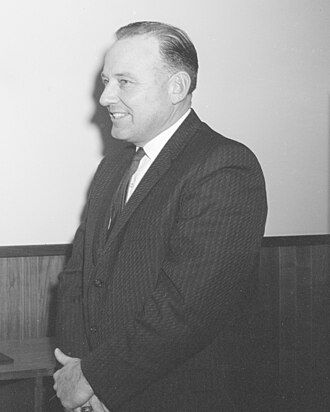
Joe D. Waggonner, Jr. was a Democratic Congressman from Louisiana's 4th district who served throughout the Nixon administration. A conservative, he was a close confidant and key ally of President Nixon in the House of Representatives, often supporting a coalition of Republicans and Southern Democrats on various issues. Waggonner acted as an informal whip for the president and was a staunch opponent of the impeachment proceedings against him.
What Waggonner talks about on the tapes
Congressional relations 4Prisoners of War 2Legislative strategy 2International Trade 2Inflation 2Foreign Policy 2Energy policy 21972 Presidential Campaign 2Watergate scandal 1Vietnam War 1United Nations 1Trade policy 1
Conversations (12)
President Nixon met with Joe D. Waggonner, Jr., Juanita Morris Moody, John C. Whitaker, and Richard K. Cook to discuss oil production concerns in Louisiana and potential impacts on national energy policy. Waggonner introduced an official from the Louisiana Department of Conservation, who presented data suggesting that claims of artificially suppressed oil production were unfounded and explained the industry's struggle with declining drilling rates and rising costs. The President acknowledged the technical complexity of the issue and directed his staff, particularly John Whitaker, to coordinate a follow-up meeting with relevant administration officials to ensure a more informed approach to oil regulation.
President Nixon met with Representative Joe D. Waggonner, Jr. to discuss the contents and reception of Waggonner's recent newsletter. The conversation centered on the political messaging within the publication and its potential impact on media coverage. Nixon acknowledged the newsletter's effectiveness, suggesting a shared interest in managing public perception through strategic communication.
President Nixon met with a group of influential Southern Democratic congressmen and key administration officials to discuss domestic and foreign policy priorities. The dialogue focused primarily on the administration's ongoing efforts regarding the Vietnam War, seeking to gauge and solidify support among conservative Democrats for the President's legislative and military agendas. The meeting served as a strategic outreach effort to maintain congressional backing for the administration's broader policy goals.
President Nixon met with a bipartisan group of House members to receive a petition signed by 336 lawmakers advocating for the preservation of Taiwan's seat in the United Nations. The delegation expressed strong support for the administration's foreign policy approach, specifically the efforts of U.S. Ambassador George H.W. Bush, while discussing the potential leverage of cutting U.S. financial contributions to the UN. The President and his staff confirmed that the administration would use the weight of this overwhelming Congressional consensus to signal the significant political challenges regarding future UN funding if Taiwan were expelled.
President Nixon, Joe D. Waggonner, Jr., and H. R. Haldeman discussed the immediate aftermath of the assassination attempt on Governor George Wallace. The conversation centered on the status of the investigation into Arthur H. Bremer, including concerns regarding evidence recovered from his apartment and the coordination between the FBI and Secret Service. Furthermore, the participants evaluated the medical prognosis of Wallace following his surgery and debated the political and physical propriety of a presidential visit to the hospital.
President Nixon met with John Connally and H.R. Haldeman to discuss political maneuvering regarding the 1972 campaign, specifically focusing on Senate races and the handling of potential legal liabilities. They strategized on how to convince Republican candidates in Arkansas to withdraw to support powerful Democratic incumbents like John McClellan, who were seen as potential allies. Additionally, the participants addressed the imminent indictment of Jake Jacobsen, debating whether political influence could delay the process to protect Connally's interests and the "Democrats for Nixon" initiative.
President Nixon facilitates a brief phone call between Congressman Joe D. Waggonner, Jr. and John B. Connally to foster communication between the two men. Following introductory pleasantries, the conversation transitions into a casual, lighthearted exchange regarding the perceived differences in manners between the wealthy and the poor. No substantive political developments or policy decisions are documented in this portion of the recording.
President Nixon met with Representative Joe D. Waggonner, Jr., Richard K. Cook, and Helmut Sonnenfeldt to discuss Waggonner's upcoming diplomatic trip to Romania to attend the Bucharest Trade Fair. The President briefed Waggonner on how to advocate for Most Favored Nation (MFN) trade status with Romania, emphasizing that the U.S. should frame such trade normalization as standard treatment for nations with positive relations rather than as special favoritism. Additionally, the participants discussed political strategy for the 1972 campaign, congressional cooperation, and personal security concerns regarding the President.
President Nixon met with a bipartisan group of Congressional leaders to provide a detailed briefing on the recently finalized Vietnam Peace Agreement and its implementing protocols. Henry Kissinger explained the strategic nuances of the agreement, including the status of North and South Vietnam, the mechanisms for the International Control Commission, and the timeline for the withdrawal of U.S. forces and the release of prisoners of war. The President emphasized the necessity of bipartisan Congressional support to ensure the agreement's stability and signaled that the administration would work with Congress to frame a positive resolution regarding the end of the war.
President Richard Nixon and Representative Joe D. Waggonner, Jr. discussed the administration's recent success in sustaining a presidential veto, with Nixon thanking Waggonner for his legislative support and inviting him to an upcoming White House reception. The conversation touched upon the political necessity of addressing energy policy, inflation, and trade legislation, with both men agreeing on the importance of granting the executive branch more authority in international trade negotiations. Additionally, Nixon reflected on his recent meetings with returning prisoners of war, highlighting their resilience and support for his administration's policies, while the two men briefly strategized on how to manage future potential vetoes regarding veterans' and older Americans' legislation.
President Nixon met with Representative Joe D. Waggonner, Jr. to discuss the necessity of executive authority in international trade negotiations. Nixon argued that he requires broader negotiating power to effectively engage with foreign counterparts like the Japanese and Germans without being hampered by constant congressional oversight. The discussion touched upon the inflationary environment and labor market conditions while emphasizing the need for tools to streamline executive diplomacy.
President Richard Nixon and Representative Joe D. Waggonner, Jr. discussed the mounting political pressures of the Watergate scandal and ongoing challenges in Congress. Waggonner expressed his loyalty and support for the administration, while Nixon criticized the media, the Senate hearings, and the legal treatment of figures like Daniel Ellsberg. The two men also reviewed legislative strategy regarding Cambodia, agreed on the importance of demanding an accounting for MIAs in Indochina, and expressed optimism about the President’s ability to overcome the current political crisis.