Miller, Jack R.
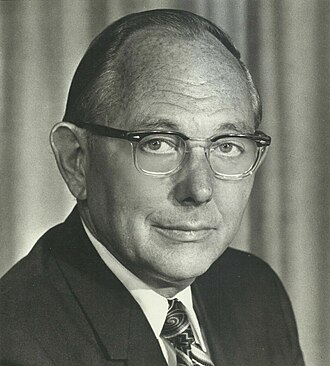
Jack R. Miller was a Republican United States Senator from Iowa, serving from 1961 until January 1973. During the Nixon taping period, he was a sitting senator and appears as a participant in conversations recorded in the White House. After being defeated for re-election in 1972, President Nixon nominated him to the United States Court of Customs and Patent Appeals in June 1973, a position he was confirmed for in July 1973.
President Nixon met with a group of Republican senators and key advisors, including Henry Kissinger, to discuss the political landscape surrounding the Vietnam War and national defense policy. The conversation focused on the erosion of public support for the war, the impact of various congressional anti-war resolutions, and the importance of maintaining American preeminence despite shifting domestic and international pressures. The participants strategized on how to manage the political fallout of the Vietnamization policy and addressed concerns regarding defense preparedness and the administration's foreign policy initiatives in the Soviet Union and China.
President Nixon met with Secretary of Agriculture Clifford Hardin and Nobel Laureate Norman Borlaug, later joined by Clark MacGregor and Congressmen H. R. Gross and Jack R. Miller, to discuss U.S. agricultural aid programs and global food production. The participants emphasized the importance of training local scientists in developing nations and long-term technical assistance over short-term financial aid. A significant portion of the discussion centered on the urgent need to address rapid population growth in countries like India, Pakistan, and Mexico as a prerequisite for global stability. The meeting also included informal exchanges regarding a gift from the National Pork Producers’ Council and a discussion on the health of former Pakistani President Ayub Khan.
President Nixon hosted a bipartisan group of congressional members and administration officials in the Cabinet Room for the ceremonial signing of the Telephone Bank Bill (S. 70). The meeting featured general discussion regarding rural telecommunications policy, the recognition of Agriculture Day, and the presentation of commemorative gifts. Attendees also engaged in casual conversation concerning the President's upcoming schedule and domestic matters.
President Nixon met with a bipartisan group of Senate leaders to frame the shifting geopolitical and economic landscape of the 1970s. Nixon highlighted the transition from a era of military confrontation to one of negotiation, emphasizing the necessity of integrating the People's Republic of China into the world community to prevent future instability. Following the President's overview, Peter G. Peterson delivered a briefing on the intensifying global economic challenge posed by the rapid industrial growth of nations like Japan and Germany. The meeting served as a strategic appeal for bipartisan support to ensure the United States remains competitive as military tensions subside and economic competition becomes the primary arena of international rivalry.
President Nixon met with a bipartisan group of Congressional leaders to discuss the progress of the 90-day wage-price freeze and to seek input on the development of Phase II economic policies. Treasury Secretary George Shultz provided an overview of the administration's administrative efforts, including the roles of the Cost of Living Council and the IRS in enforcing the freeze. The discussion centered on the need for continued cooperation across sectors—including labor, business, and agriculture—and the development of a framework for economic stabilization once the initial freeze expired.
President Nixon met with bipartisan Congressional leadership to outline his post-freeze economic program and announce plans for an upcoming summit in Moscow. He detailed the formation of a tripartite Pay Board, a Price Commission, and a committee on interest and dividends to maintain economic stability through a mix of voluntary cooperation and necessary sanctions. Additionally, the President briefed the leaders on the status of international monetary negotiations and his strategic approach to the May 1972 summit with Soviet leadership regarding arms control and trade.
President Nixon hosted a large gathering in the Oval Office, including Secretary of Agriculture Earl Butz, several members of Congress, and various agricultural officials, to discuss the state of the American agricultural sector. The President highlighted the efficiency of American farmers and the affordability of food for domestic consumers as a significant national achievement. The meeting served as a public relations event to underscore the importance of agriculture to the nation's overall well-being and to reinforce support for administration policies.
President Nixon met with a bipartisan group of Congressional leaders from the House Ways and Means Committee and the Senate Finance Committee to mark the signing of the Revenue Act of 1971. The President utilized the ceremony to praise the legislators for their cooperation in passing a responsible tax bill, contrasting it with fears that the measure would become an unmanageable 'Christmas tree' of amendments. The discussion highlighted the economic benefits of the legislation, particularly its role in job creation and the stimulation of the automobile industry following the administration's new economic program initiated in August.
President Nixon met with representatives from Kiwanis International to discuss their community service initiatives, specifically their work on drug education and environmental projects. The participants shared perspectives on the importance of local community involvement and service organizations, with the President encouraging the group to continue their efforts to reach youth and address social challenges at the grassroots level. The conversation also touched upon Bicentennial planning and the value of active civic engagement compared to passive activities like television viewing.
President Nixon met with Dallas Cowboys player Calvin Hill, Kevin Heald, and several guests for a photo opportunity and gift exchange in the Oval Office. The discussion focused on professional football, including the Cowboys' team performance and injuries to various players in the league. Additionally, the President and Hill discussed Hill's charitable work with youth drug prevention programs, with Nixon commending his efforts to help prevent addiction.
President Nixon met with Republican members of the Senate Finance Committee to discuss the legislative impasse surrounding welfare reform (H.R. 1) and upcoming fiscal challenges. The participants evaluated the political feasibility of passing administration-backed legislation, expressing concerns over the influence of liberal amendments, rising costs, and the lack of support from Chairman Russell Long. Ultimately, the group discussed strategies for managing the impending debt ceiling extension and the threat of an unpopular Social Security increase, with the President firming his stance on vetoing non-budgetary spending items.
President Nixon met with Charles Colson and H.R. Haldeman to coordinate final campaign strategies, discuss media relations, and finalize his upcoming 'Look to the Future' speech. The conversation also touched upon concerns regarding the Watergate controversy, the status of Vietnam peace negotiations, and the need to mobilize support among blue-collar voters. Additionally, Nixon placed brief follow-up calls to Jack Miller and William Scott to encourage their campaign efforts and emphasize the importance of high voter turnout in their respective regions.
President Nixon reached out to Senator Jack Miller of Iowa to request that Miller emphasize the importance of voter turnout during his final campaign appearances before the upcoming election. Nixon argued that a strong electoral mandate would bolster his administration's leverage and credibility in pursuing ongoing foreign policy initiatives, particularly those aimed at achieving global peace. Miller agreed to relay this message to his constituents, confirming he would present the President's personal interest in the election as a significant factor in his outreach.