McClellan, John L.
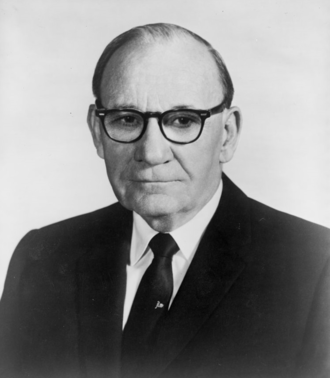
John L. McClellan, a Democratic Senator from Arkansas, was a powerful figure in Congress during the Nixon administration. Throughout the taping period, he chaired the Senate Committee on Government Operations and its Permanent Subcommittee on Investigations until 1972, leading significant inquiries into organized crime and government corruption. In 1972, he transitioned to become the influential chairman of the Senate Appropriations Committee.
President Nixon met with Senator John L. McClellan, Clark MacGregor, and Kenneth E. BeLieu to discuss legislative priorities, national defense, and the President's political standing. The participants addressed concerns regarding U.S. military strength relative to the Soviet Union, the importance of maintaining nuclear deterrent credibility, and the economic necessity of supporting American industries like steel and aviation. Additionally, the President and Senator McClellan reviewed the progress of the Arkansas River navigation project and discussed pending appointments and committee activities within Congress.
President Nixon met with Senator John L. McClellan and Clark MacGregor to accept a ceremonial Bowie knife and exchange gifts before shifting the discussion to the recent leak of the Pentagon Papers. Nixon and his guests analyzed the implications of the unauthorized disclosure, comparing the publication of the classified documents by the press to the illegal sale of stolen property. They expressed frustration over the media's defense of the act as protected speech, framing the situation instead as a dangerous institutional threat that necessitated government censorship.
President Nixon met with Senator John L. McClellan and staff members to discuss Supreme Court vacancies, current economic policy, and pending copyright legislation. The group considered potential judicial nominees and discussed the administration's need to demonstrate control over corporate profits to maintain public support for economic initiatives. Furthermore, they reviewed the status of cable television regulations and the broader copyright bill, with McClellan seeking assurances that the White House was not improperly interfering with FCC proceedings or current legislative efforts.
President Nixon, William P. Rogers, and Henry Kissinger met to coordinate a comprehensive foreign policy agenda, focusing heavily on the logistics of Secretary Rogers’s upcoming international tour and Congressional advocacy for the SALT I treaty. The participants discussed itinerary planning for Rogers's visits to Asia, the Middle East, and Europe, while simultaneously addressing personnel appointments and strategies to manage press and public perception. Additionally, the President engaged in outreach to Senator John L. McClellan to secure support for the defense budget and SALT-related military funding amidst potential opposition from other members of Congress.
President Nixon and Secretary of State William P. Rogers placed a joint congratulatory call to Senator John L. McClellan following his recent electoral victory. During the discussion, McClellan reflected on his successful campaign against organized labor efforts in his state while expressing a bipartisan commitment to cooperate with the administration. Both Nixon and Rogers emphasized their professional respect for the Senator and the importance of his continued service to the nation.
President Nixon met with a bipartisan group of Congressional leaders to provide a detailed briefing on the recently finalized Vietnam Peace Agreement and its implementing protocols. Henry Kissinger explained the strategic nuances of the agreement, including the status of North and South Vietnam, the mechanisms for the International Control Commission, and the timeline for the withdrawal of U.S. forces and the release of prisoners of war. The President emphasized the necessity of bipartisan Congressional support to ensure the agreement's stability and signaled that the administration would work with Congress to frame a positive resolution regarding the end of the war.
President Nixon met with Vice President Agnew and a broad bipartisan group of Congressional leaders to outline the administration's 1974 federal budget and economic strategy. Economic advisors Herbert Stein and George Shultz presented data highlighting a strong 1972 economy and stressed the necessity of fiscal discipline to curb inflation and maintain growth. The President urged Congress to support his proposed spending ceilings, emphasizing the need to avoid the inflationary deficits experienced during the late 1960s, while briefly acknowledging progress toward a Vietnam peace settlement.
President Nixon met with bipartisan Congressional leaders, cabinet members, and staff to outline the administration’s strategy for the 1973 and 1974 federal budgets, emphasizing a commitment to avoiding tax increases. The President defended his use of impoundment to control spending and curb inflation, arguing that Congress must share the responsibility of fiscal discipline or face the political consequences of tax hikes. The discussion also addressed the economic impact of the Vietnam cease-fire, defense budget priorities, and the need for greater cooperation between the executive and legislative branches to manage spending levels.
President Nixon met with Vice President Agnew, Secretary of State Rogers, USAID Administrator John A. Hannah, and a bipartisan group of Congressional leaders to secure support for the administration's foreign aid and security assistance requests. The discussion covered the implementation of the Nixon Doctrine, the strategic importance of military and development aid to maintain stability in Southeast Asia, the Middle East, and Latin America, and the necessity of burden-sharing with allies. Nixon emphasized that maintaining U.S. strength and diplomatic engagement was vital for ongoing negotiations regarding arms reduction and global peace, warning against unilateral reductions that could weaken the U.S. negotiating position.
President Nixon met with bipartisan Congressional leaders, Vice President Agnew, and key cabinet members to discuss U.S. foreign policy developments in Latin America, Southeast Asia, and Europe. Secretary of State William Rogers briefed the group on his recent tour of eight Latin American nations, emphasizing improved diplomatic relations despite complex issues regarding oil, inflation, and expropriation. Henry Kissinger provided an update on ongoing negotiations in Paris aimed at reinforcing the Vietnam ceasefire, while he and the President outlined a new strategy for strengthening Atlantic alliances, stressing the need to link economic, political, and defense policies to ensure future international stability.