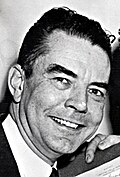
Byrnes, John W.
John W. Byrnes was a Republican Congressman from Wisconsin's 8th district who served throughout the entirety of the Nixon administration's taping period. As the ranking Republican member on the influential House Ways and Means Committee, he played a significant role in shaping tax and trade legislation. Byrnes was a key figure in the legislative discussions of the era and did not seek reelection in 1972, concluding his long congressional career in January 1973.
President Nixon met with John Byrnes and senior White House staff to coordinate a unified Administration strategy against House Ways and Means Chairman Wilbur Mills regarding ongoing Japanese textile negotiations. Concerned that Mills was bypassing the White House to conduct his own foreign policy, Nixon directed Byrnes to publicly support the President’s official position and reject the implication that congressional leaders held a veto over executive authority. The group finalized a plan for the President to issue a formal statement that afternoon, followed immediately by Byrnes endorsing the policy to the press to solidify Republican unity.
President Nixon met with H. R. Haldeman and Henry Kissinger to discuss the progress of the Laotian military operation (Lam Son 719), the status of textile trade negotiations with Japan, and strategic communications regarding Vietnam troop withdrawals. They assessed the military situation in Laos, specifically reviewing enemy casualty and supply figures to evaluate the campaign's effectiveness. Additionally, the President reviewed his recent public appearance in Williamsburg and strategized with staff on how to better manage public opinion and press relations ahead of his April 1971 troop withdrawal announcement.
President Nixon met with Gerald Ford, John Byrnes, Elliot Richardson, and other key administration officials to develop a strategy for the administration's health insurance bill. The discussion focused on the political and economic risks of placing the financial burden of the plan on small business owners and marginal employers. To address these concerns and counter potential Democratic opposition led by Edward Kennedy and Wilbur Mills, the group decided to introduce a bill that signals the administration's awareness of the economic impact on small businesses while keeping options open for committee modifications.
President Nixon calls Congressman John W. Byrnes to express appreciation for his collaboration with Wilbur D. Mills in securing legislative support for H.R. 1. The two discuss the political difficulty of rebranding the bill's provisions, specifically refuting public criticism that the legislation constitutes a 'guaranteed annual income' by emphasizing work requirements. Nixon notes his intention to lobby Senator Russell B. Long to ensure the bill's continued progress in the Senate.
President Nixon met with Representative John W. Byrnes to express appreciation for the legislative support provided by Byrnes and Wilbur Mills regarding a recent bill. The conversation centered on justifying the administration's welfare reform proposals, with both men emphasizing that the legislation should be framed as a work incentive rather than a guaranteed annual income for the unemployed. Nixon concluded by confirming his intent to lobby Senator Richard Russell to secure further support for the administration's agenda.
President Nixon convened a meeting with Vice President Agnew and a bipartisan group of Congressional leaders to discuss the national economy and his administration's "New Economic Policy." Key topics included the wage-price freeze, investment tax credits, the international monetary situation, and an import surcharge. The discussion focused on the necessity of Congressional cooperation for implementing these measures and their potential impact on inflation, trade, and specific industries like automobiles.
President Nixon met with a large group of Republican Congressional leaders to solicit support for his administration's economic initiatives, specifically the New Economic Policy and tax reform measures. Key topics included the Job Development Tax Credit, depreciation reform, and strategies to secure bipartisan support for the Economic Stabilization Act as the program entered its second phase. The participants also discussed the necessity of public and business cooperation, as well as the international trade context of the President's economic agenda.
President Nixon met with bipartisan Congressional leadership to outline his post-freeze economic program and announce plans for an upcoming summit in Moscow. He detailed the formation of a tripartite Pay Board, a Price Commission, and a committee on interest and dividends to maintain economic stability through a mix of voluntary cooperation and necessary sanctions. Additionally, the President briefed the leaders on the status of international monetary negotiations and his strategic approach to the May 1972 summit with Soviet leadership regarding arms control and trade.
President Nixon and H. R. Haldeman coordinated the President's upcoming schedule, specifically discussing travel logistics to Florida and the management of high-level meetings. The President expressed frustration with staff, particularly over unauthorized scheduling of a meeting with an ambassador to receive a letter, and raised concerns regarding the physical and mental exhaustion of Henry Kissinger. They also touched upon legislative updates regarding tax bills and broader economic indicators such as inflation and unemployment.
President Nixon calls Representative John W. Byrnes to express his gratitude for the successful House passage of tax legislation, specifically noting the victory in keeping opposition votes below 100. Byrnes expresses confidence that the Senate will follow suit and pass the conference report, citing the pressure on senators to adjourn for the session. Both men agree that the momentum makes it highly unlikely the Senate will seek to restart the legislative process.
President Nixon met with a bipartisan group of Congressional leaders from the House Ways and Means Committee and the Senate Finance Committee to mark the signing of the Revenue Act of 1971. The President utilized the ceremony to praise the legislators for their cooperation in passing a responsible tax bill, contrasting it with fears that the measure would become an unmanageable 'Christmas tree' of amendments. The discussion highlighted the economic benefits of the legislation, particularly its role in job creation and the stimulation of the automobile industry following the administration's new economic program initiated in August.
President Nixon met with a bipartisan group of Congressional leaders to brief them on his recent diplomatic discussions with French President Georges Pompidou and the status of U.S. international economic policy. The conversation focused on efforts to address the global monetary crisis, the necessity of realigning exchange rates to restore the competitive position of American goods, and the importance of burden-sharing among trade partners. Nixon highlighted the recent breakthrough in negotiations with France as a critical step toward stabilizing the international monetary system and advancing domestic economic goals like job creation and inflation control.
President Nixon met with Vice President Agnew and Republican congressional leaders to discuss strategy regarding his recent speech on Vietnam and the administration's upcoming FY 1973 budget. The President and Henry Kissinger briefed the attendees on the Vietnam peace negotiations, emphasizing that the U.S. had made comprehensive offers while denouncing North Vietnamese intransigence and political maneuvering. Economic advisors, including George Shultz and Herbert Stein, presented the administration's fiscal plans, highlighting the importance of balancing the budget while supporting a transition to a peacetime economy through controlled spending and wage-price stabilization. Participants agreed on the necessity of maintaining a firm stance on defense and economic policy to solidify public support and improve the administration's negotiating leverage.
President Nixon met with Vice President Agnew and Republican Congressional leaders to coordinate legislative strategy on key domestic priorities, specifically revenue sharing, welfare reform, and Social Security legislation. The discussion focused on overcoming legislative stalemates in the Ways and Means Committee and the Senate, particularly regarding the influence of Chairman Wilbur Mills and the need for a unified Republican stance. The President urged the leadership to maintain pressure for compromise bills that align with administration goals while avoiding fiscally irresponsible mandates during an election year.
President Nixon met with a large group of Republican Congressional leaders to coordinate legislative strategy and discuss the administration's economic record ahead of the upcoming election. The conversation focused on countering Senator George McGovern's economic proposals, with the President and his advisors emphasizing that the administration's policies had fostered recovery, reduced inflation, and increased civilian employment. Key action items included distributing briefing materials to counter Democratic attacks, pushing for a government spending ceiling to avoid future tax increases, and planning strategy for upcoming votes on controversial appropriation bills and foreign aid legislation.
President Nixon met with Republican Congressional leaders to discuss the critical need for a $250 billion federal spending ceiling to combat inflation and prevent the necessity of tax increases. The participants strategized on how to manage the upcoming House vote on HR 16810, expressing concern that Democratic leadership was pushing irresponsible, expansive spending bills—including massive social welfare and Social Security packages—that threatened the administration's fiscal goals. The President emphasized that passing the spending cap was a vital political and economic tool to hold Congress accountable and establish a framework for the 1974 budget, while also providing leverage for future presidential vetoes.
President Nixon met with a delegation of Republican congressional and gubernatorial candidates to discuss strategies for the upcoming 1972 general election. Facilitated by White House staff, the gathering served to bolster political unity and campaign momentum among the participating candidates. The discussion focused on rallying support for the administration's agenda to secure victories in their respective races.
President Nixon calls Congressman John W. Byrnes to congratulate him on a successful House vote regarding the debt limit expenditure ceiling. Seeking to maintain legislative momentum, Nixon outlines his plan to pressure Republican senators during an upcoming Thursday morning meeting to ensure a unified front. Byrnes and the President agree that securing a substantial vote is critical to strengthening their position in the subsequent House-Senate conference committee.
President Nixon met with Representative John W. Byrnes to express appreciation for a successful legislative vote and to coordinate strategy for an upcoming meeting with Republican senators. The President directed Byrnes to pressure holdouts to ensure party unity ahead of a critical conference, emphasizing the need for lawmakers to stand firm. They agreed to hold a session on Thursday morning to formalize this legislative push and secure necessary support.
President Nixon met with David Packard, James Roosevelt, John Byrnes, and William Baroody, Jr., to discuss mobilizing public and business support for his austere federal budget and efforts to curb government spending. The participants focused on strategies to counter congressional pressure for increased spending—particularly regarding programs like OEO and social initiatives—while emphasizing the link between fiscal discipline and national security. The President stressed that maintaining military strength and avoiding unilateral cuts was essential to his ongoing diplomatic efforts and arms control negotiations with the Soviet Union.