Nixon, Richard M. (President)
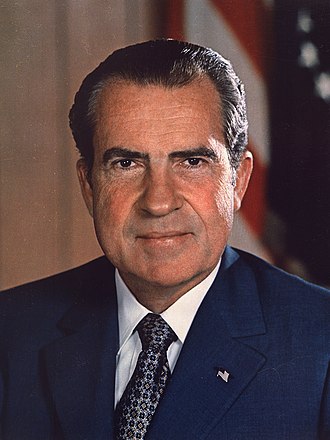
Richard M. Nixon served as the 37th President of the United States from January 1969 until his resignation in August 1974. In February 1971, he ordered the installation of a secret voice-activated taping system in the White House to preserve a historical record of his administration. Until the system's existence was revealed and dismantled in July 1973, the tapes captured Nixon directing major foreign policy initiatives, such as the opening to China, as well as his central role in the Watergate cover-up.
What Nixon talks about on the tapes
White House operations 4,718Presidential scheduling 2,225Public relations 1,784Presidential schedule 1,782Vietnam War 1,693Logistics 1,650Manolo Sanchez 1,626White House communications 1,400White House administration 1,399Presidential communication 1,243Henry Kissinger 1,191Foreign Policy 1,183
Conversations (21,010)
— Page 122 of 211President Richard Nixon met with his daughter, Tricia Nixon Cox, during a private session at Camp David. As the audio contains a withdrawn segment categorized as personal, no substantive policy matters or official developments were recorded. The brief interaction serves primarily as a record of familial engagement within the presidential residence.
President Nixon initiated a brief contact with the Camp David telephone operator from the Aspen Lodge. This interaction served a functional purpose to facilitate telecommunications during the President's stay at the retreat. No substantive policy matters or administrative decisions were addressed in this exchange.
President Nixon and Charles W. Colson discussed the need to improve public relations support for Frank C. Carlucci regarding disaster relief efforts in Pennsylvania. The conversation shifted to political strategy, specifically managing Secretary of Defense Melvin Laird’s public comments on the all-volunteer army and Vietnam policy to avoid credibility issues. Nixon directed Colson to control the timing of these announcements, favoring a mid-September rollout, while also coordinating a response to political attacks from George McGovern and Democratic figures like W. Averell Harriman and Cyrus R. Vance.
President Nixon and Charles Colson discuss public relations strategies regarding Office of Management and Budget official Frank Carlucci and the necessity of proactively managing media narratives. The two emphasize the importance of providing robust PR support for administration officials to counter accusations and maintain credibility. They agree on a cautious, strategic approach to releasing information to ensure that public charges are effectively addressed without prematurely spoiling their messaging.
President Nixon met with Alexander P. Butterfield to review and finalize the President’s daily schedule, which included a series of meetings with visitors such as Bailey K. Howard, Samuel D. Winer, and Louella Dirksen. They discussed specific logistical details, including the need to reschedule certain appointments and manage the presentation of a book by Mrs. Dirksen. The conversation concluded with instructions to arrange the timing of upcoming sessions with guests like John B. Connally and Clark MacGregor.
President Nixon met with Patrick J. Buchanan and Stephen B. Bull to dictate a memorandum outlining economic talking points for a new fact sheet. Nixon emphasized the need for a more dramatic and effective presentation of the administration's economic successes, specifically comparing U.S. growth rates, inflation reduction, and consumer food costs favorably against international benchmarks. He directed Buchanan to refine these statistics to better illustrate how the American worker has gained ground against inflation compared to the 1966–1969 period.
President Nixon utilized this brief morning session in the Oval Office to record personal dictation for his records. The interaction involved an unidentified individual whose presence did not result in a recorded dialogue. Consequently, the session focused exclusively on the President's administrative tasks and official reflections rather than a collaborative discussion or policy deliberation.
President Nixon met with his senior advisors to coordinate campaign strategy for his re-election, specifically addressing the tone of his upcoming acceptance speech and public appearances. The group discussed countering Senator George McGovern's policies, particularly regarding Vietnam and welfare, while also devising a public relations strategy to address the ongoing Watergate investigation. Nixon emphasized the need for a strong, combative campaign posture that avoids defensive positioning and effectively utilizes his cabinet members to attack political opponents.
President Nixon met with William D. Eberle, Peter M. Flanigan, and Alexander M. Haig, Jr. to discuss the status of US-Japan trade relations ahead of an upcoming meeting with Prime Minister Kakuei Tanaka. The discussion focused on addressing the trade imbalance, managing Japanese internal political factions, and evaluating a potential joint US-Japan uranium enrichment plant proposal. The President emphasized the need to maintain pressure on Japanese trade policy while Eberle provided updates on ongoing negotiations and legislative developments concerning the U.S. Senate.
President Nixon and Stephen B. Bull reviewed the President’s upcoming schedule and the logistics regarding various gift presentations. The discussion focused on coordinating the delivery of specific items, including cuff links, scrolls, photographs, a Bible, and a watch for several individuals such as Kenneth B. Keating and Daniel P. Moynihan. The brief meeting concluded after addressing these administrative appointments and gift-handling arrangements.
President Richard M. Nixon and John D. Ehrlichman met in the Oval Office for a brief three-minute discussion. The session consisted entirely of a withdrawn segment classified as personal and returnable material. Consequently, no substantive policy decisions or administrative actions are preserved in the historical record of this interaction.
President Nixon met with departing Ambassador to India Kenneth B. Keating and Alexander M. Haig, Jr. to discuss Keating's tenure in India, his upcoming domestic political activities, and foreign policy strategy for the 1972 election. They reviewed Keating's conversations with Prime Minister Indira Gandhi and analyzed the political risks of George McGovern's defense proposals, specifically regarding Israel and nuclear deterrence. The meeting concluded with President Nixon presenting Keating with an commemorative watch in recognition of his service.
President Richard M. Nixon met with his aide, Stephen B. Bull, in the Oval Office to discuss the President's upcoming daily schedule. The brief conversation focused on logistical arrangements and preparation for a forthcoming meeting. No further substantive policy matters were recorded during this brief administrative exchange.
President Nixon met with Pierre Rinfret, Charles Colson, and John Connally to strategize on economic messaging and political maneuvering regarding the upcoming International Monetary Fund meeting and the credibility of Sargent Shriver. The participants discussed framing international trade partners as fierce competitors to appeal to American laborers and business interests. Additionally, Nixon and Connally explored ways to undermine Shriver's credibility by investigating past Vietnam negotiations from the Johnson administration and potentially eliciting public statements from former officials to counter his criticisms.
President Nixon and Stephen B. Bull met briefly in the Oval Office to coordinate logistics for the President's upcoming schedule. The discussion centered on managing appointments with various individuals, including Samuel D. Winer, Louella Dirksen, and Daniel P. Moynihan, while arranging for official photography by Oliver Atkins. The meeting served as a routine administrative review to ensure the President's time was efficiently managed and documented.
President Nixon met with Charles Colson, Stephen Bull, and Samuel and Mrs. Winer to conduct a brief photo session intended to rectify a previous camera malfunction. Beyond the photography, the participants discussed the involvement of the U.S. Jaycees in the 1972 Republican National Convention and the implementation of a voter participation program. The meeting concluded with the presentation of presidential gifts to the Winers before they departed.
President Nixon met with Louella Dirksen, Rose Mary Woods, and Stephen Bull to discuss the promotion of Dirksen’s new book about her late husband, Everett Dirksen. The conversation focused on the President's potential involvement in the dedication of the Everett M. Dirksen Congressional Leadership Research Center in Pekin, Illinois, and potential fundraising efforts. Additionally, the President presented Mrs. Dirksen with a Chinese scroll and reviewed her upcoming media appearances and planned attendance at the Republican National Convention.
President Richard Nixon met with Bailey K. Howard, accompanied by Ronald L. Ziegler, to discuss Howard's upcoming retirement from business. The conversation centered on Howard's personal history, including his family connections in California and his long-standing ties to the San Diego and La Jolla areas. The meeting concluded with Nixon presenting Howard with a gift of a Chinese scroll to commemorate his transition.
President Nixon and Stephen B. Bull met briefly to review the President's upcoming schedule. The conversation focused on coordination regarding Robert Allen Forst and preparations for an imminent legal meeting. No significant policy decisions were reached, as the discussion served primarily as a logistical briefing for the President's daily agenda.
President Nixon met with Robert A. Forst and Llewellyn J. Evans, along with aide Stephen B. Bull, to discuss the social standing and political concerns of senior citizens. Nixon and his visitors contrasted the perceived pride and work ethic of retirees with welfare recipients, criticizing liberal policies for grouping the elderly with other welfare-dependent populations. During the meeting, which included a photo session, the President presented the guests with ceremonial gifts, including cufflinks and tie clasps bearing the presidential seal.
President Nixon met with his aide Stephen B. Bull in the Oval Office to address administrative matters, specifically the signing of various legal documents. First Lady Pat Nixon subsequently joined the President for a brief meeting. The session concluded shortly thereafter, with the primary focus centered on the completion of these routine executive formalities.
President Nixon held an Oval Office meeting with key staff members and guests, including First Lady Pat Nixon, H.R. Haldeman, John Ehrlichman, and John Dean. While the majority of the discussion is classified as a withdrawn item, the session focused on administrative scheduling matters involving John Ehrlichman. The meeting concluded after approximately 23 minutes with the departure of Alexander P. Butterfield and his associates.
President Nixon and his aide Stephen B. Bull reviewed the President’s upcoming schedule and discussed logistics for planned meetings with Oral Roberts and Daniel P. Moynihan. The discussion also addressed a past engagement involving Roberts, specifically the June 1971 dedication of the McClellan-Kerr Arkansas River Navigation System in Tulsa, Oklahoma. This briefing served to organize the President’s immediate administrative calendar and coordinate his interactions with these figures.
President Nixon met with televangelist Oral Roberts and Wallace B. Henley to discuss the President's public image and communication style following his recent diplomatic trips to the Soviet Union and the People’s Republic of China. Roberts praised the President's newfound ability to convey empathy and sincerity, contrasting this personal connection with his previous, more combative political persona. The conversation also touched upon Roberts's ministry, his television broadcasting strategies, and the potential for a presidential visit to dedicate the new Special Events Center at Oral Roberts University.
President Nixon and Stephen B. Bull reviewed the President’s upcoming schedule to manage his availability for the remainder of the week. The discussion focused on coordinating potential meetings with key figures, including Daniel P. Moynihan, H.R. Haldeman, and Ronald Reagan. They further addressed the logistics and timing regarding the President's planned departure.
President Nixon met with H. R. Haldeman and Daniel P. Moynihan to discuss the conceptual framework for his potential second term. The conversation centered on the necessity of integrating foreign and domestic policy into a coherent "mosaic" to restore order and establish a long-term world view. They also addressed the challenges of recruiting intellectual personnel, the importance of merit-based appointments over demographic quotas, and the strategic need to articulate a new, broadly appealing Republican philosophy.
President Nixon, H.R. Haldeman, and Daniel P. Moynihan gathered in the Oval Office to discuss the intellectual composition of the administration and the strategic landscape of the 1972 presidential campaign. Moynihan argued that the current election presented a stark ideological divide compared to previous bipartisan cycles, positioning Nixon as a moderate unifier for a majority of Americans against the extremism of his opponents. The participants also touched upon administrative personnel challenges, the role of intellectuals in government, and briefly addressed the burgeoning Watergate controversy with dismissive humor.
President Nixon held a brief, informal meeting with his personal valet, Manolo Sanchez, in the Oval Office. The conversation was largely personal in nature, as indicated by the withdrawal of sensitive or private materials from the record. No substantive policy discussions or administrative decisions were documented during this short interaction.
President Nixon requested that the White House operator place a telephone call to his daughter, Julie Nixon Eisenhower. This brief administrative interaction was focused solely on facilitating personal communication between the President and his family. No policy matters or substantive political issues were discussed.
President Nixon held a meeting with his valet, Manolo Sanchez, in the Old Executive Office Building. The recorded portion of the interaction was limited to a brief segment that was subsequently withdrawn for privacy reasons. No substantive policy discussions or administrative actions were documented for this engagement.
President Nixon dictated a memorandum to H.R. Haldeman regarding political strategy surrounding the Vietnam peace negotiations. The discussion focused on undermining the credibility of Sargent Shriver by highlighting that he was intentionally excluded from past Paris negotiations by Lyndon B. Johnson. Nixon further strategized to use John Connally’s perspectives to amplify criticisms of Shriver’s public rhetoric and alignment with former officials like Dean Rusk, William Averell Harriman, and Cyrus Vance.
President Richard Nixon met with his valet, Manolo Sanchez, in the Old Executive Office Building to facilitate administrative tasks. The primary purpose of the encounter was the delivery of a recording to personal secretary Rose Mary Woods. No further substantive policy matters were discussed during this brief administrative interaction.
President Nixon consulted with the White House operator to facilitate an outgoing telephone connection. This brief interaction served administrative purposes to establish a line for the President's subsequent communication. No substantive policy discussions or major decisions were recorded during this brief exchange.
President Richard M. Nixon held a brief telephone conversation with his daughter, Julie Nixon Eisenhower. The exchange was primarily personal in nature, serving as a check-in between family members. No substantive policy decisions or political actions were recorded during this communication.
President Richard Nixon met with his daughter, Julie Nixon Eisenhower, for a brief, informal conversation in the Old Executive Office Building. Given the absence of a transcript and the short two-minute duration of the meeting, the substance of their discussion remains undocumented in the public record. This encounter reflects the frequent, personal interactions between the President and his family during his tenure.
President Nixon consulted with a White House operator to facilitate a return call to an unidentified individual. The interaction functioned primarily as a logistical exchange to bridge a connection between the President and the external party. No substantive policy matters or historical developments were recorded in this brief administrative exchange.
President Nixon and H. R. Haldeman consulted briefly to coordinate the agenda for their upcoming meeting. The primary focus of the discussion centered on preparations for the President’s acceptance speech at the upcoming Republican National Convention. This exchange served as a logistical bridge to ensure both parties were aligned on the strategic priorities ahead of the event.
President Nixon and H. R. Haldeman briefly conferred regarding the status of staff member Pat Buchanan's current work assignments. The President inquired whether Buchanan had been adequately utilized, leading to a discussion about his ongoing responsibilities related to speechwriting. Haldeman confirmed Buchanan's focus on speech-related projects, and the two agreed to touch base again later that evening.
President Nixon and H.R. Haldeman met to coordinate political strategy, focusing on discrediting Sargent Shriver's claims regarding Vietnam peace negotiations by questioning his honesty and knowledge of the process. They also discussed administrative business, including the signing of a federal firefighters' bill and the planning of the President’s upcoming acceptance speech. Finally, the group reviewed the timing of impending Watergate-related indictments in relation to the Republican National Convention to minimize political fallout.
President Nixon contacted the White House operator to facilitate an urgent communication with Alexander M. Haig, Jr. The brief exchange served as a logistical request to initiate a follow-up conversation. No substantive policy matters were discussed during this initial connection.
President Nixon met with his personal aide, Manolo Sanchez, in the Old Executive Office Building to conduct private business. Due to the withdrawal of the primary portion of the recording for personal privacy reasons, the specific details of their discussion remain unavailable. Consequently, no substantive policy matters or official administrative decisions can be discerned from this brief interaction.
President Richard M. Nixon met with his personal aide, Manolo Sanchez, in his Old Executive Office Building suite to discuss routine administrative or personal matters. Due to the lack of an available transcript and the brevity of the recorded interaction, the specific subject matter remains unintelligible. The meeting concludes with Sanchez departing the office, leaving no record of substantive policy developments.
President Richard M. Nixon utilized his time at the Aspen Lodge in Camp David to dictate a formal memorandum. This private administrative session served to record official presidential directives or policy reflections. No further details regarding the specific subject matter are available due to the withdrawal of the recorded material.
President Nixon met with his personal aide Manolo Sanchez and Chief of Staff H.R. Haldeman at Camp David to discuss the organization and handling of sensitive materials for a private file. The primary objective of the session focused on administrative oversight regarding confidential documentation. The meeting concluded with instructions for the departure of Sanchez and Haldeman before the evening of August 15.
President Richard M. Nixon utilized his time at Camp David to dictate a memorandum for the official record. The session served as a private administrative task to formalize his thoughts or directives. No additional participants were present, and the specific content remains unavailable due to the withdrawal of the recorded material.
President Nixon met with his personal valet, Manolo Sanchez, at the Aspen Lodge during a retreat at Camp David. The discussion focused on administrative matters, specifically reviewing the President's upcoming schedule and coordinating necessary office supplies for his work while away from the White House. No major policy developments occurred, as the interaction was centered on personal logistical support and operational needs.
President Nixon dictated a memorandum to H. R. Haldeman outlining a strategic public relations counter-attack against George McGovern during the 1972 campaign. The discussion centered on exploiting McGovern’s past supportive comments regarding Ramsey Clark to portray the Senator as sympathetic to communists and critical of American interests. Nixon directed the administration to coordinate with speakers, newspaper editors, and conservative groups to amplify these criticisms and highlight the contrast between McGovern’s positions and the legacy of J. Edgar Hoover.
President Nixon met with former professional baseball player Roy Edward Sievers at Camp David to dictate a personal letter of appreciation. The President reflected on Sievers's career with the Washington Senators and discussed a specific photograph of the two men taken in 1957. This interaction served as a gesture of personal regard, highlighting Nixon's interest in maintaining connections with public figures outside of the political sphere.
President Nixon met with Dallas Cowboys quarterback Roger Staubach at Camp David to dictate a personal letter of encouragement following Staubach's recent injury. The President expressed his well wishes for the athlete's recovery and inquired about the automobile he had previously provided to the Staubach family. This interaction highlights Nixon’s practice of using personal correspondence to build rapport with prominent public figures and professional athletes.
President Nixon met with his valet, Manolo Sanchez, at the Aspen Lodge in Camp David. The primary purpose of this interaction involved the President providing specific instructions to Sanchez regarding transcription tasks. No further details regarding the nature of these documents or subsequent actions are available due to the lack of a transcript.
President Nixon consulted with the Camp David operator to initiate a telephone call to domestic policy advisor John D. Ehrlichman. After the operator reported that Ehrlichman could not be located, the President decided to abandon the immediate attempt. He ultimately directed the operator to discontinue the search and opted to defer the communication until the following day.
President Nixon consulted with his daughter, Tricia Nixon Cox, to coordinate her upcoming political appearance at the Illinois State Fair on Governor's Day. They discussed the specific content of her planned speech, which was intended to highlight agricultural issues, consumer spending, and the President's personal history with the state. Additionally, the pair touched upon broader campaign logistics, including Julie Nixon Eisenhower’s itinerary and the activities of Democratic opposition figure Sargent Shriver.
President Nixon consulted with the Camp David operator to facilitate a personal phone conversation with his daughter, Tricia Nixon Cox. The brief exchange served primarily to connect the two parties while the President was stationed at the Aspen Lodge. No substantive policy matters or administrative decisions were addressed during this brief personal communication.
President Nixon initiated a brief telephonic communication with the Camp David operator to request an outbound call to his daughter, Tricia Nixon Cox. This interaction served a strictly personal administrative purpose to facilitate the President's private communication from his retreat. No policy matters or official government business were addressed during this exchange.
President Nixon contacted the Camp David operator to facilitate an outgoing telephone connection. The brief exchange was limited to logistical communication regarding the placement of a call. No substantive policy or political discussions took place during this interaction.
President Nixon consulted with his daughter, Tricia Nixon Cox, regarding her upcoming speech at the Illinois State Fair. They discussed strategies to engage young voters and increase overall voter turnout, specifically emphasizing the role of the 'silent majority' in supporting the President's reelection. The conversation focused on effective messaging to mobilize political interest and secure support in key demographics.
President Nixon held a brief, informal meeting with his daughter, Tricia Nixon Cox, at the Aspen Lodge study during their stay at Camp David. Given the lack of a transcript and the brevity of the encounter, the discussion appears to be personal in nature rather than a formal policy consultation. No substantive executive decisions or administrative actions resulted from this interaction.
President Nixon contacted the Camp David operator to facilitate a personal phone call to his daughter, Julie Nixon Eisenhower. The brief interaction served as a logistical request for the operator to connect the President to his daughter. No political or administrative business was conducted during the exchange.
President Nixon held a brief, informal interaction with a Camp David operator to discuss personal leisure activities. The conversation centered on the President's recent viewing of a film, reflecting the casual nature of the President's downtime at the retreat. No substantive policy decisions or administrative actions were initiated during this exchange.
President Richard Nixon and his daughter, Julie Nixon Eisenhower, engaged in a brief telephone conversation while the President was at Camp David. Because the content of this discussion was classified as a personal record and subsequently withdrawn, no substantive policy or political details are available for review. The call serves as an example of the personal communication captured by the White House taping system during the President's tenure.
President Richard Nixon met with his daughter, Julie Nixon Eisenhower, for a brief informal discussion at Camp David. Given the lack of a transcript and the notation of a withdrawn item, the dialogue likely pertains to personal or family matters rather than substantive policy deliberations. The interaction highlights the intersection of the President's private family life with his presidential retreat at Camp David.
President Nixon contacted the Camp David operator to facilitate an urgent communication with his deputy assistant for national security affairs, Alexander M. Haig, Jr. The brief exchange served as a logistical bridge to connect the President with his key advisor. No substantive policy discussions occurred during this brief request for a telephone patch.
President Nixon contacted the Camp David operator from the Aspen Lodge to address a minor operational or communication issue. The brief exchange served as a routine coordination request between the President and the facility staff. No significant policy decisions or substantive political matters were addressed during this short interaction.
President Nixon directs Alexander M. Haig, Jr. to implement a strict, uncooperative approach regarding any potential security briefings for Paul C. Warnke, citing Warnke’s dismissive public statements about previous interactions with Henry Kissinger. Nixon explicitly orders that CIA Director Richard Helms subject Warnke to aggressive, sworn questioning concerning his possible connections to Daniel Ellsberg and the Pentagon Papers. The conversation also touches on the President's satisfaction with current Vietnam negotiation delays as a tactic to manage domestic political critics, noting that anti-war rhetoric from figures like Ramsey Clark has begun to backfire.
President Nixon directs Alexander Haig to instruct CIA Director Richard Helms to conduct a rigorous, sworn investigation into the involvement of individuals associated with the Pentagon Papers and Daniel Ellsberg. Nixon emphasizes the need for a sanitized, restrictive approach when dealing with outside inquiries, explicitly ordering that no sensitive information be leaked to the press or unauthorized parties. Additionally, the President critiques Henry Kissinger’s negotiation strategy regarding the Vietnam War, arguing that minor concessions should not distract from the necessity of securing a favorable political settlement.
President Nixon contacted the Camp David operator to facilitate a telephone connection with his Chief of Staff, H.R. Haldeman. This brief administrative interaction served as a logistical step to initiate a high-level discussion between the President and his top advisor. No substantive policy matters were addressed during this specific communication.
President Richard Nixon engaged in a brief communication with the Camp David switchboard operator while stationed at the Aspen Lodge. The exchange was strictly logistical in nature, focused on the functionality and operational requirements of the telecommunications equipment at the presidential retreat. No substantive policy matters or executive decisions were recorded during this interaction.
President Richard Nixon and H. R. Haldeman engaged in a brief telephone discussion while at Camp David. As the content of this conversation was withdrawn from the archival record, the specific topics and actionable decisions remain classified or unavailable for historical review. The exchange reflects the routine consultation between the President and his Chief of Staff during this period of the administration.
President Richard Nixon met with H. R. Haldeman at the Aspen Lodge to discuss internal administrative matters and sensitive White House business. The brief consultation served to align the President and his Chief of Staff on ongoing strategic priorities during their stay at Camp David. Although the specific details remain restricted, the dialogue focused on high-level executive management and the coordination of the administration's current agenda.
President Nixon utilized his time at Camp David to dictate a memorandum, though the specific content remains unavailable for review. Because the primary portion of the recording is a withdrawn personal item, the meeting's substance is not public record. The session served as an opportunity for the President to formalize policy or administrative instructions via dictation.
President Nixon met with his personal valet, Manolo Sanchez, at the Aspen Lodge during a retreat at Camp David. The conversation was interrupted by a phone call from Julie Nixon Eisenhower. Aside from this personal communication, no substantive policy discussions or major administrative decisions were recorded in this brief interaction.
President Nixon initiated a telephone call to his daughter, Julie Nixon Eisenhower, via the Camp David operator to discuss personal family matters. The bulk of the conversation was categorized as a personal, returnable communication and was subsequently withdrawn from public record. No official policy decisions or political developments occurred during this brief familial exchange.
President Nixon held a brief, informal session at the Aspen Lodge with his daughter, Julie Nixon Eisenhower, facilitated by the Camp David operator. The discussion primarily revolved around personal family matters and light conversation while the President was in residence at the retreat. No formal policy decisions or official government actions were recorded during this brief interaction.
President Nixon contacted the Camp David operator to facilitate a telephone connection with his Chief of Staff, H.R. Haldeman. This brief administrative exchange served as a functional request to bridge communication between the President and his senior aide. The conversation concluded immediately after the operator acknowledged the request.
President Nixon initiates a brief request for the Camp David operator to connect a call to an individual identified as Mr. Holland. The exchange is purely administrative, serving as a functional bridge to facilitate a subsequent private conversation. No substantive policy matters or political discussions occur during this short interaction.
President Nixon and H. R. Haldeman discussed their intense dissatisfaction with a recent, aggressive press interview of First Lady Pat Nixon, which the President characterized as an unfair 'inquisition.' Consequently, Nixon ordered the immediate cancellation of a planned interview between National Security Advisor Henry Kissinger and CBS correspondent Marvin Kalb, vowing to shift future media opportunities to other networks to punish CBS. The two also coordinated the President’s potential attendance at an upcoming Olympic team reception at the White House while reviewing security concerns regarding the event.
President Nixon and H. R. Haldeman discuss a hostile interview conducted by a reporter with Pat Nixon, expressing significant anger over the nature of the questions. Incensed by the perceived bias and personal attacks, the President orders Haldeman to instruct Ron Ziegler to cancel an upcoming CBS appearance by the reporter. Nixon further expresses his intent to retaliate against CBS by restricting their access in favor of other networks.
President Nixon contacted the Camp David operator to facilitate a telephone connection with his Chief of Staff, H.R. Haldeman. This brief administrative interaction served as a logistical step to initiate a direct discussion between the President and his key aide. No substantive policy matters were addressed during this brief exchange.
President Nixon and H. R. Haldeman discuss an upcoming interview given by First Lady Pat Nixon to reporter Marya McLaughlin. Nixon requests that Press Secretary Ron Ziegler review the transcript of the interview to provide a professional evaluation. The pair also touches upon Julie Nixon Eisenhower’s critical reaction to the nature of the questions posed to her mother during the session.
President Nixon consulted with the Camp David operator regarding telecommunications connectivity. The discussion centered on operational logistics for the Hard Wire taping system at the Aspen Lodge. No significant policy decisions were reached during this administrative exchange.
President Nixon and H. R. Haldeman met at Camp David to coordinate administrative and logistical tasks regarding White House staff. The discussion centered on the President's request for information related to Julia, a specific individual mentioned in the transcript. No broader policy decisions were reached during this brief exchange.
President Nixon met with his personal aide, Manolo Sanchez, at Camp David to discuss logistical arrangements and the President's personal preferences. The conversation primarily focused on the President's upcoming schedule, coordination with the Secret Service, and a specific preference regarding office supplies. Nixon expressed dissatisfaction with the provided legal pads, explicitly identifying the preferred style and model number to ensure he was adequately equipped for his work.
President Nixon met with his personal valet, Manolo Sanchez, at the Aspen Lodge at Camp David to attend to administrative matters. Their discussion centered on the management of office supplies and personal effects. The brief interaction concluded with Sanchez departing the study, leaving the President to continue his work.
President Nixon met with his personal valet, Manolo Sanchez, at the Aspen Lodge during a retreat at Camp David. The brief exchange centered on the procurement and organization of office supplies for the President's workspace. No major policy developments or significant political decisions occurred during this informal administrative discussion.
President Nixon contacted the Camp David operator to facilitate an urgent telephone connection with George Meany, the president of the American Federation of Labor-Congress of Industrial Organizations (AFL-CIO). The call was initiated to establish direct communication with the influential labor leader regarding matters of national concern. No further policy discussion occurred during this brief request for the operator's assistance.
President Nixon consulted with the Camp David operator regarding his attempt to contact George Meany. After the operator reported that all available phone numbers for the labor leader had been exhausted without success, Nixon decided to abandon the effort. The call concluded with the President instructing the operator to drop the matter.
President Nixon held a brief administrative interaction with the Camp David operator while situated at the Aspen Lodge. The exchange served to establish communication lines or verify telecommunications connectivity at the retreat. No substantive policy matters or major developments were addressed during this short check.
President Nixon communicated with a Camp David operator from the Aspen Lodge study to address logistical or operational requirements at the presidential retreat. The interaction functioned as a routine administrative coordination between the President and the support staff responsible for the facility's communications. No further information regarding specific policy decisions or significant developments is available due to the nature of this brief, functional exchange.
President Richard M. Nixon met with his valet, Manolo Sanchez, at the Aspen Lodge study at Camp David to conduct a brief, informal check-in. The interaction focused on the President making a specific inquiry and receiving a direct response from Sanchez. No significant policy developments or administrative decisions resulted from this personal exchange.
President Nixon requested that the Camp David operator connect him to White House Chief of Staff H. R. Haldeman. This brief administrative interaction served as a logistical step to facilitate direct communication with a senior advisor. No further substantive policy matters were discussed during this brief exchange.
President Nixon and H. R. Haldeman consulted at Camp David regarding political messaging, scheduling adjustments, and the administration's response to Senator George McGovern's recent foreign policy controversies. They analyzed the political fallout of reports regarding Pierre Salinger's unauthorized meeting with North Vietnamese negotiators and discussed the strategic timing for criticizing McGovern’s approach to the Vietnam War. Ultimately, Nixon decided to delay a formal administration attack on McGovern to keep the focus on positive campaign themes during their upcoming convention, while directing his staff to gather further strategic input from key allies.
President Nixon consulted with the Camp David operator to address logistical and technical needs while at the presidential retreat. The brief discussion focused on consolidating communications or facilities to ensure operational efficiency. No major policy decisions were reached, as the exchange was primarily administrative in nature.
President Nixon and H.R. Haldeman discuss campaign strategy and the political fallout surrounding the Vietnam War as the 1972 election season intensifies. The two evaluate the risks of attacking political opponents, citing the negative precedent of the Muskie campaign, and weigh whether to highlight the war or maintain a more positive public posture. Ultimately, Nixon decides to delay a definitive response to opposition criticism until Henry Kissinger returns from negotiations to better assess the state of the conflict.
President Nixon initiated a telephone call from Camp David to reach his daughter, Julie Nixon Eisenhower. He requested that the switchboard operator place the call on his behalf to facilitate a personal conversation. No policy matters or administrative decisions were addressed during this brief interaction.
President Nixon initiated a brief contact with the Camp David telephone operator from the Aspen Lodge. The conversation served as a routine communication check or request for assistance with switchboard services. No further administrative or political business was conducted during this brief interaction.
President Richard M. Nixon held a brief telephone conversation with his daughter, Julie Nixon Eisenhower, from Camp David. As the official record of the discussion was withdrawn for personal reasons, no substantive policy matters or administrative decisions are available for review. The dialogue remained a private communication between family members.
President Nixon met with his daughter, Julie Nixon Eisenhower, at the Aspen Lodge for an informal discussion during a retreat at Camp David. The conversation functioned primarily as a brief personal check-in between family members, reflecting the President's efforts to balance his official duties with private time. No substantive policy decisions or political initiatives were established during this brief exchange.
President Nixon contacted the Camp David operator to facilitate an urgent communication with his Chief of Staff, H.R. Haldeman. This brief administrative interaction served as the necessary bridge to initiate further high-level coordination between the President and his top advisor. No substantive policy matters were discussed, as the exchange was strictly limited to establishing contact.
President Nixon consulted with the Camp David operator regarding the scheduling of a telephone call from John B. Connally, who was currently occupied in a conversation with Chief of Staff H. R. Haldeman. Nixon indicated that he was available to receive the call whenever Connally finished his discussion with Haldeman. No further substantive matters were addressed during this brief logistical coordination.
President Nixon held a brief exchange with the Camp David operator to discuss operational logistics at the retreat. The dialogue focused on administrative coordination and routine communications management for the President’s stay. No major policy decisions were reached during this short logistical interaction.