Nixon, Richard M. (President)
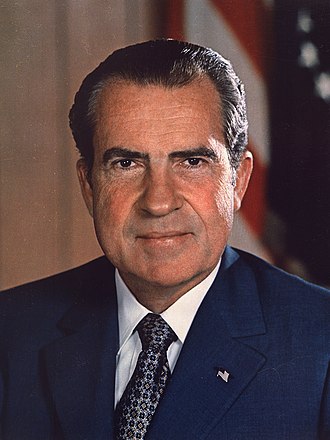
Richard M. Nixon served as the 37th President of the United States from January 1969 until his resignation in August 1974. In February 1971, he ordered the installation of a secret voice-activated taping system in the White House to preserve a historical record of his administration. Until the system's existence was revealed and dismantled in July 1973, the tapes captured Nixon directing major foreign policy initiatives, such as the opening to China, as well as his central role in the Watergate cover-up.
What Nixon talks about on the tapes
White House operations 4,718Presidential scheduling 2,225Public relations 1,784Presidential schedule 1,782Vietnam War 1,693Logistics 1,650Manolo Sanchez 1,626White House communications 1,400White House administration 1,399Presidential communication 1,243Henry Kissinger 1,191Foreign Policy 1,183
Conversations (21,010)
— Page 211 of 211President Nixon and his daughter, Tricia Nixon Cox, discuss managing the public narrative surrounding his recent health concerns. The President expresses a clear desire to avoid drawing excessive attention to his condition, rejecting a proposed five-day precautionary measure to prevent the situation from appearing larger than it is. The conversation concludes with a mutual agreement to keep the matter low-profile.
President Nixon and Alexander Haig discussed managing the optics of the President’s recent hospitalization and the scheduling of his upcoming public appearances, including the announcement of Phase IV economic policies. They also touched upon the political challenges posed by the Ervin Committee's Watergate investigations and requests for access to White House files. The two agreed on a strategy to maintain a dignified public image while controlling the narrative surrounding the President's health and staff activities.
President Nixon met with Henry Kissinger, Alexander Haig, and Ronald Ziegler to coordinate the public response to his health issues and the subsequent adjustments to his official schedule, including the potential cancellation of Zulfikar Ali Bhutto’s state visit. The participants discussed how to manage the optics of these changes to avoid political embarrassment while navigating the ongoing pressures of the Watergate investigation. Nixon and his advisors also weighed the implications of the Ervin Committee's proceedings and potential witness testimony on the administration's stability.
President Nixon met with Alexander M. Haig, Jr. to coordinate logistical arrangements for upcoming appearances. The discussion focused on the President's official schedule and the planning of a motorcade, potentially involving Ronald L. Ziegler. The meeting served to finalize details for immediate executive travel and public outreach operations.
President Nixon consulted with the White House operator to facilitate an outgoing call. The discussion served as a logistical bridge to connect the President with another party for official communications. No substantive policy matters or major political decisions were recorded during this brief exchange.
President Nixon contacted the White House operator to issue a formal request for Press Secretary Ronald L. Ziegler to join him. This brief exchange served to facilitate an immediate, private meeting between the President and his top spokesperson. No further policy or strategic details were addressed during the brief connection.
President Nixon initiates a brief telephone call through the White House operator to request a meeting with his personal secretary, Rose Mary Woods. The conversation serves as an administrative bridge to facilitate direct communication with a key staff member. No further policy or strategic matters are addressed during this brief exchange.
President Nixon calls his personal secretary, Rose Mary Woods, to personally inform her of his diagnosis of viral pneumonia and his impending week-long hospitalization at Bethesda. The two discuss his frustration regarding forced rest and the President's instructions to Press Secretary Ronald Ziegler concerning the public announcement of his condition. Nixon expresses cynical amusement at the prospect of the White House press corps applauding the news of his illness.
President Nixon and his personal secretary, Rose Mary Woods, discuss the logistical process of transferring materials. The brief exchange concerns the coordination of file management or record handling. No major policy decisions are reached during this short interaction.
President Nixon and Press Secretary Ronald Ziegler met to discuss the management of public communications regarding the President's recent health issues. They coordinated the logistics for an official announcement to be handled by Deputy Press Secretary Gerald L. Warren and Dr. Walter R. Tkach, with input from Alexander Haig. The discussion focused on controlling the narrative and anticipating the press corps' reaction to the medical news.