Solomon, Ezra
Ezra Solomon was an economist who served as a member of President Nixon's Council of Economic Advisers from September 1971 to March 1973. During this time, which falls within the White House taping period, he was involved in key economic policy discussions, including the aftermath of the suspension of the gold standard and the implementation of wage and price controls. His responsibilities on the council included domestic and international monetary policy.
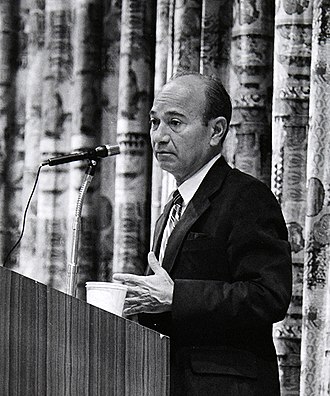
President Nixon met with Paul W. McCracken, Ezra Solomon, and George P. Shultz to discuss the appointment of Ezra Solomon to the Council of Economic Advisers and to solicit his expertise for long-term economic planning. The participants analyzed the state of the American economy, focusing on consumer confidence, retail sales, and the competitive challenges posed by international trade, particularly regarding Japan. Nixon emphasized the need for a strategic, forward-looking economic approach that considers geopolitical trends and maintains U.S. competitiveness in a globalized market.
President Nixon met with the Commission on Financial Structure and Regulation to discuss the progress of their comprehensive study on the U.S. financial system. The conversation focused on the necessity of reform to ensure economic stability, with particular attention given to the modernization of banking, savings and loan institutions, and insurance companies. Nixon urged the commission to avoid maintaining the status quo, explicitly encouraging them to investigate controversial topics like the Federal Reserve’s structure and monetary policy. The meeting concluded with an emphasis on the commission's upcoming work schedule and a reaffirmation of the administration's support for their final recommendations.
President Nixon hosted back-to-back swearing-in ceremonies in the Oval Office for Ezra Solomon, as a member of the Council of Economic Advisors, and Frank C. Carlucci III. The sessions included formal oaths of office, family photographs, and the presentation of commemorative Presidential gifts, such as cufflinks and pins. During the meetings, Nixon engaged in informal conversation with the participants, reflecting on past professional associations and discussing the careers of the appointees, including Carlucci's previous work in Brazil and at the Office of Economic Opportunity.
President Nixon, Vice President Agnew, and members of his Cabinet met to coordinate a unified administration strategy ahead of critical International Monetary Fund (IMF) meetings and ongoing global trade negotiations. The discussion emphasized the necessity of maintaining the recently imposed 10% import surcharge and a firm bargaining stance to address the nation's economic balance of payments and reshape the international monetary system. Nixon and his advisors agreed that while foreign partners would likely criticize U.S. policy, maintaining domestic political support and correcting long-standing trade imbalances remained the administration's primary objective.
President Nixon met with a bipartisan group of Congressional leaders to brief them on his recent diplomatic discussions with French President Georges Pompidou and the status of U.S. international economic policy. The conversation focused on efforts to address the global monetary crisis, the necessity of realigning exchange rates to restore the competitive position of American goods, and the importance of burden-sharing among trade partners. Nixon highlighted the recent breakthrough in negotiations with France as a critical step toward stabilizing the international monetary system and advancing domestic economic goals like job creation and inflation control.
President Nixon met with members of the President's Commission on Financial Structure and Regulation to discuss the findings and implementation strategy of their report on domestic financial reform. The discussion focused on the challenges of navigating bureaucracy and congressional committees to enact an omnibus bill aimed at increasing the viability of depository institutions through free-market mechanisms. The President emphasized the need for a cohesive legislative strategy while the group touched upon international economic policy and the recent successful efforts of the Treasury Department in global currency realignments.
President Nixon hosted a ceremony in the Oval Office for the swearing-in of Marina von Neumann Whitman as a member of the Council of Economic Advisers. The participants included Whitman’s family, members of the Council, and other White House staff. The conversation featured personal pleasantries, photographs, a discussion about the importance of accessible economic reporting, and lighthearted commentary on White House history and decor.
President Nixon met with his Cabinet and key staff to discuss the upcoming departure of Secretary of the Treasury John B. Connally and to address broader administration matters. The discussion covered the timing of administrative changes, the transition of economic policy responsibilities to George Shultz, and the status of ongoing federal investigations following the recent shooting of George C. Wallace. Connally reflected on his tenure as Treasury Secretary and his future plans, while the President reaffirmed his commitment to his current economic program and leadership agenda.
President Nixon met with his economic advisors, including George Shultz, Caspar Weinberger, and Herbert Stein, to address public and political concerns regarding rising food and beef prices. The group analyzed potential government interventions, such as suspending import quotas, utilizing government food stockpiles, and the political implications of implementing price controls. Following this, the President consulted with Kermit Gordon regarding the administration's economic policies and engaged in a broader discussion concerning the political orientation of intellectuals and the Brookings Institution.
President Nixon met with Herbert Stein and staff from the Council of Economic Advisers in the Cabinet Room to sign the 1973 Economic Report. The discussion touched upon the timing of the report's release in relation to Vietnam policy announcements and media coverage, specifically referencing reporting by Hobart Rowen. The meeting concluded with Nixon distributing pens and commemorative gifts to the attendees while offering lighthearted remarks about the staff's work on the report.