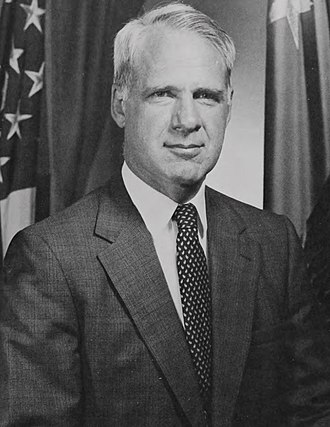
Schlesinger, James R. (Dr.)
During the Nixon administration, Dr. James R. Schlesinger held a series of high-level positions. He began as the assistant director of the Bureau of the Budget in 1969. In August 1971, President Nixon appointed him Chairman of the Atomic Energy Commission, a role he held until January 1973. Following this, he had a brief but impactful tenure as Director of Central Intelligence from February to July 1973, before being appointed Secretary of Defense in July 1973, a position he continued to hold into the Ford administration.
President Nixon met with Vice President Agnew and Republican Congressional leaders to discuss the administration's legislative and economic agenda. The participants analyzed current economic indicators, including inflation and productivity, and evaluated the implementation of the Task Force for International Development's recommendations regarding foreign and military aid. Additionally, the group addressed the future of the military draft, focusing on pay increases and the transition toward an all-volunteer force while assessing potential legislative hurdles in Congress.
President Nixon and the President’s Foreign Intelligence Advisory Board (PFIAB) met to discuss global foreign policy strategy, with a focus on shifting relationships with the People's Republic of China, the Soviet Union, and Taiwan. The discussion centered on the necessity of intelligence capabilities to navigate future arms agreements and maintain regional stability in the Pacific following the eventual conclusion of the Vietnam War. The participants also reviewed the effectiveness and accelerated timelines of current U.S. intelligence programs under the President’s leadership.
President Nixon hosted a social gathering in the Oval Office for Dr. James R. Schlesinger, his family, and the Doub and Radcliffe families. The meeting primarily served as a ceremonial visit featuring a photographic session and the presentation of presidential gifts, including cufflinks and Apollo viewers, to the guests. Following the departure of the families, the President briefly discussed his schedule, specifically regarding the Oakland A's and Henry Kissinger, with Alexander P. Butterfield, Gerald R. Ford, and Robert P. Griffin.
President Nixon, Pat Nixon, and the Cabinet met with their spouses to discuss the implementation and public perception of the administration’s New Economic Policy. Secretary of the Treasury John Connally led a comprehensive briefing on the wage-price freeze, tax reforms, and international monetary adjustments aimed at curbing inflation. The discussion emphasized the necessity of these economic measures for restoring national growth, managing federal expenditures, and building public and congressional support for the administration's program.
President Nixon met with Dr. James R. Schlesinger and Alexander M. Haig, Jr. to discuss the management and strategic direction of the Atomic Energy Commission (AEC). The conversation focused on staff appointments, the political and environmental challenges surrounding nuclear projects like the 'Plowshare' natural gas program, and the importance of maintaining U.S. technological supremacy in nuclear applications and laser defense. Nixon urged Schlesinger to navigate political and environmental opposition strategically, particularly by timing controversial activities to avoid disrupting the 1972 election cycle.
General Alexander M. Haig, Jr. convened a meeting with administration officials, including representatives from the State Department, Department of Defense, and the NSC, to establish strict coordination protocols for public communications following a potential arms limitation agreement in Moscow. Participants were instructed to centralize all public statements and congressional briefings through White House channels to ensure consistency and to minimize unauthorized commentary until the President returned. The group also discussed creating target lists of supporters and preparing rationale papers to manage public and legislative reception of the agreement once it was officially announced.
President Nixon met with his Cabinet and senior staff to discuss strategies for achieving a balanced federal budget by 1975, emphasizing the necessity of immediate spending cuts and potential vetoes of congressional legislation to curb inflation. Budget Director George Shultz outlined the administration’s plan to issue "ceiling letters" to agency heads to enforce strict fiscal guidelines and reduce government deficits. The participants also reviewed recent positive economic indicators, including growth in the Gross National Product and declining unemployment, while noting that the public generally views government spending as a primary driver of inflation.
President Nixon hosted a meeting and swearing-in ceremony for Dixy Lee Ray, who was appointed as a commissioner to the Atomic Energy Commission (AEC). The event included the participation of several AEC officials, presidential aides, and members of the press to highlight the administration's commitment to appointing qualified women to high-level government positions. During the session, the President emphasized the importance of developing atomic energy for peaceful purposes and formally concluded the proceedings by distributing presidential gifts to the attendees.
President Nixon met with members of the National Security Council and other senior officials to discuss the strategic balance of power between the U.S. and the USSR, specifically in anticipation of the SALT II negotiations. The discussion focused on the impact of qualitative and quantitative disparities in throw-weight, bombers, and MIRV technology on U.S. and Soviet first- and second-strike capabilities. Nixon emphasized the importance of maintaining an appearance of strategic equivalence to preserve the confidence of U.S. allies and domestic support, directing his team to refine their negotiating strategy without rushing into a premature moratorium on weapons testing.
President Nixon and members of the National Security Council met to discuss the strategic importance of Mutual Balanced Force Reductions (MBFR) amidst growing congressional pressure for unilateral U.S. troop cuts. The discussion focused on maintaining a credible conventional defense posture in Europe to avoid a reliance on "tripwire" nuclear escalation, which Nixon and his advisors agreed would be untenable given the current parity in nuclear capabilities between the U.S. and the Soviet Union. Participants ultimately reached a consensus to pursue negotiations that link force improvements with potential reductions while resisting domestic isolationist trends and preserving NATO's operational cohesion.
President Nixon met with Vice President Agnew and his Cabinet to discuss the ongoing impact of the Watergate scandal on the administration, personnel changes, and the need to maintain governmental stability. Key topics included the appointment of a special prosecutor, the selection of Elliot Richardson, and the importance of professional coordination between the White House and Cabinet departments to ensure the administration's 1972 election mandate remained the primary focus. Nixon emphasized the necessity of improving Congressional relations and maintaining morale within the bureaucracy despite the political distractions caused by the Ervin Committee hearings.
President Nixon met with his Vice President, Cabinet members, and senior staff to receive departmental updates and reinforce the administration's policy goals. The discussion spanned a wide array of topics, including minority recruitment, the status of the Watergate special prosecutor search, energy policy, and the administration's foreign policy record. Nixon emphasized the importance of maintaining a strong national defense and a unified front against political challenges while encouraging his team to continue their work with confidence.
President Nixon and Vice President Agnew met with the Cabinet and senior staff to discuss major foreign and domestic policy priorities and internal administration management. The discussion centered on upcoming diplomatic summits with Leonid Brezhnev and Georges Pompidou, negotiations with North Vietnam regarding the ceasefire, and economic challenges including inflation and energy policy. Additionally, General Alexander Haig briefed the Cabinet on the administration's efforts to stabilize internal governance, improve relations with Congress, and manage the ongoing political fallout from the Watergate scandal.
President Nixon met with bipartisan Congressional leaders, Vice President Agnew, and key cabinet members to discuss U.S. foreign policy developments in Latin America, Southeast Asia, and Europe. Secretary of State William Rogers briefed the group on his recent tour of eight Latin American nations, emphasizing improved diplomatic relations despite complex issues regarding oil, inflation, and expropriation. Henry Kissinger provided an update on ongoing negotiations in Paris aimed at reinforcing the Vietnam ceasefire, while he and the President outlined a new strategy for strengthening Atlantic alliances, stressing the need to link economic, political, and defense policies to ensure future international stability.
President Nixon met with his Vice President, Cabinet members, and senior staff to announce the implementation of a 60-day price freeze as part of a strategy to combat inflation. He explained that this measure, aimed at stabilizing food and gasoline prices, was a necessary pragmatic step to preempt more extreme, mandatory controls favored by Congress. Nixon emphasized his commitment to maintaining a free-market economy and tasked his Cabinet with actively promoting this policy to the public and opinion makers. He also highlighted the administration's broader accomplishments in foreign policy, including the end of the draft and the upcoming U.S.-Soviet summit.
President Nixon met with Vice President Agnew and his Cabinet to discuss the transition from the current wage and price freeze to a "Phase IV" economic policy. The President emphasized the need to balance controlling inflation with maintaining domestic production, while acknowledging the political difficulty of removing controls due to congressional and public pressure. Key developments included the administration's resolve to move toward a free-market economy as quickly as possible, coupled with a renewed commitment to fiscal austerity and a balanced federal budget to bolster economic confidence.