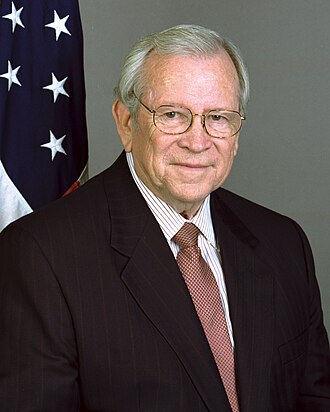
Baker, Howard H., Jr.
Howard H. Baker Jr. was a Republican U.S. Senator from Tennessee throughout the Nixon administration. A key figure during the Nixon taping period, he gained national prominence as the Vice Chairman of the Senate Watergate Committee, which was established in February 1973. In this role, he famously asked the pivotal question, "What did the President know and when did he know it?", which helped to focus the investigation into President Nixon's involvement in the Watergate scandal.
President Nixon and a wide-ranging group of Cabinet members, advisors, and Congressional representatives met to discuss the growing national energy crisis and the necessity of transitioning to nuclear power. AEC Chairman Glenn Seaborg and other experts detailed the technological, environmental, and economic advantages of the liquid metal fast breeder reactor, emphasizing its ability to maximize fuel efficiency and provide long-term, pollution-free energy. The participants concluded that a strong national commitment, including significant federal funding and industry collaboration, is essential to accelerate the development of demonstration reactors and ensure future energy independence.
President Nixon met with a group of Republican senators and key advisors, including Henry Kissinger, to discuss the political landscape surrounding the Vietnam War and national defense policy. The conversation focused on the erosion of public support for the war, the impact of various congressional anti-war resolutions, and the importance of maintaining American preeminence despite shifting domestic and international pressures. The participants strategized on how to manage the political fallout of the Vietnamization policy and addressed concerns regarding defense preparedness and the administration's foreign policy initiatives in the Soviet Union and China.
President Nixon met with a Tennessee delegation led by Senator Howard H. Baker, Jr., which included local officials and artist Gordon Wetmore. The conversation centered on Tennessee state politics, specifically the legislative agenda of Governor Winfield Dunn, and included lighthearted social interaction and photo opportunities. The group also discussed various administrative schedules and upcoming cultural events, such as a performance by the Ohio State Fair Youth Choir.
President Nixon and Henry Kissinger met to discuss potential personnel changes within the administration, specifically debating the merits of Elliot Richardson versus Nelson Rockefeller for future roles, including potential State Department leadership. The discussion emphasized maintaining administrative control and managing political expectations for the 1972 campaign. Additionally, Nixon instructed Kissinger to ensure John B. Connally receives prominent credit for his contributions to the administration's economic policy initiatives.
President Nixon initiated this brief telephone call to Senator Howard H. Baker, Jr. primarily to extend personal birthday greetings. The conversation remained cordial and informal, focusing on lighthearted exchanges regarding aging and Baker’s status as a young statesman. No substantive policy matters or political actions were addressed during the interaction.
President Nixon held a large-scale photographic session in the Oval Office with numerous Republican senators, representatives, and congressional candidates. The event was coordinated by technical staff to capture official images of the President with party members. Following the main group session, Clark MacGregor remained for a brief private discussion with the President.
President Nixon met with Senators John Tower and Howard Baker, William Timmons, and photographer Ollie Atkins to discuss 1972 campaign strategies and a photograph session. The participants analyzed the political landscape in Tennessee, focusing on local congressional candidates and polling data regarding George McGovern. Nixon emphasized that the Vietnam War remained a potent campaign issue that would work to his advantage if framed effectively against Democratic opponents.
President Nixon met with several Republican senators to strategize on gaining legislative action against school busing during the remaining session of the 92nd Congress. Nixon encouraged the senators to support the current busing legislation as the most viable vehicle for immediate progress, emphasizing that the Senate should at least proceed to a vote on the merits rather than allowing the bill to stall. The President also discussed the broader political landscape, including his judicial philosophy regarding Supreme Court appointments and his intent to emphasize these themes in upcoming campaign appearances.
President Nixon and his senior staff, H. R. Haldeman and John Ehrlichman, coordinated campaign messaging in the final days before the 1972 election. Much of the discussion focused on refuting George McGovern’s criticisms regarding Vietnam, specifically emphasizing the administration's stance that they had achieved a breakthrough toward "peace with honor" while clarifying that remaining "central points" were merely details requiring resolution. To reinforce these themes, Nixon made a series of telephone calls to various Republican candidates across the country to offer his endorsement, boost morale, and provide talking points for their final campaign appearances.
President Nixon called Senator Howard H. Baker, Jr. to convey his well-wishes for the upcoming 1972 election and to outline campaign talking points regarding his administration's pursuit of "peace with honor" in Vietnam. Nixon emphasized the progress made on cease-fire negotiations and the return of prisoners of war, while dismissing opposition claims of a political hoax. The President also requested that Baker personally contact various House candidates on his behalf to demonstrate his support.
President Nixon met with Senator Howard H. Baker, Jr. to discuss the ongoing Senate Watergate hearings and the importance of managing the political fallout. The two reviewed strategies for navigating the committee's inquiries, with Nixon emphasizing the need to avoid negative public commentary and prevent a broader scandal. They explored tactics to shift the narrative and ensure the administration maintains a controlled response to the investigators' requests.
President Nixon met with Senators Howard Baker and William Brock, along with a delegation of Tennessee officials and constituents, to participate in a ceremonial event. The group discussed the centennial of Martin, Tennessee, and finalized plans for the President’s potential attendance at the town's July 4th commemoration. During the session, the President accepted various gifts, including letters from schoolchildren regarding the Vietnam cease-fire, and engaged in informal photo opportunities with the visitors.
President Nixon met with members of the Senate Commerce Committee, including Senators Griffin, Hartke, Baker, Beall, Cannon, and Moss, to discuss their recent visit to the Soviet Union and its implications for U.S.-Soviet relations. The conversation centered on the potential impact of the Jackson-Vanik amendment on trade negotiations, specifically regarding the emigration of Soviet Jews and the risk of damaging the President's diplomatic progress with Leonid Brezhnev. Nixon emphasized the need for a bipartisan approach and suggested developing modified language for the legislation to provide an "escape valve" that would avoid a confrontational ultimatum while maintaining progress on key strategic interests like SALT II.