Dunlop, John T.
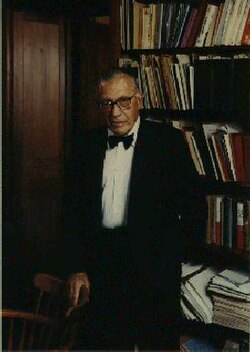
John T. Dunlop, a labor economist and Harvard dean, played a key role in the Nixon administration's efforts to combat inflation during the taping period. In March 1971, he was appointed chairman of the Construction Industry Stabilization Committee, which was created to control soaring wage increases in the construction industry. Shortly before the taping ended, in 1973, he transitioned to become the Director of the Cost of Living Council, where he oversaw the broader wage and price control program.
President Nixon met with the National Commission on Productivity to discuss the evolving state of the global economy and the United States' competitive position in the post-World War II era. The conversation focused on the rapid industrial growth of Japan and Western Europe, the emergence of China, and the necessity for the U.S. to enhance its productivity to maintain economic leadership. Nixon emphasized that while diplomatic and political tensions with the Soviet Union might fluctuate, long-term economic stability and international influence would depend on domestic production and effective global economic engagement.
President Nixon met with members of the National Commission on Productivity, including union leaders, corporate executives, and government officials, to discuss strategies for enhancing American economic productivity and competitiveness. The conversation focused on the role of government-industry cooperation, the importance of basic versus applied research in fostering technological innovation, and the challenges posed by foreign trade competition and environmental regulations. Participants emphasized the need to align private sector investment with national economic goals to ensure long-term stability and job growth in an increasingly global market.
President Nixon and George Shultz met to deliberate on the implementation of a major new economic program, specifically focusing on the necessity of a wage-price freeze and a potential import tax to combat inflation and restore public confidence. They discussed the legal and political complexities of these actions, weighing the risks of such measures against the need for U.S. economic leadership and stability. Henry Kissinger joined the meeting briefly to coordinate on international affairs, including the Accidental War Agreement and diplomatic relations with China and the Soviet Union, before the conversation returned to the logistical challenges of the domestic economic agenda, including federal budget cuts and public communication strategies.
President Nixon met with the Construction Industry Collective Bargaining Commission to review the progress of labor-management relations and wage stabilization efforts in the construction sector. The discussion focused on the success of the Commission's voluntary approach to curbing inflation, the role of craft boards in fostering industry cooperation, and the broader integration of productivity goals. Nixon commended the participants for their responsible leadership and collaborative efforts, emphasizing the importance of keeping the industry's management in the hands of construction professionals while continuing to modernize labor practices.
President Nixon met with John T. Dunlop and several senior administration officials to formalize Dunlop’s appointment as the new chair of the Cost of Living Council. The discussion centered on the challenges of implementing Phase III of the administration's economic policy, specifically emphasizing the necessity of fiscal restraint and cooperation from labor and management to combat inflation. Nixon expressed his confidence in Dunlop’s unique ability to bridge the gap between business and labor interests to stabilize food prices and the broader economy.
President Nixon met with his economic advisors to address rising inflation, specifically focusing on the political and economic instability caused by soaring food prices and labor's wage demands. He instructed his team to aggressively bypass bureaucratic resistance and increase the supply of commodities by selling off federal stockpiles and grain surpluses to stabilize the market. Nixon emphasized the need for a more visible and proactive administration stance, including the possibility of issuing a white paper on the food situation to reassure the public and unions.
President Nixon met with his Cabinet and key administration officials to address the national crisis of rising food prices and related supply chain bottlenecks. The discussion focused on agricultural production, the impact of labor costs on retail food prices, and the implementation of strategic stockpiling policies to stabilize the market. The President instructed his team to prioritize the transportation of farm produce, explore measures to increase production, and maintain clear accountability through regular reporting to manage public concern and inflation.
President Nixon met with Republican Congressional leaders and economic advisors to discuss strategies for addressing rising food prices, inflation, and the ongoing transition of the wage-price stabilization program. Key topics included the administration's efforts to increase food supplies and imports, the management of labor-management relations, and the necessity of maintaining party unity to sustain presidential vetoes on spending legislation. The meeting underscored the administration's focus on economic control and the importance of Congressional support in implementing fiscal policy.
President Nixon met with the Labor-Management Advisory Committee, including George Shultz, John T. Dunlop, and various labor and business leaders, to discuss the ongoing management of the national economy and inflation. The discussion centered on the successes and challenges of the administration's economic stabilization efforts, particularly the transition from Phase II to Phase III of wage and price controls. Participants deliberated on the importance of maintaining public confidence and business compliance, with the President emphasizing the need for continued cooperation between labor and management to ensure stability without excessive government intervention.
President Nixon met with Vice President Agnew and his key economic advisors to assess the national economy, focusing on rising inflation and the status of the Phase III wage and price control program. The group evaluated the success of recent industrial wage settlements, particularly in the meatpacking industry, and discussed the potential necessity of fiscal and monetary restraint to avoid a future recession. The President and his team ultimately decided against implementing a new price freeze while considering the political feasibility of a variable investment tax credit with Congressional leaders.
President Nixon met with a broad group of Republican Congressional leaders to propose the creation of a bipartisan, independent commission on federal election reform. The President outlined the commission's broad mandate to study and recommend improvements to campaign financing, ethics, disclosure rules, and potentially the length of election campaigns. Nixon emphasized that the commission, which would include both public members and Congressional representatives, should serve as a catalyst for practical reform and generate public support for legislative action without preempting the authority of existing Congressional committees. The meeting focused on establishing a non-partisan framework to address the inefficiencies and technical challenges identified in previous election laws.
President Nixon met with his economic advisors and staff to discuss growing concerns over inflation, the stock market, and the public's perception of the economy. The group analyzed the potential effectiveness of various measures, including a possible excise tax on gasoline, an investment tax credit, and a compulsory savings plan, while considering the political challenges of implementing such a package with Congress. Ultimately, the President decided against immediate, piecemeal action, opting instead to have his advisors develop a comprehensive economic package for review at a follow-up meeting.
President Nixon met with his economic advisors and John Connally to evaluate potential policy responses to the national economy, specifically focusing on the impact of food prices and the potential implementation of an export freeze. The group debated the efficacy of a 60-day price freeze versus alternative measures to curb inflation and addressed the political risks associated with such interventions. Additionally, Nixon and Connally discussed Connally's ongoing advisory role, navigating the potential for public speculation regarding his conflict of interest and the administration's need to maintain a strong, proactive image amid the escalating Watergate scandal.
President Nixon met with Alexander Haig to discuss personnel and political strategy regarding Watergate, specifically focusing on the role of Attorney General Elliot Richardson. Following this, Nixon convened with John Connally, George Shultz, Herbert Stein, and John Dunlop to debate the administration's economic response to mounting Congressional pressure for a wage and price freeze. The group evaluated various options, ultimately deciding on a strategy that balanced political necessity with the risks of economic uncertainty, while preparing for a follow-up consultation with labor and management leaders.
President Nixon met with the President's Advisory Committee on Labor-Management Policy to discuss the state of the national economy and potential strategies for curbing inflation, specifically focusing on the recent surge in food prices. Participants, including key labor leaders like George Meany and Leonard Woodcock, debated the merits of various policy options, including a possible price freeze versus maintaining the flexibility of Phase III controls. Nixon emphasized his administration's goal of returning to a free economy while acknowledging the need for potential short-term actions to restore public confidence and address the public's anxiety over rising costs.
President Nixon met with George Shultz, Herbert Stein, and John Dunlop to discuss economic strategies for curbing inflation, specifically focusing on the implementation of export controls and potential wage-price freezes. The participants debated the necessity and credibility of these measures, particularly regarding food prices and foreign aid, while considering the political implications of upcoming electoral cycles. Nixon expressed a determination to eventually move toward a strengthened Phase III economic policy and tasked the advisors with developing a concrete plan to manage these economic interventions effectively.
President Nixon met with his senior economic advisors and staff to deliberate on a strategy for stabilizing the national economy, specifically focusing on a proposed 60-day price freeze on food and gasoline. The discussion covered the implementation of Phase IV economic controls, the necessity of securing congressional support for trade and spending measures, and the political challenges of potential vetoes on agricultural and minimum wage legislation. Nixon emphasized the importance of public education regarding his administration's economic goals and requested that his cabinet members and advisors actively advocate for these policies to build public and congressional confidence.
President Nixon met with his Vice President, Cabinet members, and senior staff to announce the implementation of a 60-day price freeze as part of a strategy to combat inflation. He explained that this measure, aimed at stabilizing food and gasoline prices, was a necessary pragmatic step to preempt more extreme, mandatory controls favored by Congress. Nixon emphasized his commitment to maintaining a free-market economy and tasked his Cabinet with actively promoting this policy to the public and opinion makers. He also highlighted the administration's broader accomplishments in foreign policy, including the end of the draft and the upcoming U.S.-Soviet summit.
President Nixon met with Vice President Agnew, cabinet members, and a bipartisan group of Congressional leaders to announce an upcoming economic policy address and discuss the administration's new strategy to combat inflation. The President detailed a 60-day price freeze—excluding wages and raw agricultural products—and sought legislative assistance regarding export controls on food and gasoline supply allocations. Additionally, the President arranged for key Congressional leaders to receive ongoing briefings from administration officials during the upcoming summit with Soviet leader Leonid Brezhnev to ensure better oversight of the resulting agreements.
President Nixon met with Vice President Agnew, top economic advisors, and a large group of Republican Congressional leaders to discuss the administration's current 60-day economic freeze and the development of a subsequent "Phase IV" program. The primary challenge identified was managing inflation and supply shortages—particularly in food—while avoiding the long-term economic damage of permanent price and wage controls. The President and his advisors sought Congressional support for a balanced budget and specific legislative measures, such as the release of strategic stockpiles, while acknowledging the significant political difficulty of passing unpopular fiscal reforms. Participants emphasized the need for a careful balance between short-term political relief and long-term economic stability to avoid the pitfalls of past rationing and supply-side distortions.
President Nixon met with his economic advisors and Cabinet members to debate the design of 'Phase IV' of his economic program, focusing on the appropriate speed for removing wage and price controls. The discussion centered on balancing the political need to curb inflation with the economic necessity of incentivizing production, particularly in the agricultural sector, where export controls and price ceilings had created supply shortages. The President and his team also addressed the critical need for a balanced federal budget to bolster business confidence, ultimately agreeing on the necessity of a tough, credible policy to stabilize the economy.
President Nixon met with Vice President Agnew and his Cabinet to discuss the transition from the current wage and price freeze to a "Phase IV" economic policy. The President emphasized the need to balance controlling inflation with maintaining domestic production, while acknowledging the political difficulty of removing controls due to congressional and public pressure. Key developments included the administration's resolve to move toward a free-market economy as quickly as possible, coupled with a renewed commitment to fiscal austerity and a balanced federal budget to bolster economic confidence.