Nixon, Richard M. (President)
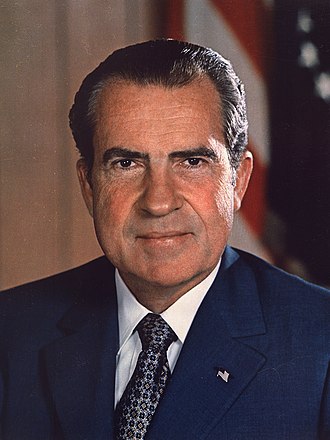
Richard M. Nixon served as the 37th President of the United States from January 1969 until his resignation in August 1974. In February 1971, he ordered the installation of a secret voice-activated taping system in the White House to preserve a historical record of his administration. Until the system's existence was revealed and dismantled in July 1973, the tapes captured Nixon directing major foreign policy initiatives, such as the opening to China, as well as his central role in the Watergate cover-up.
What Nixon talks about on the tapes
White House operations 4,718Presidential scheduling 2,225Public relations 1,784Presidential schedule 1,782Vietnam War 1,693Logistics 1,650Manolo Sanchez 1,626White House communications 1,400White House administration 1,399Presidential communication 1,243Henry Kissinger 1,191Foreign Policy 1,183
Conversations (21,010)
— Page 47 of 211President Nixon initiates a brief telephone exchange with the White House operator to request a connection to Press Secretary Ronald L. Ziegler. The call serves as an administrative bridge to facilitate direct communication with his press office. No further substantive discussion occurs during this specific recording segment.
President Nixon instructed the White House operator to contact two members of his writing staff to facilitate immediate meetings. He requested that William L. Safire be directed to the Executive Office Building and asked for a follow-up call to be placed to Raymond K. Price, Jr. This brief exchange served to coordinate presidential speechwriting and communication efforts.
President Nixon directs the White House operator to facilitate a meeting with William Safire at the Executive Office Building. He further requests that the operator obtain the price of a specific book. No other business is transacted during this brief administrative exchange.
President Nixon directs Raymond Price to incorporate anecdotal support into an upcoming announcement regarding the administration's economic policies. By highlighting brief, representative examples from diverse citizens—such as a Los Angeles woman and a Texas teacher—Nixon aims to demonstrate widespread public willingness to prioritize the national interest. Price is tasked with project-managing the selection and integration of these testimonials to ensure the message remains concise and impactful.
President Nixon and speechwriter Raymond K. Price, Jr. discuss the strategic use of brief, illustrative anecdotes to strengthen the impact of a planned address or communication. The pair considers the efficacy of incorporating a limited selection of concise examples to better convey their message. This brief exchange serves as a tactical coordination effort regarding the drafting process for an upcoming public-facing presentation.
President Nixon met with William L. Safire to refine the speech draft for his upcoming announcement regarding Phase II of the Economic Stabilization Program. The discussion focused on re-framing the narrative to emphasize the fight against inflation and the transition from an "inflation psychology" to a "price reduction psychology" supported by business, labor, and the public. Nixon directed Safire to incorporate anecdotal material, emphasize the importance of productivity, and specifically clarify the jurisdiction of the Price and Pay Boards regarding profits and wage restraints. The President also established a workflow for finalizing the text, emphasizing direct oversight and limiting circulation to select advisors like Herbert Stein.
President Nixon and H.R. Haldeman reviewed the draft of an upcoming speech regarding Phase II of the Economic Stabilization Program, focusing on articulating economic and foreign policy goals for the administration. They also discussed potential appointments for the Price Board and evaluated the merits of prospective candidates. Additionally, the pair coordinated the President’s logistical arrangements for travel to Camp David and upcoming appearances in Virginia.
President Nixon met with an unidentified individual in the Old Executive Office Building to discuss administrative coordination. The primary focus of the brief interaction concerned the President’s upcoming schedule and the logistics of a forthcoming phone call. The conversation concluded with arrangements for the individual to reconnect with the President once a current medical matter was addressed.
President Nixon and Henry Kissinger discussed legislative strategy regarding the Byrd amendment on chrome, focusing on the need to manage relations with Senator Harry F. Byrd, Jr. and the broader implications for Congress. The conversation also touched upon the administration's stance on the PRC and upcoming messaging efforts, including the preparation of the President's Phase II economic speech. Kissinger committed to coordinating with Clark MacGregor to ensure key political allies were reassured and remained aligned with the administration's objectives.
President Nixon initiates a brief communication with the White House operator to facilitate an outgoing call. The exchange serves solely as a logistical request to connect the President to another party. No substantive policy discussions or administrative decisions occur during this brief interaction.
President Nixon and Press Secretary Ronald Ziegler coordinate the rollout of upcoming announcements, specifically focusing on the timing of a presidential speech and the handling of the West Coast dock strike via a Taft-Hartley injunction. They discuss the strategic sequencing of media briefings regarding legislative leader meetings, a cabinet meeting, and a press conference for Treasury Secretary John B. Connally. Nixon instructs Ziegler to keep the duration of his upcoming address vague to maintain the perception of a major, high-stakes statement.
President Nixon and Press Secretary Ronald Ziegler coordinate the timing and messaging for an upcoming public speech and legislative announcement. The discussion focuses on managing media expectations and the strategic impact of the announcement on the viewing audience. Ultimately, the President expresses caution regarding the potential public reception and the timing of the release.
President Nixon instructed the White House operator to place an outgoing call to speechwriter William L. Safire. The primary purpose of this communication was to establish contact with Safire for further discussion. No substantive policy matters or additional instructions were recorded during this brief administrative request.
President Nixon contacted the White House operator to initiate a telephone call to speechwriter and aide Raymond K. Price, Jr. The brief exchange served as a procedural request to facilitate communication between the President and his staff member. No further substantive discussion took place during this specific call.
President Nixon consulted with the White House operator to facilitate an outgoing call. The brief exchange focused on establishing a telephonic connection to another party. No substantive policy discussions occurred during this administrative interaction.
President Nixon and speechwriter William Safire discussed adjustments to the President's upcoming schedule to accommodate his departure time. Nixon requested that a previously planned meeting be moved to 4:00 pm to ensure it concluded before he needed to leave at 5:30 pm. The brief call concluded with both parties confirming the new time and expressing satisfaction with the progress of their ongoing work.
President Nixon and William Safire briefly coordinate their schedules, with the President requesting that an upcoming appointment be rescheduled to four o'clock. Nixon acknowledges Safire's work on a document, commending him for providing a strong initial draft. No further substantive policy discussions occurred during this brief interaction.
President Nixon instructed speechwriter Raymond K. Price, Jr. to incorporate specific public feedback regarding the administration’s wage and price freeze into an upcoming address. The President requested that the draft feature a diverse array of examples from thousands of letters, highlighting support from various demographics such as union members, housewives, and retirees. This effort aimed to demonstrate broad, grassroots approval for the economic policy through a punchy and representative narrative.
President Nixon consults with speechwriter Raymond K. Price, Jr. regarding the development of a persuasive communication strategy involving testimonials from diverse citizens. The President directs Price to incorporate anecdotes from ordinary Americans—such as teachers and retirees—to emphasize public support for his administration's messaging. This exercise aims to create a punchy, grassroots narrative that reflects a broad cross-section of the country.
President Nixon instructed the White House operator to place an outgoing call to Congressman H.R. Gross of Iowa. This administrative exchange served as the precursor to a direct political consultation between the President and the Representative. No further discussion occurred during this brief segment.
President Nixon and H. R. Haldeman briefly conferred to coordinate an upcoming meeting regarding media relations and the schedule of Henry Kissinger. Nixon instructed Haldeman to approach the task with confidence and ease, promising to provide further specific instructions shortly. This exchange functioned as a preparatory coordination for high-level staff interactions.
President Nixon met with H. R. Haldeman, Henry Kissinger, and other staff to coordinate communications and legislative strategy, specifically focusing on the announcement of a planned Soviet summit and the importance of timing to manage press and congressional reactions. They discussed the effectiveness of congressional lobbying efforts, including recent successes in the House, and debated the strategic timing and format of a proposed "Western Summit" involving key allies. The President prioritized controlling the narrative through deliberate, sudden announcements and emphasized the need for direct communication with heads of state via personal letters to maintain diplomatic influence without compromising the administration's strategic agenda.
President Nixon called Representative H. R. Gross to express his appreciation for Gross's effective parliamentary maneuver in the House, which contributed to a significant legislative victory for the administration. Gross explained the tactical use of a quorum call and inquiry to catch the opposition by surprise despite intense labor union pressure. The two also discussed strategy for an upcoming Senate vote, with the President encouraging Hugh Scott to utilize filibuster tactics if necessary to block unfavorable outcomes.
President Nixon met with his personal valet, Manolo Sanchez, in the Old Executive Office Building to discuss personal arrangements. The brief interaction focused on the President's request for refreshments. The meeting concluded quickly with no substantive policy or administrative developments.
President Nixon met with his personal valet, Manolo Sanchez, in the Old Executive Office Building to discuss the President's upcoming schedule. The brief interaction focused on logistics regarding Nixon's daily itinerary. No significant policy decisions or major strategic developments were recorded during this short exchange.
President Nixon and Henry Kissinger met to discuss the volatile situation between India and Pakistan. The conversation focused on rising tensions at the border and the potential strategic implications of United States involvement in the regional conflict. The exchange served as a briefing on maintaining neutrality while monitoring military developments in South Asia.
President Nixon met with his personal valet, Manolo Sanchez, to coordinate the setup of a television in the Old Executive Office. The primary purpose of this brief interaction was for the President to arrange the viewing of the National League Championship Series. No significant policy decisions were made during this exchange, which focused entirely on the President's personal schedule and leisure activities.
President Nixon met with his personal valet, Manolo Sanchez, in the Old Executive Office Building. The brief interaction appears to involve a discussion regarding the adjustment or operation of a television broadcast. No significant policy decisions were recorded during this segment of the meeting.
President Nixon initiates a request to the White House operator to place a sidebar call. The brief exchange serves as a procedural step to connect the President with a specific individual for a private conversation. No substantive policy matters or further developments were captured in this recording.
President Nixon requested that the White House operator place a call to his speechwriter, William L. Safire. This brief exchange served solely as a logistical directive to facilitate direct communication with a key staff member. No further substantive discussion took place between the President and the operator.
President Nixon consults with speechwriter William Safire regarding the inclusion of legislative updates in an upcoming Phase II economic address. Nixon directs Safire to incorporate a segment urging the Senate to act promptly on a tax program already passed by the House, highlighting its potential for job creation. This addition serves to reinforce the administration's momentum on the "three-front program" of restraining prices, creating jobs, and stabilizing the dollar.
President Nixon and speechwriter William Safire consult on the framing of an administration economic initiative, specifically focusing on the messaging for a public jobs program. The brief discussion centers on clarifying the program's narrative for media dissemination and ensuring consistent communication regarding its implementation. The pair concludes by briefly addressing the logistics of recovering a misplaced item.
President Nixon addresses a potential communication error regarding a requested callback, likely intended for H. R. Haldeman. The President clarifies that he did not initiate the call in question, attempting to resolve confusion over administrative scheduling or contact protocols. This brief exchange highlights the operational friction often present in the coordination of the President's daily outreach.
President Nixon consults with an unidentified staff member, likely in connection to H.R. Haldeman’s office, regarding scheduling logistics. The discussion focuses on locating individuals currently occupied in a meeting to coordinate the President's upcoming appointments. The exchange serves as a brief administrative interaction to facilitate the movement of personnel within the Executive Office Building.
President Nixon contacted the White House operator to facilitate a telephone connection with Alexander P. Butterfield. The brief exchange served as a routine administrative request to initiate communication with a staff member. No further policy or substantive matters were discussed during this specific call.
President Nixon and John Ehrlichman discuss the growing political pressure to address federal busing mandates, noting that the issue has become a significant concern in states like Michigan and Tennessee. They deliberate on potential legislative responses, including the possibility of a constitutional amendment versus other policy interventions during upcoming House debates on school aid. The conversation concludes with a directive for Ehrlichman to continue coordinating with John Mitchell to finalize a strategy by the end of the week.
President Nixon requested that the White House operator connect him to an external line to address a personal administrative matter. The sole objective of the brief interaction was to facilitate a phone call regarding a water bill payment. No policy discussions or significant political developments occurred during this exchange.
President Nixon consulted with John D. Ehrlichman to discuss personnel matters and the strategic handling of a sensitive legal or administrative issue. The conversation centered on the status of individuals potentially linked to a Boston-related matter and the broader implications of court involvement. Nixon expressed uncertainty regarding the current situation and instructed Ehrlichman to delay further external communications until he could personally review the details.
President Nixon and H.R. Haldeman reviewed and adjusted the President’s upcoming schedule to better accommodate Secretary John Connally's preparations for a press conference and to optimize the format of Cabinet and legislative leader meetings. They decided to cancel an unproductive Friday session, opting instead to consolidate updates on the Cost of Living Council’s Phase Two policies and foreign policy summit preparations into a Tuesday afternoon block. Additionally, they coordinated a meeting with Senator Russell Long to discuss pending legislative business.
President Nixon and H. R. Haldeman discuss rescheduling a planned Friday meeting to avoid unnecessary disruptions and potential conflicts regarding Treasury Secretary John Connally’s participation. They decide to shift the engagement to a later time to better facilitate reports on the administration’s Stage II economic policies and the upcoming summit. The participants emphasize the need to avoid repetitive patterns in scheduling and maintaining control over the narrative presented to congressional leaders.
President Nixon instructed Alexander P. Butterfield to reschedule a planned Cabinet meeting from Friday to 4:30 p.m. on the following Tuesday. This adjustment was made specifically to accommodate the schedule of Treasury Secretary John Connally. Butterfield confirmed that he had already coordinated the change with Chief of Staff H.R. Haldeman.
President Nixon and Alexander P. Butterfield briefly discussed the rescheduling of an upcoming Cabinet meeting. The primary focus was confirming the shift of the session from Friday to Tuesday, the 30th. This conversation served as a logistical follow-up to a previous phone discussion regarding adjustments to the President's official calendar.
President Nixon contacted the White House operator to facilitate a telephone call to First Lady Pat Nixon. The brief interaction served as a formal request to connect the President with his wife. No policy matters or significant administrative decisions were discussed during this exchange.
President Nixon held a brief telephone conversation with First Lady Pat Nixon. The discussion was classified as a personal matter, as indicated by the withdrawal of the content from the public record. No substantive policy or administrative developments resulted from this brief exchange.
President Nixon and First Lady Pat Nixon held a brief, one-minute meeting in the Old Executive Office Building. The conversation primarily functioned as a personal or administrative coordination point, during which the President requested the presence of his personal secretary, Rose Mary Woods. No significant policy discussions or major developments were recorded during this brief exchange.
President Nixon contacted the White House operator to facilitate a telephone connection with his personal secretary, Rose Mary Woods. The brief exchange served as a routine administrative request to reach a key member of his staff. No further substantive policy matters or decisions were discussed during this brief communication.
President Nixon instructed the White House operator to place a telephone call to his personal secretary, Rose Mary Woods. The conversation was strictly administrative, serving solely to facilitate communication between the President and his long-time aide. No substantive policy discussions or major decisions occurred during this brief request.
President Nixon checked in on Rose Mary Woods’ recovery from illness and coordinated their upcoming schedule. The discussion centered on Woods' potential assistance with the President's speech preparation, which Nixon suggested could be handled by Marjorie P. Acker if Woods remained fatigued. They also addressed a pending dinner invitation from First Lady Pat Nixon, with the President advising Woods to prioritize her health over these professional and social obligations.
President Nixon and his personal secretary, Rose Mary Woods, held a brief, one-minute meeting in the Old Executive Office Building. While no transcript or recording details are available to specify the exact agenda, this interaction occurred in the context of their ongoing professional collaboration. The meeting concluded without any documented public policy shifts or major administrative decisions.
President Nixon and an unknown aide discuss scheduling logistics for upcoming meetings, specifically reviewing appointments with John Ehrlichman and John Mitchell regarding the administration's stance on busing. The conversation also briefly addresses potential meetings with Robert Dole, William Safire, and George Shultz. During the discussion, the participants are distracted by a televised baseball game, which occupies the majority of the audio recording.
President Nixon met with an unidentified individual in the Old Executive Office Building to discuss adjustments to his official schedule. The conversation focused on the logistical management of his upcoming appointments and obligations. No specific policy decisions were finalized, as the dialogue remained limited to administrative oversight of the President’s time.
President Nixon met with an unknown individual to coordinate the technical execution of a recording or playback session. The discussion focused on precise adjustments to technical settings, equipment positioning, and confirming the status of specific media segments. The participants successfully aligned on the necessary configurations for their task.
President Nixon directs the White House operator to place a telephone call to his special counsel, Charles W. Colson. The exchange is brief, consisting solely of the President's request for the connection. This administrative communication serves to facilitate an immediate consultation between Nixon and his advisor.
President Nixon held a brief, informal meeting with his personal valet, Manolo Sanchez, in the Old Executive Office Building. Due to the withdrawal of the conversation's content and the lack of a transcript, no substantive policy matters or administrative decisions are recorded. The exchange appears to be of a personal or private nature rather than a professional policy deliberation.
President Nixon initiates a brief telephone exchange with the White House operator to request a connection to Charles W. Colson. This administrative interaction serves as a bridge for the President to consult with one of his key advisors. No substantive policy matters are discussed, as the call functions solely as a logistical request for an outgoing communication.
President Nixon and Charles Colson reviewed positive economic indicators, including wholesale price drops and stock market gains, to assess the success of the administration's wage-price freeze and upcoming Phase II announcements. They also discussed legislative strategy regarding a tax package and the Mathias Amendment in the Senate, agreeing to stall if necessary to secure a favorable outcome. Additionally, Colson reported on polling data from Albert Sindlinger and Louis Harris, which indicated that public confidence in the President’s economic leadership remained strong and that union leader George Meany’s opposition was negatively impacting his standing among labor members.
President Nixon met with Charles W. Colson and Manolo Sanchez in the Executive Office Building to handle administrative tasks and personal coordination. The discussion primarily focused on the management of specific documents or materials that required relocation. While the exchange was brief and included the brief attendance of Sanchez, it functioned as a routine logistical session between the President and his staff.
President Nixon instructed the White House operator to contact speechwriter William Safire. The purpose of this call was to request Safire's immediate presence at the White House. The operator confirmed the directive and prepared to relay the message to Safire's office in the Executive Office Building.
President Nixon met with his personal valet, Manolo Sanchez, in the Old Executive Office Building to review the President’s daily schedule. During this brief encounter, the two addressed logistical matters, including the handling of an incoming telephone call from an unidentified individual. The meeting concluded immediately upon Sanchez's departure at 4:00 pm.
President Nixon and speechwriter William Safire met to refine a pending speech draft, focusing on the specific linguistic framing of the administration's economic policies. The President expressed a strong preference for using the term "yardstick" rather than "guideline" to describe economic benchmarks. This brief consultation served to finalize the rhetorical tone of the address before Safire departed to proceed with the revisions.
President Nixon and Henry Kissinger met to coordinate foreign policy maneuvers, specifically focusing on the upcoming announcement of Kissinger’s trip to the People's Republic of China and the strategic timing of Vietnam-related policy announcements. They reviewed recent legislative developments, including the passage of the Byrd Amendment, and discussed managing domestic political reactions to foreign affairs, such as the UN vote and potential impacts on the U.S.-USSR summit. Nixon emphasized his desire to keep foreign policy initiatives low-key to minimize criticism while simultaneously pressuring officials to ensure that ongoing crises, such as the India-Pakistan situation, remained under control.
President Nixon summoned a White House operator to his office in the Old Executive Office Building for a brief administrative interaction. While the transcript remains largely undefined, the President issued a directive to accompany him while making a brief reference regarding speechwriter Ray Price. This meeting serves primarily as an instance of routine staff coordination within the executive workspace.
President Nixon met with speechwriter William Safire to finalize a draft for an upcoming address regarding Phase II economic policies, including wage and price controls. The discussion focused on refining the speech's tone and messaging, specifically emphasizing the connection between economic prosperity and peace, while integrating positive feedback from the public. Nixon directed that the finalized text be reviewed by key economic advisors, including John Connally and George Shultz, to ensure broad consensus without excessive outside input.
President Nixon initiates a brief telephone exchange with the White House operator to request a formal connection to Treasury Secretary John B. Connally. This call serves as an administrative bridge to facilitate direct communication between the President and the Secretary. No further policy discussions or substantive developments occur during this brief interaction.
President Nixon and John Connally coordinate the final review process for an upcoming economic speech draft prepared by William Safire. Nixon outlines a restricted vetting procedure involving only Connally, George Shultz, Herbert Stein, and a limited contribution from Arthur Burns regarding interest rates. The President emphasizes keeping the review circle small to ensure efficiency, tasking Connally with reviewing the document after Safire delivers it.
President Nixon initiated a brief telephone call through the White House operator to contact Charles W. Colson. The conversation includes an unidentified speaker, likely William L. Safire, participating in the background. The primary action taken during this short exchange was the formal request to connect the President with Colson.
President Nixon and Charles Colson discuss a significant surge in the stock market, which Colson attributes to the passage of a tax bill and the positive anticipation surrounding the President's upcoming Phase II economic policy speech. The two also verify positive data regarding wholesale prices, noting a rare decline that provides favorable optics for the administration's economic efforts. Colson reports that speechwriter William Safire is incorporating this favorable pricing data into the President's scheduled remarks.
President Nixon met briefly with his personal valet, Manolo Sanchez, in the Old Executive Office Building. The conversation primarily addressed personal matters, as indicated by the withdrawal of the segment due to its private nature. No formal policy discussions or significant administrative actions resulted from this interaction.
President Nixon and H. R. Haldeman met briefly in the Old Executive Office Building to coordinate their schedules. The discussion focused on managing the President's upcoming commitments and logistical planning. An unidentified individual briefly joined the pair before the meeting concluded.
President Nixon and H. R. Haldeman met to coordinate strategy for an upcoming speech and to review economic indicators, particularly wholesale price trends. They discussed the necessity of blocking Senate legislative maneuvers through a filibuster and evaluated the status of various public opinion polls regarding the President's reelection prospects. Additionally, they touched upon internal personnel concerns and media management strategies, including plans to address negative coverage and book reviews.
President Nixon contacted the White House operator to facilitate a personal telephone call to his daughter, Tricia Nixon Cox. This brief communication served solely as a logistical request to establish a connection with a family member. No policy matters or official administrative business were conducted during this interaction.
President Nixon and his daughter, Tricia Nixon Cox, engaged in a private telephone conversation. The entire duration of the call was marked as a withdrawn personal item. Consequently, no substantive policy matters or official developments were recorded or disclosed for public review.
President Nixon met with speechwriter William Safire to finalize the text for a upcoming speech regarding the administration's Phase II economic policies. The pair discussed specific wording and necessary revisions for the speech's concluding page. Nixon directed Safire to polish the final draft and coordinate with Rose Mary Woods to ensure the document was prepared for his review the following morning.
President Nixon contacted the White House operator to place an outgoing call to Nellie L. Yates. This brief interaction served solely as a logistical request for the operator to connect the President to his intended party. No substantive policy matters or further developments were discussed during the exchange.
President Nixon communicated with the White House operator to facilitate contact with Nellie L. Yates. The operator informed the President that Yates was currently in transit, and they agreed to coordinate a follow-up call once she arrived home. This brief exchange served as an administrative arrangement to bridge communication between the President and Yates.
President Nixon initiated a brief administrative request to the White House operator to be connected with Mrs. Nell Yates. This brief exchange served solely as an operational directive to facilitate a telephone call to an outside party. No further policy or substantive matters were discussed during this brief interaction.
President Nixon instructed the White House operator to place an outgoing telephone call. The exchange was strictly logistical, serving only to facilitate the connection of a pending message or communication. No policy matters or substantive discussions were addressed during this brief administrative interaction.
President Nixon met with an unidentified individual in the Old Executive Office Building to discuss matters that remain obscured due to the lack of an available transcript. The interaction lasted for approximately 39 minutes, during which a brief segment was withdrawn from the record. No specific policy developments or decisions can be confirmed from the existing historical documentation for this meeting.
President Nixon and William Safire discussed the status of an economic speech draft, with Safire confirming that the document had been reviewed and finalized without significant revisions. The President invited Safire to the White House from the Executive Office Building to review the work in person. This brief exchange served to coordinate the finalization and presentation of the administration's upcoming economic policy messaging.
President Nixon and speechwriter William Safire briefly touched upon Safire’s need for additional assistance in his role. The President encouraged Safire to reflect on the matter, suggesting they reconvene later to discuss potential support arrangements. They also briefly coordinated the initiation of a phone call to a third party.
President Nixon met with speechwriter William Safire to refine a draft for an upcoming speech regarding economic policy and Phase II stabilization efforts. The discussion focused on the structural roles of the Price Commission and the Wage Commission, specifically debating the administrative oversight of George P. Shultz and the involvement of Dr. W. Allen Wallis. Nixon emphasized the importance of phrasing regarding price controls and corporate responsibilities to avoid negative political connotations, ultimately opting for language that highlights business efficiency over excessive government policing.
President Nixon placed a brief social call to Nellie L. Yates to wish her a pleasant vacation prior to her departure for Europe. During the conversation, Yates outlined her extensive travel itinerary, which included stops in London, Zurich, Austria, Italy, Morocco, and Portugal. The exchange concluded with Yates confirming that the President's ongoing work on an upcoming speech was progressing well.
President Nixon initiates a brief interaction with the White House operator to place an outgoing call. No substantive policy discussions or administrative decisions are recorded during this exchange. The recording serves primarily as a procedural connection to facilitate further communication.
President Nixon initiates a brief request for the White House operator to place a telephone call to Marjorie P. Acker. The interaction serves solely as a logistical bridge to connect the President with his intended party. No substantive policy matters or further developments occur during this brief exchange.
President Nixon contacted his staff via Marjorie P. Acker to request an urgent communication from speechwriter William Safire. The purpose of the call was to ensure Safire would reach out to the President immediately upon his arrival at his current location. This brief exchange served to facilitate direct contact between the President and his advisor regarding an unspecified pending matter.
President Nixon and Marjorie P. Acker briefly discussed the impending arrival of an individual referred to as "Sapphire" and the complications this person's presence would create for them. The exchange suggests a private, logistical concern regarding someone currently en route to meet with the President. No formal policy decisions were reached, as the conversation served as a short update on an anticipated encounter.
President Nixon instructed the White House operator to place a telephone call to speechwriter William L. Safire. The brief interaction served solely to facilitate this communication. No further substantive discussion occurred during the recorded segment.
President Nixon and William Safire discussed revisions to a speech regarding Phase II economic controls, specifically focusing on how to address corporate profits without alarming the business community. Nixon insisted on narrowing the language to target only "exorbitant" or "windfall" profits, ensuring that the Price Commission would not be perceived as having broad regulatory authority to monitor all business earnings. Consequently, they decided to strike several paragraphs and soften the rhetoric surrounding mandatory controls on dividends and interest to avoid unnecessary political or economic friction.
President Nixon and speechwriter William Safire discuss the framing of economic policy regarding corporate profits and price controls to avoid business alarm. Nixon emphasizes the need for language that frames cost savings as a benefit passed to the consumer while explicitly rejecting the implementation of an excess profits tax. He instructs Safire to coordinate with administration officials George Shultz and John Connally to revise the messaging and remove references to mandatory controls that might threaten business confidence.
President Nixon and his valet, Manolo Sanchez, discuss the President's upcoming schedule, which includes speechwriting and a medical physical. The two also coordinate personal arrangements for a dinner party for twelve guests, focusing on menu planning that specifies tenderloin and particular wine selections. The brief exchange highlights the intersection of Nixon’s administrative duties and his domestic staff coordination.
President Nixon consulted with an unidentified staff member regarding adjustments to his morning schedule. The brief discussion focused on clarifying the timing of a scheduled engagement, specifically ensuring it was set before 9:00 a.m. The interaction concluded with an agreement on the logistical arrangement of the President's upcoming appointments.
President Nixon and Henry Kissinger met to coordinate public relations strategy regarding sensitive foreign policy developments and to discuss the domestic political landscape. They agreed to maintain a matter-of-fact, low-key approach to upcoming diplomatic announcements to preserve bargaining leverage with the Soviet Union and China. The discussion also touched on Nelson Rockefeller’s state of mind following the Attica Prison riots and the administration’s intention to minimize reliance on mainstream press outlets like the New York Times in favor of direct communication. Finally, they explored potential initiatives to better publicize the administration's foreign policy achievements, including a possible television appearance by the President.
President Nixon directs the White House operator to contact speechwriter William Safire to arrange a meeting at the Executive Office Building. This brief administrative directive highlights the President's efforts to coordinate his communications staff for upcoming business. No further policy matters or substantive discussions were addressed during this brief call.
President Nixon instructed the White House operator to connect Treasury Secretary John B. Connally with speechwriter William Safire. This administrative request was intended to facilitate communication between the two men regarding Safire's schedule. No further policy or strategic discussions were recorded in this brief exchange.
President Nixon consulted with a White House operator to facilitate an outgoing call. This interaction served a logistical purpose to connect the President with a specific party identified as the Sapphire Company. The conversation functioned solely as a brief administrative step to initiate external communication.
President Nixon met with H. R. Haldeman, William Safire, and other advisors to finalize the messaging and structure of a critical televised speech regarding Phase II of his economic program. The discussion focused on carefully balancing the rhetoric surrounding inflation, corporate profits, and wage controls to avoid appearing anti-business while ensuring the public understood the administration's commitment to prosperity. Nixon explicitly decided to defer the announcement of the Price Commission chairman to John Connally for the following day to maximize the media impact of the overall economic plan.
President Nixon initiates a request to the White House operator to place an outgoing call to Secretary of the Treasury John B. Connally. The brief exchange serves as a logistical bridge to facilitate direct communication between the President and his Treasury Secretary. No substantive policy discussions occur, as the conversation is limited to the operator's fulfillment of the connection request.
President Nixon instructed the White House operator to contact Secretary of the Treasury John B. Connally, who was currently testifying before Congress. Nixon emphasized that the message was not urgent and explicitly directed the operator not to interrupt the Secretary's testimony or require an immediate callback. The President decided to postpone the communication until later in the day or the following day to avoid disrupting Connally's official duties.
President Nixon directed the White House operator to place a telephone call to Daniel P. Moynihan. The operator advised that Moynihan was likely reachable at either the United Nations or Harvard University. No substantive policy discussions occurred, as the exchange focused solely on locating and connecting with the advisor.
President Nixon initiates a brief request for the White House operator to place a telephone call to John Connally. The interaction serves as a functional administrative step to facilitate official communication between the President and the Secretary of the Treasury. No further substantive policy discussion or developments occur during this brief exchange.