Nixon, Richard M. (President)
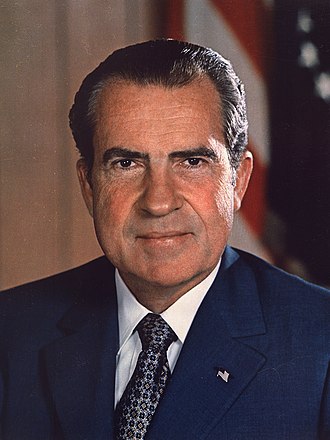
Richard M. Nixon served as the 37th President of the United States from January 1969 until his resignation in August 1974. In February 1971, he ordered the installation of a secret voice-activated taping system in the White House to preserve a historical record of his administration. Until the system's existence was revealed and dismantled in July 1973, the tapes captured Nixon directing major foreign policy initiatives, such as the opening to China, as well as his central role in the Watergate cover-up.
What Nixon talks about on the tapes
White House operations 4,718Presidential scheduling 2,225Public relations 1,784Presidential schedule 1,782Vietnam War 1,693Logistics 1,650Manolo Sanchez 1,626White House communications 1,400White House administration 1,399Presidential communication 1,243Henry Kissinger 1,191Foreign Policy 1,183
Conversations (21,010)
— Page 48 of 211President Nixon met with his personal valet, Manolo Sanchez, in the Old Executive Office Building to discuss personal refreshments. During the brief encounter, the President requested that tea be prepared. No significant policy matters were addressed during this short, informal interaction.
President Nixon instructed the White House operator regarding the handling of an incoming call, specifying that the caller should not be told to wait or step away. He emphasized that the matter was neither urgent nor important, opting to defer his response until later that day or the following day. This brief administrative interaction illustrates the President's protocol for managing his communication flow and scheduling priorities.
President Nixon directs H. R. Haldeman to initiate a telephone call immediately. The brief exchange centers on managing the President's schedule and prioritizing a specific outreach effort. No further substantive policy matters are addressed in the recording.
President Nixon consulted with a White House operator to facilitate contact with Daniel Patrick Moynihan. The brief exchange focused on determining Moynihan's current location, as the President sought to reach him at either the United Nations or Harvard University. No substantive policy discussions occurred during this logistics-oriented call.
In a wide-ranging series of discussions, President Nixon consults with H. R. Haldeman, Daniel P. Moynihan, John N. Mitchell, and Arthur F. Burns on domestic political strategy and the management of sensitive public narratives. Key topics include the limits of social policy, the political implications of intelligence testing, and defensive tactics against hostile press coverage involving Charles Rebozo and Ramona Banuelos. The President explicitly directs Mitchell to use Immigration and Naturalization Service (INS) enforcement powers against political adversaries, specifically targeting the Los Angeles Times and various Democratic-aligned interests to neutralize criticism.
President Nixon and Daniel P. Moynihan discussed a wide range of sensitive topics, including racial differences in intelligence and governance, social policy, and the efficacy of government education programs. Nixon emphasized his belief that while certain inherent differences might exist between groups, a leader must publicly project a commitment to equal opportunity to avoid fueling social discord. The two also addressed the crisis in East Pakistan, with Nixon requesting Moynihan’s continued analysis, and touched upon upcoming diplomatic efforts and the status of various administration legislative initiatives.
President Nixon instructed the White House operator to connect him via telephone to Attorney General John N. Mitchell. The brief exchange served as a logistical request to initiate a direct line of communication with the Attorney General. No substantive policy matters were discussed during this connection attempt.
President Nixon instructed Attorney General John Mitchell to launch an aggressive investigation into the Los Angeles Times for potential immigration violations, specifically regarding the hiring of undocumented workers. Targeting publisher Otis Chandler, Nixon demanded a review of Chandler's personal staff to see if his gardener was an undocumented immigrant. The President emphasized that he wanted this directive carried out immediately and expected a formal report on the findings.
President Nixon contacted the White House operator to facilitate an urgent telephone connection with Attorney General John N. Mitchell. The brief exchange served as a routine administrative request to bridge communication between the President and the Department of Justice. No further substantive policy matters were discussed during this operator-assisted routing call.
President Nixon directs Attorney General John Mitchell to purge specific personnel within the Immigration and Naturalization Service, specifically demanding the immediate removal of Rosenberg for unauthorized media appearances and challenging the loyalty of Raymond F. Farrell. Nixon expresses frustration over leaks regarding his San Clemente property and demands stricter bureaucratic discipline to counter political opposition. Furthermore, the President informs Mitchell that he has instructed Treasury Secretary John Connally to initiate income tax investigations against the Chandler family and those targeting Billy Graham.
President Nixon and Federal Reserve Chairman Arthur Burns discuss the communication strategy and implementation details for Phase II of the administration's economic program. They coordinate on messaging regarding interest rates and dividends, with Nixon emphasizing that Burns' involvement is essential to provide the necessary moral authority and impact. They further agree on the necessity of requesting standby controls from Congress to preempt political pressure from legislators like Wright Patman and John McClellan.
President Nixon contacted the White House operator to request a telephone connection with First Lady Pat Nixon. The brief interaction served solely as a functional bridge to facilitate personal communication between the President and his wife. No policy matters or administrative decisions were addressed during this exchange.
President Richard Nixon and First Lady Pat Nixon coordinate their respective schedules, specifically focusing on upcoming social obligations and White House church services. The President decides to bypass a wedding reception for Helen Thomas to avoid excessive public exposure, delegating the attendance to their daughter Tricia and her husband, Edward Cox. Additionally, they discuss streamlining the receiving line protocols for future church services to manage the President's time more efficiently.
President Nixon contacted the White House operator to initiate a telephone call to speechwriter William L. Safire. The interaction served as a logistical bridge to connect the President with his aide for an unspecified purpose. No further substantive discussion occurred during this brief request.
President Nixon consulted with William Safire to check on the progress of a draft for an upcoming Phase II economic policy speech. Safire confirmed that the document was in the final stages of proofreading and would be delivered to the President immediately. Nixon emphasized the urgency of the delivery to ensure he received the materials in a timely manner.
President Nixon contacted the White House operator to place an outgoing call to speechwriter William L. Safire. The brief interaction served exclusively as a procedural request to initiate this communication. No further substantive policy matters or decisions were discussed during this exchange.
President Nixon interacts with a White House operator to facilitate a telephonic connection. This brief exchange serves as the logistical precursor to a subsequent, separate conversation. No substantive policy discussions or administrative decisions occur during this brief technical interaction.
President Nixon and speechwriter William Safire discussed the strategic presentation of correspondence to the press to maximize political impact. The President instructed Safire to prioritize the core message by selectively withholding certain letters or texts to ensure the administration's narrative remains clear and compelling. This meeting focused on refining media management techniques to control public perception and avoid potential dilution of the President's key talking points.
President Nixon and speechwriter William Safire discuss the strategy for an upcoming Phase II economic speech, specifically focusing on how to manage the release of accompanying letters to the press. Nixon instructs Safire to withhold the letters from the prepared text to maintain a spontaneous appearance, preferring they emerge as a secondary story. Regarding a report from George Shultz on labor cooperation, Nixon decides against including a reference to George Meany’s support, choosing instead to let labor leaders speak for themselves to avoid potential public contradiction.
President Nixon directs the White House operator to place an outgoing call to speechwriter William L. Safire. The brief interaction serves solely as a logistical request to initiate contact with Safire. No further substantive policy discussions occur during this exchange.
President Richard M. Nixon and speechwriter William L. Safire reviewed a draft of the President's upcoming Phase II speech concerning economic policy. They focused on refining specific phrasing regarding the anti-inflation campaign, specifically debating the phonetic clarity and rhetorical impact of the words "launched" versus "began." Ultimately, they agreed to replace "launched" with "began" to improve the delivery and flow of the opening line.
President Nixon instructed the White House operator to intercept an outgoing call being placed by an unidentified woman. The President’s urgent directive to halt the connection suggests an immediate need to prevent or redirect the communication. No further substantive dialogue was recorded during this brief interaction.
President Nixon and speechwriter William Safire review and refine the wording of a presidential address concerning economic policy. They focus specifically on improving the rhetoric regarding the administration's "battle against inflation." The brief exchange concludes with an agreement to use the phrasing "we launched this battle" to emphasize the government's commitment to winning the fight against rising prices.
President Nixon contacted the White House operator to place a telephone call to speechwriter William L. Safire. The conversation was purely procedural, serving as a brief request to facilitate communication between the President and his aide. No substantive policy discussions or decisions occurred during this brief interaction.
President Nixon interacts with the White House operator to facilitate a telephonic connection. This brief exchange serves as the administrative lead-in to a subsequent conversation, identified as Conversation 10-130. The recording captures the functional process of White House switchboard operations during the President's work day.
President Nixon and speechwriter William Safire discuss refinements to the upcoming Phase II economic policy speech, specifically focusing on the language surrounding wage and price controls. They agree to replace the phrase "inflationary pressures ease up" with "brought under control" to project a stronger message. Furthermore, Nixon decides to ad-lib a statement emphasizing his commitment to ending these government controls as soon as they are no longer necessary to prevent them from becoming a permanent fixture of American life.
President Nixon and speechwriter William Safire consult on the phrasing of an upcoming public address regarding economic policy. They focus on refining language concerning wage and price controls to ensure the public understands these measures are temporary rather than a permanent feature of American life. Nixon emphasizes the political and economic necessity of framing the controls as a limited intervention that will be dismantled once inflationary pressures are resolved.
President Nixon instructed the White House operator to terminate a pending telephone call. This brief exchange reflects the President's administrative oversight regarding his outgoing communications. No substantive policy matters were discussed, and the call was successfully cancelled per his request.
President Nixon interacted with a White House operator to facilitate an outgoing call. The brief exchange focused on establishing a telephonic connection to another party. No substantive policy discussions occurred during this transition.
President Nixon held a brief, procedural interaction with a White House operator to facilitate an outgoing call. The conversation served primarily as an administrative bridge to connect the President to another party. No substantive policy discussions or significant decisions were recorded during this exchange.
President Nixon contacted the White House operator to place a personal telephone call to Marjorie P. Acker. This brief administrative exchange served solely to facilitate a connection with the requested individual. No further policy or political discussions occurred during the brief communication.
President Nixon calls Marjorie P. Acker to coordinate a brief meeting at the White House. The discussion centers on the review and integration of specific text edits and inserts into a draft document Acker has prepared. Acker agrees to bring her annotated copy to the President's office to finalize the revisions.
President Nixon met briefly with Marjorie P. Acker to coordinate the delivery of personal documents. The discussion centered on Acker bringing copies of specific materials for the President's review. The interaction concluded with Nixon expressing his intent to use his private telephone line to address personal matters.
President Nixon consulted with speechwriter William Safire regarding the drafting of an upcoming speech on Phase II economic policies. The discussion centered on the political risks of incorporating a proposed phrase about "price reduction psychology" and "windfall profits" to combat inflation. Fearing that opponents and labor unions might weaponize the language, Nixon and Safire ultimately decided to adopt a more ambiguous, "fuzzier" presentation for the address.
President Nixon met with speechwriter William Safire to refine a public statement regarding inflation, economic policy, and public support for his administration. Nixon emphasized the need to address the psychology of rising prices, specifically suggesting that the rhetoric should include a call for price reductions on "windfall" goods. The conversation focused on balancing the messaging to acknowledge the economic frustrations of the American public while maintaining a positive tone about the administration's goals.
President Nixon met with his personal valet, Manolo Sanchez, in the Old Executive Office Building. The recording is extremely brief and consists of an undefined interaction between the two men. No substantive policy discussions or significant historical developments are documented in this segment.
President Nixon held a brief, informal meeting with an unidentified individual in his Old Executive Office Building workspace. The interaction lasted only eight seconds and involved limited, non-substantive dialogue in Italian regarding a potential invitation or request. No significant policy discussions, administrative decisions, or political developments were recorded during this brief encounter.
President Nixon met with his personal valet, Manolo Sanchez, to discuss a brief, undefined request. The interaction was short and lacks significant political or administrative substance, serving primarily as a routine exchange between the President and his staff member. No major policy decisions or executive actions resulted from this brief encounter.
President Nixon and H. R. Haldeman met to coordinate the President's upcoming schedule, including appointments with F. Edward Hebert and Cabinet members. The discussion shifted toward political strategy, specifically addressing polling, public reaction to Phase II wage and price controls, and the need to overhaul the bureaucracy. Nixon also directed Haldeman to instruct John Dean to aggressively use the IRS to investigate the Los Angeles Times, citing his desire to retaliate against the publication's perceived bias.
President Nixon rehearses a televised address to the nation regarding his New Economic Policy and the progress of the ongoing wage-price freeze. He emphasizes the success of the anti-inflation measures, citing declines in wholesale and industrial commodity prices, and advocates for prompt Senate action on his tax incentive bill. The speech aims to bolster public support by highlighting grassroots cooperation and the necessity of sacrifice to ensure national economic stability.
President Nixon met with Alexander Butterfield, Oliver Atkins, and Marjorie Acker to coordinate a photo opportunity intended for a Newsweek feature story. Nixon directed Atkins to capture candid images of him working on a speech to serve as the lead photograph for the upcoming press coverage. The brief meeting concluded once the necessary arrangements for the portrait session were finalized.
President Richard M. Nixon met with his personal valet, Manolo Sanchez, in the Old Executive Office Building. The brief interaction focused on the President's personal request for tea. No other substantive policy or administrative matters were recorded during the short duration of the meeting.
President Nixon rehearsed his televised address regarding Phase II of his economic stabilization program. He emphasized the necessity of continued cooperation between labor, business, and government to combat inflation following the expiration of the initial 90-day wage-price freeze. The rehearsal confirmed his decision to implement a Price Commission composed of private citizens to oversee wage and price restraints.
President Nixon and his valet, Manolo Sanchez, discussed logistical arrangements for the President's upcoming trip to Camp David and West Virginia. Sanchez confirmed the travel schedule and arrival times while briefing the President on plans involving Julie Nixon Eisenhower and David Eisenhower. The discussion focused primarily on coordinating departure times and confirming the necessary preparations for the presidential transport.
President Nixon and Henry Kissinger met to coordinate strategy regarding upcoming announcements on Vietnam troop levels and the diplomatic implications of Nixon’s planned trip to the People's Republic of China. The discussion focused on carefully timing these announcements to maximize political impact and maintain public confusion regarding administration objectives. Additionally, they explored the logistics of hosting a potential European summit in Washington, D.C., and touched upon diplomatic communications involving Pakistan and the USSR.
President Richard Nixon met in the Old Executive Office Building to rehearse a televised address to the nation regarding his administration's economic policies. The speech focused on the effectiveness of his wage and price control program, the role of the Pay Board and Price Commission, and the necessity of voluntary cooperation to combat inflation. Nixon outlined his strategy for achieving economic prosperity and full employment while signaling his intent to seek legislative extensions for his stabilization authorities.
President Nixon held a brief, informal meeting with his longtime personal valet, Manolo Sanchez, in the Old Executive Office Building. The recording captures a short exchange that primarily serves as a personal interaction between the President and a member of his domestic staff. No policy discussions or significant political decisions were recorded during this brief encounter.
President Nixon and speechwriter William Safire reviewed final revisions for a major upcoming address concerning the administration's Phase II economic policies. The discussion focused on refining specific phrasing regarding wholesale prices and business cost-savings to ensure the message was clear and firm for the public. Nixon emphasized that the policy must apply equitably across all sectors and expressed indifference toward potential short-term volatility in the stock market, which he characterized as neurotic.
President Nixon and speechwriter William Safire review a draft text, likely an upcoming presidential address regarding economic policy. The President emphasizes the need for brevity to maintain audience engagement while debating the effectiveness of price-cutting strategies. Nixon expresses optimism that his economic initiatives will stabilize inflation and stimulate gradual job growth and market recovery.
President Nixon contacted the White House operator to facilitate a telephone call to Clark MacGregor. The brief exchange served as an administrative request to connect the President with his Congressional Relations director. No further policy discussions occurred during this specific interaction.
President Nixon rehearsed a public address detailing his administration's economic policy for Phase II of his wage and price control program. He outlined the roles of the Price Commission, the Pay Board, and the Committee on Interest and Dividends in curbing inflation while maintaining voluntary cooperation. The President requested that Congress extend the Economic Stabilization Act to provide the legal authority necessary to enforce these economic policies.
President Nixon initiates a brief interaction with the White House operator to request a break in telephone operations. This short exchange serves as a routine administrative request regarding the management of the President's incoming call line. No substantive policy matters or major political decisions were addressed during this brief communication.
President Nixon and Clark MacGregor discuss the administration's recent legislative successes, specifically a Senate vote on federal pay and House passage of a tax bill, which serve as positive momentum for the upcoming Phase II economic policy announcement. The President outlines his strategy for an upcoming meeting with Senator Russell Long to expedite tax legislation and pressure the Senate to act more decisively on his broader domestic agenda. MacGregor confirms his plans to attend a Midwest Republican Conference in Indiana, where he will promote the administration’s legislative programs and the President's vision for government reform.
President Nixon met with Clark MacGregor to commend him for recent legislative successes and to coordinate messaging strategy ahead of an upcoming presidential speech. The discussion touched on the importance of highlighting economic performance and framing the administration's agenda as a historic era of reform. Nixon also provided guidance on handling specific legislative priorities, including revenue sharing and welfare reform, while preparing for an upcoming meeting with Senator Russell Long.
President Nixon contacted the White House operator to request a telephone connection with Charles W. Colson. This brief administrative exchange served solely to facilitate communication between the President and his special counsel. The interaction concluded once the operator acknowledged the request to initiate the call.
President Nixon rehearsed a nationally televised address outlining the next phase of his economic policy following the conclusion of the initial 90-day wage and price freeze. He detailed the establishment of a Price Commission and a Pay Board to implement voluntary restraints backed by legal authority, aiming to combat inflation while fostering economic growth. The speech served to build public support for these stabilization measures and signaled the administration's ongoing commitment to achieving full employment and price stability.
President Nixon initiates a request through the White House operator to be connected with Charles W. Colson. The brief exchange serves as a logistical coordination for the President to communicate directly with his Special Counsel. No further substantive policy matters or decisions are documented in this specific audio segment.
President Nixon and Charles Colson reviewed the administration's political and economic momentum ahead of a televised address regarding the Phase II transition of his New Economic Policy. They discussed the positive impact of Nixon's recent decision to invoke the Taft-Hartley Act in response to the West Coast dock strike and noted favorable polling trends indicating strong public support for the administration's inflation-fighting measures. Colson also updated the President on efforts to politicize recent comments made by Senator Edward Kennedy and confirmed that they were successfully managing expectations for the upcoming wage and price restraint program.
President Nixon and Charles Colson discuss political strategy, focusing on public support for the administration's economic policies and the labor front. They review the declining poll numbers of potential Democratic challenger Edmund Muskie and analyze the effectiveness of using constituent letters to bolster the President's upcoming speech on inflation. The conversation concludes with a focus on maintaining messaging control and political momentum in anticipation of further congressional and public engagement.
President Nixon met with his personal valet, Manolo Sanchez, to issue brief logistical instructions regarding the handling of presidential property. The primary purpose of the interaction was for Nixon to direct Sanchez to transport a specific briefcase to the White House residence. This short exchange highlights the routine administrative support provided by staff to manage the President’s personal and professional materials.
President Nixon met with bipartisan Congressional leadership to outline his post-freeze economic program and announce plans for an upcoming summit in Moscow. He detailed the formation of a tripartite Pay Board, a Price Commission, and a committee on interest and dividends to maintain economic stability through a mix of voluntary cooperation and necessary sanctions. Additionally, the President briefed the leaders on the status of international monetary negotiations and his strategic approach to the May 1972 summit with Soviet leadership regarding arms control and trade.
President Nixon held a meeting in the Cabinet Room with an unidentified individual to discuss scheduling matters. Due to the lack of a transcript and the sudden cutoff of the recording, the specific nature of the agenda remains undocumented. No definitive policy decisions or developments were captured during this brief recorded segment.
President Richard Nixon met with his staff to rehearse and refine a nationally broadcast speech regarding the second phase of his New Economic Policy. The discussion focused on strategies to combat inflation and unemployment, specifically outlining the transition from a 90-day wage and price freeze to a new, more flexible regulatory framework. Nixon emphasized the need for bipartisan support and public cooperation to ensure the success of these economic stabilization programs as the administration prepared to roll out its long-term strategy.
President Nixon rehearsed a televised address outlining the administration's economic policy following the conclusion of the initial 90-day wage and price freeze. He detailed the creation of a Price Commission and a Pay Board to manage ongoing voluntary restraints on wages, prices, and interest rates. The speech served to articulate the transition to Phase II of his economic program and to solicit public cooperation in the effort to curb inflation.
President Nixon held a brief meeting in the Old Executive Office Building with an unidentified individual to discuss scheduling matters. The discussion centered on an incoming request for a formal meeting. No further substantive details regarding the nature of the request or the identity of the participant were recorded.
President Nixon instructed the White House operator to contact Charles W. Colson to request his immediate presence at the Executive Office Building. The brief exchange served as an administrative directive to coordinate a meeting with a key aide. No further policy or strategic matters were addressed during this interaction.
President Nixon initiated a call to the White House operator to facilitate a connection with speechwriter and advisor William L. Safire. This administrative interaction served as a logistical step to reach a key member of the White House staff. No further substantive dialogue occurred during this brief exchange.
President Nixon consulted with the White House operator to facilitate a telephonic connection with Charles W. Colson. The interaction served as a logistical step to initiate a private consultation between the President and his special counsel. No substantive policy discussions were recorded during this brief exchange.
President Nixon met with H. R. Haldeman and Charles Colson to coordinate the announcement of Donald Rumsfeld's new role as director of operations for the Cost of Living Council. The group also collaborated with William Safire on speech drafts and messaging regarding favorable economic indicators, specifically focusing on declining industrial and wholesale prices. Throughout the discussion, the President emphasized the importance of framing these economic developments positively to build public confidence in his administration's policies.
President Nixon and speechwriter William Safire consult on the specific language for an upcoming economic address, focusing on the historical significance of a decline in industrial prices. Nixon insists on characterizing the drop as a seven-year first to maximize the rhetorical impact, explicitly instructing Safire to omit technical caveats like seasonal adjustments. Additionally, they discuss the inclusion of a short passage requested by Donald Rumsfeld, with Nixon agreeing to incorporate a brief five-word mention to satisfy Rumsfeld’s concerns.
President Nixon contacted the White House operator to facilitate a telephone connection with his Chief of Staff, H.R. Haldeman. This brief administrative interaction served as a logistical step to initiate a direct line of communication between the President and his top aide. No substantive policy matters were discussed during this request for assistance.
President Nixon rehearsed his televised address to the nation regarding the next phase of his administration's economic policy. He outlined plans to transition from the initial 90-day wage and price freeze to a system of long-term economic stabilization, including the establishment of a Price Commission and a Pay Board. The speech emphasized the need for continued voluntary cooperation from the public while warning that the government would enforce compliance to ensure long-term stability and curb inflation.
President Richard Nixon met with his personal valet, Manolo Sanchez, in the Old Executive Office Building. The brief interaction, which included a segment of withheld personal material, primarily functioned as a private exchange between the President and his longtime staff member. No substantive policy discussions or major administrative decisions were recorded during this brief visit.
President Nixon held a private meeting in the Old Executive Office Building with an unidentified individual. Given the lack of a transcript and the absence of specific recorded details, the substance of their discussion remains classified or undocumented. Consequently, no specific policy decisions or action items can be attributed to this particular encounter.
President Richard Nixon met with his longtime valet, Manolo Sanchez, in the Old Executive Office Building for a brief personal interaction. While the specifics of their discussion remain restricted due to the withdrawal of the recorded material, the exchange serves as an example of Nixon’s routine administrative and personal engagement with his domestic staff. No formal policy decisions or government business were documented during this short encounter.
President Nixon rehearsed his televised address to the nation regarding the next phase of his economic policy following the initial 90-day wage and price freeze. He outlined the creation of a Price Commission and a Pay Board to oversee continued economic stabilization while soliciting bipartisan support from Congress for the extension of the Economic Stabilization Act. The rehearsal session served to refine the administration's messaging on inflation control, voluntary cooperation, and the appointment of Donald Rumsfeld to lead the Cost of Living Council operations.
President Nixon met with Ronald Ziegler and television production staff in the Oval Office to coordinate technical preparations and staging for a nationally televised address. Following these adjustments, Nixon delivered a speech focused on his administration's economic policies, specifically outlining the transition to the next phase of wage and price controls. The conversation concluded with post-broadcast feedback and logistics involving the technical crew.
President Nixon and H. R. Haldeman reviewed the positive initial public and political reception of the President's latest economic speech. They discussed the effectiveness of using personal letters to humanize the administration's economic policies, with the President specifically directing Haldeman to incorporate more such testimonials into future communications. The conversation also touched upon the strategic political handling of wage and price controls, upcoming legislative efforts, and the President's public presentation, including his choice of wardrobe for the televised address.
President Nixon instructed the White House operator to intercept and hold all incoming telephone calls until 8:45 pm. This directive served to secure a period of uninterrupted time for the President during the evening. No other substantive political or administrative matters were discussed during this brief exchange.
President Nixon instructed the White House operator to place a telephone call to speechwriter William L. Safire. The exchange served exclusively as a procedural request to initiate communication with a member of the President's staff. No further substantive discussion took place during this brief interaction.
President Nixon and William Safire discuss the positive reception and communication strategy following the President’s recent economic address. Nixon emphasizes the importance of using anecdotal stories from constituent letters to connect with the public, arguing that personal narratives are more effective than abstract policy discussions. The two reflect on favorable press coverage and the necessity of mobilizing public opinion to support the administration's economic program.
President Nixon contacted the White House operator to place a personal telephone call to his close friend and confidant, Charles G. "Bebe" Rebozo. The interaction served solely as a logistical request to facilitate the connection between the President and Rebozo. No other policy matters or administrative business were discussed during this brief communication.
President Nixon initiates a brief telephonic request through the White House operator to reach his Chief of Staff, H.R. Haldeman. The exchange serves solely as a logistical bridge to facilitate direct communication with a key advisor. No substantive policy discussions or decision-making occurs during this connection attempt.
President Nixon instructed the White House operator to contact him once H. R. Haldeman arrived at his destination. The brief exchange served to coordinate communication channels between the President and his Chief of Staff. No further policy or strategic matters were discussed during this connection.
President Nixon contacted the White House operator to facilitate a telephone connection with his special counsel, Charles W. Colson. The brief exchange served exclusively as a logistical step to initiate the communication between the President and his aide. No substantive policy discussions or decisions occurred during this brief request for assistance.
President Nixon initiated a call to reach H. R. Haldeman regarding his personal schedule but rescinded the request upon learning that Haldeman was attending a concert. The President instructed the operator not to interrupt him or facilitate a return call, effectively canceling the effort to reach his Chief of Staff. This brief interaction concludes without any substantive policy discussion or administrative action.
President Nixon and Charles Colson spoke shortly after Nixon delivered a nationally televised address outlining his Phase II economic controls. Colson relayed positive feedback from various observers, including pollster Louis Harris and Senator Barry Goldwater, who praised the President’s display of decisive leadership and strength. They also discussed the effective use of personal letters in the speech to humanize the administration's economic policies and briefly addressed the President's interest in potentially making a surprise visit to a concert at the Kennedy Center.
President Nixon held a brief telephone conversation with his close confidant Charles G. "Bebe" Rebozo. The interaction consists entirely of withdrawn material designated as personal and returnable. Consequently, no substantive policy discussions, political developments, or action items are available for historical analysis.
President Nixon and Charles Colson discuss potential evening entertainment options at the Kennedy Center. Colson clarifies the scheduling of Eugene Ormandy’s performance at Constitution Hall and identifies the current acts at the Kennedy Center, specifically the Alvin Ailey Dance Theatre and the Chamber Orchestra of Mexico City. Nixon expresses skepticism regarding the appeal of the current Kennedy Center programming, prompting Colson to offer to conduct further research on the events.
President Nixon initiated a brief telephone communication through the White House operator to contact evangelist William F. “Billy” Graham. The primary purpose of this interaction was to facilitate a direct conversation between the President and Graham. No further substantive policy matters or decisions were recorded during this brief connection attempt.
President Richard Nixon and Billy Graham discuss the President's recent public performance and the political fallout surrounding a press story targeting Charles "Bebe" Rebozo. The conversation touches upon the President's upcoming trip to West Virginia and the inclusion of Treasury Secretary John Connally in future travel plans. Graham also seeks assurance regarding the content of remarks he intends to make about his relationship with the President, which Nixon encourages him to deliver without prior vetting.
President Nixon initiates a brief telephone exchange with the White House operator to request a connection to Charles W. Colson. This administrative interaction serves as a routine coordination effort to facilitate direct communication between the President and his special counsel. No further substantive policy matters were discussed during this brief request.
President Nixon and Charles Colson discuss a military band concert being held at the Kennedy Center, prompted by conflicting reports regarding the event's nature and media coverage from the Washington Post. Nixon directs Colson to verify the event's dress code and private status, expressing potential interest in attending the end of the performance if appropriate. Colson agrees to investigate the details immediately and report back to the President.
President Nixon and Charles Colson discuss the logistics of the President’s last-minute attendance at a performance by the Interservice Symphonic band at the Kennedy Center. Colson provides details regarding the dress code and composition of the audience to ensure the President feels comfortable appearing in a business suit. Nixon ultimately decides to attend and directs Colson to notify the event organizers to hold the presidential box for his arrival within ten minutes.
President Nixon and H. R. Haldeman debriefed on the President’s recent attendance at the Kennedy Center, focusing specifically on the protocol for his theatrical arrivals. They discussed the effectiveness of coordinating his entrance to coincide with the National Anthem or musical intervals to maximize impact. Additionally, they briefly touched upon the President’s recent company in the presidential box, acknowledging the political value of hosting figures like Alexander Haig.
President Nixon held a brief, one-minute meeting with John D. Ehrlichman in the Oval Office. Due to the lack of an available transcript or audio clarity, the specific subject matter and any resulting directives remain undocumented in the historical record. This session reflects the routine, often rapid nature of executive consultation between the President and his senior staff.
President Nixon and H. R. Haldeman met to review the public and media reception of the President's recent economic speech, concluding that the coverage across major television networks was unexpectedly positive. They discussed the administration's ongoing negotiations with labor leader George Meany regarding the structure of the Wage Board and the Cost of Living Council, with Nixon expressing frustration over Meany's opposition and considering whether to proceed without labor union cooperation. The conversation also touched upon logistical preparations for upcoming travel to West Virginia and the scheduling of events at Camp David for visitors.
President Nixon met with John Mitchell and John Ehrlichman to discuss high-level personnel and policy matters, specifically focusing on potential Supreme Court nominees, school busing legislation, and tensions regarding FBI Director J. Edgar Hoover. The group evaluated candidates such as Robert C. Byrd and Howard H. Baker Jr., while also debating the merits of a constitutional amendment versus legislative action to address court-ordered busing. Additionally, the President and his advisors addressed the secure handling of sensitive files related to the Pentagon Papers investigation and contemplated how to manage Hoover’s increasingly difficult tenure.
President Nixon met with Charlotte T. Reid and her family, along with several officials including Donald Rumsfeld and Dean Burch, to conduct a swearing-in ceremony for Reid. During the proceedings, the President offered formal congratulations and presented gifts to commemorate the occasion. Nixon also took the opportunity to explain his rationale for Reid's appointment, emphasizing that it was based on merit and capability rather than gender.
President Nixon met with Alexander Butterfield to discuss the logistics of an upcoming engagement involving CIA Director Richard M. Helms. The brief exchange focused on coordinating the Director's return and ensuring the administration's readiness for a significant, unspecified event. The conversation emphasizes the President's reliance on Butterfield to manage the sensitivities and execution of this task.