O'Neill, Thomas P. ("Tip"), Jr.
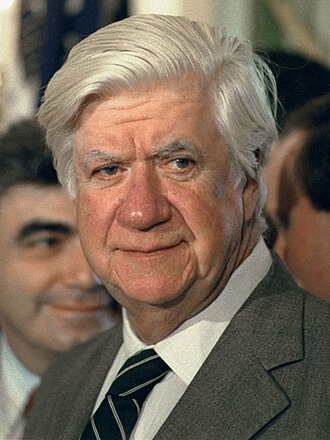
Thomas P. "Tip" O'Neill, Jr., a Democratic Congressman from Massachusetts, served as the House Majority Whip starting in January 1971. In this role, he was a key figure in the Democratic leadership. In January 1973, he transitioned to the position of House Majority Leader. As Majority Leader, O'Neill became one of the most prominent Democrats in the House to advocate for the impeachment of President Richard Nixon in relation to the Watergate scandal.
President Nixon met with Vice President Agnew and a bipartisan group of Congressional leaders to announce a significant diplomatic breakthrough in the Strategic Arms Limitation Talks (SALT). Nixon informed the attendees of a forthcoming joint statement with the Soviet Union pledging to focus on limiting anti-ballistic missile (ABM) systems and certain offensive strategic weapons. While some lawmakers advocated for immediate unilateral U.S. defense cuts to demonstrate good faith, the President and his advisors successfully urged the leaders to maintain existing defense programs during the negotiations to avoid losing vital bargaining leverage.
President Nixon met with John Ehrlichman and George Shultz to discuss strategies for addressing the persistent West Coast dock strike and the administration's public posture toward labor unions. They evaluated the political necessity of firm rhetoric and potential legislative action, including an arbitration bill, while managing the logistical challenges of upcoming budget messaging and the appointment of Peter Peterson to the Commerce Department. The discussion also addressed the administration's broader concerns regarding the State Department's performance, foreign policy negotiations, and the need to mount a more aggressive political defense against Democratic challengers like Edward Kennedy.
President Nixon held a brief, informal call with House leaders Hale Boggs, Gerald Ford, and Tip O'Neill to coordinate the logistics of his upcoming State of the Union address. The participants discussed the President's plan to deliver a live address on Thursday combined with a supplementary written message to keep the presentation concise. The conversation also included lighthearted banter regarding the recent Super Bowl and a joking remark about the lack of presidential candidates within the House compared to the Senate.
President Nixon, Tip O'Neill, and Gerald Ford discuss the imminent adjournment of Congress and the formal notification process required. The President invites O'Neill, Ford, and Speaker Carl Albert to the White House for an informal meeting and coffee later that afternoon. Nixon tasks his aide, William Timmons, with coordinating the logistics of this meeting based on the progress of the Senate's final activities.
President Nixon and Tip O'Neill discussed scheduling logistics for an upcoming meeting involving House leadership. Nixon coordinated with O'Neill to have staff finalize timing and ensure the Speaker of the House would be present for the session. The brief interaction concluded with plans to communicate further details through White House staff once the schedule was confirmed.
President Nixon held a brief, informal call with newly elected Democratic majority leader Tip O'Neill and Representative Gerald Ford to congratulate O'Neill on his new role. The conversation served to coordinate the congressional schedule, specifically confirming upcoming bipartisan breakfast meetings and attendance at both Hale Boggs' funeral and Harry S. Truman's memorial service. Additionally, the President clarified his intent to deliver the State of the Union as a written message rather than a formal address to Congress, citing the proximity to his second inaugural address.
President Nixon met with House Majority Leader Tip O'Neill and House Minority Leader Gerald Ford to foster rapport and discuss upcoming legislative agenda items. The President informed the congressional leaders of his decision to prioritize his inaugural address over a traditional State of the Union address to avoid redundant messaging. Nixon extended an invitation to both men for a follow-up breakfast meeting to further coordinate on the administration's legislative priorities.
President Nixon met with bipartisan Congressional leadership, Vice President Agnew, and Henry Kissinger to discuss the imminent Vietnam peace settlement and the subsequent withdrawal of U.S. forces. The participants reviewed key provisions of the agreement, including cease-fire terms, the release of prisoners of war, and the complexities surrounding continuing conflicts in Laos and Cambodia. Nixon coordinated with the congressional delegation regarding the distribution of briefings to broader legislative members and finalized plans for his public address announcing the agreement.
President Nixon met with Vice President Agnew and a bipartisan group of Congressional leaders to outline the administration's proposed foreign trade legislation. The discussion focused on securing presidential authority to negotiate trade agreements, implementing safeguards for domestic industries, and establishing pension and unemployment insurance reforms. Nixon emphasized the necessity of shifting away from a 'one-way street' trade policy to protect American workers and leverage better terms with international partners, while urging caution against attaching human rights conditions to Most Favored Nation (MFN) status for the Soviet Union to avoid jeopardizing broader diplomatic and arms control initiatives.
President Nixon met with Vice President Agnew and a bipartisan group of Congressional leaders to address the nation's growing energy needs and proposed legislative solutions. The discussion focused on mitigating potential future shortages by balancing environmental protections with domestic production efforts, including natural gas deregulation, expanded offshore oil leasing, and the completion of the Alaska pipeline. The President and his cabinet members emphasized the importance of developing a cohesive national energy strategy to maintain independence and discussed the foreign policy implications of relying on foreign oil exports. The administration sought Congressional cooperation for pending energy legislation and signaled an intent to increase research and development funding for alternative fuel sources like coal and nuclear power.
President Nixon met with Vice President Agnew, Secretary of State Rogers, USAID Administrator John A. Hannah, and a bipartisan group of Congressional leaders to secure support for the administration's foreign aid and security assistance requests. The discussion covered the implementation of the Nixon Doctrine, the strategic importance of military and development aid to maintain stability in Southeast Asia, the Middle East, and Latin America, and the necessity of burden-sharing with allies. Nixon emphasized that maintaining U.S. strength and diplomatic engagement was vital for ongoing negotiations regarding arms reduction and global peace, warning against unilateral reductions that could weaken the U.S. negotiating position.
President Nixon met with Vice President Agnew, cabinet members, and a bipartisan group of Congressional leaders to announce an upcoming economic policy address and discuss the administration's new strategy to combat inflation. The President detailed a 60-day price freeze—excluding wages and raw agricultural products—and sought legislative assistance regarding export controls on food and gasoline supply allocations. Additionally, the President arranged for key Congressional leaders to receive ongoing briefings from administration officials during the upcoming summit with Soviet leader Leonid Brezhnev to ensure better oversight of the resulting agreements.