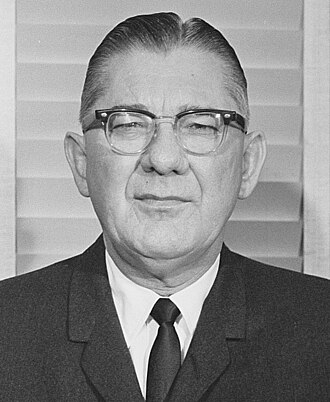
Mills, Wilbur D.
During the Nixon administration, Wilbur D. Mills served as a Democratic U.S. Representative from Arkansas and the highly influential Chairman of the House Ways and Means Committee. Holding these positions throughout Nixon's presidency, Mills was a central legislative figure who frequently negotiated with the White House over taxation, Social Security, and Nixon's proposed Family Assistance Plan. During the White House taping period, he also mounted a brief, unsuccessful campaign for the 1972 Democratic presidential nomination before continuing his powerful committee work.
President Nixon met with H. R. Haldeman and Rose Mary Woods to coordinate his upcoming schedule, specifically regarding the logistics of hosting Jack and Helene Drown at Camp David and managing various social engagements for the First Lady. The discussion emphasized the President's need for privacy at Camp David to prepare for a television interview and meet with Henry Kissinger. Additionally, Nixon briefly spoke by telephone with Representative Wilbur D. Mills to acknowledge a White House tour provided to Mills' family.
President Nixon met with John B. Connally and other advisors to discuss legislative strategy, particularly regarding the House of Representatives' progress on H.R. 1 and efforts to influence the Senate. Connally was identified as a key political strategist, with the President praising his ability to lobby lawmakers on issues such as Lockheed funding and to secure support from diverse coalitions. The conversation also touched upon the necessity of shaping public image and the strategic use of media appearances to strengthen the administration's political standing.
President Nixon called Representative Wilbur D. Mills to express his gratitude for the House Ways and Means Committee's progress on H.R. 1, a significant piece of welfare and tax reform legislation. The two discussed the legislative schedule for the bill, including plans for a closed rule and potential hurdles in the Senate. Nixon affirmed his commitment to personally lobby Senate leadership, characterizing the legislation as a collaborative partnership between the White House and the committee.
President Nixon met with H.R. Haldeman, Henry Kissinger, and other staff members to strategize on administration messaging, foreign policy initiatives, and political tactics. The conversation centered on managing the upcoming press conference, refining the administration's stance on drug policy by shifting focus toward youth rather than just veterans, and monitoring polling data regarding China and the United Nations. Nixon and his advisors also reviewed plans for an upcoming speech at West Point and discussed sensitive diplomatic maneuvering regarding potential summits and China-related negotiations.
President Nixon spoke with Representative Wilbur D. Mills to commend his successful efforts in passing H.R.1 through the House and to coordinate legislative strategy for the bill in the Senate. The two discussed welfare reform, including the distinction between current guaranteed welfare payments and the administration’s work-based proposal, as well as potential outreach to Governor Ronald Reagan regarding his concerns. Additionally, Nixon addressed the ongoing controversy surrounding the Pentagon Papers, emphasizing the necessity of protecting government classification systems and the importance of upholding the rule of law against unauthorized leaks.
President Nixon met with Congressman Wilbur D. Mills to commend his leadership in advancing H.R. 1, a significant piece of social welfare legislation. The two discussed legislative strategy and the necessity of maintaining a strong work requirement for benefit eligibility. Furthermore, Nixon articulated his rationale for opposing the unauthorized release of classified documents, framing the Pentagon Papers controversy as a critical issue of national security and the rule of law rather than a partisan cover-up.
President Nixon convened a meeting with Vice President Agnew and a bipartisan group of Congressional leaders to discuss the national economy and his administration's "New Economic Policy." Key topics included the wage-price freeze, investment tax credits, the international monetary situation, and an import surcharge. The discussion focused on the necessity of Congressional cooperation for implementing these measures and their potential impact on inflation, trade, and specific industries like automobiles.
President Nixon, Henry Kissinger, and various senior advisors met to discuss the escalating India-Pakistan conflict, focusing on the potential for a U.N. ceasefire, the status of American civilians, and the management of regional military actions. Concurrently, the President consulted with George H.W. Bush regarding U.N. strategy and coordinated with John Ehrlichman and Vice President Agnew on domestic legislative priorities, specifically tax bills and revenue sharing. The President also spoke with Wilbur Mills to foster a spirit of cooperation between the Administration and Congress regarding economic and tax legislation, emphasizing the need for a unified approach to ensure key bills advance.
President Nixon initiated this call to Chairman Wilbur Mills to reassure him of the administration's support following negative press coverage regarding recent tax bill compromises. The two leaders discussed strategies to foster cooperation between the White House and the Ways and Means Committee, specifically focusing on the financial relief provided to cities and counties through H.R. 1 and proposed health programs. They also coordinated legislative strategy for revenue sharing and potential Senate opposition, with Nixon emphasizing his commitment to working closely with Mills to avoid unnecessary confrontations.
President Nixon calls Congressman Wilbur Mills to commend him for securing the House passage of recent tax legislation despite opposition from George Meany and Edward B. Miller regarding the "check off" provision. Mills reports that key Senate figures, including Russell B. Long, Herman E. Talmadge, and Carl T. Curtis, have expressed confidence in the bill's prospects in the upper chamber. Nixon offers to intervene by calling senators if necessary, though both agree to monitor the situation for any signs of obstruction.
President Nixon met with Congressman Wilbur D. Mills to exchange congratulations regarding the successful passage of pending legislation, likely related to economic or tax policy. The brief discussion served to affirm their ongoing collaboration, with Mills expressing his readiness to intervene or provide further support if the legislative process requires additional executive pressure. Nixon acknowledged the congressman's contributions, solidifying the coordination strategy for the remainder of the session.
President Nixon met with a bipartisan group of Congressional leaders from the House Ways and Means Committee and the Senate Finance Committee to mark the signing of the Revenue Act of 1971. The President utilized the ceremony to praise the legislators for their cooperation in passing a responsible tax bill, contrasting it with fears that the measure would become an unmanageable 'Christmas tree' of amendments. The discussion highlighted the economic benefits of the legislation, particularly its role in job creation and the stimulation of the automobile industry following the administration's new economic program initiated in August.
President Nixon met with a bipartisan group of Congressional leaders to brief them on his recent diplomatic discussions with French President Georges Pompidou and the status of U.S. international economic policy. The conversation focused on efforts to address the global monetary crisis, the necessity of realigning exchange rates to restore the competitive position of American goods, and the importance of burden-sharing among trade partners. Nixon highlighted the recent breakthrough in negotiations with France as a critical step toward stabilizing the international monetary system and advancing domestic economic goals like job creation and inflation control.
President Nixon and John Ehrlichman met to coordinate political strategy for the 1972 reelection campaign, with a heavy emphasis on securing Pennsylvania through the support of Philadelphia Mayor Frank Rizzo. The discussion covered the importance of maintaining an ethnic, law-and-order coalition in key urban centers and utilizing damaging information about Democratic opponents to bolster the President's standing. Additionally, they addressed personnel concerns, including the management of Howard Hughes-related loan controversies and the navigation of diplomatic and economic challenges like relations with China and the Soviet Union.
President Nixon called Congressman Wilbur D. Mills to express concern regarding Mills’s recent back injury and to recommend a personal physician, Dr. W. Kenneth Riland, who also treated other prominent political figures. The two men discussed treatment options and potential scheduling for a consultation once Mills returned to Washington. During the call, Nixon also briefly conversed with Mills’s granddaughter and mother, maintaining a cordial and personal rapport.
President Nixon and Congressman Wilbur Mills coordinated legislative strategy to secure support in the Senate Finance Committee for a pending bill involving debt limits, Medicare, and welfare. Mills encouraged Nixon to convene a private, Republican-led meeting with key Senators, specifically mentioning Len Jordan and Harry F. Byrd, Jr., to build momentum while avoiding obstruction from Russell Long. The two agreed on a strategy to compromise on specific bill provisions, such as disability and widow's benefits, to ensure passage while keeping the administration's legislative team, including William Timmons and John Veneman, fully informed.
President Nixon consulted with Congressman Wilbur D. Mills to solicit praise and strategic advice regarding a recent legislative speech delivered on the House floor. Following a brief exchange of pleasantries, the two discussed coordinating a high-stakes meeting with Senate leadership scheduled for the following Thursday morning. Nixon sought to align legislative strategy while navigating the sensitive, partisan nature of the upcoming discussions with key senators.
President Nixon met with Vice President Agnew and a broad bipartisan group of Congressional leaders to outline the administration's 1974 federal budget and economic strategy. Economic advisors Herbert Stein and George Shultz presented data highlighting a strong 1972 economy and stressed the necessity of fiscal discipline to curb inflation and maintain growth. The President urged Congress to support his proposed spending ceilings, emphasizing the need to avoid the inflationary deficits experienced during the late 1960s, while briefly acknowledging progress toward a Vietnam peace settlement.
President Nixon met with bipartisan Congressional leaders, cabinet members, and staff to outline the administration’s strategy for the 1973 and 1974 federal budgets, emphasizing a commitment to avoiding tax increases. The President defended his use of impoundment to control spending and curb inflation, arguing that Congress must share the responsibility of fiscal discipline or face the political consequences of tax hikes. The discussion also addressed the economic impact of the Vietnam cease-fire, defense budget priorities, and the need for greater cooperation between the executive and legislative branches to manage spending levels.
President Nixon met with George Shultz, John Ehrlichman, and Wilbur Mills to coordinate the administration's legislative strategy regarding tax reform, foreign trade, and energy policy. The discussion focused on establishing a bipartisan approach to these initiatives, with Nixon emphasizing the need for political cooperation to advance key priorities like energy independence and trade negotiations while avoiding overly contentious tax reform proposals. The participants agreed on the importance of consulting with congressional leadership to ensure bipartisan support for upcoming legislative packages and discussed leveraging presidential bargaining authority in international trade and monetary affairs.
President Nixon and his advisors, including H. R. Haldeman and Henry Kissinger, held a wide-ranging meeting to discuss executive appointments, staff management, and domestic economic strategy. They specifically vetted candidates for the IRS, reviewed the organizational structure and personnel assignments for figures like Anne Armstrong, and strategized on maintaining public confidence in the face of inflation and price controls. Furthermore, Kissinger provided updates on diplomatic initiatives with the People's Republic of China, and the group analyzed the political impact of ongoing military developments in Laos and Cambodia.
President Nixon and Congressman Wilbur D. Mills discussed the implementation of a 15% selective tariff surcharge to address international trade imbalances and the perceived failure of the Smithsonian Agreement. Mills argued that such drastic measures were necessary to force international cooperation, noting that he planned to issue a press release to pressure the administration into adopting this stance. Additionally, the pair briefly discussed the looming risk of a domestic milk shortage and potential regulatory adjustments to fluid milk and dairy prices to prevent supply deficits.
In this meeting, President Nixon, H. R. Haldeman, and John Dean discussed strategies for managing the unfolding Watergate scandal and associated congressional investigations. They focused on ways to contain the political fallout, including potentially limiting the scope of Senator Sam Ervin's hearings and establishing a favorable narrative regarding the White House's lack of prior knowledge. Additionally, the participants reviewed legislative priorities with Wilbur Mills regarding tax and trade policy and considered the political utility of providing access to presidential records for sympathetic journalists.
President Nixon and Representative Wilbur Mills discussed legislative priorities, specifically the scheduling of Treasury Secretary George Shultz's testimony on tax reform and trade legislation. They agreed on a timeline that would have Shultz testify on taxes on April 30, followed immediately by the start of hearings on trade legislation on May 1. Nixon emphasized the urgency of trade reform to support the dollar and American jobs, while Mills proposed strategies for incentivizing foreign investment to improve the balance of payments.
President Nixon met with Vice President Agnew and a bipartisan group of Congressional leaders to outline the administration's proposed foreign trade legislation. The discussion focused on securing presidential authority to negotiate trade agreements, implementing safeguards for domestic industries, and establishing pension and unemployment insurance reforms. Nixon emphasized the necessity of shifting away from a 'one-way street' trade policy to protect American workers and leverage better terms with international partners, while urging caution against attaching human rights conditions to Most Favored Nation (MFN) status for the Soviet Union to avoid jeopardizing broader diplomatic and arms control initiatives.