Albert, Carl B.
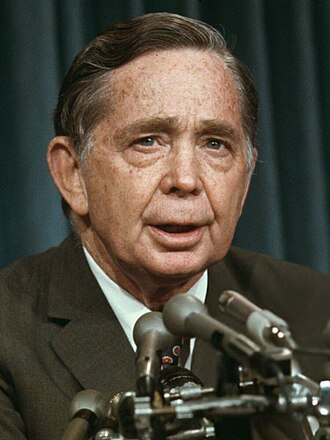
Carl B. Albert, a Democrat from Oklahoma, served as the 46th Speaker of the U.S. House of Representatives during the latter part of the Nixon administration. He assumed the speakership in January 1971, a position he held throughout the entirety of the White House taping period. During the Watergate scandal, Albert played a crucial role by referring numerous impeachment resolutions to the House Judiciary Committee. Following the resignation of Vice President Spiro Agnew in October 1973, Albert was next in line for the presidency until Gerald Ford's confirmation in December of that year.
President Nixon, H.R. Haldeman, and Ronald Ziegler met to discuss the President's upcoming schedule, including a potential press conference and public relations strategies regarding recent media coverage of his trip to Des Moines. Later, John Mitchell joined the meeting to coordinate his own upcoming press conference, specifically focusing on Revenue Sharing and the Law Enforcement Assistance Administration (LEAA). The group prioritized proposing a reorganization of U.S. Capitol Police security, using the President’s successful implementation of the Executive Protective Service as a model, which Nixon subsequently discussed with Speaker Carl Albert.
President Nixon met with key Congressional leadership, including Hugh Scott, Robert Byrd, Robert Griffin, Gerald Ford, and Carl Albert, to brief them on his upcoming televised address regarding Vietnam policy. The discussion focused on the administration's plan for troop withdrawals, the handling of the Prisoner of War (POW) issue, and the strategic rationale behind ongoing U.S. air operations in Southeast Asia. Nixon emphasized the need for flexibility in negotiations and stressed that Congressional support was essential to maintaining a credible bargaining position against North Vietnam.
President Nixon met with a bipartisan group of Congressional leaders and administration officials to propose a centralized federal office for coordinating drug abuse prevention and treatment strategies. The discussion highlighted the urgency of addressing drug addiction, particularly among servicemen in Vietnam and youth in the United States, by shifting from a fragmented, multi-agency approach to a unified, performance-based model. Participants debated the integration of law enforcement, research, and treatment programs, with an emphasis on establishing flexible, community-based solutions and securing Congressional support for new enabling legislation.
President Nixon met with H. R. Haldeman, John Ehrlichman, and Henry Kissinger to strategize their public and political response to the leak of the Pentagon Papers and the ongoing Vietnam peace negotiations. Nixon emphasized a desire to appear dignified while shifting the burden of declassification to Congress, simultaneously plotting to expose the perceived duplicity of previous Democratic administrations. The President signaled a tough stance against Senate interference, warning that if negotiations with North Vietnam were derailed, he would prioritize a military escalation over a fixed withdrawal date.
John Ehrlichman, speaking on behalf of President Nixon, contacted Speaker of the House Carl Albert to relay details from the President's recent breakfast meeting with Senator Mike Mansfield regarding the Vietnam War. The administration offered to provide Congress with 47 volumes of Vietnam reports and a 1965 Tonkin Gulf study, which remained classified while undergoing a declassification review by Secretary of Defense Melvin Laird. The participants discussed the logistical challenges of secure document storage and the necessity for joint congressional leadership to determine the appropriate distribution and oversight of these sensitive materials.
President Nixon met with bipartisan Congressional leaders and senior administration officials to discuss the sensitive diplomatic initiative concerning the normalization of relations between the United States and the People’s Republic of China. The President and Henry Kissinger briefed the group on the nature of these confidential negotiations, emphasizing the necessity of absolute discretion to ensure the process remained successful. Nixon and his team requested that participants avoid speculation and maintain a unified, non-partisan front when speaking publicly about the delicate geopolitical implications of this shift in U.S. foreign policy.
President Nixon met with a bipartisan group of Congressional leaders to discuss the progress of the 90-day wage-price freeze and to seek input on the development of Phase II economic policies. Treasury Secretary George Shultz provided an overview of the administration's administrative efforts, including the roles of the Cost of Living Council and the IRS in enforcing the freeze. The discussion centered on the need for continued cooperation across sectors—including labor, business, and agriculture—and the development of a framework for economic stabilization once the initial freeze expired.
President Nixon met with a bipartisan group of Congressional leaders and key administration officials to discuss his upcoming summit in Moscow and broader U.S. strategy regarding the Soviet Union and China. The President emphasized that his administration sought to maintain a delicate balance between the two powers without appearing to collude with one against the other. The discussion underscored the importance of bipartisan support for national defense funding and the need for diplomatic engagement to prevent escalation in volatile regions like the Middle East.
President Nixon met with a bipartisan group of Congressional leaders to brief them on his recent diplomatic discussions with French President Georges Pompidou and the status of U.S. international economic policy. The conversation focused on efforts to address the global monetary crisis, the necessity of realigning exchange rates to restore the competitive position of American goods, and the importance of burden-sharing among trade partners. Nixon highlighted the recent breakthrough in negotiations with France as a critical step toward stabilizing the international monetary system and advancing domestic economic goals like job creation and inflation control.
President Nixon initiated a brief holiday call to Speaker of the House Carl B. Albert to exchange Christmas greetings and discuss the recent passing of Representative George W. Andrews. Nixon committed to providing military aide support to Elizabeth Andrews, continuing a new procedure he had previously established for other senior officials. The two men also briefly touched upon their respective holiday schedules, including the Sugar Bowl and upcoming presidential meetings with international leaders Willy Brandt and Eisaku Sato.
President Nixon met with a bipartisan group of Congressional leaders to discuss his upcoming historic trip to the People's Republic of China. The President sought to build support for the mission, briefing the group on communication protocols with Peking and his strategy for managing the international and domestic implications of the visit. The discussion emphasized the goal of establishing a new dialogue with the PRC to foster long-term global stability and balance regional power dynamics.
President Nixon met with bipartisan Congressional leaders, administration officials, and cabinet members to advocate for a legislative moratorium on court-ordered busing to achieve racial balance in schools. Nixon argued that current judicial mandates were causing societal turmoil and urged Congress to act immediately to stop new busing orders while advancing his broader 'Equal Educational Opportunities Act.' The administration proposed a two-pronged strategy involving an immediate legislative moratorium followed by a long-term commitment to compensatory education funding to improve school quality, specifically for low-income and minority students.
President Nixon met with bipartisan Congressional leadership, Vice President Agnew, and Henry Kissinger to discuss the imminent Vietnam peace settlement and the subsequent withdrawal of U.S. forces. The participants reviewed key provisions of the agreement, including cease-fire terms, the release of prisoners of war, and the complexities surrounding continuing conflicts in Laos and Cambodia. Nixon coordinated with the congressional delegation regarding the distribution of briefings to broader legislative members and finalized plans for his public address announcing the agreement.
President Nixon met with Vice President Agnew and a broad bipartisan group of Congressional leaders to outline the administration's 1974 federal budget and economic strategy. Economic advisors Herbert Stein and George Shultz presented data highlighting a strong 1972 economy and stressed the necessity of fiscal discipline to curb inflation and maintain growth. The President urged Congress to support his proposed spending ceilings, emphasizing the need to avoid the inflationary deficits experienced during the late 1960s, while briefly acknowledging progress toward a Vietnam peace settlement.
President Nixon met with bipartisan Congressional leaders, cabinet members, and staff to outline the administration’s strategy for the 1973 and 1974 federal budgets, emphasizing a commitment to avoiding tax increases. The President defended his use of impoundment to control spending and curb inflation, arguing that Congress must share the responsibility of fiscal discipline or face the political consequences of tax hikes. The discussion also addressed the economic impact of the Vietnam cease-fire, defense budget priorities, and the need for greater cooperation between the executive and legislative branches to manage spending levels.
President Nixon and H.R. Haldeman met to discuss a wide-ranging agenda of personnel appointments, political strategy, and the ongoing Watergate investigation. Key topics included coordinating legislative strategy with Senator Howard Baker regarding the Ervin Committee hearings, managing the public image of the administration, and navigating staffing transitions within the Justice Department and the Bicentennial Commission. The President also deliberated on the handling of upcoming public appearances, potential executive privilege claims, and campaign funds, ultimately deciding to maintain a firm stance on staff loyalty and the strategic use of political assets.
President Nixon consulted with Speaker of the House Carl Albert regarding the selection of House members for future diplomatic visits to the People's Republic of China. Nixon advised Albert to coordinate closely with House Minority Leader Gerald Ford to recommend a delegation that would ensure fair and cooperative representation for the House. This conversation served to delegate the vetting process to congressional leadership, with the President pledging to facilitate the administration's approval of their choices.
President Nixon met with Vice President Agnew and a bipartisan group of Congressional leaders to outline the administration's proposed foreign trade legislation. The discussion focused on securing presidential authority to negotiate trade agreements, implementing safeguards for domestic industries, and establishing pension and unemployment insurance reforms. Nixon emphasized the necessity of shifting away from a 'one-way street' trade policy to protect American workers and leverage better terms with international partners, while urging caution against attaching human rights conditions to Most Favored Nation (MFN) status for the Soviet Union to avoid jeopardizing broader diplomatic and arms control initiatives.
President Nixon met with Vice President Agnew and a bipartisan group of Congressional leaders to address the nation's growing energy needs and proposed legislative solutions. The discussion focused on mitigating potential future shortages by balancing environmental protections with domestic production efforts, including natural gas deregulation, expanded offshore oil leasing, and the completion of the Alaska pipeline. The President and his cabinet members emphasized the importance of developing a cohesive national energy strategy to maintain independence and discussed the foreign policy implications of relying on foreign oil exports. The administration sought Congressional cooperation for pending energy legislation and signaled an intent to increase research and development funding for alternative fuel sources like coal and nuclear power.
President Nixon met with Vice President Agnew, Secretary of State Rogers, USAID Administrator John A. Hannah, and a bipartisan group of Congressional leaders to secure support for the administration's foreign aid and security assistance requests. The discussion covered the implementation of the Nixon Doctrine, the strategic importance of military and development aid to maintain stability in Southeast Asia, the Middle East, and Latin America, and the necessity of burden-sharing with allies. Nixon emphasized that maintaining U.S. strength and diplomatic engagement was vital for ongoing negotiations regarding arms reduction and global peace, warning against unilateral reductions that could weaken the U.S. negotiating position.
President Nixon met with bipartisan Congressional leaders, Vice President Agnew, and key cabinet members to discuss U.S. foreign policy developments in Latin America, Southeast Asia, and Europe. Secretary of State William Rogers briefed the group on his recent tour of eight Latin American nations, emphasizing improved diplomatic relations despite complex issues regarding oil, inflation, and expropriation. Henry Kissinger provided an update on ongoing negotiations in Paris aimed at reinforcing the Vietnam ceasefire, while he and the President outlined a new strategy for strengthening Atlantic alliances, stressing the need to link economic, political, and defense policies to ensure future international stability.
President Nixon met with Vice President Agnew, cabinet members, and a bipartisan group of Congressional leaders to announce an upcoming economic policy address and discuss the administration's new strategy to combat inflation. The President detailed a 60-day price freeze—excluding wages and raw agricultural products—and sought legislative assistance regarding export controls on food and gasoline supply allocations. Additionally, the President arranged for key Congressional leaders to receive ongoing briefings from administration officials during the upcoming summit with Soviet leader Leonid Brezhnev to ensure better oversight of the resulting agreements.
President Nixon contacted Speaker of the House Carl Albert to lobby against further congressional restrictions on military operations in Cambodia during the pending Second Supplemental Appropriations Act. Nixon argued that maintaining tactical air support is essential to leverage ongoing diplomatic efforts with the Soviet Union, China, and local factions to secure a peace settlement. He warned that if the House adopted the more restrictive stance favored by the Senate, he would be forced to veto the bill, shifting the political responsibility for any resulting instability onto Congress.
President Nixon met with Speaker of the House Carl Albert to urge the House of Representatives to support his administration's position on ongoing military and diplomatic efforts in Cambodia. Nixon emphasized the necessity of maintaining tactical air support until a settlement is reached, warning that legislative interference could undermine delicate negotiations with China and the Soviet Union. He pressured Albert to lead the House in resisting congressional efforts to curtail this authority, framing the request as a critical matter of national interest.