Hughes, James D. ("Don")
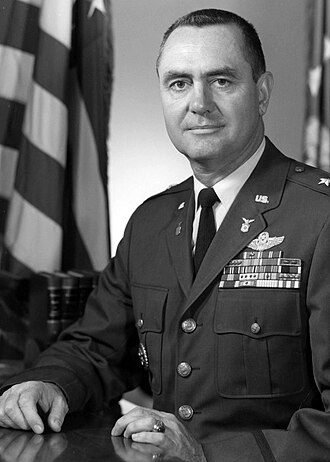
James D. ("Don") Hughes served as the Armed Forces Aide (later Military Assistant) to President Richard Nixon from January 1969 to February 1972, managing military support, logistics, and emergency planning for the White House. During the taping period, he transitioned from his White House role to active command, becoming Vice Commander of the 12th Air Force in February 1972. He subsequently deployed to Southeast Asia, serving as Deputy Commander of the 7th/13th Air Force (September 1972 – March 1973), Commander of Detachment 7, 13th Air Force (March – April 1973), and Deputy Commander of the 7th Air Force (April – December 1973). Hughes concluded the Nixon era as Commander of the 9th Air Force, a position he held from December 1973 through the end of the administration.
President Nixon met with his senior staff and advisors to discuss communication strategies for the administration's policy achievements and historical outreach. The group explored ways to better leverage the President's personal historical expertise, such as his recent presentation on John Quincy Adams, to improve public perception through televised forums rather than relying on the mainstream press. Nixon emphasized the need to bypass the press corps by speaking directly to key demographics, including the elderly and youth, while instructing his staff to maintain stricter control over who is permitted to discuss substantive policy on television.
President Nixon met with representatives of the International Military Sports Council, led by Admiral Aldo Massarini, to accept a commemorative medal and discuss the organization's contributions to international relations. The meeting featured a brief photo opportunity with the press to highlight the role of military personnel in fostering global peace through athletic competition. Following the delegation's departure, Nixon consulted with Alexander Butterfield regarding the upcoming signing of a proclamation for USO Day.
President Nixon met with military aides Commander Craig S. Campbell, Charles R. Larson, and Major General James D. Hughes to facilitate introductions and formal photographs. The discussion centered on Larson’s upcoming military reassignment to a submarine command based in San Diego, which Nixon noted was conveniently located near his San Clemente estate. The brief meeting concluded with the exchange of personal gifts and expressions of mutual appreciation regarding the aides' service.
President Nixon met with his senior advisors, including Kissinger, Rogers, and Laird, to finalize the strategy and messaging for a televised address regarding the Vietnam War. They analyzed recent public opinion polling, which showed a significant, though potentially temporary, boost in the President's approval ratings following his intervention in the William Calley case. Nixon emphasized the need for simplified, slogan-based communication to gain public support for his administration's policies, specifically criticizing his own staff's tendency to over-complicate policy presentations. The President decided against allowing film coverage for an upcoming social event, expressing frustration with the constant focus on minor PR details.
President Nixon met with Secretary of Agriculture Clifford Hardin, General George A. Lincoln, and Peter Flanigan to coordinate a strategic response to a severe drought in Texas and Oklahoma. The President emphasized that the administration must appear highly responsive and concerned to mitigate political fallout, even if a full disaster declaration was not yet legally or fiscally advisable. Nixon directed the team to facilitate a high-profile visit to the region, including securing appropriate aircraft and media presence, to reassure farmers and political allies like John Connally and John Tower that the administration was proactively exhausting all available relief channels.
President Nixon consulted with General James D. Hughes to arrange a larger aircraft for an upcoming trip to Texas, specifically for Secretary of Agriculture Clifford M. Hardin and his delegation. Hughes confirmed that they would utilize the backup aircraft, designated '970,' which shares the same presidential paint scheme and capacity as Air Force One. Nixon authorized this change to accommodate an expanded party of approximately 60 people.
President Nixon met with Melvin Laird, James Johnson, and other officials to discuss personnel appointments, specifically the nomination of James Johnson and the broader administration policy regarding minority representation in the military. The group reviewed the qualifications of black officers, including Admiral Samuel Gravely and General Daniel 'Chappie' James, while emphasizing that selection criteria were based on merit rather than race. The discussion also covered the President's recent speech on welfare reform and strategic scheduling for upcoming appearances by Navy officials.
President Nixon met with Jacob A. Preus, General James D. Hughes, and others to discuss diplomatic efforts aimed at securing the release of American prisoners of war (POWs) in Vietnam. Preus reported on his international travels, highlighting conversations with Swedish, Indian, and Vatican officials regarding the separation of humanitarian POW issues from the broader military conflict. The discussion underscored the strategic necessity of maintaining pressure on North Vietnam while navigating the complexities of international negotiations and countering negative public perceptions of U.S. efforts in Southeast Asia.
President Nixon instructed General James D. Hughes to make a concerted effort to ensure Secretary of the Treasury John B. Connally utilized the Sequoia presidential yacht and Camp David facilities. Nixon emphasized that he wanted Connally to receive preferential access to these amenities compared to other officials. Hughes acknowledged the directive and thanked the President for a recent phone call to his wife, Bette.
President Nixon met with his military aide, Major General James D. Hughes, to coordinate logistics regarding the use of the presidential yacht, the Sequoia. Nixon explicitly directed that the vessel be made available to a specific unnamed individual, emphasizing that this person should receive preferential treatment over others. The conversation served to formalize scheduling arrangements and ensure the guest felt prioritized.
President Nixon met with Master Chief Eleuterio Mendoza, his family, and Brig. Gen. James D. Hughes to recognize and commend the Chief's dedicated service at the White House. The brief social encounter included a photo opportunity, the presentation of presidential gifts, and informal conversation about the Mendoza children. The meeting served as a formal farewell and expression of appreciation for the Chief's contributions.
President Nixon hosted Stanley H. Bear, a longtime doctor and associate, along with his wife and children for a brief Oval Office meeting. The visit served as a social courtesy to acknowledge the family, during which the President exchanged pleasantries, presented gifts, and arranged for a special White House tour. Nixon also expressed personal gratitude for Bear's years of loyal professional service as the family prepared to depart.
President Nixon and H.R. Haldeman discussed a wide range of administrative, political, and personnel matters, including the handling of Vice President Spiro Agnew’s return from an African tour and the potential nomination of Robert S. McNamara to the World Bank. The conversation also covered strategic planning for upcoming presidential radio addresses, the management of economic policy advisors like Paul McCracken, and the implementation of tighter control over presidential media coverage, specifically regarding Nixon's planned trip to the Bohemian Grove. Finally, the President directed staff to gather sensitive historical documents from the Kennedy and Johnson administrations, emphasizing the need for organized access to records concerning the Bay of Pigs, the Cuban Missile Crisis, and other Cold War-era crises.
President Nixon met with Brig. Gen. James D. Hughes to briefly discuss minor housekeeping matters regarding facilities at Camp David. The conversation focused on the removal of carpeting from a porch area to address concerns raised by the First Lady. No major policy decisions were made during this brief administrative check-in.
President Nixon hosted a brief Oval Office ceremony to honor Brigadier General Albert Redman, Jr. on the occasion of his promotion and to recognize his long-standing military service. Accompanied by his family and members of the White House Communications Agency, Redman received presidential gifts, including cufflinks bearing the presidential seal. The meeting concluded with official group photography to commemorate the event.
President Nixon met with James D. ("Don") Hughes and General Brent G. Scowcroft to discuss administrative transitions, specifically Hughes's forthcoming military assignment at Bergstrom Air Force Base and his departure from the White House staff. The conversation touched upon the management of military aides, including the recent addition of a Coast Guard representative, and the importance of maintaining staff relations with key personnel like H.R. Haldeman. Additionally, the group briefly addressed preparations for the President's upcoming trip to the People's Republic of China, confirming the inclusion of personnel to ensure continuity.
President Nixon met with Alexander R. Larzelere and James D. Hughes to facilitate a ceremonial meeting and the presentation of gifts to Larzelere’s family. The discussion remained informal, focusing on the presence of the Coast Guard and the recognition of Larzelere’s professional background. The interaction concluded with the President ensuring that photographic mementos and copies of the event were provided to the attendees.
H. R. Haldeman contacts General Don Hughes to address a premature and unauthorized communication from the Aide's office regarding the President's travel schedule. Haldeman expresses frustration that Manolo Sanchez was incorrectly instructed to depart on a flight for a trip that was intended to remain confidential. Hughes agrees to investigate the breach immediately and instructs his staff to halt all travel preparations while ensuring the helicopters remain grounded.
President Nixon and H. R. Haldeman met to discuss pending tax legislation, including the politically sensitive Percy amendment and the potential for a presidential veto. The conversation shifted to strategic planning for the President’s upcoming address to the AFL-CIO, where they aimed to balance a message of economic dignity with a clear-eyed defense of the administration's policies. Additionally, they reviewed recent polling data to assess the President's regional approval ratings and determined the timing and methodology for future surveys to measure public sentiment on economic and foreign policy initiatives.
President Nixon met with senior military officials and personnel, including Brigadier Generals Jeanne M. Holm, Anna M. Hays, and Elizabeth P. Hoisington, to discuss the status and recruitment of women in the armed services. The discussion focused on the high quality of female college graduates entering officer training and the overall progress of integrating women into peacetime military roles. Following this, Stephen B. Bull briefed the President on the scheduling of the “Most Courageous Junior Olympian” award ceremony.
President Nixon met with Stephen B. Bull and Major General James D. Hughes to facilitate an award presentation. The brief discussion focused on administrative coordination for the ceremony, specifically involving General Leonard F. Chapman, Jr. and potentially Ronald L. Ziegler. The meeting served as a logistical arrangement to organize the schedule and attendees for the upcoming event.
President Nixon hosted a ceremony in the Oval Office to honor General Leonard F. Chapman, Jr., upon the conclusion of his tenure as Commandant of the Marine Corps. The President formally presented General Chapman with the Distinguished Service Medal in recognition of his leadership during the Vietnam War and his service on the Joint Chiefs of Staff. The meeting included remarks from both the President and the General reflecting on the dedication of Marine Corps personnel, the importance of military families, and Chapman's 36-year career.
President Nixon consulted with Major General James D. Hughes regarding a request for the Grambling College Band to travel to Liberia for an inauguration. Despite concerns about setting a precedent for such transportation, Nixon determined the trip should proceed as a political decision. He instructed Hughes to coordinate with press secretary Ronald Ziegler to ensure the administration received maximum favorable publicity for the gesture.
President Nixon and General James D. "Don" Hughes held a brief, informal meeting in the Old Executive Office Building on Christmas Eve. The exchange functioned as a short holiday greeting and a check-in between the President and his military aide. No substantive policy matters or administrative directives were recorded during this brief interaction.
President Nixon instructed Major General James D. Hughes to telephone Representative Otto E. Passman to secure his support for a specific presidential initiative. Hughes was directed to convey the President's personal holiday wishes and assure Passman that Nixon trusted his judgment regarding the expenditure of taxpayer funds. By positioning the initiative as an exception and emphasizing mutual confidence, the President sought to cultivate goodwill and influence the congressman's legislative cooperation.
President Nixon met with his military aide, General James D. Hughes, to provide specific instructions regarding a personal favor or exception for an acquaintance. The President directed Hughes to contact a pastor to communicate that an exception had been granted on his behalf. This brief exchange served to facilitate a message of authorization for the individual in question.
President Nixon instructed Major General James D. Hughes to initiate standard protocol following the death of Congressman George W. Andrews. The President requested that an aide be dispatched to assist the Congressman’s widow, Elizabeth Andrews. This brief exchange served to ensure appropriate administrative and ceremonial support for the grieving family during the holiday.
President Nixon met with his senior staff, including H. R. Haldeman, to address ongoing frustrations regarding the mismanagement of his daily schedule, the handling of sensitive staff briefings, and the need for stricter control over administrative operations. He expressed irritation with staff who deliberately misrepresented the time requirements of meetings, specifically citing Henry Kissinger’s performance, and emphasized the necessity of maintaining personal and professional discipline ahead of critical upcoming events like the State of the Union and the China trip. Nixon also clarified his stance on public relations, notably his decision to refuse portrait sittings until after his presidency and his skepticism toward further press commentary regarding foreign policy leaks.
H. R. Haldeman and Major General James D. Hughes discussed the logistical difficulties of transporting President Nixon to Camp David via helicopter due to poor weather conditions. Haldeman emphasized the President's preference to avoid a long drive and requested an evaluation of alternative landing sites, such as Thurmont. Hughes committed to investigating the viability of nearby landing locations and reporting back to Haldeman shortly.
H. R. Haldeman and Major General James D. Hughes discussed the feasibility of transporting the President to Camp David despite severe weather conditions in Maryland. Hughes reported that low visibility and icing risks currently grounded all helicopter and aircraft operations near the retreat. They agreed to maintain an airplane on five-minute alert while awaiting a potential improvement in the weather before Haldeman consulted the President on whether to proceed.
H. R. Haldeman coordinates with Maj. Gen. James D. Hughes to finalize the logistics for President Nixon’s upcoming trip to Camp David. They determine 4:00 p.m. as the optimal departure time, balancing weather forecasts for Thurmont, Maryland, and the status of helicopter availability. The pair establishes a contingency plan to travel by car if adverse weather conditions prevent air travel.
President Nixon dictates a personal letter to Major General James D. Hughes to express his gratitude for Hughes’ recent correspondence and offer congratulations on his daughter’s wedding. During the session, Nixon briefly consults with Stephen B. Bull regarding Rose Mary Woods’ schedule and a visit from George H. Allen. The President concludes by reflecting on the bravery of American airmen during the December 1972 bombing campaign in Vietnam and reiterating his commitment to securing an honorable peace through ongoing negotiations.
President Nixon received a supportive telephone call from Major General James D. Hughes following the President's televised address regarding the Watergate scandal. Joined briefly by Tricia Nixon Cox during the call, Nixon expressed personal gratitude for Hughes's loyalty and his positive feedback on the speech. The exchange served primarily as a morale-boosting communication between the President and a military aide during a period of significant political instability.