Ehrlichman, John D.
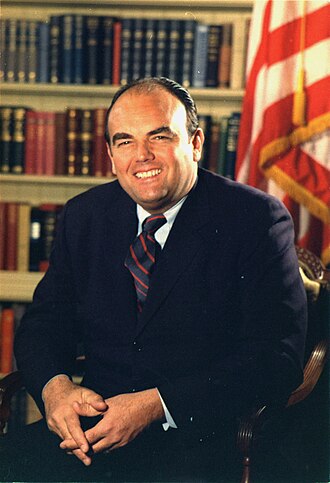
John D. Ehrlichman initially served as Counsel to the President from January 1969 to November 1969, where his duties quickly expanded from legal issues to broader policy development. This shift led to his transition in November 1969 to Assistant to the President for Domestic Affairs, a role he held until April 1973. Throughout the majority of the White House taping period (February 1971 – July 1973), he acted as Nixon's chief domestic advisor and helped direct the covert "Plumbers" unit before the escalating Watergate scandal forced his resignation in April 1973.
What Ehrlichman talks about on the tapes
Economic policy 119Congressional relations 101Public relations 91Watergate 77Vietnam War 58Political strategy 58Legislative strategy 57Welfare Reform 55Revenue sharing 53Busing 52Foreign Policy 47Executive privilege 47
Conversations (807)
— Page 9 of 9John D. Ehrlichman and Ronald L. Ziegler discuss the management of ongoing Watergate-related communications and public statements. Ziegler informs Ehrlichman that the President ordered him not to contact John Dean, and the two briefly touch upon the handling of a forthcoming written statement from Ehrlichman. Despite Ziegler expressing his disagreement with the content of that statement, Ehrlichman remains committed to discussing the matter further with the President.
President Nixon met with William D. Ruckelshaus, John D. Ehrlichman, and Ronald L. Ziegler to finalize Ruckelshaus's appointment as Acting Director of the FBI following the resignation of L. Patrick Gray III. The President emphasized the need for a thorough, unbiased investigation into the Watergate scandal and directed Ruckelshaus to reorganize the Bureau and restore its integrity while a permanent director was sought. Ruckelshaus agreed to serve on an interim basis, with the participants coordinating the public announcement and strategy for fielding press inquiries regarding the transition.
President Nixon and John Ehrlichman discussed the strategic handling of the Watergate scandal, specifically addressing the impending departure of John Dean and the potential legal exposure related to White House "plumbers" operations. They evaluated the political necessity of Ehrlichman and H.R. Haldeman taking a leave of absence to create a clear separation from the scandal and prepare for an upcoming public address by the President. During the conversation, Nixon probed Ehrlichman about his involvement in, and knowledge of, unauthorized activities and questionable intelligence operations—including alleged fabricated documents involving the Kennedy administration—while also coordinating on how to manage communications with the Attorney General and legal counsel.
President Nixon and John Ehrlichman met to coordinate a strategy regarding Egil "Bud" Krogh, Jr., who was seeking to provide an affidavit concerning the break-in at Daniel Ellsberg's psychiatrist's office. They discussed the necessity of establishing that the break-in yielded no usable intelligence and that the President had no prior knowledge of the operation. Nixon instructed Ehrlichman to ensure Krogh communicated to Attorney General Elliot Richardson that he—and others within the Justice Department—had been aware of the break-in details, such as the photographs of G. Gordon Liddy, well before the President was officially briefed.
President Nixon and John Ehrlichman met to discuss the mounting political and legal pressures surrounding the Watergate investigation, with a primary focus on the potential exposure of the White House-sanctioned 'Plumbers' unit. They reviewed the implications of Egil Krogh's forthcoming affidavit and debated how to manage their prior knowledge of the Daniel Ellsberg break-in while maintaining a defensible stance before the Justice Department and prosecutor Henry Petersen. The two men coordinated their strategy for handling Attorney General Elliot Richardson and expressed shared concern regarding the potential legal jeopardy faced by Krogh and the need to protect him from unfair prosecution.
President Nixon informs John Ehrlichman of his decision to appoint Alexander M. Haig, Jr. as White House Chief of Staff to manage staff operations. The two men also discuss the Watergate scandal, specifically focusing on the extent of the Justice Department's prior knowledge regarding the break-in. They emphasize that Egil Krogh and John Dean allegedly communicated this information to officials such as Elliot Richardson and Henry Petersen, a narrative they intend to use to justify their own conduct.
President Nixon met with a broad group of Republican Congressional leaders to propose the creation of a bipartisan, independent commission on federal election reform. The President outlined the commission's broad mandate to study and recommend improvements to campaign financing, ethics, disclosure rules, and potentially the length of election campaigns. Nixon emphasized that the commission, which would include both public members and Congressional representatives, should serve as a catalyst for practical reform and generate public support for legislative action without preempting the authority of existing Congressional committees. The meeting focused on establishing a non-partisan framework to address the inefficiencies and technical challenges identified in previous election laws.