Reagan, Ronald W.
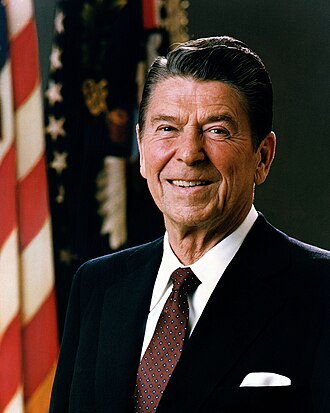
During the Nixon administration, Ronald W. Reagan served as the 33rd Governor of California, a position he held for two terms. As a prominent Republican governor, he was a key conservative voice and maintained a direct line of communication with President Nixon, as evidenced by their recorded telephone conversations. These discussions included his strong reactions to foreign policy events and offering support to Nixon during the Watergate scandal in April 1973.
President Nixon met with William F. Graham, Henry Kissinger, Ronald Reagan, and John Ehrlichman to discuss political strategy, labor relations, and foreign policy. The group addressed public support for the administration, including the President's firm stance against demonstrators, and strategic moves involving maritime unions and grain exports to the People's Republic of China. Nixon and Kissinger further evaluated ongoing Vietnam negotiations and the importance of maintaining military strength to retain political leverage over domestic critics and international rivals.
President Nixon initiated this call to Governor Ronald Reagan to coordinate federal support for California, specifically announcing a new shipbuilding contract for San Diego intended to boost employment. Nixon also expressed appreciation for Reagan's recent letter to the Young Americans for Freedom before transitioning the call to Henry Kissinger. Kissinger and Reagan discussed upcoming travel plans involving Vice President Spiro Agnew and reviewed positive foreign policy developments, including declining Vietnam War casualty rates and the recent diplomatic activity of Romanian President Nicolae Ceaușescu.
President Richard Nixon and California Governor Ronald Reagan spoke to coordinate their respective schedules for upcoming travel and to arrange a meeting during the President's planned trip to California. The two discussed the political implications of New York City Mayor John Lindsay's recent party affiliation change and touched upon upcoming diplomatic developments. Nixon emphasized the importance of these confidential foreign policy matters and instructed Reagan to receive a formal briefing from Henry Kissinger regarding these hopeful, non-public affairs.
President Nixon and Governor Ronald Reagan discussed the recent United Nations vote to expel Taiwan and recognize the People's Republic of China. Reagan expressed strong frustration with the UN, proposing that the U.S. maintain its presence for debate while refusing to participate in future votes as a way to signal American dissatisfaction. Nixon acknowledged the political weight of the issue and the potential for congressional repercussions, while also briefing Reagan on his recent judicial nominees to the Supreme Court.
President Nixon and Ronald Reagan discussed the recent United Nations vote to expel Taiwan and recognize the People's Republic of China, expressing disappointment regarding the lack of support from various African nations. Nixon articulated concerns about the potential repercussions in Congress, particularly regarding foreign aid appropriations, while emphasizing the importance of remembering allies like Japan who stood with the U.S. during the vote. Additionally, the two men reviewed Nixon's recent Supreme Court nominations of Lewis Powell and William Rehnquist, focusing on the political necessity of balancing regional representation and professional background.
President Nixon met with California Governor Ronald Reagan to discuss the governor's recent Far East diplomatic trip and the administration's ongoing domestic and foreign policy challenges. They reviewed Reagan's interactions with leaders in Taiwan, Singapore, Thailand, and Japan, focusing on reassuring these allies regarding U.S. treaty commitments and the President's planned visit to the People's Republic of China. Additionally, the pair coordinated strategies for negotiating welfare reform experiments in California, addressing anti-trust concerns for U.S. firms in Asia, and solidifying support among conservative Republicans ahead of the 1972 election.
President Richard Nixon called Governor Ronald Reagan to exchange Christmas greetings and invite him to join a diplomatic golf outing with Japanese Prime Minister Eisaku Sato at Walter Annenberg’s estate. Nixon planned for the January 7, 1972, event to serve as a symbolic gesture to strengthen U.S.-Japan relations following formal policy discussions. Reagan expressed interest in attending, though he noted he would verify his schedule, and Nixon confirmed that political rivals Senators John Tunney and Alan Cranston were explicitly excluded from the invitation.
President Richard Nixon contacted Governor Ronald Reagan to extend holiday greetings and formally invite him to join a diplomatic outing with Japanese Prime Minister Eisaku Satō. The proposed event, scheduled for January 7, 1972, involved a golf outing at the estate of Ambassador Walter Annenberg following official meetings. Reagan accepted the invitation, and the two men concluded the brief discussion with personal remarks regarding the upcoming Washington Redskins versus San Francisco 49ers playoff game.
President Nixon initiated a telephone call to California Governor Ronald Reagan following a brief briefing from aide Stephen B. Bull regarding Henry Kissinger's schedule. While the specific substance of the discussion with Reagan is captured elsewhere, the interaction reflects the ongoing coordination between the White House and prominent Republican leaders. Bull’s presence served to facilitate administrative logistics ahead of the President's engagement.
President Nixon and Governor Ronald Reagan discussed the need for national unity regarding U.S. peace proposals in Vietnam, emphasizing that a unified front is essential to force North Vietnam to negotiate. Following this strategic discussion, Reagan advocated for the appointments of William French Smith and Caspar Weinberger to potential roles within the administration, specifically the Supreme Court or Attorney General. Nixon explained his preference to nominate Richard Kleindienst as the immediate successor to John Mitchell due to the logistical challenges of transitioning a new official into the Justice Department, while acknowledging the high qualifications of Reagan's candidates.
President Nixon consulted with California Governor Ronald Reagan to coordinate political messaging regarding a new Vietnam peace proposal, emphasizing the need for a unified national voice to force North Vietnamese negotiations. Nixon also discussed personnel decisions within the Justice Department, explaining his preference for Richard Kleindienst to serve as Attorney General for the remainder of the term rather than installing a new appointee who would lack the necessary institutional knowledge. The two leaders additionally touched upon internal administrative personnel and ongoing political dynamics in California.
President Nixon met with California Governor Ronald Reagan and various administration officials to discuss domestic policy challenges, specifically addressing stalled welfare reform legislation and the ongoing West Coast dock strike. The group explored the economic implications of federal spending and potential strategies to bypass congressional inaction regarding labor disputes, with Reagan sharing his past experience managing strike negotiations. Additionally, the participants discussed the political and ethical complexities surrounding abortion access through Medicaid and the legal status of the unborn.
President Nixon met with Governors Nelson Rockefeller, Ronald Reagan, William Milliken, and Linwood Holton to formally dictate letters of appreciation following a recent governors' dinner. The conversation highlights the administration's effort to maintain political cohesion and express gratitude for the participants' supportive remarks regarding his peace initiatives and policy agenda. These letters served to acknowledge the governors' contributions and reinforce existing alliances heading into a challenging political period.
President Nixon met with Charles Colson, Ronald Ziegler, Caspar Weinberger, and others to strategize on administration policy, political messaging, and pending legislation. The conversation focused on managing the political optics of Social Security increases and federal budget cuts, as well as coordinating a firm stance on Vietnam peace negotiations and prisoners of war. Nixon directed his team to emphasize that any increased federal spending must be balanced by tax increases, and he instructed staff to challenge negative media coverage, particularly regarding Vietnam and administrative integrity.
President Richard Nixon and Ronald Reagan coordinated the logistics of Reagan's upcoming travel and his scheduled meeting with Henry Kissinger. The discussion centered on aligning schedules and determining the conditions under which Reagan should proceed with specific diplomatic or committee-related objectives. Nixon emphasized the necessity of Kissinger’s involvement to ensure the meetings and itineraries were properly managed.
President Nixon and Ronald Reagan consult on the messaging strategy for Nixon's upcoming acceptance speech. The pair specifically discusses the political positioning regarding the amnesty issue, ultimately deciding to pivot away from the topic to emphasize honoring and respecting those who served in the military. This brief exchange serves to align their views on prioritizing patriotic messaging for the remainder of the campaign.
Governor Ronald Reagan placed a courtesy call to President Richard Nixon to offer personal support and prayers following the President’s televised address regarding the Watergate scandal. The conversation focused on the resignations of H. R. Haldeman and John Ehrlichman, with Reagan affirming his continued loyalty to the administration. Nixon expressed appreciation for the gesture while emphasizing the necessity of their shared commitment to global peace amidst the ongoing political crisis.