Johnson, U. Alexis
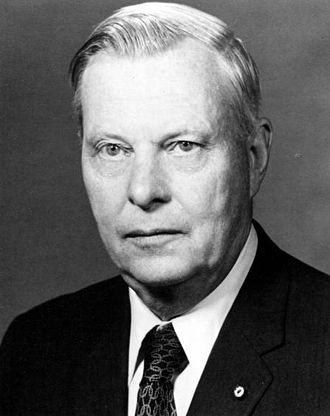
U. Alexis Johnson served as a high-ranking diplomat during the Nixon administration, holding the position of Under Secretary of State for Political Affairs from February 1969 until February 1973. In this role, he was the third-highest official in the State Department and was involved in the formulation and conduct of U.S. foreign policy. Following this, in February 1973, Johnson was appointed Ambassador at Large and became the chief United States delegate to the Strategic Arms Limitation Talks (SALT) with the Soviet Union, a role he held until 1977.
President Nixon met with his national security team, including Vice President Agnew, Henry Kissinger, and William Rogers, to review the status of ongoing military operations in Southeast Asia and the complex diplomatic situation in the Middle East. Military leadership provided a detailed briefing on Operation Lam Son 719 and related efforts to interdict the Ho Chi Minh Trail, emphasizing that while the fighting is intense, the operations are effectively disrupting enemy logistics and protecting American withdrawal interests. The discussion subsequently shifted to the Middle East, where the President expressed frustration over Israel's reluctance to offer a concrete negotiating position despite Egypt's concessions. Nixon concluded by stressing the importance of maintaining a firm stance, noting that while the U.S. remains a reliable ally, it will not offer unconditional support without a reciprocal commitment to a serious peace process.
President Nixon met with members of the National League of Families of American Prisoners and Missing in Southeast Asia, along with various military officials and members of Congress, to observe the signing of a proclamation for the National Week of Concern for POW/MIA. The gathering served as a public demonstration of support for families affected by the ongoing war in Vietnam. The ceremony focused on acknowledging the plight of those missing in action and reinforcing the administration's commitment to their families.
President Nixon and the National Security Council met to evaluate U.S. policy options regarding the People's Republic of China's potential admission to the United Nations and the status of Taiwan. Attendees debated the risks of a potential diplomatic defeat, weighing the benefits of "dual representation" versus maintaining the current, increasingly untenable policy of excluding the PRC. The President emphasized the need to manage domestic American public opinion carefully while assessing tactical shifts, ultimately seeking a strategy that minimizes political fallout while addressing the evolving geopolitical reality of China's status.
President Nixon met with his economic advisors and Henry Kissinger to strategize on managing mounting domestic and international pressures regarding textile, steel, and shoe import quotas. The discussion focused on leveraging diplomatic and economic inducements, such as trade initiatives and aid, to secure favorable voluntary restraint agreements with Japan, Taiwan, Hong Kong, and Korea. The participants concluded that a coordinated strategy involving high-level diplomatic outreach followed by technical negotiations was necessary to address industry concerns and prevent restrictive legislative action.
President Nixon hosted a Federal Civilian Service Awards ceremony in the Oval Office to honor distinguished public servants, including Samuel M. Cohn, U. Alexis Johnson, Edward F. Knipling, Fred Leonard, and George H. Willis. During the event, the President presented medals and recognized the recipients for their significant contributions to fiscal policy, diplomacy, entomology, medical research, and international monetary systems. Following the formal presentations and a group photograph, the President engaged in general conversation with the attendees regarding the Oval Office décor, his daily schedule, and his auxiliary office in the Executive Office Building.
President Nixon met with his Cabinet and Republican Congressional leaders to coordinate the administration's legislative agenda, specifically addressing the ongoing national railroad strike and the upcoming Congressional vote on the military draft. The discussion also focused on foreign policy, with Secretary of Defense Melvin Laird and Henry Kissinger providing briefings on the status of NATO, the credibility of U.S. military commitments in Europe, and the implications of recent Soviet statements regarding mutual force reductions. The President urged the Congressional leaders to maintain a firm stance against unilateral U.S. force withdrawals while emphasizing the need to handle these matters through stable, negotiated frameworks rather than disruptive legislative amendments.
President Nixon met with his cabinet, diplomatic staff, and intelligence officials to declare drug abuse 'public enemy number one' and to coordinate a comprehensive strategy for eradicating the international supply of narcotics. The participants evaluated the effectiveness of current interdiction programs in Southeast Asia, the Middle East, and Europe, ultimately concluding that despite increased law enforcement efforts, the drug problem was expanding. The President directed his team to prioritize the escalation of foreign pressure, including potential subsidies for poppy crop eradication in Turkey, and announced the centralization of domestic drug policy under a new White House office.
President Nixon, Vice President Agnew, and members of his Cabinet met to coordinate a unified administration strategy ahead of critical International Monetary Fund (IMF) meetings and ongoing global trade negotiations. The discussion emphasized the necessity of maintaining the recently imposed 10% import surcharge and a firm bargaining stance to address the nation's economic balance of payments and reshape the international monetary system. Nixon and his advisors agreed that while foreign partners would likely criticize U.S. policy, maintaining domestic political support and correcting long-standing trade imbalances remained the administration's primary objective.
President Nixon and U. Alexis Johnson discussed the scheduling and diplomatic priorities for Secretary of State William P. Rogers's upcoming trip to Rome. The primary concern involved coordinating Rogers's meetings with Italian government officials in light of an impending visit by Ronald Reagan and the status of the Italian government. Additionally, they evaluated the diplomatic impact of U.S. recognition of Yemen and potential outreach to Algeria, with Johnson emphasizing the importance of securing the Algerian connection to improve regional diplomatic outcomes.
President Nixon consults with U. Alexis Johnson regarding the scheduling and diplomatic priorities for an upcoming overseas trip involving a representative referred to as Bill. The conversation centers on balancing a potential meeting with the Pope against securing a diplomatic opening in Algeria, with Nixon expressing that an Algerian engagement is of higher strategic importance. Ultimately, Nixon instructs Johnson to prioritize the Algerian contact and directs that a meeting with the Pope should only proceed if the Algerian arrangement is finalized.
President Nixon and Under Secretary of State U. Alexis Johnson discussed the security protocols for communicating the decision to halt U.S. bombing north of the 20th parallel. Johnson explained that he took the initiative to inform the relevant parties to listen to the public announcement rather than risking an insecure transmission of the sensitive news. The two men acknowledged the difficulty of the decision to pause the bombing, with Nixon reflecting that only history would judge the efficacy of his choice.
President Nixon and U. Alexis Johnson briefly conferred regarding the status of sensitive diplomatic negotiations and communications following a period of intense conflict. Nixon expressed that the recent breakdown in talks left him with no alternative course of action, framing the situation as a necessary challenge compared to previous wartime escalations. The discussion focused on maintaining operational security to prevent information leaks, with Nixon confirming his personal involvement in managing key contacts.
President Nixon met with members of the National Security Council and other senior officials to discuss the strategic balance of power between the U.S. and the USSR, specifically in anticipation of the SALT II negotiations. The discussion focused on the impact of qualitative and quantitative disparities in throw-weight, bombers, and MIRV technology on U.S. and Soviet first- and second-strike capabilities. Nixon emphasized the importance of maintaining an appearance of strategic equivalence to preserve the confidence of U.S. allies and domestic support, directing his team to refine their negotiating strategy without rushing into a premature moratorium on weapons testing.