Usery, Willie J., Jr.
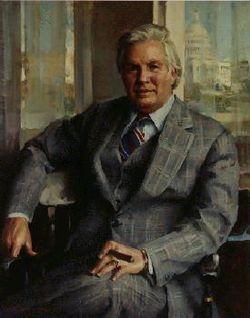
During the Nixon administration taping period, W. J. Usery, Jr. served as the Assistant Secretary of Labor for Labor-Management Relations, a position he held from February 1969 until March 1973. In that month, President Nixon appointed him as the Director of the Federal Mediation and Conciliation Service, where he was the government's chief mediator in significant national labor-management disputes. He was a key figure in resolving major labor conflicts, including the 1970 postal workers' strike.
President Nixon met with the executive council of the AFL-CIO Building and Construction Trades Department to discuss the state of the construction industry, economic growth, and the administration's recent suspension of the Davis-Bacon Act. The discussion addressed concerns regarding job stability, the rising costs of land and construction, and the need for continued labor-management cooperation under the administration's new wage stabilization policies. Nixon emphasized his support for the trades and sought their partnership in fostering economic stability, while also pivoting to broader topics of national security, international defense commitments, and the strategic importance of U.S. economic and military strength in the global landscape.
President Nixon met with AFL-CIO President George Meany and Assistant Secretary of Labor Willie J. Usery, Jr. to secure labor support for critical economic and legislative initiatives, specifically the continuation of the Supersonic Transport (SST) program and financial support for Lockheed. The President emphasized that these projects were vital for job creation and national industrial prestige, urging Meany to lobby key legislators for the necessary votes. They also discussed the status of the building trades unions, the administration's stance on apprenticeship programs, and the leadership transition within the Teamsters union, while touching upon the broader domestic economy and international trade challenges.
President Nixon met with various railway union leaders, accompanied by Secretary of Transportation John A. Volpe and Secretary of Labor James D. Hodgson, to discuss the economic challenges facing the railroad industry. The discussion focused on the necessity of industry modernization, the impact of outdated government regulations, and the need for tax reforms to incentivize the reinvestment of profits into infrastructure and equipment. Both the administration and union representatives emphasized the importance of labor-management stability and the potential for a unified approach to ensure the future prosperity of the industry.
In this meeting, President Nixon and his advisors, including John Connally and George Shultz, strategized on economic messaging and labor relations ahead of the 1972 election. They discussed the political risks of wage and price controls, analyzed the shifting attitudes of the American working class compared to the intellectual elite, and explored ways to appeal directly to the labor rank-and-file. The President emphasized the need to frame his economic and foreign policy initiatives in terms of national strength and job security to consolidate his base against political opponents.
President Nixon calls Willie J. Usery, Jr. to commend his successful mediation efforts in recent postal and railroad labor negotiations. The discussion shifts toward the upcoming steel labor disputes, with Nixon emphasizing the necessity of avoiding a strike while urging a non-inflationary settlement. Usery expresses optimism regarding the steel negotiations and affirms that the President's previous meetings with labor leaders have positively influenced the process.
President Nixon met with United Transportation Union leaders and railroad management representatives to address the economic crisis caused by an ongoing railroad strike. Nixon emphasized his administration's preference for private-sector collective bargaining over government intervention, warning that continued labor stoppages could provoke negative public and Congressional reactions that would ultimately damage the industry. The discussion centered on the need for both parties to reach an equitable settlement quickly to protect the economy, with the President urging management to streamline their decision-making process to facilitate a resolution.
President Nixon met with Assistant Secretary of Labor Willie J. Usery, Jr. to formally acknowledge and express gratitude for his pivotal role in negotiating the recent steel industry labor settlement. The discussion centered on the successful conclusion of these negotiations and the strategy for managing the immediate aftermath of the agreement. No specific follow-up actions were recorded, as the meeting served primarily as a debriefing and recognition of Usery’s diplomatic efforts.
President Nixon met with key labor leaders and administration officials to solicit input on the development of 'Phase II' of his economic program, following the conclusion of the initial 90-day wage and price freeze. The discussion centered on transitioning to a more permanent, yet flexible, mechanism for controlling inflation while maintaining the principles of collective bargaining and a free-market system. The participants debated the merits of tripartite boards—modeled after the War Labor Board—versus government-imposed mandates, with labor leaders emphasizing the need for voluntary compliance and equitable standards. Nixon concluded by establishing an October 1 deadline for the group to submit their formal views, underscoring the necessity of labor-management cooperation for the program's success.
President Nixon met with the Construction Industry Collective Bargaining Commission to review the progress of labor-management relations and wage stabilization efforts in the construction sector. The discussion focused on the success of the Commission's voluntary approach to curbing inflation, the role of craft boards in fostering industry cooperation, and the broader integration of productivity goals. Nixon commended the participants for their responsible leadership and collaborative efforts, emphasizing the importance of keeping the industry's management in the hands of construction professionals while continuing to modernize labor practices.
President Nixon met with labor leader Joseph T. DeSilva, Willie J. Usery, Jr., and Charles W. Colson to discuss labor support for his reelection campaign and economic policies. DeSilva offered his personal endorsement, critiquing current union leadership while advocating for wage stabilization and increased job opportunities over welfare. The participants examined strategies for securing support among working-class voters and the political landscape regarding Nixon's administration.
President Nixon met with United Paper Makers International Union leader Joseph P. Tonelli and members of his administration, including Secretary of Labor James D. Hodgson, to discuss labor relations and union support for the administration's policies. Tonelli expressed strong approval of Nixon's foreign policy and his approach to economic stabilization, while the group discussed specific legislative concerns regarding pulp and paper industry trade. They also addressed the importance of establishing the National Commission for Industrial Peace to improve labor dispute resolution as an alternative to economic strikes.
President Nixon met with leaders of various building trades unions to discuss their ongoing collaboration with his administration and their formal endorsement of his re-election. The participants addressed labor-management relations, the future of wage and price controls, and the administration’s commitment to providing union representation in high-level government positions. Nixon praised the group for their support of his foreign policy and national security objectives, while the labor leaders reaffirmed their commitment to the President despite the neutrality stance held by the broader AFL-CIO.
President Nixon met with the executive board of the Utility Workers Union of America (UWUA) to accept their formal endorsement for the 1972 presidential campaign. During the session, the President and union representatives discussed labor issues, the necessity of nuclear energy development despite environmental opposition, and the complexities of regulating executive salaries. The meeting concluded with the exchange of presidential memorabilia, reinforcing the administration's attempt to build rapport with labor leadership.
President Nixon dictated a memorandum to H.R. Haldeman expressing distress over the administration's failure to meet directives for employing minorities and ethnics, particularly Mexicans and Italians. He emphasized the need to increase minority appointments, especially in advisory roles, and suggested a goal of two out of five appointments. Nixon also discussed congressional relations, criticizing the effectiveness of social events and advocating for meetings with small groups of congressmen to secure votes for vetoes, tasking Haldeman with developing a plan.
President Nixon calls Assistant Secretary of Labor Willie J. Usery, Jr. to commend his successful mediation of the Philadelphia strike. The President also expresses appreciation for the collaboration with Secretary of Labor Peter J. Brennan and Philadelphia Mayor Frank L. Rizzo, noting the political value of maintaining support among the city’s labor unions. Nixon instructs Usery to convey these congratulations to Brennan and the Mayor, while explicitly declining to call the Mayor himself to avoid anticipated requests for federal funding.