Chapin, Dwight L.
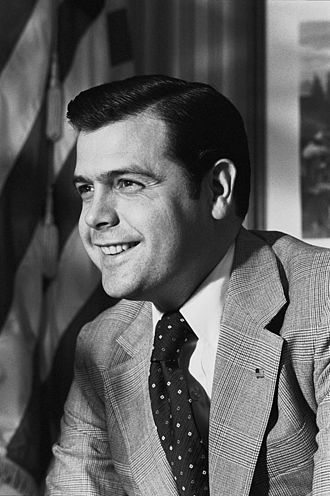
Dwight L. Chapin began his service in the Nixon administration as a Special Assistant to the President in January 1969, a role in which he acted as the President's appointments secretary. During the taping period, he was promoted to Deputy Assistant to the President in 1971, where he continued to manage President Nixon's schedule and travel arrangements. His responsibilities also included the crucial task of supervising the advance team for presidential trips, such as the historic visit to China, before he left the White House in March 1973.
President Nixon and Dwight Chapin discuss strategic political outreach, specifically focusing on building support among rural populations in the Midwest. The President instructs Chapin to reallocate staff resources to emphasize rural and state policy issues in collaboration with Senator Robert Dole. They also briefly touch upon economic concerns regarding wage and price controls and the necessity of maintaining political flexibility in their administrative messaging.
President Nixon met with White House staffer Harriet Elam and her family, accompanied by Dwight L. Chapin and David N. Parker, to express his appreciation for her government service. The session served as a formal acknowledgment of Elam's work and included the presentation of commemorative gifts. A White House photographer was present to document the meeting, which focused on recognizing Elam’s career contributions.
President Nixon and Dwight L. Chapin discussed logistical arrangements for upcoming White House events, specifically a reception involving John Quincy Adams' portrait and a dinner honoring astronauts. They reviewed seating plans, the program structure, and potential guest list additions, including the possibility of inviting prominent golfers. Nixon also addressed the travel arrangements for John B. Connally to Camp David and decided against inviting an MIT scientist who had contributed to the Apollo 14 mission due to concerns over his appearance.
President Nixon, H.R. Haldeman, and several staff members met to discuss administrative scheduling, public relations strategies, and domestic political polling. The President emphasized a preference for radio over television for addressing the public, citing its effectiveness for targeted messaging and avoiding excessive media scrutiny. Additionally, they reviewed recent polling data regarding Congress and discussed personnel arrangements, including the roles of Bryce Harlow and Donald Rumsfeld in managing intergovernmental relations.
President Nixon and H.R. Haldeman reviewed the President's recent public relations efforts, focusing specifically on the impact of his recent eulogy for Whitney M. Young, Jr. and the need to strategically manage the President's press interviews. They discussed concerns regarding the influence and tactics of speechwriter William Safire, as well as the importance of maintaining an image of accessibility through controlled media engagements rather than traditional press conferences. Additionally, the President provided specific instructions to his staff regarding future press outreach and the upcoming funeral arrangements for Thomas E. Dewey.
President Nixon consulted with Dwight L. Chapin regarding a potential trip to California for the upcoming weekend. The President intended to coordinate the logistics of this visit with H.R. Haldeman and Bebe Rebozo. Chapin deferred his response, agreeing to provide the President with a definitive answer the following day.
President Nixon and Dwight L. Chapin discussed logistical arrangements for an upcoming event or visit involving Tricia Nixon Cox. The conversation focused on coordination with the Marriott hotel chain, specifically regarding J. Willard Marriott, Jr. and the review of floor plans. Chapin was directed to manage these site details through the White House advance team to ensure the event's security and operational requirements were met.
President Nixon and Dwight L. Chapin discuss logistics for an upcoming event involving Tricia Nixon and her mother, specifically regarding hotel accommodations. The conversation focuses on ensuring the arrangements meet the President’s expectations for the guests' attendance. No major policy decisions were made during this brief exchange.
President Nixon met with New York Governor Nelson Rockefeller to discuss a variety of domestic policy issues, most notably the implementation of federal revenue sharing and strategies to address New York's fiscal challenges. They explored the potential for a Hoover-type commission to examine municipal corruption and inefficiency, and coordinated on the President's upcoming travel plans, including a trip to Rochester. Additionally, the conversation touched upon managing political optics regarding diplomatic visits by foreign leaders and the legislative hurdles for revenue-sharing bills in Congress.
President Nixon met with his senior staff and Caspar Weinberger to develop a political and economic strategy centered on job creation and tax policy. The discussion focused on leveraging construction projects to stimulate the economy, addressing the regressive nature of property taxes, and crafting a messaging strategy that emphasizes the President's leadership and strength. Nixon directed his team to prioritize projects that provide immediate employment and instructed them to present these efforts as a decisive counter-argument to the spending agendas proposed by Congress.
President Nixon consulted with Dwight L. Chapin to ensure that commemorative certificates were being distributed to the various groups involved in his recent travel, including musical ensembles and police departments. Chapin confirmed that the administrative staff was actively handling these requests for both the Tulsa and West Point visits. The President emphasized the importance of these routine acknowledgments as a public relations tool for the White House.
President Nixon and Dwight L. Chapin met to coordinate administrative logistics, including staffing roles for Stephen B. Bull and Lucy A. Winchester, as well as gift arrangements for the Tricia Nixon wedding. The discussion primarily focused on analyzing the timing and release strategies of public opinion polls, specifically comparing White House phone polls with Gallup poll cycles. They concluded by reconciling the timing of recent polling efforts with the President’s travel schedule to ensure optimal public relations impact.
President Nixon and H. R. Haldeman met to assess the overwhelmingly positive press coverage and market reaction following the administration’s recent economic policy announcements. The discussion focused on leveraging the current momentum, including potential political strategies for dealing with Democratic opponents and coordinating a strategic, unannounced visit to the New York Stock Exchange. Additionally, the President reviewed pending matters such as textile negotiations with Japan and decided against meeting with the Mayor of West Berlin to avoid political complications.
President Nixon and Dwight Chapin met to discuss administrative tasks and urgent scheduling matters. The President requested a copy of a memorandum from George H. Gallup and reviewed a meeting request from Attorney General John N. Mitchell. Noting that Mitchell’s sudden request for an audience was atypical, Nixon instructed Chapin to determine the degree of urgency behind the Attorney General’s outreach.
President Nixon and H.R. Haldeman discuss logistical arrangements for the upcoming trip to the People's Republic of China, emphasizing the need for strict control over media coverage to prevent unauthorized exclusives. They decide against granting early commitments to networks like ABC, opting instead to utilize a White House-contracted film unit to manage output. Additionally, the President deliberates on his post-trip schedule, specifically debating whether to stop in Anchorage to allow for a prime-time arrival in Washington, D.C., and expresses his personal disdain for hosting social dinners as a political outreach tool.
President Nixon met with his Cabinet and senior staff to debrief them on the results and implications of his recent diplomatic trip to the People's Republic of China. The President emphasized that the primary success of the visit was the establishment of a new communication channel between the two nations, which he argued was essential for managing long-term stability and reducing the potential for future conflict. Nixon shared his impressions of Chinese leadership, particularly his discussions with Chou En-lai, noting the stark ideological differences while highlighting common strategic interests, such as peace in the Pacific and balancing influence against the Soviet Union. The discussion concluded with a focus on how this opening could be leveraged to reshape international relations and manage regional tensions across Asia.
President Nixon met with his appointments secretary, Dwight L. Chapin, to review and discuss the President's upcoming daily schedule. The conversation focused on the logistical arrangements and timing for his scheduled engagements. No major policy decisions were recorded during this brief administrative check-in.
President Nixon met with Dwight L. Chapin to discuss the logistics of the President’s recent campaign travel and the preparation of commemorative certificates for supporters. The conversation focused on the administrative distribution of these materials to police, bands, and local figures in towns visited during the tour. Nixon emphasized the importance of these gestures as a strategic effort to bolster electoral support.
H. R. Haldeman and Dwight L. Chapin engaged in a brief telephone conversation regarding administrative or scheduling matters. Due to the withdrawal of the primary segment of the recording for personal privacy, the specific substance of their discussion is not available for historical review. The exchange serves as a record of communication between the two senior staff members during the lead-up to the 1972 presidential election.
H. R. Haldeman initiated a telephone call to Dwight L. Chapin via the White House operator to facilitate a direct conversation. Due to the withdrawal of the recorded audio for personal reasons, no specific policy or political topics are available for analysis. The primary action item was the successful establishment of a line of communication between the two senior staff members.
H. R. Haldeman coordinates with Dwight L. Chapin to manage the President's upcoming campaign itinerary, specifically focusing on an appearance in West Virginia. The discussion outlines logistical arrangements, including outreach to Governor Arch Moore and potential events in Huntington and Ashland, Kentucky. They aim to finalize these details following a note sent by Clark MacGregor to the Governor.
H. R. Haldeman and Dwight Chapin engaged in a brief telephone conversation to facilitate a direct communication line with President Nixon. The discussion served as a logistical bridge to connect the President, though the specific substance of the exchange was recorded as a personal returnable item and subsequently withdrawn from the public record. No definitive policy decisions were documented in the available segments of this call.
H. R. Haldeman and Dwight Chapin engage in a brief, informal exchange following a segment of the call that remains restricted for personal reasons. The conversation reflects a sense of mutual frustration or disappointment regarding an unspecified situation described as a "shame." No specific policy decisions or administrative actions are recorded in the available transcript.
President Nixon and H. R. Haldeman met to coordinate administration strategy regarding the Vietnam peace negotiations and the final stages of the 1972 presidential campaign. They discussed the political implications of a potential peace settlement before the election, emphasizing the need to maintain an image of progress while avoiding the appearance of being rushed or coerced into a flawed agreement. Additionally, they reviewed campaign tactics, including the President’s travel schedule and strategies to counter Democratic accusations regarding campaign practices and corruption.
President Nixon and Dwight L. Chapin engaged in a brief telephone conversation regarding personal matters. Due to the withdrawal of the discussion content for security or privacy reasons, no specific policy decisions or political actions were recorded. The exchange serves as a record of administrative communication between the President and his Deputy Assistant.
President Nixon met with his Deputy Assistant, Dwight L. Chapin, for a brief discussion in the Old Executive Office Building. While no transcript is available for this two-minute exchange, the meeting occurred during the final stages of the 1972 presidential campaign. The brief duration suggests an administrative check-in or the communication of urgent tactical instructions regarding campaign logistics or scheduling.
President Nixon met with J. Willard Marriott, Jeb Stuart Magruder, and Dwight L. Chapin to discuss the organizational preparations for the 1973 presidential inauguration. The conversation included a presentation of gifts for the President, specifically a Hopi Indian doll, and a review of various commemorative items, including watches, cuff links, and presidential glassware. The participants coordinated photograph sessions and touched upon the administrative logistics and fundraising efforts associated with the upcoming inaugural events.
President Nixon met with Ronald H. Walker and Dwight L. Chapin to discuss reforming the National Park Service by eliminating special privileges and private facilities previously reserved for members of Congress. Nixon expressed disapproval of the exclusive use of government-maintained properties, such as Coco Lobo, and directed his staff to repurpose these assets for public use as an economy measure. Additionally, the President criticized the agency's lack of promotional support for his administration and emphasized the need for better public relations and the promotion of loyal personnel within the organization.