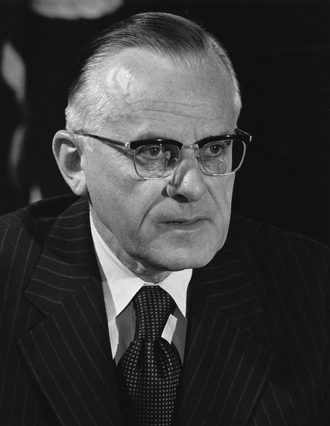
Butz, Earl L.
Earl L. Butz served as Secretary of Agriculture, taking office in December 1971 and remaining in the position through the end of the Nixon administration. During the White House taping period, Butz was a central figure in shaping federal agricultural policy, notably orchestrating the massive 1972 grain sale to the Soviet Union and shifting farm policies toward a free-market model. His influence briefly expanded from January to May 1973 when Nixon additionally appointed him as Counselor to the President for Natural Resources as part of a short-lived executive reorganization.
President Nixon met with John Ehrlichman, John Whitaker, and Secretary of Agriculture Earl Butz to discuss political strategy regarding depressed corn prices and agricultural policy heading into the 1972 election cycle. The President emphasized the need for Butz to serve as a strong, partisan advocate for farmers to counter potential anti-administration sentiment in agricultural states. The group also addressed the logistics of a forthcoming administrative announcement regarding government reorganization, with Nixon insisting on a concise, one-sentence statement to avoid overcomplicating the issue.
President Nixon met with outgoing Secretary of Agriculture Clifford Hardin and his designated successor, Earl Butz, to coordinate the transition and manage the associated media rollout. The participants discussed the timing of Hardin's resignation and the logistics for a forthcoming joint press conference to announce the change in leadership. Additionally, the group touched upon international matters, including U.S. relations with Turkey, and addressed administrative planning regarding the potential reorganization of the Department of Agriculture.
President Nixon hosted a large gathering in the Oval Office, including Secretary of Agriculture Earl Butz, several members of Congress, and various agricultural officials, to discuss the state of the American agricultural sector. The President highlighted the efficiency of American farmers and the affordability of food for domestic consumers as a significant national achievement. The meeting served as a public relations event to underscore the importance of agriculture to the nation's overall well-being and to reinforce support for administration policies.
President Nixon called Secretary of Agriculture Earl L. Butz to exchange Christmas greetings and check on his progress in his new role. Nixon praised Butz's recent media appearances on programs like "Meet the Press" and the "Today" show, encouraging him to prioritize regional broadcasts to reach key farm audiences. The conversation served primarily as a gesture of personal rapport and strategic communication advice.
President Nixon met with his Vice President and Cabinet to discuss the state of the U.S. economy, the administration's fiscal policy, and the upcoming 1973 budget. Key areas of focus included interpreting unemployment data—specifically the impact of new entrants to the workforce—and managing inflation through Phase II price and wage controls. Nixon urged his department heads to aggressively implement approved spending programs to stimulate the economy, while simultaneously directing them to more effectively communicate and promote the administration's economic achievements and social policy investments to the public.
President Nixon met with Henry Kissinger to discuss the administration's strategic response to North Vietnam's rejection of the latest U.S. peace proposal, agreeing to maintain a tough, offensive public relations stance. Following this, the President held an extensive session with Representative Page Belcher, Secretary of Agriculture Earl Butz, and Clark MacGregor to address agricultural policy, congressional relations, and the political necessity of better maintaining ties with key legislative allies. During the meeting, Nixon authorized a mortgage guarantee for a Tulsa hospital and emphasized his desire for more frequent, direct communication with his congressional supporters to improve morale and political coordination.
President Nixon met with the Cabinet Committee on International Narcotics Control to evaluate the administration's progress and strategies in combating the global drug trade. The participants discussed international trafficking routes, the effectiveness of law enforcement efforts in countries like Turkey and Southeast Asia, and the need for improved coordination between federal agencies. The meeting served to reinforce the priority of drug interdiction and treatment programs while addressing inter-agency conflicts that hindered unified action.
President Nixon, Henry Kissinger, and Secretary of Agriculture Earl Butz met to debrief on Butz's recent trip to the Soviet Union and coordinate messaging ahead of the President's upcoming Moscow summit. The discussion focused on the potential for U.S.-Soviet agricultural trade and grain deals, which Nixon insisted must be linked to broader geopolitical progress, specifically regarding the conflict in Vietnam. They agreed that while Butz should highlight positive, preliminary discussions, he must publicly emphasize that significant hurdles regarding credit terms and international political tensions remained unresolved to avoid appearing desperate for an agreement.
President Nixon met with his Cabinet and key staff to discuss the upcoming departure of Secretary of the Treasury John B. Connally and to address broader administration matters. The discussion covered the timing of administrative changes, the transition of economic policy responsibilities to George Shultz, and the status of ongoing federal investigations following the recent shooting of George C. Wallace. Connally reflected on his tenure as Treasury Secretary and his future plans, while the President reaffirmed his commitment to his current economic program and leadership agenda.
President Nixon met with his economic advisors, including George Shultz, Caspar Weinberger, and Herbert Stein, to address public and political concerns regarding rising food and beef prices. The group analyzed potential government interventions, such as suspending import quotas, utilizing government food stockpiles, and the political implications of implementing price controls. Following this, the President consulted with Kermit Gordon regarding the administration's economic policies and engaged in a broader discussion concerning the political orientation of intellectuals and the Brookings Institution.
President Nixon met with Carlos D. Dixon and his family, accompanied by Secretary of Agriculture Earl L. Butz and other officials, to discuss the state of American agriculture and the importance of programs like 4-H and the Future Farmers of America. The conversation highlighted the role of the Farmers Home Administration in supporting capital acquisition for successful farming ventures. Additionally, the President presented the family with gifts and engaged in casual discussion regarding White House furnishings and the economic concerns of cattlemen regarding beef prices.
President Nixon met with the Cost of Living Council to address surging food and meat prices, emphasizing the need to combat inflation without imposing direct price controls. The discussion focused on managing supply-side pressures, including reduced military food stockpiles and potential adjustments to meat import policies, while coordinating a "jawboning" strategy to encourage price restraint among industry leaders and labor unions. Nixon urged the council to publicly highlight the administration's commitment to fighting inflation while cautioning against speculating on a price freeze, which he warned would destabilize the market.
President Nixon met with his Cabinet and senior staff to discuss strategies for achieving a balanced federal budget by 1975, emphasizing the necessity of immediate spending cuts and potential vetoes of congressional legislation to curb inflation. Budget Director George Shultz outlined the administration’s plan to issue "ceiling letters" to agency heads to enforce strict fiscal guidelines and reduce government deficits. The participants also reviewed recent positive economic indicators, including growth in the Gross National Product and declining unemployment, while noting that the public generally views government spending as a primary driver of inflation.
President Nixon met with the Council on International Economic Policy and senior advisors to discuss U.S. trade relations with an expanding European Community. The group debated four strategic options ranging from maintaining the status quo to aggressive confrontation, with the President ultimately directing that the administration maintain a firm, "tough" stance while avoiding specific, provocative threats until after the upcoming election. Nixon emphasized that trade policy should not be viewed in isolation but as a component of a broader strategy concerning global power balances and U.S. national security commitments in Europe.
President Nixon met with the Cost of Living Council to review the administration’s economic performance and coordinate strategy regarding inflation, labor relations, and food prices ahead of the 1972 election. Council members, including George Shultz and Donald Rumsfeld, discussed measures to protect Social Security recipients from illegal rent increases and highlighted the relative success of U.S. wage and price controls compared to foreign nations. The President directed his team to maintain an affirmative, disciplined public messaging campaign, emphasizing that the U.S. was achieving growth and reduced inflation without the reliance on wartime spending seen in the 1960s.
President Nixon met with various staff and visitors, including H.R. Haldeman and John Ehrlichman, to coordinate end-of-campaign activities and legislative priorities. Key decisions included the veto of the Older Americans bill and the strategic timing of further bill signings to maintain positive press coverage. The group also discussed campaign surrogates, including Senator Robert Dole, and planned polling efforts to gauge public sentiment on the Vietnam War and presidential approval ratings.
President Nixon and Secretary of Agriculture Earl L. Butz discuss the favorable reception of the President's recent farm radio address and coordinate plans to distribute the recording to key electoral battleground states. Butz confirms that the Committee to Re-elect the President is actively mobilizing farm support in states like Ohio, Illinois, and Wisconsin, while focusing on California's Central Valley. The two men also observe that the political impact of the Watergate scandal is significantly less pronounced in the Western states than in the Eastern media.
In this meeting, President Nixon met with his Vice President, Cabinet, and senior staff to provide a briefing on the impending Vietnam cease-fire agreement, scheduled for signing on January 27, 1973. National Security Advisor Henry Kissinger detailed the arduous negotiation process, emphasizing that the agreement achieved key U.S. objectives including the return of POWs, the withdrawal of American forces, and the right of South Vietnamese self-determination. Following the Vietnam discussion, the President transitioned to a briefing on the fiscal year 1974 budget, where Director Caspar Weinberger presented plans for spending cuts and program terminations designed to maintain a full-employment balance and avoid tax increases.
President Nixon met with his Vice President, Cabinet members, and senior staff to conduct a briefing on the upcoming federal budget. The discussion focused on the necessity of fiscal restraint, including the reduction and termination of certain government programs, to avoid tax increases and curb inflationary pressures while maintaining an expanding economy. Cabinet members analyzed projections for the 1974 and 1975 budgets, emphasizing the shift in spending priorities from defense toward human resources and the importance of presenting the budget to Congress and the public as a responsible alternative to higher taxation.
President Nixon and his Cabinet members strategized on how to promote the administration’s 1974 budget and defend proposed spending cuts against inevitable Congressional and lobbying opposition. The participants emphasized shifting from a constituency-based political strategy to a national message centered on fiscal responsibility, specifically using the themes of 'jobs' and 'taxes' to appeal to working-class voters. Nixon underscored the necessity of forcing Congress to accept accountability for spending, ultimately positioning the administration to blame Democrats if tax increases become required to fund legislative priorities.
President Nixon met with key officials, including Earl Butz, James Lynn, Caspar Weinberger, and John Ehrlichman, to coordinate administration policy on housing, welfare reform, and government reorganization. The discussion focused on addressing the ineffectiveness of subsidized housing programs, the potential for a housing moratorium, and the need to craft a cohesive legislative agenda before the upcoming Congressional recess. Nixon emphasized the importance of presenting an aggressive, bipartisan posture to Congress and strategically managing Cabinet relations to ensure unified messaging on domestic policy.
President Nixon met with his Cabinet and staff to discuss legislative strategy, specifically focusing on overcoming congressional opposition to his budget cuts and vetoes. The group evaluated the political risks of opposing rural and urban programs, concluding that the administration must move away from defensive justifications and instead leverage secondary advocacy from business groups and local organizations to pressure Congress. Nixon also emphasized the need to prioritize House support over the Senate, as he deemed the latter uncooperative and inefficient, and discussed long-term political planning for the 1974 midterm elections.
President Nixon and his Cabinet met to launch a strategic public relations campaign, titled the Presidential Spokesmen program, aimed at pressuring Congress to support his budget priorities and oppose spending-heavy legislation. Nixon urged his officials to frame the budget debate not as a constitutional conflict, but as a direct choice between the economic interests of the 'New American Majority' and the fiscal irresponsibility of the opposition. The session included briefings on foreign policy, defense spending, and law enforcement, emphasizing the need for administration spokesmen to maintain a positive, disciplined narrative while avoiding defensive posturing on 'false issues.'
President Nixon hosted the recipients of the 1972 Management Improvement Award in the Cabinet Room to coordinate the logistics for a formal ceremony. Brian Usilaner facilitated a briefing for award winners and cabinet members, including William P. Rogers and Caspar Weinberger, to establish the specific order of presentation and photography arrangements. The session focused on streamlining the proceedings to manage the large group effectively while ensuring individual recognition for the agency and department representatives.
President Nixon held a ceremony in the Oval Office to present awards to various federal employees and government agency representatives for their public service. Accompanied by H. R. Haldeman and several cabinet members, the President recognized individuals from departments including Agriculture, Treasury, Defense, and the Atomic Energy Commission. During his remarks, Nixon praised the recipients for prioritizing public service over private financial gain, emphasizing that the intrinsic rewards of their work provided a satisfaction that private enterprise could not match.
President Nixon met with his Cabinet and key administration officials to address the national crisis of rising food prices and related supply chain bottlenecks. The discussion focused on agricultural production, the impact of labor costs on retail food prices, and the implementation of strategic stockpiling policies to stabilize the market. The President instructed his team to prioritize the transportation of farm produce, explore measures to increase production, and maintain clear accountability through regular reporting to manage public concern and inflation.
President Nixon met with his Cabinet and key staff to coordinate messaging and strategy on pressing administration priorities, specifically energy policy, economic inflation, and the ongoing Watergate investigations. Nixon urged his officials to actively support the administration's legislative agenda, particularly in the face of rising economic concerns and energy supply challenges. He emphasized the necessity of a unified, firm stance against political pressure, framing the current crises as manageable problems rather than catastrophic failures. Additionally, Nixon underscored his commitment to a thorough investigation into Watergate, stressing the need to maintain public order and confidence while the legal process unfolded.
President Nixon met with Vice President Agnew and his Cabinet to discuss the ongoing impact of the Watergate scandal on the administration, personnel changes, and the need to maintain governmental stability. Key topics included the appointment of a special prosecutor, the selection of Elliot Richardson, and the importance of professional coordination between the White House and Cabinet departments to ensure the administration's 1972 election mandate remained the primary focus. Nixon emphasized the necessity of improving Congressional relations and maintaining morale within the bureaucracy despite the political distractions caused by the Ervin Committee hearings.
President Nixon met with Secretary of Agriculture Earl L. Butz and several Department of Agriculture staff members to preside over a bill signing ceremony. The participants, including Dana G. Mead and William W. Erwin, gathered for a photo opportunity with the President to commemorate the new legislation. Brief discussions during the event touched upon the cattle industry in Colorado and concerns regarding consumer food prices.
President Nixon met with his Vice President, Cabinet members, and senior staff to receive departmental updates and reinforce the administration's policy goals. The discussion spanned a wide array of topics, including minority recruitment, the status of the Watergate special prosecutor search, energy policy, and the administration's foreign policy record. Nixon emphasized the importance of maintaining a strong national defense and a unified front against political challenges while encouraging his team to continue their work with confidence.
President Nixon met with Republican congressional leadership to discuss administration strategy regarding pending agricultural legislation and the proposed Alaska pipeline. The President and his team emphasized the shift toward an export-driven agricultural policy and sought consensus on managing the Senate's version of the farm bill, noting the political risks of introducing a standalone administration proposal. Regarding the Alaska pipeline, the President and Secretary Morton argued for immediate legislative approval to address urgent domestic energy shortages, asserting that current supply crises were exacerbated by previous delays and that alternative Canadian routes were not currently viable. Finally, the President urged the leaders to maintain support for his foreign policy initiatives, highlighting recent successes in Vietnam, China, and the USSR while stressing the need for continued operational security to protect sensitive ongoing negotiations.
President Nixon and Vice President Agnew met with the Cabinet and senior staff to discuss major foreign and domestic policy priorities and internal administration management. The discussion centered on upcoming diplomatic summits with Leonid Brezhnev and Georges Pompidou, negotiations with North Vietnam regarding the ceasefire, and economic challenges including inflation and energy policy. Additionally, General Alexander Haig briefed the Cabinet on the administration's efforts to stabilize internal governance, improve relations with Congress, and manage the ongoing political fallout from the Watergate scandal.
President Nixon met with his Cabinet and key legislative leaders to discuss the restructuring of domestic policy operations, the appointment of Clarence M. Kelley as FBI Director, and strategies for improving congressional cooperation. Nixon emphasized a team-based approach to policy formulation, delegating significant oversight to Mel Laird, and urged Cabinet members to actively engage with Congress to pass the administration's legislative agenda. The discussion also addressed the administration's response to inflation, the importance of maintaining public morale amidst the Watergate crisis, and the necessity of presenting a unified, forward-looking policy front to the American people.
President Nixon hosted the Buxton family, the designated National Farm Family of the Year, alongside Agriculture Secretary Earl Butz and Senator Wallace Bennett for a ceremonial meeting in the Oval Office. The participants engaged in light conversation regarding the Buxtons' Utah farming operations, cattle ranching, and the rising costs of higher education. The President utilized the visit to present gifts to the guests and facilitate an official photo session with the press and White House staff.
President Nixon met with Vice President Agnew and his Cabinet to discuss the transition from the current wage and price freeze to a "Phase IV" economic policy. The President emphasized the need to balance controlling inflation with maintaining domestic production, while acknowledging the political difficulty of removing controls due to congressional and public pressure. Key developments included the administration's resolve to move toward a free-market economy as quickly as possible, coupled with a renewed commitment to fiscal austerity and a balanced federal budget to bolster economic confidence.