Meany, George
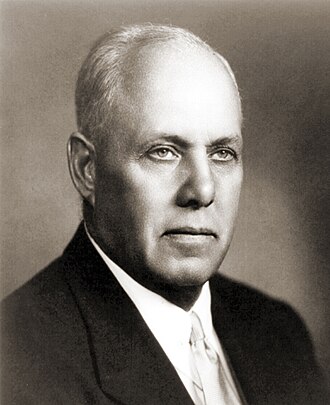
George Meany served as the president of the AFL-CIO throughout the entirety of the Nixon administration. During this period, he maintained a complex relationship with the president, supporting his Vietnam War policy while also being an early and vocal advocate for Nixon's impeachment following the Watergate scandal. Under his leadership, the AFL-CIO officially remained neutral in the 1972 presidential election. Meany was a powerful voice for American labor, lobbying for legislation such as the Occupational Safety and Health Act (OSHA) of 1970.
What Meany talks about on the tapes
Economic policy 8Vietnam War 6Foreign Policy 6Labor unions 4Labor relations 4Inflation 4Wage and price controls 3Pay Board 3Wage-price freeze 2Supreme Court appointments 2International Trade 2Domestic Policy 2
Conversations (21)
President Nixon met with AFL-CIO President George Meany and Assistant Secretary of Labor Willie J. Usery, Jr. to secure labor support for critical economic and legislative initiatives, specifically the continuation of the Supersonic Transport (SST) program and financial support for Lockheed. The President emphasized that these projects were vital for job creation and national industrial prestige, urging Meany to lobby key legislators for the necessary votes. They also discussed the status of the building trades unions, the administration's stance on apprenticeship programs, and the leadership transition within the Teamsters union, while touching upon the broader domestic economy and international trade challenges.
President Nixon met with the National Commission on Productivity to discuss the evolving state of the global economy and the United States' competitive position in the post-World War II era. The conversation focused on the rapid industrial growth of Japan and Western Europe, the emergence of China, and the necessity for the U.S. to enhance its productivity to maintain economic leadership. Nixon emphasized that while diplomatic and political tensions with the Soviet Union might fluctuate, long-term economic stability and international influence would depend on domestic production and effective global economic engagement.
President Nixon met with members of the National Commission on Productivity, including union leaders, corporate executives, and government officials, to discuss strategies for enhancing American economic productivity and competitiveness. The conversation focused on the role of government-industry cooperation, the importance of basic versus applied research in fostering technological innovation, and the challenges posed by foreign trade competition and environmental regulations. Participants emphasized the need to align private sector investment with national economic goals to ensure long-term stability and job growth in an increasingly global market.
President Nixon met with key labor leaders and administration officials to solicit input on the development of 'Phase II' of his economic program, following the conclusion of the initial 90-day wage and price freeze. The discussion centered on transitioning to a more permanent, yet flexible, mechanism for controlling inflation while maintaining the principles of collective bargaining and a free-market system. The participants debated the merits of tripartite boards—modeled after the War Labor Board—versus government-imposed mandates, with labor leaders emphasizing the need for voluntary compliance and equitable standards. Nixon concluded by establishing an October 1 deadline for the group to submit their formal views, underscoring the necessity of labor-management cooperation for the program's success.
Henry Kissinger contacted George Meany to provide advance notice of President Nixon's upcoming public announcement regarding a scheduled 1972 summit meeting in Moscow. Kissinger explained that the strategic goal of the summit is to balance Soviet and Chinese interests while advancing negotiations concerning Vietnam and the Middle East. He concluded the call by promising to meet with Meany in the following days to provide a more detailed briefing on the administration's foreign policy strategy.
President Nixon consulted with aides Patrick J. Buchanan and Henry A. Kissinger regarding economic policies, the impending announcement of a U.S.-Soviet Union summit, and potential Supreme Court appointments. The participants discussed strategies for the Pay Board, the timing of foreign policy announcements, and the political implications of prospective judicial candidates. Significant actions included coordinating briefings for labor leader George Meany and finalizing preparations for the President’s public announcement regarding upcoming diplomatic negotiations.
President Nixon, H. R. Haldeman, Henry Kissinger, and George Shultz met to discuss recent developments regarding upcoming summits with the Soviet Union and the status of domestic labor relations. Kissinger provided a status update on the diplomatic conditioning for the Soviet visit and emphasized the strategic importance of the ongoing negotiations with the USSR and the PRC. Concurrently, Shultz and the President coordinated a public response to organized labor’s agreement to serve on the Pay Board, deciding to frame the cooperation as a victory for the country’s economic program rather than a political win for either side.
President Nixon and AFL-CIO President George Meany discussed the administration's economic policies, specifically coordinating on inflation control and labor participation. The two men confirmed their mutual agreement on a precise policy statement regarding economic goals, which had been reviewed by Treasury Secretary John Connally. Additionally, Nixon signaled his intent to issue a public statement welcoming organized labor's cooperation, while acknowledging their continued disagreement regarding specific tax proposals.
President Nixon consulted with Secretary of State William Rogers and AFL-CIO leader George Meany to gauge their reactions to his recent Supreme Court nominations of Lewis F. Powell, Jr. and William H. Rehnquist. The conversations emphasized the nominees' commitment to law and order and their lack of anti-labor bias, which helped secure Meany’s preliminary support. Nixon also reflected on the authorship of his October 21 speech and discussed the ongoing challenges of finding qualified female candidates for judicial appointments.
President Nixon met with members of the newly formed Pay Board and Price Commission to discuss the administration's strategy for curbing inflation through the wage-price freeze. Nixon emphasized his preference for a system reliant on voluntary public support rather than the rigid, expansive government controls characteristic of the Office of Price Administration. He thanked the board members for their service and sacrifice, acknowledging that their mission to stabilize the economy without long-term government intervention presented a significant challenge. The President also contextualized these domestic economic efforts within his broader foreign policy agenda, highlighting the importance of managing relations with the Soviet Union and China to maintain global peace.
President Nixon met with aides Alexander P. Butterfield and Stephen B. Bull to finalize logistical arrangements, including helicopter transport for a trip to Camp David and upcoming photography opportunities. Following these internal briefings, the President conducted a brief follow-up telephone call with AFL-CIO President George Meany. The discussion primarily focused on administrative scheduling and coordinating personal travel plans prior to the President's upcoming engagements.
President Nixon reached out to AFL-CIO President George Meany to offer private briefings regarding ongoing Vietnam peace negotiations and defense budget priorities. Nixon proposed that Henry Kissinger and George Shultz meet with Meany to provide detailed insights into the administration's strategic efforts, specifically emphasizing the necessity of an honorable withdrawal from Vietnam and the need to counter the growing Soviet naval threat. Meany agreed to the briefings, and both parties discussed the importance of maintaining a firm stance against congressional deadline amendments that could undermine the administration's bargaining position.
President Nixon and his senior staff, including H.R. Haldeman, met to evaluate the public and political reaction to the President's recent televised speech regarding the mining of North Vietnamese harbors. The discussion focused on maintaining a firm, "hawkish" stance to emphasize the administration's resolve and ensuring that supporters mobilize to counteract potential criticism from Congress and the media. Nixon directed his team to maximize public displays of support and address logistical issues, such as jammed Western Union lines, to ensure his message of "iron determination" remained the dominant narrative.
President Nixon reached out to AFL-CIO President George Meany to seek labor's endorsement for his recently announced decision to implement a naval blockade of North Vietnam. Nixon emphasized the necessity of the action to prevent foreign aggression, and Meany signaled his willingness to back the administration's policy. The brief exchange concluded with Meany promising to issue a supportive public statement the following morning.
President Nixon and AFL-CIO President George Meany held a brief, cordial telephone conversation primarily to exchange birthday greetings regarding Nixon’s grandson. Meany informed the President that the national building trades had unanimously adopted the administration’s position, which Nixon praised as the "guts" of the labor movement. The two concluded the call by briefly discussing the President's ongoing work on his upcoming acceptance speech and local weather conditions.
President Nixon initiated this brief exchange with AFL-CIO President George Meany to offer personal birthday congratulations to Meany and his grandson. The conversation served as a social gesture to build rapport rather than to address policy or administrative business. The brief interaction concluded with an acknowledgment of their shared commitment to the labor movement's values.
Herbert Stein, Donald Rumsfeld, and George Shultz met with prominent labor union leaders to discuss the state of the economy and federal productivity initiatives. The discussion touched upon current economic indicators, including farm prices, and featured planning for an upcoming productivity exhibit at the Smithsonian Institution. The meeting served as a consultative session between the administration and labor representatives regarding ongoing economic policy and the Productivity Commission's objectives.
President Nixon met with the National Commission on Productivity, including various labor union leaders and administration officials, to express his appreciation for their voluntary service and to emphasize the necessity of labor-management cooperation in national economic policy. Nixon encouraged the members to offer input beyond labor issues and reaffirmed that his door remains open for direct engagement between the White House and organized labor. The discussion also touched on specific policy concerns, including maritime programs, grain exports, and the challenges faced by local unions.
President Nixon, Alexander Haig, and Melvin Laird met to coordinate the announcement of Laird's return to the administration as Counselor for Domestic Affairs. They discussed strategies for managing press inquiries, particularly regarding Watergate, and debated potential economic interventions like a wage-price freeze. The group also planned Laird's forthcoming schedule, which included meetings with key congressional figures and labor leader George Meany to ensure a smooth transition and maintain party unity.
President Nixon and Melvin R. Laird called AFL-CIO President George Meany to personally inform him of Laird's appointment as Counselor to the President for Domestic Affairs. During the conversation, Laird clarified that his new role would include overseeing the Cost of Living Council and wage-price policy. The participants agreed to meet once Meany recovered from a recent bout of tendinitis to discuss these economic issues in greater detail.
President Nixon met with the President's Advisory Committee on Labor-Management Policy to discuss the state of the national economy and potential strategies for curbing inflation, specifically focusing on the recent surge in food prices. Participants, including key labor leaders like George Meany and Leonard Woodcock, debated the merits of various policy options, including a possible price freeze versus maintaining the flexibility of Phase III controls. Nixon emphasized his administration's goal of returning to a free economy while acknowledging the need for potential short-term actions to restore public confidence and address the public's anxiety over rising costs.