Nixon, Richard M. (President)
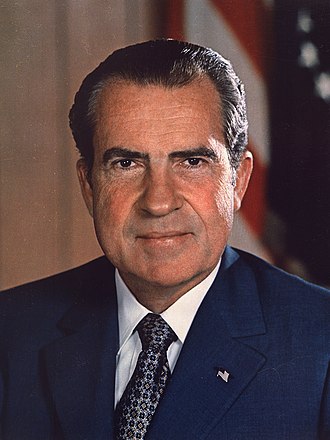
Richard M. Nixon served as the 37th President of the United States from January 1969 until his resignation in August 1974. In February 1971, he ordered the installation of a secret voice-activated taping system in the White House to preserve a historical record of his administration. Until the system's existence was revealed and dismantled in July 1973, the tapes captured Nixon directing major foreign policy initiatives, such as the opening to China, as well as his central role in the Watergate cover-up.
What Nixon talks about on the tapes
White House operations 4,718Presidential scheduling 2,225Public relations 1,784Presidential schedule 1,782Vietnam War 1,693Logistics 1,650Manolo Sanchez 1,626White House communications 1,400White House administration 1,399Presidential communication 1,243Henry Kissinger 1,191Foreign Policy 1,183
Conversations (21,010)
— Page 162 of 211President Nixon, Henry Kissinger, and Press Secretary Ronald Ziegler coordinated the final revisions and distribution protocol for the President's upcoming speech regarding the Vietnam peace settlement. The participants emphasized strict security for the announcement text, mandating that no media access or 'sneak previews' occur until after the President’s delivery. Nixon and Kissinger finalized specific phrasing edits to ensure the speech's tone and message were accurate before its release.
President Nixon contacts the White House operator to place an outgoing call to speechwriter Raymond K. Price, Jr. This brief interaction serves as a routine administrative request to facilitate direct communication with a senior advisor. No substantive policy matters or decisions are discussed beyond the initiation of the connection.
President Nixon rehearsed his televised address to the nation regarding the imminent conclusion of the peace agreement in Vietnam. This session served as a final preparation for his public announcement to the American people that the war was ending. The President focused on refining his delivery and messaging to ensure the historic news was communicated effectively.
President Nixon held a private meeting in the Old Executive Office Building with an unidentified individual to discuss matters related to his professional schedule. Due to the lack of available documentation or transcript, the specific objectives and outcomes of the session remain unverified. The discussion concluded when the visitor departed the office shortly before 8:08 pm.
President Richard Nixon utilized his office in the Old Executive Office Building to rehearse his televised Address to the Nation regarding the Vietnam peace agreement. This session served as a final preparation for the formal announcement of the conclusion of hostilities and the restoration of peace. The president focused on refining his delivery to ensure the historical significance of the agreement was clearly communicated to the American public.
President Richard Nixon met with his longtime valet, Manolo Sanchez, in the Old Executive Office Building to handle personal administrative matters. The brief encounter focused on the delivery of unspecified items or correspondence. No major policy discussions occurred during this informal interaction.
President Nixon met to rehearse his upcoming televised address regarding the conclusion of peace agreements in Vietnam. This session served as a final preparation for the President to communicate the end of American military involvement to the public. The primary objective was to ensure the delivery effectively framed the administration's role in achieving a peace agreement.
President Richard Nixon utilized this session to rehearse his upcoming televised address announcing the conclusion of the Paris Peace Accords. The focus of the recording was primarily on the delivery and tone of his speech regarding the end of the Vietnam War. This preparation served as a final refinement of his message to the nation before the formal restoration of peace.
President Nixon rehearsed his televised address to the nation regarding the successful conclusion of peace negotiations to end the Vietnam War. He refined the language and delivery of the speech intended to inform the public of the agreement reached to restore peace. This preparation ensured the President was ready to formally announce the cessation of American involvement in the conflict.
In this meeting, President Nixon met with his Vice President, Cabinet, and senior staff to provide a briefing on the impending Vietnam cease-fire agreement, scheduled for signing on January 27, 1973. National Security Advisor Henry Kissinger detailed the arduous negotiation process, emphasizing that the agreement achieved key U.S. objectives including the return of POWs, the withdrawal of American forces, and the right of South Vietnamese self-determination. Following the Vietnam discussion, the President transitioned to a briefing on the fiscal year 1974 budget, where Director Caspar Weinberger presented plans for spending cuts and program terminations designed to maintain a full-employment balance and avoid tax increases.
President Nixon met with bipartisan Congressional leadership, Vice President Agnew, and Henry Kissinger to discuss the imminent Vietnam peace settlement and the subsequent withdrawal of U.S. forces. The participants reviewed key provisions of the agreement, including cease-fire terms, the release of prisoners of war, and the complexities surrounding continuing conflicts in Laos and Cambodia. Nixon coordinated with the congressional delegation regarding the distribution of briefings to broader legislative members and finalized plans for his public address announcing the agreement.
President Nixon contacted the White House operator to facilitate an outgoing call to Stephen B. Bull. The brief communication served solely as a logistical request to establish a connection with his aide. No further substantive policy matters or decisions were discussed during this brief exchange.
President Richard Nixon met with Ronald Ziegler and production staff in the Oval Office to conduct a final technical rehearsal for his televised address regarding the Vietnam cease-fire. During the session, the team finalized camera cues, countdown procedures, and logistical coordination for the live broadcast. The President practiced his delivery to ensure a smooth announcement of the peace agreement, which officially concluded the war and initiated the withdrawal of American forces.
President Nixon and speechwriter Raymond K. Price, Jr. discuss the positive reception of the Vietnam peace settlement announcement and the notably negative reaction from the press corps. Nixon recounts how Julie Nixon Eisenhower observed CBS reporters appearing distraught by the news, which the President interpreted as a sign of intellectual frustration among journalists who had anticipated a failure. Nixon also reflects on his successful briefing of Congressional leaders and draws stylistic parallels between the clarity of the announcement and his recent inaugural address.
President Nixon initiates a brief telephone call to the White House operator to request a connection with Charles W. Colson. The primary purpose of this interaction is to facilitate communication between the President and his special counsel late in the evening. No substantive policy matters or further developments were recorded in this short exchange.
President Nixon contacted the White House operator to place an urgent telephone call to General Alexander M. Haig. This brief interaction served solely as a logistical request to establish communication with his close advisor. No further substantive policy matters or decisions were discussed during this brief exchange.
President Nixon and Charles Colson discussed the positive public reception of the Vietnam peace settlement and formulated a strategy to leverage this momentum against political critics and the press. They coordinated efforts to mobilize allies, including labor leaders, veterans' groups, and supportive members of Congress, to issue statements that would vindicate the administration's policy and neutralize anti-war voices. Nixon explicitly directed Colson to ensure the White House staff maintained intense pressure throughout the night to control the media narrative and rally the 'silent majority.'
President Nixon instructed the White House operator to cancel a pending call to Alexander Haig, noting that he had already obtained the necessary information elsewhere. He also addressed a request from his brother, Donald Nixon, explicitly refusing to take the call himself. Nixon directed the operator to refer his brother to his daughter, Julie Nixon Eisenhower, instead.
President Nixon contacted the White House operator to facilitate a personal telephone call to his daughter, Julie Nixon Eisenhower. The brief interaction served exclusively as a procedural request for the operator to connect the President to his daughter. No policy matters or substantive political issues were discussed during this brief exchange.
President Nixon asks his daughter, Julie Nixon Eisenhower, to contact his brother, F. Donald Nixon, to explain his unavailability. The President instructs Julie to tell his brother that he has retired early to prepare for an 8:00 a.m. breakfast briefing with congressmen. This request appears intended to manage potential political inquiries regarding a recent broadcast without the President having to speak to his brother directly.
President Nixon directs the White House operator to connect him with National Security Advisor Henry Kissinger. This brief administrative exchange serves to facilitate urgent communication between the President and his advisor during the late evening. No further substantive policy matters were discussed during this specific interaction.
President Nixon and Henry Kissinger discuss the overwhelmingly positive public and political reception of the Vietnam peace settlement, contrasting it with the visible frustration of the news media, specifically CBS reporters. Nixon expresses satisfaction at having outmaneuvered congressional critics like Mike Mansfield and Tip O'Neill, while affirming his intent to bypass the established intellectual elite. The two agree on the effectiveness of Nixon's recent address and coordinate Kissinger’s upcoming schedule for congressional briefings.
President Nixon contacted the White House operator to facilitate an urgent connection to his Chief of Staff, H.R. Haldeman. The brief exchange served as a logistical bridge to initiate a private communication between the two men. No substantive policy discussions occurred during this operator-assisted request.
President Nixon and H. R. Haldeman discussed the overwhelmingly positive public and political reception to Nixon's televised announcement of the Vietnam peace settlement. They reflected on the strategic decision to deliver the speech independently rather than addressing Congress, which they believed allowed for a more powerful and controlled message. Looking forward, they finalized plans for Henry Kissinger to conduct briefings in both the House and Senate to provide detailed analysis and handle legislative inquiries.
President Nixon and Charles Colson reviewed the positive public and political reception to the President’s announcement of a Vietnam ceasefire. They discussed strategies to maintain momentum and dominate the news cycle by coordinating favorable public statements from labor leaders, veterans, and administration allies while actively countering critical press coverage. Nixon and Colson also evaluated the possibility of delaying the President’s upcoming budget message to ensure that the Vietnam settlement remained the primary focus of public attention.
President Nixon met with his aide Stephen B. Bull to coordinate his daily schedule and upcoming engagements. The discussion focused on preparations for a Cabinet meeting, specifically ensuring the participation of George H. W. Bush and John A. Scali. Additionally, the President reviewed plans regarding an interaction with Charles W. Colson.
President Nixon met with his aide Stephen B. Bull to review his daily schedule and manage administrative tasks. The discussion centered on upcoming appointments, specifically mentioning Charles W. Colson, and the processing of documents requiring the President’s signature. This brief session served as a logistical coordination meeting to ensure the efficient flow of executive paperwork and daily priorities.
President Nixon met with Charles Colson to coordinate a public relations strategy following the announcement of the Vietnam peace settlement. The President directed Colson to aggressively shape media coverage, cultivate supportive commentary from scholars, and solicit positive reactions from key constituencies, including labor "hardhats." Nixon emphasized the necessity of framing the settlement as a major achievement while countering criticism from political opponents and the press.
President Nixon, Henry Kissinger, and Ronald Ziegler met to discuss public relations strategies surrounding the recently announced Vietnam peace settlement. The participants focused on managing the press, specifically addressing how to handle potentially hostile questioning from journalists like Marvin Kalb and Helen Thomas regarding the agreement. Nixon emphasized the importance of controlling the narrative regarding the release of Prisoners of War (POWs) and directed Kissinger on how to present these details during his upcoming briefings.
President Nixon met with his aide Stephen B. Bull to review logistical details regarding his upcoming schedule and the first meeting of his new Cabinet. The discussion focused on coordinating the assembly of the Cabinet and arranging for official photographer Oliver F. Atkins to document the proceedings. No major policy decisions were reached, as the conversation served primarily as an administrative briefing on presidential scheduling.
President Nixon met with a bipartisan group of Congressional leaders to provide a detailed briefing on the recently finalized Vietnam Peace Agreement and its implementing protocols. Henry Kissinger explained the strategic nuances of the agreement, including the status of North and South Vietnam, the mechanisms for the International Control Commission, and the timeline for the withdrawal of U.S. forces and the release of prisoners of war. The President emphasized the necessity of bipartisan Congressional support to ensure the agreement's stability and signaled that the administration would work with Congress to frame a positive resolution regarding the end of the war.
President Nixon met with his aide Stephen B. Bull to coordinate administrative matters and review the President's upcoming schedule. The brief discussion primarily focused on the activities and responsibilities of personal secretary Rose Mary Woods. No major policy decisions were recorded during this logistical check-in.
President Nixon, H. R. Haldeman, and Stephen B. Bull met to coordinate logistics for Lyndon B. Johnson’s upcoming funeral and discuss broader political strategy. The discussion covered the President's public relations efforts regarding the recent Vietnam settlement, including managing press and congressional reactions, alongside ongoing budget considerations. They also addressed sensitive administrative matters, including the kidnapping of an American diplomat in Haiti and developments related to the Watergate-linked Senate testimony involving Committee to Re-elect the President officials.
President Richard Nixon met with his personal valet, Manolo Sanchez, in the Old Executive Office Building to discuss personal arrangements. The brief interaction focused primarily on the coordination of a food order for the President. No other policy matters or significant administrative decisions were recorded during this segment of the meeting.
President Nixon and his valet, Manolo Sanchez, engaged in an informal discussion following the President's public announcement regarding the Vietnam peace settlement. The conversation focused on the significance of the peace agreement and the duty associated with the President's role. No official policy decisions were made during this brief exchange.
President Nixon met with his personal valet, Manolo Sanchez, to discuss the delivery of items coordinated by H.R. Haldeman. The brief exchange involves logistical arrangements and personal financial matters between the two men. No major policy developments occurred during this administrative interaction.
President Nixon met with his personal valet, Manolo Sanchez, in the Executive Office Building to handle routine administrative tasks. The discussion primarily focused on placing a food order for the President. No substantive policy decisions or political developments were recorded during this brief encounter.
President Nixon met with his personal aide, Manolo Sanchez, in the Old Executive Office Building to handle personal matters. The discussion primarily focused on placing a food order for the President. No significant policy developments or political actions were recorded during this brief administrative exchange.
President Richard Nixon met with his valet, Manolo Sanchez, in the Old Executive Office Building. The brief interaction consisted primarily of personal greetings and a discussion regarding the President’s upcoming schedule. The conversation concluded with mention of Charles W. Colson before Sanchez departed.
President Richard Nixon met with his personal valet, Manolo Sanchez, in the Old Executive Office Building to discuss personal matters. The primary focus of the brief interaction involved the coordination of a food order. No significant policy developments or political decisions resulted from this administrative exchange.
President Nixon met with his aide Stephen B. Bull to coordinate his daily schedule and manage administrative logistics. The discussion centered on arrangements for an upcoming Cabinet meeting and the scheduling of a visit with journalist Willard Edwards. Additionally, the two briefly addressed matters regarding personal photographs and potential visitors to the Oval Office.
President Nixon held a meeting with an unidentified individual in the Oval Office to discuss administrative logistics. The conversation primarily focused on placing a food order for the President. No significant policy developments or substantive political matters were recorded during this brief exchange.
President Nixon contacted the White House operator to facilitate an immediate connection with his aide, Stephen B. Bull. This brief administrative communication served as a functional request to initiate a follow-up conversation with a member of the President's staff. No further substantive dialogue occurred during this specific exchange.
President Nixon interacted with the White House operator to facilitate an outgoing call. The discussion primarily functioned as a logistical bridge to connect the President with another party. No substantive policy matters or strategic decisions were addressed during this brief exchange.
President Nixon met with Stephen Bull to finalize complex logistical arrangements for attending the funeral of Lyndon B. Johnson, including motorcade routes, wreath-laying ceremonies, and interactions with the Johnson family and congressional delegates. The discussion also addressed a request for biographical data regarding the death dates of several former U.S. presidents and involved planning for a separate meeting with a retiring Chicago Tribune journalist. These instructions ensured the President’s itinerary remained synchronized with the state funeral proceedings.
President Nixon and Charles Colson met to discuss strategies for managing public and media perception regarding the impending Vietnam peace settlement. The conversation focused on coordinating talking points for upcoming Cabinet meetings and briefing television network commentators to ensure consistent messaging on the agreement's six key points. They specifically examined the role of Henry Kissinger in these media efforts and evaluated the effectiveness of recent public communication strategies.
President Nixon met with his aide Stephen B. Bull to finalize logistical arrangements regarding the President's attendance at the upcoming funeral for Lyndon B. Johnson. They specifically discussed the necessity of minimizing interruptions and ensuring smooth travel conditions for the President. The conversation concluded with instructions regarding the delivery of a report to address these scheduling concerns.
President Nixon met with H. R. Haldeman and Ron Ziegler to discuss the successful conclusion of the Vietnam peace negotiations and the favorable press coverage following the President's recent televised address. The participants analyzed the positive public reception and the strategic effectiveness of Henry Kissinger's recent press briefings in neutralizing critical questioning. Additionally, the group reviewed logistics for upcoming events, including a memorial for Lyndon B. Johnson, and issued directives to limit administration participation in an energy symposium.
President Nixon met with his Vice President, Cabinet members, and senior staff to conduct a briefing on the upcoming federal budget. The discussion focused on the necessity of fiscal restraint, including the reduction and termination of certain government programs, to avoid tax increases and curb inflationary pressures while maintaining an expanding economy. Cabinet members analyzed projections for the 1974 and 1975 budgets, emphasizing the shift in spending priorities from defense toward human resources and the importance of presenting the budget to Congress and the public as a responsible alternative to higher taxation.
President Nixon and his Cabinet members strategized on how to promote the administration’s 1974 budget and defend proposed spending cuts against inevitable Congressional and lobbying opposition. The participants emphasized shifting from a constituency-based political strategy to a national message centered on fiscal responsibility, specifically using the themes of 'jobs' and 'taxes' to appeal to working-class voters. Nixon underscored the necessity of forcing Congress to accept accountability for spending, ultimately positioning the administration to blame Democrats if tax increases become required to fund legislative priorities.
President Nixon and Stephen B. Bull met briefly in the Oval Office to coordinate administrative logistics. The conversation focused on reconciling scheduling details and confirming specific internal references, likely related to the President's upcoming appointments. The meeting concluded quickly after these brief logistical clarifications were addressed.
President Nixon and Press Secretary Ronald Ziegler coordinate logistics for an upcoming meeting with columnist Willard Edwards and his wife. The President expresses his desire to see Edwards before an evening reception and arranges for the couple to be transported via White House car. The discussion focuses on ensuring Edwards receives appropriate attention, including scheduling adjustments for cabinet members to facilitate the interaction.
President Nixon met with veteran journalist Willard Edwards and his wife to congratulate them on their 50th wedding anniversary and present them with gifts. Following a brief photo session with White House photographer Ollie Atkins, the conversation turned toward the political climate surrounding the recent Vietnam peace settlement. Nixon expressed satisfaction with the terms of the agreement, noting that critics who previously demanded peace were now frustrated by the administration's successful conclusion of the conflict.
President Nixon met with Stephen B. Bull, Manolo Sanchez, and Ronald L. Ziegler to coordinate administrative tasks at the end of the workday. The primary focus involved the President's upcoming schedule and the secure transport of materials to the Executive Office Building. Nixon specifically directed the staff to ensure a speech located in his desk was placed into his briefcase for transport.
President Nixon contacted the White House operator to request an outgoing call to his special counsel, Charles W. Colson. The interaction served as a logistical administrative step to facilitate a direct conversation between the President and a key aide. No substantive policy matters were discussed during this brief request for assistance.
President Nixon consulted with the White House operator to coordinate communication with his close associate, Charles G. “Bebe” Rebozo. After confirming the status and expected arrival time of Charles W. Colson, the President requested that the operator initiate a call to Rebozo. The interaction served as a logistical bridge to facilitate private presidential correspondence.
President Nixon and Charles Colson discussed public relations strategies to capitalize on the positive reception of the Vietnam peace settlement following the President's televised address. The conversation focused on mobilizing political allies, including Henry Cabot Lodge, Melvin Laird, and George H.W. Bush, to champion the agreement and counter criticism from political opponents. They also evaluated media coverage and prioritized maintaining the momentum of the administration's foreign policy achievements over immediate domestic budget confrontations.
President Nixon and Bebe Rebozo discussed the logistics of Rebozo's upcoming attendance at Lyndon B. Johnson's funeral as the President's representative. They reviewed the presentation of ceremonial gifts for the Johnson family and touched upon the public reception of Nixon's recent Vietnam peace announcement. Additionally, Rebozo suggested that the President send a personal emissary to greet released POWs, while Nixon confirmed his upcoming visit to Florida.
President Nixon instructed the White House operator to place an outgoing call to his Chief of Staff, H.R. Haldeman. This brief interaction served solely as a logistical request to facilitate communication between the President and his top aide. No substantive policy discussions or decisions occurred during this brief administrative exchange.
President Nixon directs H. R. Haldeman to convene a meeting with John Ehrlichman, George Shultz, and Charles Colson to discuss shifting the administration's public relations focus from the recent Vietnam settlement to domestic budget issues. Nixon cautions against prioritizing the budget debate, fearing it would allow political opponents to pivot away from the Vietnam issue where they are currently on the defensive. He requests that Colson attend the meeting to provide a perspective aligned with Labor Secretary Peter Brennan’s warnings against engaging in domestic battles on the opponents' terms.
President Nixon initiates a brief communication with the White House operator to facilitate a connection with his aide, Stephen B. Bull. The exchange serves solely as a logistical request for the operator to place the call. No substantive policy discussions or further developments occur during this brief interaction.
President Nixon dictated a memorandum for his files to document internal reflections regarding the death of former President Lyndon B. Johnson and the upcoming memorial services at the Capitol. The recording also touches upon the administration's strategic goals for the Vietnam settlement, emphasizing the commitment to achieving a "peace with honor." The dictation serves as an official record of the President's private assessments of these high-level political and foreign policy matters.
President Nixon met with H. R. Haldeman to dictate a memorandum regarding the framing of the Vietnam peace settlement. The discussion focused on establishing a public relations strategy to define the agreement as "peace with honor" and secure support against political opposition. They emphasized the importance of managing congressional relations and clearly communicating the impact of the administration's policies on South Vietnam's future and the return of prisoners of war.
President Nixon held a brief, early-morning meeting with an unidentified individual in the Old Executive Office Building. The conversation is largely unintelligible, containing cryptic references to the "strength and power of the sea," and yields no clear substantive policy discussion or actionable directives. Consequently, the meeting remains a fragment of the taping system with no discernable historical or political outcome.
President Nixon held a brief, routine interaction with the White House operator while located in his Executive Office Building workspace. The primary purpose of this contact involved managing the President's immediate telephonic communications. No substantive policy discussions or major administrative decisions occurred during this brief exchange.
President Nixon coordinated with Stephen B. Bull to arrange a meeting with H.R. Haldeman regarding revisions to an upcoming speech. The President established a strict timeline to review these materials before his departure for a funeral later that morning. Bull was tasked with confirming Haldeman's availability to ensure the briefing occurred between 8:45 and 9:15 AM.
President Richard M. Nixon and personal aide Stephen B. Bull held a brief meeting in the Old Executive Office Building to conduct routine administrative business. This interaction served to facilitate the President's immediate morning schedule or personal logistical requirements. No significant policy decisions were recorded during this one-minute exchange.
President Nixon met with an unknown individual in the Old Executive Office Building to discuss scheduling matters. Chief of Staff H. R. Haldeman was also present during the discussion. The primary focus of the meeting centered on administrative coordination regarding the President's upcoming agenda.
President Nixon met briefly with his personal aide, Stephen B. Bull, to discuss administrative matters regarding the President's daily schedule. The session served as a logistical coordination meeting to review upcoming appointments and priorities. No major policy decisions were recorded during this short briefing.
President Nixon utilized a brief session in his Executive Office Building suite to dictate a memorandum. The recording captures the President engaged in the formal process of documenting official correspondence or instructions. No other participants were involved in the brief dictation.
President Nixon and H. R. Haldeman coordinated the strategic rollout of the upcoming 1974 budget speech, focusing on press coverage, congressional relations, and the necessary integration with the recent Vietnam settlement. They reviewed cabinet meeting logistics and potential personnel assignments, weighing the roles of various advisors like George Shultz and John Ehrlichman. Stephen B. Bull joined briefly toward the end to finalize logistical arrangements for the President’s travel to Texas to attend the funeral of Lyndon B. Johnson.
President Nixon met with his personal valet, Manolo Sanchez, in the Oval Office to conduct a brief administrative review. The discussion centered on logistics regarding the President’s daily schedule and upcoming personal arrangements. No major policy decisions were reached during this short interaction, which served primarily to manage the President's routine movements.
President Nixon and Stephen B. Bull met to discuss administrative and logistical matters regarding White House press relations. The conversation specifically addressed the role and activities of official White House photographer Oliver F. “Ollie” Atkins. No major policy shifts were recorded, as the discussion focused on the management of internal personnel related to public relations imagery.
President Nixon met with his aide, Stephen B. Bull, to conduct administrative business regarding official documentation and visual records. Their discussion focused on the handling of photographs, including the arrangements for days of mourning and the work of photographer Oliver F. Atkins. Additionally, the pair addressed the processing of a letter from W. Marvin Watson, which was referred to speechwriter Raymond K. Price, Jr. for further action.
President Nixon dictates a formal letter to W. Marvin Watson regarding the passing of former President Lyndon B. Johnson. Nixon commends Watson for his dedicated service, integrity, and significant contributions as a close advisor to Johnson. The correspondence serves as both a gesture of sympathy and a recognition of the professional bond between Watson and the late president.
President Nixon dictated a letter to Dr. George R. Davis, minister of the National Christian Church, to express his appreciation for the funeral services held for former President Lyndon B. Johnson. He specifically commended the choir’s performance and praised Davis for his qualities as a spiritual advisor and patriot. Nixon also incorporated a reflection on the recent Vietnam peace settlement, aiming to frame the agreement as a significant achievement for peace and honor.
President Nixon met with an unknown individual to discuss the administrative handling of correspondence. The primary focus of the discussion concerned the transcription of specific letters, with particular attention given to tasks assigned to Rose Mary Woods and Marjorie P. Acker. No further policy or strategic developments were recorded during this brief administrative exchange.
President Nixon, H.R. Haldeman, Manolo Sanchez, and Stephen B. Bull met to discuss administrative personnel changes, specifically regarding Secret Service staffing, and to coordinate the President's upcoming public relations and media strategy. A significant portion of the discussion addressed friction between John Ehrlichman and Charles Colson regarding policy advice, presidential speech themes, and the frequency of Nixon's televised appearances. Ultimately, the President decided to proceed with a radio address rather than a televised speech to avoid overexposure and concluded that both Ehrlichman and Colson should provide input on administration strategy.
President Nixon met with outgoing Israeli Ambassador Yitzhak Rabin to discuss the state of U.S.-Israel relations and Middle East regional stability. Following Rabin's departure, Nixon and Henry Kissinger transitioned to a tactical review of the recent Vietnam peace settlement, emphasizing the necessity of maintaining a firm stance with Congress and the media. The conversation also touched upon the political implications of Lyndon B. Johnson’s death and the President's upcoming diplomatic strategy regarding the war's conclusion.
President Nixon held a brief, one-minute meeting in the Oval Office with an unidentified individual. The discussion focused on the President's schedule, though the transcript remains undefined. The participants departed immediately following this short administrative exchange.
President Nixon met with an unidentified individual in the Old Executive Office Building to discuss administrative or personal matters. The available archival record is limited to a brief segment involving a food order, indicating the session lacked significant policy deliberations. Consequently, no substantive executive decisions or historical action items were recorded for this encounter.
President Nixon and H. R. Haldeman met to coordinate upcoming administrative priorities, including the development of the 1974 budget speech and preparations for the Vietnam peace settlement. They discussed strategies for managing executive privilege, congressional relations, and the evolving roles of staff members like John Ehrlichman. Additionally, the pair reviewed the President’s crowded schedule, which encompassed appointments for Cabinet swearing-in ceremonies, memorial events, and press engagement strategies.
President Nixon met with his personal valet, Manolo Sanchez, to facilitate the delivery of materials to speechwriter Raymond K. Price, Jr. The discussion centered on logistics involving an unnamed secretary to ensure the prompt transfer of these documents. This interaction highlights the routine administrative and staffing coordination managed by the President within the Executive Office Building.
President Richard Nixon met with his personal aide, Manolo Sanchez, in the Old Executive Office Building to discuss the delivery of a presidential speech. The brief interaction focused on the logistical arrangements or distribution strategy for the address. Sanchez concluded his duties and departed the office shortly thereafter.
President Nixon met with his valet, Manolo Sanchez, in the Old Executive Office Building to attend to personal and administrative matters. Their discussion centered on the handling of the President's coat and the finalization of a speech draft. The interaction concluded with Sanchez departing the office after assisting with these brief tasks.
President Richard M. Nixon met with an unidentified individual in his Old Executive Office Building workspace to conduct administrative business. Although no transcript or specific records of the discussion survive, the meeting took place during a critical period of the Nixon presidency. The encounter concluded without any documented action items or historical record of the topics addressed.
President Nixon, Charles Colson, and H.R. Haldeman met to coordinate public relations and legislative strategy surrounding the Vietnam peace settlement and the associated cease-fire announcement. The discussion focused heavily on managing press coverage, shaping the public image of Nixon’s leadership, and ensuring favorable congressional reactions to the administration’s actions. Participants also strategized on the handling of returning prisoners of war and the logistics of the President’s upcoming speeches and scheduling.
President Nixon met with his personal valet, Manolo Sanchez, and an unidentified individual in the Oval Office to briefly discuss the President's upcoming schedule. The encounter concluded shortly thereafter with an expression of thanks from the President. No substantive policy decisions were documented during this short exchange.
President Nixon met with his aide Stephen B. Bull to coordinate his upcoming schedule and administrative agenda. The discussion focused primarily on arranging meetings with key senior advisors John D. Ehrlichman and H. R. Haldeman. This brief session served as a logistical check-in to manage the President’s immediate workflow and high-level internal communications.
President Nixon and Stephen B. Bull reviewed the guest list for an upcoming state dinner honoring former Japanese Prime Minister Eisuku Sato. Nixon exercised strict control over the invitations, explicitly excluding various cabinet members, senators, and White House staff to focus on specific Japanese-American relations. Additionally, the pair briefly discussed logistics for a dinner honoring Georgia O'Keeffe and reviewed speech drafts for upcoming policy announcements.
President Nixon met with H.R. Haldeman and John Ehrlichman to discuss personnel staffing, legislative strategy, and the administration’s approach to managing congressional relations following his reelection. A significant portion of the discussion centered on Vice President Spiro Agnew’s recent attempts to assert independent policy initiatives, with Nixon and his aides expressing concern about Agnew's lack of coordination with the White House and his pursuit of public attention. The group also evaluated strategies for promoting the administration's budget and legislative agenda, specifically focusing on how to handle executive privilege claims and the confirmation of presidential assistants by Congress.
President Nixon initiated a brief telephone request through the White House operator to be connected with Richard M. Helms. The primary objective of the call was to facilitate immediate communication between the President and the outgoing Director of Central Intelligence. No further substantive policy matters were recorded during this connection process.
President Nixon consulted CIA Director Richard Helms regarding his upcoming appointment as Ambassador to Iran and his role in addressing the unstable situation surrounding Iranian oil. Nixon emphasized the need for Helms to exert broader influence over regional stability in the Persian Gulf, suggesting an early trip to the region despite Helms’s initial plans for a mid-March departure. Helms was instructed to consult with John Ehrlichman, Peter Flanigan, and John Connally to prepare for this mission, which aimed to consolidate U.S. interests and intelligence prior to an anticipated crisis.
President Nixon and his valet, Manolo Sanchez, briefly met in the Oval Office to coordinate the President's immediate morning schedule. The discussion focused on upcoming administrative arrangements involving Marjorie P. Acker and personal secretary Rose Mary Woods. The meeting concluded quickly with the President preparing to depart for an on-site appearance.
President Nixon and H. R. Haldeman met to coordinate logistics for upcoming White House events, including state dinners for foreign leaders and the management of Congressional guest lists. They discussed the protocol for hosting high-profile figures such as King Hussein of Jordan and Edward Heath, while addressing the need to balance traditional rank with a desire to broaden the invitation list to include new members. Additionally, they reviewed administrative staffing issues at the Department of Labor and strategies for ensuring positive press coverage regarding the Vietnam settlement.
President Nixon and Stephen B. Bull reviewed the day's upcoming schedule, focusing on a bill signing ceremony involving Caspar Weinberger and photo opportunities. Nixon provided specific instructions regarding the recipients of ceremonial pens and limited the scope of media coverage for meetings with Congressional and Republican leaders. The conversation concluded with Nixon emphasizing his preference for maintaining a controlled and streamlined public relations strategy for the day.
President Nixon and Ronald Ziegler discussed logistical arrangements for the upcoming 1974 budget presentation and addressed a pending Time Magazine inquiry regarding the commutation of Angelo De Carlo's prison sentence. Ziegler sought to clarify that the commutation was based on compassionate health grounds, denying any political influence from Vice President Agnew or Frank Sinatra. They also strategized on managing media relations, focusing on how Henry Kissinger should handle television interviews to ensure he properly credits the President's role in Vietnam negotiations.
President Nixon met with his aide Stephen B. Bull to coordinate his morning agenda. The discussion focused on finalizing the logistics for upcoming meetings with Republican Congressional leaders, specifically involving John G. Tower, John J. Rhodes, and Roy L. Ash. No significant policy decisions were recorded during this brief scheduling synchronization.
President Nixon met with Republican congressional leadership to outline his fiscal strategy for the 1974 budget, emphasizing the necessity of expenditure control to avoid tax increases and curb inflation. Nixon and his advisors discussed the use of budget impoundments to maintain a spending ceiling of $269 billion, framing this approach as a critical move for economic prosperity despite the anticipated pushback from special interest groups. The meeting concluded with a call for Republican leaders to unify behind the administration's fiscal restraint and to clearly communicate that budget cuts are essential for maintaining national economic stability.
President Nixon met with Stephen B. Bull to coordinate the scheduling of upcoming meetings and social engagements. The discussion focused on arrangements for Henry Kissinger, Indonesian Foreign Minister Adam Malik, and visiting dignitaries, including Eisaku Sato and King Hussein of Jordan. Bull sought clarification on specific logistical protocols and instructions regarding the President's public appearances and reception requirements.