Nixon, Richard M. (President)
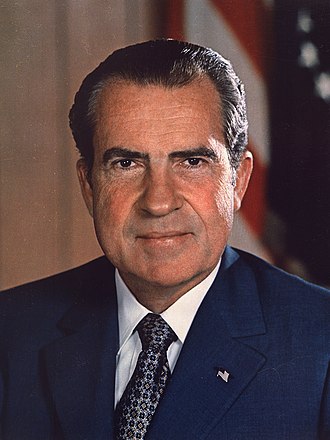
Richard M. Nixon served as the 37th President of the United States from January 1969 until his resignation in August 1974. In February 1971, he ordered the installation of a secret voice-activated taping system in the White House to preserve a historical record of his administration. Until the system's existence was revealed and dismantled in July 1973, the tapes captured Nixon directing major foreign policy initiatives, such as the opening to China, as well as his central role in the Watergate cover-up.
What Nixon talks about on the tapes
White House operations 4,718Presidential scheduling 2,225Public relations 1,784Presidential schedule 1,782Vietnam War 1,693Logistics 1,650Manolo Sanchez 1,626White House communications 1,400White House administration 1,399Presidential communication 1,243Henry Kissinger 1,191Foreign Policy 1,183
Conversations (21,010)
— Page 170 of 211President Nixon attempted to reach George H. W. Bush via telephone to discuss an unspecified matter. After the operator informed him that Bush was occupied at a press conference in Florida, the President decided not to pursue an immediate connection. Nixon instructed the operator to hold off on further attempts, indicating that the call was not urgent.
President Nixon contacted the White House operator to place an outgoing call to Congressman F. Edward Hebert. This brief exchange served as a procedural request to initiate a direct conversation with the Chairman of the House Armed Services Committee. No further policy discussions or substantive developments occurred during this connection attempt.
President Nixon held a brief, administrative meeting with a White House operator in the Executive Office Building. The discussion functioned as a logistical interaction to facilitate telephonic communication for the President. No specific policy matters or significant historical developments were recorded during this brief encounter.
President Nixon consulted with the White House operator in his Old Executive Office Building workspace to facilitate an outgoing call. The brief interaction served as a logistical bridge to connect the President with another party for further communication. No substantive policy matters or administrative decisions were documented during this exchange.
President Nixon held a brief, procedural interaction with the White House operator to facilitate an outgoing communication. No substantive policy matters or political discussions were recorded during this exchange. The conversation served primarily as an administrative bridge to connect the President to another party.
President Nixon calls Representative F. Edward Hébert to confirm that a personal request regarding appropriations has been resolved through the efforts of John Ehrlichman. Hébert expresses his gratitude for the President's intervention in clearing the bureaucratic hurdle. The pair concludes the brief conversation with Hébert praising a recent presidential speech and reaffirming their shared hardline stance on using military force to achieve diplomatic goals.
President Nixon and Representative F. Edward Hébert met briefly to follow up on the resolution of an unspecified personnel or procedural matter. The participants confirmed that the issue had been successfully settled and that appropriate credit would be granted. The conversation concludes with a brief, cryptic remark regarding the successful handling of the situation without collateral impact on uninvolved parties.
President Nixon consulted with RNC Chairman George H.W. Bush regarding Republican recruitment strategies, specifically emphasizing the importance of identifying and supporting viable female candidates. The two discussed organizational staffing for the Congressional Campaign Committee and personnel updates involving Ken Reitz and others. Additionally, Bush provided a positive report on his recent public relations efforts in Rochester, New York, where he promoted the administration's record on human resources spending and economic policy.
President Nixon and RNC Chairman George H.W. Bush discuss personnel recommendations and the recruitment of prospective speakers for Republican Party efforts. The brief exchange touches on the selection of qualified women for representative roles and acknowledges current party spending concerns. Bush confirms that he is receiving a positive reception as he continues to manage the organization's financial and outreach strategies.
President Nixon contacted the White House operator to facilitate a telephone call to Congressman Gerald R. Ford. This brief interaction served as an administrative request to establish communication between the President and the future Vice President. No substantive policy discussions occurred during this exchange, as the operator immediately proceeded to connect the two parties.
President Nixon attempted to reach Congressman Gerald R. Ford via the White House operator to discuss an unspecified matter. After learning that Ford was currently in transit to Grand Rapids, Michigan, the President instructed the operator to attempt the call again in approximately one hour. The brief exchange served solely as a logistical coordination effort to facilitate a future conversation between the two men.
President Nixon and H. R. Haldeman met briefly in the Old Executive Office Building to coordinate the Chief of Staff's upcoming schedule. The discussion focused on managing the President's priorities and ensuring the alignment of Haldeman's administrative commitments. No major policy decisions were recorded during this brief administrative exchange.
President Nixon consulted with a White House operator to facilitate an outgoing call. This brief interaction served as a logistical step to connect the President with another party for further communication. No substantive policy discussions or major decisions occurred during this brief exchange.
President Nixon held a brief, routine communication with the White House operator to facilitate an outgoing call. No substantive policy matters or political discussions were addressed during this short exchange. The interaction served strictly as an administrative step to connect the President with another party.
President Nixon and his advisors, including H. R. Haldeman and Henry Kissinger, held a wide-ranging meeting to discuss executive appointments, staff management, and domestic economic strategy. They specifically vetted candidates for the IRS, reviewed the organizational structure and personnel assignments for figures like Anne Armstrong, and strategized on maintaining public confidence in the face of inflation and price controls. Furthermore, Kissinger provided updates on diplomatic initiatives with the People's Republic of China, and the group analyzed the political impact of ongoing military developments in Laos and Cambodia.
President Nixon and Representative Gerald Ford discussed managing bipartisan congressional travel to the People's Republic of China, emphasizing the need for selective, balanced participation. The two also reviewed the positive reception of a recent White House event intended to reward political loyalty, specifically addressing concerns from members excluded due to their opposition to administration policies. Furthermore, they strategized on encouraging Democratic defections to the Republican Party and identified the importance of fostering congressional pride in the administration's Vietnam settlement.
President Nixon initiates a request through the White House operator to place a telephone call to Congressman Wilbur D. Mills. The conversation serves solely as an administrative coordination to facilitate direct communication between the President and the Representative. No substantive policy matters or further details were discussed during this brief exchange.
President Nixon and Congressman Wilbur D. Mills discussed the implementation of a 15% selective tariff surcharge to address international trade imbalances and the perceived failure of the Smithsonian Agreement. Mills argued that such drastic measures were necessary to force international cooperation, noting that he planned to issue a press release to pressure the administration into adopting this stance. Additionally, the pair briefly discussed the looming risk of a domestic milk shortage and potential regulatory adjustments to fluid milk and dairy prices to prevent supply deficits.
President Nixon met with an unidentified individual in the Old Executive Office Building to finalize logistical arrangements regarding a departure. The brief discussion concluded with a mutual agreement concerning the schedule. The participants terminated the meeting shortly thereafter.
President Nixon initiates a phone call to Alabama Governor George C. Wallace through the Camp David operator. The conversation is limited to the President requesting the operator's assistance in facilitating this connection. No substantive policy discussion or further interaction is captured in this brief administrative exchange.
President Nixon consulted with the Camp David operator to facilitate a telephone connection with George C. Wallace. This brief exchange served as a logistical arrangement to reach the Alabama governor, likely to discuss current political matters or administrative coordination. The primary action item resulting from the discussion was the initiation of the call to Wallace.
President Nixon called Governor George Wallace to request that he convey the administration's gratitude and support to attendees at a dinner honoring returning Vietnam Prisoners of War. The two leaders discussed the importance of achieving 'peace with honor' and recognized the fortitude of the POWs and their wives. Additionally, they briefly touched upon Wallace's recent health issues and confirmed arrangements for Wallace's upcoming participation in the National Governors' Conference.
President Nixon contacted Governor George C. Wallace to offer his support and appreciation for a dinner event honoring returning Vietnam War prisoners of war. Nixon emphasized that the nation’s success in securing 'peace with honor' was due to the resilience of the POWs and their families. The discussion centered on the importance of maintaining national pride and gratitude for the sacrifice and steadfastness of those affected by the war.
President Nixon contacted the Camp David operator to facilitate a personal phone call to Shelley Buchanan in Detroit. The brief exchange served as a logistical request to connect the President with his intended party. No substantive policy matters or administrative decisions were addressed during this interaction.
President Nixon met with his valet, Manolo Sanchez, and an unidentified individual at Camp David to coordinate the installation or transfer of communications equipment. The discussion centered on technical requirements for connecting specific devices, including references to Birch Lodge and other site locations. The primary action involved organizing the setup of this hardware to ensure consistent equipment functionality across the retreat.
President Nixon communicated with a Camp David operator to facilitate a telephonic connection. This brief exchange served an administrative function to assist the President in initiating a call while stationed at the Aspen Lodge. No substantive policy discussions or significant political developments occurred during this interaction.
President Nixon, Pat Nixon, Julie Nixon Eisenhower, and Manolo Sanchez gathered at the Aspen Lodge at Camp David for an informal family meeting. The interaction was largely social and domestic, characterized by casual exchanges among the President and his family members. No significant policy discussions or official government decisions were recorded during this session.
President Nixon contacted the Camp David operator to facilitate a telephone connection to National Security Advisor Henry A. Kissinger. This brief administrative exchange served as a logistical step to enable high-level communication regarding ongoing foreign policy matters. No substantive policy discussions occurred during this brief interaction.
President Nixon consulted with a Camp David operator to confirm the current whereabouts and transit status of National Security Advisor Henry Kissinger. The operator reported that Kissinger was en route to New York via Andrews Air Force Base and was accompanied by General Brent Scowcroft. Nixon determined the information was not urgent and declined the operator's offer to initiate a call with his staff at that time.
President Nixon and Henry Kissinger discuss international developments, media coverage, and diplomatic strategy while Kissinger is in New York. The conversation covers ongoing military actions in Laos and Cambodia, with Nixon expressing indifference toward negative network news coverage regarding these strikes. They also evaluate the Middle East situation, criticizing the perceived rigidity of the Israeli government's negotiating stance while acknowledging the domestic political pressures influencing those policies.
President Nixon held a brief administrative interaction with the Camp David operator while stationed at the Aspen Lodge. The conversation served to address routine telecommunications or logistical needs required during the President's stay at the retreat. No policy decisions or substantive political discussions occurred during this exchange.
President Nixon met with William Hirsch at Camp David to discuss the arrangement and placement of furniture and amenities on the grounds. The conversation centered on the preferences for lounge chair locations, specifically comparing the sunroom and the pool area. No high-level policy decisions were recorded during this brief administrative exchange regarding the facility's layout.
President Nixon initiates a brief administrative communication with the Camp David operator to establish contact for a later time. The interaction serves as a routine coordination of presidential telecommunications during his stay at Aspen Lodge. No substantive policy discussions or major decisions occurred during this exchange.
President Nixon met with an unidentified individual at Camp David to coordinate his daily schedule and manage pending telephone calls. The brief discussion focused on logistical priorities, with the participants emphasizing the need to address specific action items within a constrained five-minute window. No significant policy decisions were recorded during this brief administrative exchange.
President Nixon consulted with the Camp David operator to facilitate a telephone connection with National Security Advisor Henry Kissinger. This administrative interaction was necessary to establish secure communication between the President and his advisor while Nixon was working from the Aspen Lodge. No substantive policy discussions were recorded during this brief logistical coordination.
President Nixon and Henry Kissinger spoke via telephone to coordinate communications while the President was at Camp David. The brief exchange served primarily to initiate a secure line for further high-level deliberations between the two leaders. No substantive policy matters were recorded, as the call functioned as a procedural step to establish contact.
President Nixon and Henry Kissinger met to discuss current press coverage and ongoing geopolitical tensions. The two men reviewed the positive reception of returning American POWs, noted the effectiveness of recent military strikes in Laos, and expressed frustration with critical media reports. Furthermore, Nixon criticized the Israeli government's lack of diplomatic flexibility in regional peace negotiations, contrasting it with more favorable recent developments in other international discussions.
President Nixon met with his longtime personal aide, Manolo Sanchez, at the Aspen Lodge study at Camp David. The brief audio segment contains applause, suggesting a moment of casual interaction or a commemorative gesture rather than a formal policy discussion. No significant substantive decisions or political strategies were recorded during this exchange.
President Nixon and his daughter, Tricia Nixon Cox, met at the Aspen Lodge at Camp David for a personal visit. The brief discussion primarily concerned the logistics surrounding the departure of a staff member or associate named Fina Sanchez. No major policy decisions were reached during this informal interaction.
President Nixon met with his personal valet, Manolo Sanchez, in the Old Executive Office Building to discuss his daily schedule. The conversation was brief and administrative in nature, focusing on the President's upcoming commitments. No significant policy decisions or major developments were recorded during this brief interaction.
President Nixon held a brief meeting with H. R. Haldeman to discuss internal administrative matters within the White House. The discussion focused on coordinating the President's schedule and managing ongoing executive priorities. No specific policy decisions were finalized during this brief interaction.
President Nixon and H. R. Haldeman met to discuss a variety of administrative and personal matters, including staff transitions for William Safire and potential social or cultural engagements. The conversation also touched upon broader governmental concerns, such as the ongoing investigation into North Vietnam, the FBI, and media-related subpoena issues. The participants weighed logistics for a possible live broadcast from Camp David while navigating sensitive national security discussions regarding the United Kingdom.
President Nixon met with H. R. Haldeman and Manolo Sanchez to dictate a memorandum regarding administrative strategies for managing White House staff, cabinet communications, and press relations. The discussion focused on establishing a systematic checklist for tracking congressional and media supporters versus critics, while also addressing planning for the upcoming visit of Italian Prime Minister Giulio Andreotti. Additionally, the President provided instructions regarding personal inquiries into his family history and directed efforts toward refining the administration's public rhetoric.
President Nixon met with his personal valet, Manolo Sanchez, in the Old Executive Office Building. The brief interaction consisted primarily of personal greetings and the exchange of an unspecified item for delivery. No significant policy discussions occurred during this brief encounter.
President Nixon consulted with an associate regarding the logistical management and public release of the official prisoner of war (POW) list. The discussion addressed the strategic implications of delaying this announcement and touched upon the broader context of the American agenda in Cambodia. Additionally, the participants coordinated on scheduling matters related to Henry Kissinger’s return from New York.
President Nixon met with his personal valet, Manolo Sanchez, in the Old Executive Office Building. The brief interaction centers on a minor equipment mishap, specifically involving a pen. No substantive policy or political matters were addressed during this encounter.
President Nixon summoned H. R. Haldeman to the Old Executive Office Building to coordinate a meeting involving Stephen B. Bull. The primary purpose of this discussion was to facilitate a planning session regarding the President's schedule. No further substantive policy issues were recorded in this brief logistical exchange.
President Nixon met with H.R. Haldeman and Stephen B. Bull to coordinate his upcoming schedule, specifically focusing on the management of White House social events and public relations strategies. They discussed minimizing repetitive guest lists for dinners and church services, while also addressing the President's concerns about press coverage and the need to control the administration's public goals for his second term. The conversation included decisions on the handling of potential Nobel Prize recognition and planning for future state visits, reflecting Nixon's desire to streamline operations and project a more disciplined executive image.
President Nixon met with his valet, Manolo Sanchez, in the Old Executive Office Building to discuss adjustments to the President’s upcoming daily schedule. The brief interaction focused on logistical coordination and planning for official duties. No significant policy decisions were recorded during this informal administrative exchange.
President Nixon met with his valet, Manolo Sanchez, to provide instructions regarding the handling of personal documents. Nixon requested that Sanchez bring several large envelopes from Rose Mary Woods to organize his papers. This interaction reflects the President's ongoing efforts to manage and secure his private files.
President Nixon met with his personal valet, Manolo Sanchez, to discuss the logistics surrounding his daughter Julie Nixon Eisenhower’s return. The President requested that Sanchez check on the specific timing of her arrival. No major political developments occurred during this brief personal exchange.
President Nixon met with his personal aide, Manolo Sanchez, in the Old Executive Office Building. The brief discussion primarily concerned the arrival of the President’s daughter, Julie Nixon Eisenhower. No significant policy decisions or governmental actions resulted from this personal interaction.
President Nixon met with his personal valet, Manolo Sanchez, in the Old Executive Office Building to attend to personal matters or routine domestic assistance. Given the lack of a transcript and the brief nature of the recorded interaction, the discussion remains primarily confined to private staff-related duties. No significant policy developments or administrative decisions are recorded as resulting from this encounter.
President Nixon and Press Secretary Ronald Ziegler met to coordinate responses for an upcoming press conference, specifically addressing economic policies, the status of the Fitzgerald case, and the administration's position on federal shield laws. Regarding the economy, they discussed clarifying the flexibility of wage-price guidelines and strategies to mitigate public concern over rising food prices. Nixon also directed Ziegler to investigate the Fitzgerald case while avoiding public escalation, and they finalized a cautious, technical stance on press shield laws to deflect criticism regarding press freedom.
President Nixon attempted to initiate a telephone call to First Lady Pat Nixon via the White House operator. Upon learning that the First Lady was already engaged in another conversation, Nixon declined to have his call put through or to interrupt her. The request was ultimately dropped after the President determined that the communication was not of an urgent nature.
President Nixon requested assistance from the White House operator to place an outgoing telephone call. The exchange served as a routine administrative task to facilitate communication through the White House switchboard. No substantive policy matters or political discussions were recorded during this brief administrative interaction.
President Nixon met with his aide, Stephen B. Bull, to address administrative tasks regarding the President's daily schedule. During this brief encounter, Bull presented a document requiring the President's signature and sought early consideration for specific items on the agenda. The meeting concluded immediately after these logistical matters were addressed.
President Nixon met with his personal valet, Manolo Sanchez, in the Old Executive Office Building. The brief interaction focused on the President's immediate desire to conclude the conversation and dismiss his aide. No substantive policy or political matters were addressed during this exchange.
President Richard Nixon contacted First Lady Pat Nixon to inform her of a scheduling change regarding his evening plans. He explained that he needed to have dinner at the White House to meet with National Security Advisor Henry Kissinger in preparation for a press engagement the following day. Mrs. Nixon acknowledged the update, and the brief conversation concluded with the confirmation of his revised itinerary.
President Nixon contacted the White House operator to place a direct telephone call to William L. Safire. The interaction served as a brief administrative request to facilitate communication with his speechwriter and advisor. No further substantive discussion took place during this brief exchange.
President Nixon met briefly with First Lady Pat Nixon to coordinate their evening and following day’s schedule. The President informed her of his upcoming meeting with Henry Kissinger and his need to work from the Old Executive Office Building to prepare for a press engagement. The discussion focused on these logistical arrangements and the President's immediate administrative priorities.
President Nixon met with H.R. Haldeman and William Safire to refine the administration's public relations and media strategy, specifically debating the merits of scripted Q&A sessions versus unrehearsed press conferences. The President emphasized a desire to control the narrative and minimize traps from adversarial reporters. Following these discussions, Henry Kissinger joined to brief the President on sensitive Middle East peace negotiations with Egypt, detailing plans for an interim settlement that could potentially involve the Soviet Union and eventually leverage Israel into deeper engagement.
President Nixon and William Safire discussed strategies to manage labor relations following recent economic discussions involving George Shultz and union leader George Meany. They agreed to avoid escalating tensions and to adopt a positive public posture regarding wage guidelines. Additionally, they reviewed the bureaucratic friction between the National Security Council and budget officials concerning the funding of economic aid to Hanoi. The conversation concluded with plans for the President’s upcoming press conference, which Nixon viewed as a routine necessity for addressing current news cycles.
President Nixon contacted the White House operator to facilitate a telephone connection to Major John V. Brennan. The interaction served purely as an administrative request to reach the Major. No further substantive policy matters or strategic discussions occurred during this brief exchange.
President Nixon and Henry Kissinger discussed the positive public reception following the return of prisoners of war and evaluated the shifting climate regarding potential amnesty for draft resisters. They analyzed media criticism of recent bombing campaigns, specifically targeting coverage by the New York Times and Washington Post, while dismissing these critiques as out of touch with broader public sentiment. The conversation also touched upon Kissinger's recent social engagements and his ongoing diplomatic interactions regarding China.
President Nixon met with his personal valet, Manolo Sanchez, in the Old Executive Office Building to review the President's upcoming schedule. The brief discussion functioned as an administrative check-in to prepare for Nixon's itinerary. No major policy decisions were recorded during this transitionary meeting.
President Nixon consulted with the White House operator to facilitate an outgoing call. This routine interaction served to connect the President with another party for official communications. No substantive policy matters or further details were recorded during this brief exchange.
President Nixon instructed Major John V. Brennan to coordinate a congratulatory gesture for Debbie Reynolds following her performance in the Broadway musical "Irene." The President directed Brennan to procure a large bouquet of roses to be presented on stage during the first curtain call. Brennan was tasked with wearing his military uniform to deliver the flowers on behalf of the President and the First Lady to ensure the presentation was handled appropriately.
President Nixon met with John V. Brennan for a brief discussion regarding the scheduling and opening timeline of a specific show. The two men coordinated a plan to verify these details before proceeding with further action. No other substantive policy matters were addressed during this short exchange.
President Nixon met with his personal valet, Manolo Sanchez, in the Old Executive Office Building to express his appreciation for Sanchez's service. The interaction served as a brief, personal exchange between the two men. No policy decisions or substantive political matters were addressed during this conversation.
President Richard Nixon met with his personal valet, Manolo Sanchez, in the Old Executive Office Building to attend to routine administrative and personal tasks. The interaction primarily involved the organization of physical documents and a brief discussion regarding the security or placement of specific materials. The conversation remained informal and focused on these mundane logistical activities.
President Nixon initiated a brief telephone request through the White House operator to be connected with National Security Advisor Henry A. Kissinger. This administrative interaction served as a logistical step to facilitate direct communication between the President and his top foreign policy aide. No further policy discussions occurred during this exchange as it functioned solely as a routine operator request.
President Nixon consulted with a White House operator to facilitate an outgoing telephone connection. This brief interaction served a purely administrative function to initiate communication with another party. No substantive policy discussions or significant decisions occurred during this brief exchange.
President Nixon and Henry Kissinger discussed the administration's public response to reports that North Vietnam might delay the release of American prisoners of war (POWs). They agreed that the POW issue was of paramount domestic importance and decided to adopt a tough stance, instructing Secretary of State William Rogers to prioritize this issue at the Paris Peace Conference over all other matters. Kissinger was tasked with drafting a firm statement for the President’s upcoming press conference, emphasizing that the U.S. has strictly adhered to the peace agreement and will not discuss other issues until the POW situation is resolved.
President Nixon and Henry Kissinger met to coordinate their strategy regarding North Vietnamese ceasefire violations ahead of a scheduled public address. They evaluated the extent of these violations and discussed the necessity of framing their response carefully while managing expectations for future diplomatic engagements. The two agreed to maintain a measured approach as they prepared for the evening’s events.
President Nixon met with his personal aide, Manolo Sanchez, at the Old Executive Office Building for a brief morning session. The meeting was informal in nature, focusing on personal assistance rather than matters of state. Their interaction consisted primarily of the President receiving refreshments served by Sanchez.
President Nixon held a meeting in the Old Executive Office Building with unidentified participants. Due to the lack of available transcript data for this specific recording, the substance of the discussion remains undocumented. Consequently, no specific policy decisions or action items can be attributed to this particular exchange.
President Nixon met with Henry Kissinger and Ronald Ziegler to manage the fallout from the Vietnam cease-fire agreement, focusing specifically on North Vietnam's delays in releasing prisoners of war (POWs) and potential violations of the treaty. The participants discussed strategies for public communications, including the timing of press conferences and statements regarding the administration's firm stance on North Vietnamese compliance. Additionally, they reviewed press relations, expressed frustration with negative media coverage, and touched upon ongoing concerns related to the Watergate investigation and the legal maneuvering of the Committee to Re-elect the President.
President Nixon initiates a brief telephone call to the White House operator to request the immediate presence of Press Secretary Ronald L. Ziegler. The President instructs the operator to direct Ziegler to the Executive Office Building for a meeting. This exchange serves as a routine administrative coordination for a high-level staff consultation.
President Nixon initiates a brief telephone exchange with the White House operator to request a connection to his personal aide, Stephen B. Bull. The interaction serves as a routine administrative task to facilitate direct communication with a key staff member. No policy matters or significant developments are discussed beyond the logistical coordination of this call.
President Nixon consulted with his aide Stephen B. Bull to reorganize his immediate and upcoming schedule. The President directed Bull to clear his Wednesday agenda and finalized appointments for the afternoon, including meetings with Patricia R. Hitt and a personal grooming session with the White House barber. Furthermore, Nixon confirmed the cancellation of a potential trip to Atlantic City.
President Nixon and aide Stephen B. Bull coordinated the President's afternoon schedule to ensure adequate time for a private meeting with John D. Ehrlichman. The President requested that Ehrlichman be scheduled for 2:45 p.m. to allow for a full hour of consultation prior to subsequent appointments. This meeting was intended to address various administrative matters before the President proceeded to his next engagement.
President Nixon contacted the White House operator to facilitate a telephone connection with his personal aide, Stephen B. Bull. This brief exchange served as a routine administrative request to initiate communication with a member of his inner staff. No substantive policy matters or further developments were discussed during the brief call.
President Nixon communicated with the White House operator to facilitate an outgoing call. This interaction served a purely administrative purpose to connect the President with another party. No substantive policy matters or political developments occurred during this brief exchange.
President Nixon and aide Stephen B. Bull briefly discussed adjustments to the President's upcoming schedule to accommodate administrative tasks. They deliberated on potential public relations strategies, including the appointment of an environmental advisor to facilitate favorable media opportunities. The President ultimately directed Bull to coordinate these logistical changes and promotional efforts.
President Nixon and H. R. Haldeman engaged in a brief, cryptic discussion regarding their upcoming schedule and the potential need for a speech. The exchange concluded with a mutual agreement to cease further discussion on a specific, unspecified subject, with both participants expressing a desire to remain uninformed. No concrete policy decisions were finalized during this interaction beyond coordination of their meeting timeline.
President Nixon and H. R. Haldeman met to discuss White House staff management, media relations, and administrative strategy, with Henry Kissinger and Ronald Ziegler briefly joining to address the ongoing Vietnam peace settlement. The participants reviewed the importance of the prisoner of war (POW) issue in upcoming international conferences and the necessity of maintaining tough public rhetoric. Nixon and Haldeman also evaluated the effectiveness of recent news summaries, the handling of budget cut messaging, and internal concerns regarding staff leaks and the Watergate investigation.
President Nixon engages in a brief, informal exchange with an unidentified individual, likely a staff member or associate, regarding the review of personal or official documents. The conversation lacks substantial policy discussion, focusing instead on clarifying the reading of specific materials. No major decisions are recorded, suggesting the interaction was primarily administrative or preparatory in nature.
President Nixon recorded a memorandum for the file regarding his strategic communications and foreign policy management, specifically focusing on the postponement of a press conference. The discussion addresses the complexities of the Vietnam peace process, including the resolution of POW issues and the maintenance of a hard-line stance against cease-fire violations by North Vietnam. Additionally, the President reviewed internal tensions between Henry Kissinger and William Rogers, while also addressing administrative matters involving White House staff and efforts to manage press relations.
President Nixon held a brief administrative interaction with a White House operator. The conversation focused on the operator's work schedule, with the President specifically instructing the individual to remain home. No further policy or administrative actions were recorded during this exchange.
President Nixon met with his aide, Stephen B. Bull, to coordinate scheduling and administrative logistics regarding an upcoming meeting. The President instructed Bull to verify an individual's availability and coordinate with Heather for subsequent action. The brief discussion served to organize presidential movements and manage immediate staff directives.
President Nixon consulted with the White House operator to facilitate an outgoing call. The brief interaction focused on connecting the President to a specific party, serving as a standard administrative exchange for presidential telecommunications. No substantive policy discussions or major decisions were recorded during this brief logistical coordination.
President Nixon initiates a brief telephone exchange with the White House operator to facilitate a connection with his Press Secretary, Ronald L. Ziegler. The interaction serves solely as a routine administrative request to establish a line for a follow-up conversation. No substantive policy discussions or decisions occur during this brief operator contact.
President Richard Nixon met with his personal valet, Manolo Sanchez, in the Old Executive Office Building. The brief discussion focused on administrative matters regarding the President's daily schedule. No significant policy decisions or substantive political developments resulted from this brief encounter.
President Nixon and Press Secretary Ronald Ziegler reviewed Ziegler’s recent press briefing concerning the Vietnam ceasefire and the release of American Prisoners of War (POWs). They discussed the importance of emphasizing North Vietnamese violations of the Paris Agreement to counter media narratives that disproportionately blamed South Vietnam. Nixon and Ziegler decided to maintain scheduling flexibility for a potential future presidential press conference, potentially aligning it with the upcoming visit of Israeli Prime Minister Golda Meir.
President Nixon and Press Secretary Ronald Ziegler briefly discussed the ongoing implementation of the Vietnam ceasefire and related diplomatic challenges. The conversation touched upon the status of ceasefire violations and the management of personnel or industry-related logistics. The meeting served as a brief administrative touchpoint between the President and his press secretary regarding these sensitive foreign policy developments.
President Nixon and John Ehrlichman held a brief coordination meeting to finalize arrangements for a scheduled 2:15 p.m. appointment. The discussion was limited to administrative logistics and ensuring both parties were prepared for the upcoming engagement. No substantive policy matters were addressed during this brief encounter.
President Richard M. Nixon met with his personal valet, Manolo Sanchez, in the Old Executive Office Building. The recording of this brief interaction is largely restricted due to the presence of withdrawn personal material. No substantive policy discussions or significant political decisions are preserved in the available segments of this encounter.
President Nixon dictated a memorandum for the file concerning his recent interactions and observations. He reflected on a meeting with Julie Nixon Eisenhower and David Eisenhower, II, which covered topics ranging from family correspondence and photographs to the public perception of his presidential policies. The discussion also touched upon the reaction to his administration's policies among David Eisenhower’s naval peers and the broader concept of the presidency as a national symbol.
President Nixon met with his valet, Manolo Sanchez, in the Old Executive Office Building to discuss personal needs and refreshments. The brief interaction focused on the provision of food and drink for the President. No major policy decisions were reached, as the discussion remained limited to administrative and personal matters.