Nixon, Richard M. (President)
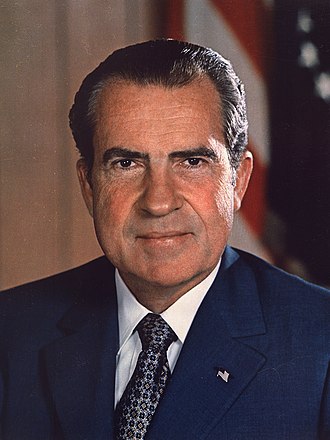
Richard M. Nixon served as the 37th President of the United States from January 1969 until his resignation in August 1974. In February 1971, he ordered the installation of a secret voice-activated taping system in the White House to preserve a historical record of his administration. Until the system's existence was revealed and dismantled in July 1973, the tapes captured Nixon directing major foreign policy initiatives, such as the opening to China, as well as his central role in the Watergate cover-up.
What Nixon talks about on the tapes
White House operations 4,718Presidential scheduling 2,225Public relations 1,784Presidential schedule 1,782Vietnam War 1,693Logistics 1,650Manolo Sanchez 1,626White House communications 1,400White House administration 1,399Presidential communication 1,243Henry Kissinger 1,191Foreign Policy 1,183
Conversations (21,010)
— Page 49 of 211President Nixon met with John Ehrlichman and CIA Director Richard Helms to discuss the President's access to sensitive, classified intelligence documents, specifically concerning past operations like the Bay of Pigs and the assassination of Ngo Dinh Diem. Nixon emphasized his need for full information regarding historical foreign policy and intelligence "dirty tricks" to prepare for upcoming diplomatic negotiations and to manage political exposure. Following this, Nixon met with David Kennedy, Henry Kissinger, and Peter Peterson to strategize on high-stakes textile trade negotiations with Japan, where they aimed to secure an agreement by applying pressure while maintaining the credibility of the U.S. position.
President Nixon met with Stephen B. Bull and H. R. Haldeman to coordinate the President's upcoming schedule and manage press relations regarding Wayne Hays. The discussion also included administrative logistics involving Charles E. Lucet and a scheduled lunch briefing with F. Edward Hebert. The meeting focused primarily on operational scheduling and the handling of key political figures.
President Nixon met with a delegation of French legislators and U.S. Congressman Wayne Hays in the Oval Office to discuss the relationship between French and American legislative bodies. The President extended a formal welcome, emphasizing the importance of international cooperation and sharing his perspectives on the legislative process. The brief meeting concluded with informal pleasantries and the President discussing his upcoming travel schedule to West Virginia.
President Nixon met with Stephen B. Bull and Alexander P. Butterfield to coordinate logistics for a scheduled appearance with college presidents. Butterfield provided a briefing regarding an event involving Dr. Jerome H. Jaffe and the students assembled at the South Portico. The participants finalized the sequence of movements to ensure the President was positioned to observe the group before his formal arrival.
President Nixon contacted the White House operator to initiate a telephone call to his close friend and confidant, Charles G. ("Bebe") Rebozo. The brief exchange served strictly as a procedural request to facilitate this communication. No further policy or administrative matters were discussed during this interaction.
President Nixon communicated with the White House operator to coordinate the scheduling of Charles G. "Bebe" Rebozo. The operator informed the President that Rebozo would be arriving shortly and would initiate a return call. This exchange served as a brief administrative update regarding the logistics of Rebozo's upcoming visit.
President Nixon instructed the White House operator to place an outgoing call to Attorney General John N. Mitchell. This brief administrative interaction served as a formal request to initiate communication with the Attorney General regarding official business. No further substantive matters were discussed during this brief exchange.
President Nixon met with an unidentified individual in the Old Executive Office Building to review his upcoming daily schedule. The brief discussion focused on administrative logistics and preparations for an anticipated news briefing. No major policy decisions were recorded during this short appointment.
President Nixon met briefly with a White House operator to facilitate a communication request. The primary purpose of the brief interaction was to initiate a telephone call to Attorney General John N. Mitchell. No further policy or strategic discussions took place during this exchange.
President Nixon and Attorney General John Mitchell discuss strategy for upcoming Supreme Court nominations, specifically focusing on the potential candidacy of Senator Robert C. Byrd and the reactions of various political figures. They coordinate the timeline for submitting names to the American Bar Association and the Senate while considering the use of a "smokescreen" to manage political optics. The two decide to inform Chief Justice Warren E. Burger in advance about the nomination of Mildred L. Lillie to maintain professional relations and ensure a smooth confirmation process.
President Nixon and Attorney General John Mitchell discuss the political landscape surrounding upcoming judicial nominations and the influence of Senate lobbying. They evaluate the ideological positioning of potential candidates, noting the importance of choosing individuals who align with the administration's conservative agenda. The two agree to maintain strategic ambiguity regarding the timing of the nominations to keep Senate pressure in their favor.
President Nixon initiates a request for the White House operator to place a telephone call to Special Counsel Charles W. Colson. This brief interaction serves as a routine administrative step to facilitate direct communication between the President and his advisor. No substantive policy discussions or decisions occur during this brief exchange.
President Nixon and H. R. Haldeman met to discuss media reactions to his economic policies, the political landscape surrounding potential congressional critics, and the internal handling of upcoming policy announcements. Nixon provided specific instructions for preparing for an imminent, highly confidential summit announcement, emphasizing a need for secrecy comparable to his approach toward China. Additionally, the President directed his staff to streamline the development of economic talking points by coordinating Herbert Stein, William Safire, and George Shultz while minimizing John Connally's involvement in the preliminary drafting phase.
President Nixon and Henry Kissinger met to review the President's upcoming schedule and address outstanding questions regarding pending administrative priorities. The discussion served as a strategic planning session to resolve procedural uncertainties and coordinate future diplomatic or executive tasks. No major policy shifts were finalized, as the dialogue focused primarily on organizing the President's immediate agenda.
President Nixon requested that the White House operator place a telephone call to his special counsel, Charles W. Colson. This administrative interaction served as a logistical step to facilitate direct communication between the President and a key advisor. No further substantive policy discussions were recorded during this brief exchange.
President Nixon and Charles Colson discuss strategies to bolster public support for the administration's economic program, specifically focusing on influencing media coverage and managing labor union relations. They express satisfaction with positive Harris poll results and coordinate efforts to marginalize Democratic rival Edmund Muskie. Additionally, they plan to aggressively promote Edith Efron’s book as a way to critique CBS media bias, prioritizing this effort as a significant political goal.
President Nixon and Henry Kissinger met to finalize the logistics and strategy for the upcoming presidential trip to the People's Republic of China, with a primary focus on maintaining extreme operational security and minimizing the size of the accompanying delegation. Nixon mandated that the traveling party remain as small as possible—eschewing excessive communications infrastructure, large staff support, and luxury services—to ensure the trip remained a focused, high-level diplomatic mission rather than a media spectacle. Furthermore, they coordinated on the messaging for the concurrent US-Soviet Union summit, prioritizing the need for the President to personally manage the briefing while maintaining a carefully controlled sense of mystery regarding the geopolitical agenda.
President Nixon contacted the White House operator to request a telephone connection with his personal physician, Dr. Walter R. Tkach. This brief administrative interaction served as a routing request to facilitate direct communication with the President's medical staff. No other substantive policy or political matters were discussed during this exchange.
President Nixon consulted with Manolo Sanchez regarding a specific request for an item. The brief exchange focused on verifying the availability or status of this personal or administrative item. No broader policy decisions were recorded during this short telephonic interaction.
President Nixon consulted with his personal physician, Dr. Walter R. Tkach, during a brief telephone call. Given the withdrawal of the conversation's content under privacy exemptions, the discussion likely pertained to confidential personal health matters. No further actions or public policy developments are indicated in the available records for this exchange.
President Nixon instructed the White House operator to place a telephone call to Attorney General John N. Mitchell. The brief exchange served as an administrative request to facilitate direct communication between the President and the Attorney General. No substantive policy matters were discussed during this brief connection.
President Nixon met with his personal aide, Manolo Sanchez, to discuss administrative logistics and the President's upcoming schedule. The brief conversation centered on the handling of specific documents and the President’s anticipated return to the office after an hour-long absence. No major policy decisions were made during this exchange, which focused primarily on personal office management and scheduling coordination.
President Nixon and Stephen Bull met to finalize scheduling and logistical details for an upcoming meeting with John A. Volpe and Aldo Moro of the Sons of Italy. The President emphasized a strict time limit of ten minutes for the event and instructed Bull to ensure the interaction remained focused solely on the presentation of awards. To facilitate the proceedings, Nixon decided to present the group with presidential paperweights as gifts.
President Nixon met with Italian Foreign Minister Aldo Moro and his delegation to discuss European foreign policy, the international role of the United States, and the upcoming United Nations vote concerning the representation of Taiwan and the People's Republic of China. Nixon emphasized the necessity of close cooperation among the world's major powers to ensure global stability, while acknowledging Italy's difficult domestic and international balancing act. The conversation also touched on Nixon's ongoing efforts regarding the Middle East and the importance of maintaining a unified, responsible front among Western allies.
President Nixon and Attorney General John Mitchell discuss political considerations regarding potential Supreme Court nominations and judicial appointments. Nixon expresses frustration over Secretary of Transportation John Volpe's persistent pressure to appoint an Italian-American to the Supreme Court, while also tasking Mitchell with managing these lobbying efforts to shield the President's time. Additionally, the pair discusses the progress of Mildred L. Lillie's vetting process for a Supreme Court seat, with Nixon emphasizing the political optics of potentially appointing the first woman to the Court.
President Nixon initiates a request to the White House operator to place an urgent call to Attorney General John N. Mitchell. The conversation serves strictly as an administrative bridge to facilitate direct communication between the President and the Attorney General. No substantive policy matters are addressed during this brief exchange.
President Nixon and Attorney General John Mitchell discuss the pending Supreme Court nomination of Mildred L. Lillie, focusing on the optics of her marital status and religious background. The two men deliberate on the political advantages of emphasizing her marriage to an Italian-American, A.V. Falcone, and explore the potential electoral benefits of identifying her as Catholic. Nixon directs Mitchell to verify her religious and ethnic details to ensure the nomination is presented in the most favorable light.
President Nixon met with his personal valet, Manolo Sanchez, in the Old Executive Office Building to review the President's upcoming schedule. The brief discussion centered on logistical arrangements for the President's appointments and daily obligations. No significant policy decisions or major developments were recorded during this short administrative exchange.
President Nixon and H.R. Haldeman discussed scheduling for a meeting with George Shultz to address pressing labor issues and potential strategy regarding AFL-CIO leader George Meany. The President concurred with advisors that he should avoid a direct meeting with Meany to prevent political complications. Furthermore, Nixon decided to maintain a neutral, non-committal stance toward the press regarding Meany's anticipated public statements.
President Nixon and H. R. Haldeman briefly discuss the strategic timing of releasing poll results to maximize their impact in morning newspapers. Nixon emphasizes the urgency of the release, instructing Haldeman to coordinate the effort with George Bush. The exchange highlights the administration’s focus on controlling the public narrative through media placement.
President Nixon directs the White House operator to place a telephone call to his daughter, Tricia Nixon Cox. The conversation consists solely of this brief request and the operator's acknowledgement of the task. No further substantive policy or administrative matters are addressed during this exchange.
President Nixon and H.R. Haldeman met to coordinate logistics for upcoming high-level meetings involving George P. Shultz and AFL-CIO leader George Meany. The discussion focused on managing the President's schedule and determining the appropriate level of executive involvement in these negotiations. Nixon ultimately decided to minimize his direct participation, directing Haldeman to facilitate the meetings to maintain strategic distance.
President Nixon instructed the White House operator to place a telephone call to his daughter, Tricia Nixon Cox. This brief administrative interaction served as a logistical step to initiate a personal communication. No policy matters or significant government business were addressed during this exchange.
President Nixon and his daughter, Tricia Nixon Cox, engage in a brief, informal check-in regarding her time at Camp David. The conversation touches on weather conditions at the retreat and a minor update regarding a scheduled announcement. The exchange remains strictly personal, concluding with plans for the President and his daughter to spend time together.
President Richard M. Nixon and his daughter, Tricia Nixon Cox, engaged in a brief, personal telephone conversation. The discussion was entirely private in nature, as the primary segment of the call was withdrawn from the record for personal reasons. No official business or substantive policy matters were addressed during this exchange.
President Nixon contacted the White House operator to place an outgoing call to Attorney General John N. Mitchell. The brief exchange served as an administrative request to facilitate direct communication between the President and the Attorney General. No substantive policy matters were discussed during this connection process.
President Nixon met with his personal aide, Manolo Sanchez, while also placing a brief call to Attorney General John N. Mitchell via a White House operator. During the meeting, the pair engaged in casual conversation regarding automotive manufacturing quality and durability. The interaction also included logistical arrangements for the President to view the conclusion of a sporting event.
President Nixon and Attorney General John Mitchell discuss the vetting process for the potential Supreme Court nomination of Mildred L. Lillie. They evaluate the political advantages of her Catholic faith and her marriage to an Italian husband, while also reviewing her judicial record and her husband’s professional background. Mitchell confirms that a nomination package is being prepared for the President's final approval to ensure the appointment remains on schedule.
President Nixon and Attorney General John Mitchell engage in a brief, informal discussion concerning the personal background and familial connections of an unidentified woman. The exchange focuses on navigating social or professional arrangements, with Nixon inquiring about the woman's awareness of upcoming plans. Their dialogue highlights a degree of personal rapport as they confirm details regarding her Catholic faith and her husband's profession.
President Nixon directs the White House operator to place a telephone call to George P. Shultz. The brief exchange serves as a logistical communication to facilitate a private consultation between the President and the Director of the Office of Management and Budget. No further substantive discussion occurs during this recording.
President Nixon met with his personal valet, Manolo Sanchez, to delegate several personal errands. The President requested that Sanchez procure specific items seen on television advertisements, including a new type of Gillette razor with two blades. Sanchez acknowledged these instructions before departing to fulfill the President’s request.
President Nixon instructed his valet, Manolo Sanchez, to coordinate with the Secret Service regarding the scheduling and security arrangements for First Lady Pat Nixon, David Eisenhower, and Julie Nixon Eisenhower. The primary purpose of this meeting was to clarify travel or logistical expectations for the family members. This request highlights the President's personal oversight of his family's movements and the administrative coordination required by the Secret Service.
President Nixon met with an unidentified individual to briefly coordinate his upcoming schedule and communication priorities. The discussion centered on arranging a follow-up meeting with Henry Kissinger to address specific pending matters. The primary action item resulting from the exchange was the scheduling of a briefing for the following evening to review these outstanding issues.
President Nixon initiates a request to the White House operator to place a telephone call to George P. Shultz. The brief interaction serves primarily as a logistical step to facilitate direct communication between the President and the Director of the Office of Management and Budget. No policy discussions occur during this exchange.
President Nixon and George P. Shultz coordinate an upcoming meeting to prepare for the President's scheduled press conference. Nixon emphasizes his desire to focus exclusively on immediate, short-term issues and pending administrative actions rather than long-range policy planning. Shultz receives approval to bring Donald Rumsfeld to the meeting and confirms that they will prioritize time-sensitive matters, including a potential move by James D. Hodgson.
President Nixon and George Shultz briefly coordinated their priorities ahead of an upcoming press conference. Nixon expressed a desire to focus strictly on immediate, relevant issues for the briefing rather than engaging in long-range strategic planning. The two agreed to limit the scope of their upcoming discussion to ensure the President was adequately prepared for the next day's public appearance.
President Nixon met with George P. Shultz and Donald H. Rumsfeld to discuss economic strategy and the administration's ongoing efforts to manage wage and price controls. The participants focused on navigating labor relations, specifically managing expectations regarding the Pay Board and the Cost of Living Council, while avoiding direct political confrontation with labor leadership. Nixon and his advisors agreed on the necessity of maintaining the appearance of a cooperative, non-partisan approach to combat inflation and promote economic expansion while preparing for potential future labor unrest.
President Nixon communicated with a White House operator regarding an attempt to reach National Security Advisor Henry Kissinger. Upon being informed that Kissinger had disconnected, the President received confirmation that the call had been officially canceled. No further action was taken regarding the outreach.
President Nixon requested that the White House operator connect him to First Lady Pat Nixon. The brief communication functioned as a routine administrative task to facilitate a personal phone call. No substantive policy matters or significant political developments were discussed during the exchange.
President Nixon held a brief, informal exchange with an unidentified individual, likely serving as a follow-up to an earlier attempt at communication. The dialogue concludes abruptly with logistical pleasantries regarding rotating availability. No substantive policy matters or administrative decisions were documented during this short interaction.
President Nixon and H. R. Haldeman met to review the President's upcoming schedule and coordinate logistics for the administration's historic trip to the People's Republic of China. The discussion focused on managing media coverage and ensuring effective communication regarding the delegation's secret service and support staff requirements. Nixon emphasized the necessity of prioritizing the China summit, tasking Haldeman with ensuring that preparations—particularly regarding press strategy—were executed precisely to maximize favorable visibility.
President Nixon interacts with a White House operator to facilitate a telephone call to First Lady Pat Nixon. The brief exchange includes informal pleasantries regarding a baseball game and the First Lady's recent public appearance. The primary action item concludes with the operator assisting the President in connecting to his wife.
President Richard Nixon and First Lady Pat Nixon engaged in a brief, personal telephone conversation. The exchange appears to be a check-in between the couple, though the specific substance remains largely unavailable due to the withdrawal of the recording for personal reasons. No official policy decisions or significant administrative actions resulted from this interaction.
President Nixon held a brief, informal meeting with Pat Nixon in his Old Executive Office Building office. The recording primarily serves as a logistical capture of their presence, though the transcript indicates the President was also engaged in unrelated discussions regarding economic policy, labor relations, and administrative strategy with staff members. No significant policy decisions were finalized during this particular interaction.
President Nixon initiates a brief telephone request to the White House operator to be connected with his National Security Advisor, Henry A. Kissinger. This interaction serves as a logistical bridge to facilitate a high-level consultation between the President and his advisor. No policy decisions or substantive matters are addressed during this administrative exchange.
President Nixon and Press Secretary Ronald L. Ziegler held a brief meeting in the Old Executive Office Building to discuss a specific briefing paper. While the transcript remains incomplete, the interaction focused on the coordination of official materials or media messaging. No further actions or significant policy decisions are documented in this short exchange.
President Nixon met with his valet, Manolo Sanchez, to coordinate the preparation of briefing materials. The discussion focused on the physical organization of documents, with Nixon instructing Sanchez to punch and insert specific items into a briefing book. Sanchez confirmed the task and arranged to place the materials in the residence for the President's subsequent review.
President Nixon consulted the White House operator to facilitate an urgent communication with his National Security Advisor, Henry A. Kissinger. This administrative interaction served as a logistical step to bridge the connection between the President and Kissinger regarding ongoing foreign policy matters. No further substantive policy discussions occurred during this brief request for assistance.
President Nixon and Henry Kissinger discussed strategies for the upcoming October 12, 1971, press conference, focusing specifically on the announcement of the President's trip to Moscow. They expressed concern regarding potential news leaks to the Japanese by the Soviets and coordinated a 'no comment' policy for Press Secretary Ronald Ziegler should the information emerge prematurely. Furthermore, they deliberated on how the President should address sensitive topics like China's status at the UN and the controversial Byrd Amendment, ultimately deciding that Nixon would deliver a brief, deadpan statement to maintain control over the messaging.
President Nixon and Henry Kissinger met to discuss strategy regarding interactions with an individual identified as Johnson and the management of sensitive information networks. The dialogue focused on navigating potential inquiries and defining a clear, cautious posture to avoid compromising official positions during external questioning. The two reached an understanding on maintaining discretion and prioritized internal consensus over written documentation.
President Nixon met with his personal valet, Manolo Sanchez, in the Old Executive Office Building for a brief, informal exchange. While the transcript remains largely unintelligible and appears to contain Welsh-language errors or encoding issues, the interaction reflects a routine administrative or personal check-in between the President and his staff member. No substantive policy decisions or historical actions were recorded during this short meeting.
President Nixon met with his valet, Manolo Sanchez, in the Old Executive Office Building for a brief, informal encounter. The interaction, which lasted only a few minutes, primarily involved personal matters rather than substantive policy deliberations. No significant administrative decisions or developments were recorded during this brief exchange.
President Nixon contacted the White House operator to facilitate a telephone connection with Press Secretary Ronald L. Ziegler. The brief interaction served purely as a logistical request to initiate communication with a key staff member. No policy discussions occurred during this exchange, as its sole purpose was to place an outgoing call.
President Nixon initiated a brief contact with the White House operator to facilitate a telephone call. The sole purpose of this interaction was to reach Press Secretary Ronald L. Ziegler. The President’s primary objective was to establish communication with his staff for immediate administrative or press-related coordination.
President Nixon and Henry Kissinger met to discuss logistics regarding Kissinger's upcoming trip to Chicago and broader political strategy, including judicial appointments. A significant portion of the conversation focused on the internal administration response to the situation in Chile. The two discussed the development of an options paper and the potential for a public statement by the President to clarify the U.S. position on the unfolding events.
President Nixon coordinates with Press Secretary Ronald Ziegler to manage the logistics and messaging for an upcoming press conference. Nixon directs Ziegler to ensure media outlets correct a recent Washington Post report by emphasizing that Senator Robert C. Byrd remains under active consideration for a Supreme Court vacancy. This strategy aims to force Democratic opponents, such as George McGovern, to take a public stance on the potential nomination.
President Richard Nixon met with Press Secretary Ronald Ziegler to discuss logistics regarding media access and filming operations within the White House. The conversation centered on ensuring staff compliance with administrative protocols and managing the narrative surrounding ongoing activities. The two evaluated current procedures to verify that internal communications remained consistent with the administration's public messaging strategy.
President Nixon instructed the White House operator to connect him with speechwriter and political aide Patrick J. Buchanan. The call served as a brief administrative request to initiate communication with a key staff member. No further policy discussions or substantive developments occurred during this short exchange.
President Nixon met with John D. Ehrlichman in the Executive Office Building to review and coordinate the Domestic Advisor's upcoming professional schedule. The discussion centered on managing Ehrlichman's calendar to ensure alignment with presidential priorities and administrative demands. No further policy decisions were recorded during this brief administrative meeting.
President Nixon consulted with the White House operator to facilitate a telephonic communication with Patrick J. Buchanan. The conversation served exclusively as a procedural request to initiate this contact. No further policy discussions or substantive developments occurred during this brief interaction.
President Nixon and Patrick J. Buchanan discussed the status of labor-related negotiations involving George Shultz and James Hodgson. Nixon informed Buchanan that he was currently meeting with the two officials to address the issue and consequently requested a delay in preparing further materials. The President ultimately decided to refrain from immediate public comment on the subject and invited Buchanan to his office for a follow-up discussion.
President Nixon and Patrick J. Buchanan briefly discussed an ongoing meeting involving Secretary of Labor James Hodgson and an unidentified individual. Nixon indicated that a pending decision or response would be delayed until the conclusion of these talks. The brief exchange served to coordinate strategy and manage expectations regarding the outcome of those discussions.
President Nixon instructed the White House operator to facilitate an urgent telephone call between AFL-CIO President George Meany and National Security Advisor Henry Kissinger. Nixon emphasized the importance of the contact, explicitly stating that he needed to be patched through to the conversation immediately. This coordination reflects the administration's priority to establish direct communication with organized labor leadership during a period of complex domestic and international policy challenges.
President Nixon initiates a request through the White House operator to be connected with George P. Shultz. The brief exchange serves as a procedural step to facilitate a direct communication line between the President and his Director of the Office of Management and Budget. No further substantive policy matters were discussed during this brief administrative interaction.
President Nixon consulted with aides Patrick J. Buchanan and Henry A. Kissinger regarding economic policies, the impending announcement of a U.S.-Soviet Union summit, and potential Supreme Court appointments. The participants discussed strategies for the Pay Board, the timing of foreign policy announcements, and the political implications of prospective judicial candidates. Significant actions included coordinating briefings for labor leader George Meany and finalizing preparations for the President’s public announcement regarding upcoming diplomatic negotiations.
President Nixon and George Shultz discuss the positive reception from labor leaders, specifically George Meany, regarding the administration's wage and price control proposals. Nixon briefs Shultz on his decision to have Henry Kissinger inform Meany of the upcoming announcement concerning the 1972 Moscow summit, aiming to secure labor cooperation and mitigate potential opposition. The President emphasizes the importance of controlling the narrative and instructs Shultz to release the official statement immediately to avoid it being leaked prematurely from labor meetings.
President Nixon directs the White House operator to place a telephone call to George P. Shultz, who was serving as the Director of the Office of Management and Budget at the time. This brief administrative exchange serves as the logistical precursor to a subsequent policy or personnel discussion between the President and Shultz. No substantive policy decisions or political developments are finalized during this specific interaction.
President Nixon contacted the White House operator to facilitate a telephone connection. The primary purpose of this brief interaction was to request a direct line to George P. Shultz. The operator successfully initiated the call request to complete the President's communication objective.
President Nixon and George Shultz discuss the need to maintain a unified administration front regarding economic policy following recent statements from John Connally. Nixon expresses concern that members of the Cost of Living Council, specifically George Romney, Maurice Stans, and Arthur Burns, might publicly dissent or criticize the administration's stance. Shultz agrees with the President's suggestion to have Donald Rumsfeld coordinate the message to ensure that business leaders and other officials understand the strategic importance of securing labor's cooperation on wage settlements.
President Nixon met with George P. Shultz to discuss the operations and public perception of the Cost of Living Council (COLC). The two leaders emphasized the importance of maintaining the council's effectiveness and managing its public image. They agreed on the necessity of coordinating these efforts among a select group of key officials to ensure consistent policy communication.
President Nixon initiates a request through the White House operator to be connected with his personal secretary, Rose Mary Woods. This brief administrative interaction serves as a bridge to facilitate further communication with his staff. The conversation focuses solely on establishing this connection.
President Nixon and Henry Kissinger met to coordinate administrative scheduling and personnel matters. The discussion focused on the upcoming itinerary for Henry Kissinger and the involvement of Alexander M. Haig, Jr. in an impending press conference. The pair briefly aligned on these operational details to ensure clear communication regarding the administration's public messaging.
President Nixon consulted with a White House operator to facilitate an outgoing call. This routine interaction served as a logistical step to connect the President with another party for official communications. No substantive policy discussions or major decisions were recorded during this brief administrative exchange.
President Richard Nixon and his personal secretary, Rose Mary Woods, met to discuss administrative matters and the management of sensitive documents. While the transcript remains largely obscured by unintelligible Welsh audio fragments, the interaction focuses on the logistical coordination of presidential records and internal office communications. No major policy decisions are documented in this brief exchange.
President Nixon invited his personal secretary, Rose Mary Woods, to attend a small dinner at the White House that evening. The guest list included First Lady Pat Nixon, Margaret Theriault, and Henry Kissinger. The President requested Woods's presence specifically to facilitate a brief policy discussion with Kissinger during the event.
President Nixon and H. R. Haldeman met to coordinate upcoming scheduling and staffing logistics, specifically addressing travel plans for Henry Kissinger and meetings involving Senator Charles Percy in Chicago. The discussion focused on managing the President's calendar and delegating responsibilities to aides like Clark MacGregor to ensure operational efficiency. The pair evaluated the political implications of these engagements and determined the necessary preparatory steps for the following day.
President Nixon met with his personal secretary, Rose Mary Woods, to discuss political strategy and potential nominees for the Supreme Court. The conversation included a review of press criticism regarding Nixon's personal finances and an evaluation of various political figures, including comparisons between Nixon and former President Lyndon B. Johnson. They specifically focused on the vetting process and potential political advantages of appointing a woman to the Court, weighing candidates such as Mildred L. Lillie against the complexities of Senate confirmation.
President Nixon held an undocumented meeting with unknown participants in the Old Executive Office Building. Due to the lack of a transcript or specific context, the details regarding the substance of the discussion remain unavailable for historical review. No specific decisions or action items can be verified from this record.
President Nixon met with an unknown individual in the Old Executive Office Building to address a request for a telephone call. The nature of the request and the identity of the visitor remain unidentified due to the lack of available transcripts or supplementary documentation. No specific policy decisions or significant administrative actions were recorded during this brief interaction.
President Nixon and H.R. Haldeman briefly conferred regarding the specific time difference between Washington and Moscow to facilitate scheduling or communications planning. Haldeman committed to verifying the exact offset and providing the information to the President upon his arrival at the White House. This short exchange highlights the logistical coordination required for Nixon's ongoing international diplomatic engagements.
President Nixon and H. R. Haldeman briefly conferred to clarify the current time in Moscow. The primary purpose of the exchange was to establish a precise temporal reference for international coordination or scheduling. No further policy decisions were recorded during this brief administrative check.
President Nixon directs the White House operator to initiate a telephone call to AFL-CIO President George Meany. This brief exchange serves as the administrative coordination required to connect the President with the labor leader. The interaction reflects the President's active outreach to organized labor regarding his economic policies during this period.
President Nixon and Alexander P. Butterfield held a brief meeting in the Old Executive Office Building to conduct administrative business. Although the transcript is unavailable, the conversation was recorded as part of the White House taping system. The two men concluded their discussion and exited the office together after approximately two minutes.
President Nixon met with Henry Kissinger, Ronald Ziegler, and Stephen Bull to discuss the strategy and media optics surrounding upcoming diplomatic announcements, including a forthcoming US-USSR summit. The group reviewed the effectiveness of the President's recent press conference performance and the administration’s messaging regarding foreign policy. Additionally, Nixon provided instructions to Ziegler regarding press management and coordination for upcoming inauguration-related communications.
President Nixon, Henry Kissinger, and William P. Rogers met to coordinate U.S. strategy regarding upcoming European diplomatic engagements and a potential summit. They agreed to maintain a cautious stance on the proposed European Security Conference to avoid granting concessions to the Soviets prematurely. Additionally, the group explored the feasibility of hosting a 'Big Four' summit including Japan, tasking John B. Connally with further development of the concept.
President Nixon met with a bipartisan group of Congressional leaders and key administration officials to discuss his upcoming summit in Moscow and broader U.S. strategy regarding the Soviet Union and China. The President emphasized that his administration sought to maintain a delicate balance between the two powers without appearing to collude with one against the other. The discussion underscored the importance of bipartisan support for national defense funding and the need for diplomatic engagement to prevent escalation in volatile regions like the Middle East.
President Nixon and Press Secretary Ronald Ziegler discuss the logistics and public reception of recent televised press briefings, specifically noting the positive media reaction to filming in the press room. They also address the strategy for handling anticipated press inquiries regarding upcoming Supreme Court nominations. Nixon emphasizes his desire to avoid public speculation or controversy when discussing potential appointees, such as Senators Robert C. Byrd, George S. McGovern, and Edmund S. Muskie.
President Nixon met with Stephen B. Bull and Ronald L. Ziegler to coordinate his immediate professional schedule. The discussion focused on upcoming engagements, specifically prioritizing arrangements for meetings with Henry Kissinger and various labor leaders. The session concluded with the participants aligning the President's calendar for these key consultations.
President Nixon held a brief meeting in the Oval Office with an unidentified individual to discuss matters pertaining to the President's schedule and labor-related issues. The session lasted approximately two minutes before the participant departed the office. No specific policy decisions or significant developments were recorded during this abbreviated exchange.
President Nixon, H. R. Haldeman, Henry Kissinger, and George Shultz met to discuss recent developments regarding upcoming summits with the Soviet Union and the status of domestic labor relations. Kissinger provided a status update on the diplomatic conditioning for the Soviet visit and emphasized the strategic importance of the ongoing negotiations with the USSR and the PRC. Concurrently, Shultz and the President coordinated a public response to organized labor’s agreement to serve on the Pay Board, deciding to frame the cooperation as a victory for the country’s economic program rather than a political win for either side.