Byrd, Robert C.
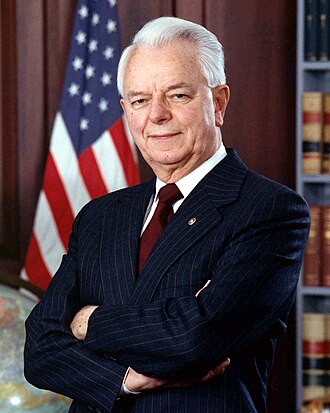
During the Nixon administration, Robert C. Byrd, a Democratic senator from West Virginia, ascended in the Senate leadership. At the beginning of the taping period in February 1971, he had just transitioned from his role as Secretary of the Senate Democratic Conference to become the Senate Majority Whip in January 1971, a position he held throughout the rest of the Nixon presidency. A key moment during this era was in March 1973, when his sharp questioning of L. Patrick Gray, the acting FBI director, during his confirmation hearings was instrumental in connecting the Watergate cover-up to the White House.
President Nixon met with key Congressional leadership, including Hugh Scott, Robert Byrd, Robert Griffin, Gerald Ford, and Carl Albert, to brief them on his upcoming televised address regarding Vietnam policy. The discussion focused on the administration's plan for troop withdrawals, the handling of the Prisoner of War (POW) issue, and the strategic rationale behind ongoing U.S. air operations in Southeast Asia. Nixon emphasized the need for flexibility in negotiations and stressed that Congressional support was essential to maintaining a credible bargaining position against North Vietnam.
President Nixon calls Senator Robert C. Byrd to personally thank him for his public support regarding the President's recent speech on the Vietnam War and troop withdrawal policy. The two discuss the logistical difficulties of including Byrd and Senator Robert P. Griffin in exclusive White House briefings due to procedural tensions with House leadership. Nixon reassures Byrd of his intent to ensure their continued participation in future briefings, suggesting that private meetings may be arranged to bypass formal scheduling constraints.
President Nixon met with Vice President Agnew and a bipartisan group of Congressional leaders to announce a significant diplomatic breakthrough in the Strategic Arms Limitation Talks (SALT). Nixon informed the attendees of a forthcoming joint statement with the Soviet Union pledging to focus on limiting anti-ballistic missile (ABM) systems and certain offensive strategic weapons. While some lawmakers advocated for immediate unilateral U.S. defense cuts to demonstrate good faith, the President and his advisors successfully urged the leaders to maintain existing defense programs during the negotiations to avoid losing vital bargaining leverage.
President Nixon met with a bipartisan group of Congressional leaders to discuss the progress of the 90-day wage-price freeze and to seek input on the development of Phase II economic policies. Treasury Secretary George Shultz provided an overview of the administration's administrative efforts, including the roles of the Cost of Living Council and the IRS in enforcing the freeze. The discussion centered on the need for continued cooperation across sectors—including labor, business, and agriculture—and the development of a framework for economic stabilization once the initial freeze expired.
President Nixon met with bipartisan Congressional leadership to outline his post-freeze economic program and announce plans for an upcoming summit in Moscow. He detailed the formation of a tripartite Pay Board, a Price Commission, and a committee on interest and dividends to maintain economic stability through a mix of voluntary cooperation and necessary sanctions. Additionally, the President briefed the leaders on the status of international monetary negotiations and his strategic approach to the May 1972 summit with Soviet leadership regarding arms control and trade.
President Nixon met with a bipartisan group of Congressional leaders to discuss his upcoming historic trip to the People's Republic of China. The President sought to build support for the mission, briefing the group on communication protocols with Peking and his strategy for managing the international and domestic implications of the visit. The discussion emphasized the goal of establishing a new dialogue with the PRC to foster long-term global stability and balance regional power dynamics.
President Nixon met with a bipartisan group of Congressional leaders to provide a firsthand report on his recent diplomatic mission to the People's Republic of China (PRC). During the briefing, the President discussed his interactions with Chinese leadership, the strategic importance of establishing communication channels, and the complex geopolitical dynamics concerning Taiwan and the broader Pacific region. The meeting emphasized the necessity of maintaining trust and diplomatic dialogue to navigate future international relations and manage long-term foreign policy objectives.
President Nixon met with bipartisan Congressional leaders, administration officials, and cabinet members to advocate for a legislative moratorium on court-ordered busing to achieve racial balance in schools. Nixon argued that current judicial mandates were causing societal turmoil and urged Congress to act immediately to stop new busing orders while advancing his broader 'Equal Educational Opportunities Act.' The administration proposed a two-pronged strategy involving an immediate legislative moratorium followed by a long-term commitment to compensatory education funding to improve school quality, specifically for low-income and minority students.
President Nixon and Henry Kissinger met to review and finalize the text of a forthcoming nationally televised address regarding the Vietnam War. They discussed strategic revisions to the speech, emphasizing the prevention of a potential communist bloodbath and the necessity of maintaining U.S. credibility. Kissinger also coordinated with Senator Robert C. Byrd to delay a scheduled Democratic caucus vote on Vietnam policy, aiming to avoid public dissent that could undermine sensitive, ongoing diplomatic efforts in Paris and Moscow.
Henry Kissinger contacted Senator Robert C. Byrd to request a delay of an upcoming Democratic caucus regarding Vietnam, citing the extreme sensitivity of ongoing diplomatic negotiations with Le Duc Tho. Byrd explained that while he had already postponed the meeting at the request of J. William Fulbright, he was constrained by Senate leadership obligations and required a public justification to delay it further. Kissinger agreed to consult with President Nixon to determine if sufficient information could be shared with Byrd to provide that justification, while both men emphasized the need for strict confidentiality regarding their communication.
President Nixon met with Senator Robert C. Byrd, John Ehrlichman, and Clark MacGregor to discuss the pending black lung benefits bill. Acknowledging the fiscal concerns and potential budget implications, Nixon informed Byrd of his decision to sign the legislation, concluding that a veto would likely be overridden by Congress. They coordinated a public relations strategy for the announcement, agreeing that Byrd would signal his satisfaction with the meeting to the press while emphasizing the President's careful deliberation of the budgetary and humanitarian factors.
President Nixon met with bipartisan Congressional leaders to discuss the upcoming Soviet summit and the administration's strategic approach to international relations. The discussion focused on complex issues including trade, Most Favored Nation (MFN) status for the Soviet Union, and the potential for bilateral cooperation despite ideological differences. Nixon emphasized the importance of maintaining a unified stance to ensure the success of the negotiations while managing domestic political expectations.
President Nixon met with a bipartisan group of Congressional leaders to provide a detailed briefing on the recently finalized Vietnam Peace Agreement and its implementing protocols. Henry Kissinger explained the strategic nuances of the agreement, including the status of North and South Vietnam, the mechanisms for the International Control Commission, and the timeline for the withdrawal of U.S. forces and the release of prisoners of war. The President emphasized the necessity of bipartisan Congressional support to ensure the agreement's stability and signaled that the administration would work with Congress to frame a positive resolution regarding the end of the war.
President Nixon met with Vice President Agnew and a broad bipartisan group of Congressional leaders to outline the administration's 1974 federal budget and economic strategy. Economic advisors Herbert Stein and George Shultz presented data highlighting a strong 1972 economy and stressed the necessity of fiscal discipline to curb inflation and maintain growth. The President urged Congress to support his proposed spending ceilings, emphasizing the need to avoid the inflationary deficits experienced during the late 1960s, while briefly acknowledging progress toward a Vietnam peace settlement.
President Nixon met with bipartisan Congressional leaders, cabinet members, and staff to outline the administration’s strategy for the 1973 and 1974 federal budgets, emphasizing a commitment to avoiding tax increases. The President defended his use of impoundment to control spending and curb inflation, arguing that Congress must share the responsibility of fiscal discipline or face the political consequences of tax hikes. The discussion also addressed the economic impact of the Vietnam cease-fire, defense budget priorities, and the need for greater cooperation between the executive and legislative branches to manage spending levels.
President Nixon met with Vice President Agnew and a bipartisan group of Congressional leaders to outline the administration's proposed foreign trade legislation. The discussion focused on securing presidential authority to negotiate trade agreements, implementing safeguards for domestic industries, and establishing pension and unemployment insurance reforms. Nixon emphasized the necessity of shifting away from a 'one-way street' trade policy to protect American workers and leverage better terms with international partners, while urging caution against attaching human rights conditions to Most Favored Nation (MFN) status for the Soviet Union to avoid jeopardizing broader diplomatic and arms control initiatives.
President Nixon met with Vice President Agnew and a bipartisan group of Congressional leaders to address the nation's growing energy needs and proposed legislative solutions. The discussion focused on mitigating potential future shortages by balancing environmental protections with domestic production efforts, including natural gas deregulation, expanded offshore oil leasing, and the completion of the Alaska pipeline. The President and his cabinet members emphasized the importance of developing a cohesive national energy strategy to maintain independence and discussed the foreign policy implications of relying on foreign oil exports. The administration sought Congressional cooperation for pending energy legislation and signaled an intent to increase research and development funding for alternative fuel sources like coal and nuclear power.