Bennett, Wallace F.
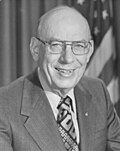
Wallace F. Bennett was a Republican Senator from Utah who served throughout the entire Nixon administration. During the White House taping period, he was a consistent supporter of the administration's policies and was considered a financial expert and a spokesman on finance for the Nixon administration in the Senate. He was also the ranking member of the Senate Finance Committee.
President Nixon met with Senator Russell Long, administration officials, and congressional representatives to strategize on the advancement of the President’s welfare and health care legislation. The discussion focused on overcoming opposition to the administration's health bill, particularly the competing proposal from Senator Edward Kennedy, while emphasizing the need for congressional education and potential compromises to secure passage. Additionally, the President and Senator Long discussed refining welfare reform, specifically focusing on work incentives, child support enforcement, and addressing public concerns regarding welfare dependency.
President Nixon hosted a ceremonial event in the Oval Office for the swearing-in of James C. Fletcher as the new Administrator of NASA, attended by Fletcher's family, members of Congress, and administration officials. Following the photo session and official proceedings, the President discussed the importance of space exploration and future policy ideas with attendees. The meeting concluded with a private discussion regarding Representative James G. Fulton’s congressional career and potential future scheduling.
President Nixon met with a bipartisan group of Senate leaders to frame the shifting geopolitical and economic landscape of the 1970s. Nixon highlighted the transition from a era of military confrontation to one of negotiation, emphasizing the necessity of integrating the People's Republic of China into the world community to prevent future instability. Following the President's overview, Peter G. Peterson delivered a briefing on the intensifying global economic challenge posed by the rapid industrial growth of nations like Japan and Germany. The meeting served as a strategic appeal for bipartisan support to ensure the United States remains competitive as military tensions subside and economic competition becomes the primary arena of international rivalry.
President Nixon convened a meeting with Vice President Agnew and a bipartisan group of Congressional leaders to discuss the national economy and his administration's "New Economic Policy." Key topics included the wage-price freeze, investment tax credits, the international monetary situation, and an import surcharge. The discussion focused on the necessity of Congressional cooperation for implementing these measures and their potential impact on inflation, trade, and specific industries like automobiles.
President Nixon met with a large group of Republican Congressional leaders to solicit support for his administration's economic initiatives, specifically the New Economic Policy and tax reform measures. Key topics included the Job Development Tax Credit, depreciation reform, and strategies to secure bipartisan support for the Economic Stabilization Act as the program entered its second phase. The participants also discussed the necessity of public and business cooperation, as well as the international trade context of the President's economic agenda.
President Nixon met with a bipartisan group of Congressional leaders to discuss the progress of the 90-day wage-price freeze and to seek input on the development of Phase II economic policies. Treasury Secretary George Shultz provided an overview of the administration's administrative efforts, including the roles of the Cost of Living Council and the IRS in enforcing the freeze. The discussion centered on the need for continued cooperation across sectors—including labor, business, and agriculture—and the development of a framework for economic stabilization once the initial freeze expired.
President Nixon met with bipartisan Congressional leadership to outline his post-freeze economic program and announce plans for an upcoming summit in Moscow. He detailed the formation of a tripartite Pay Board, a Price Commission, and a committee on interest and dividends to maintain economic stability through a mix of voluntary cooperation and necessary sanctions. Additionally, the President briefed the leaders on the status of international monetary negotiations and his strategic approach to the May 1972 summit with Soviet leadership regarding arms control and trade.
President Nixon met with various aides and technicians to prepare for and broadcast a televised national address, followed by a meeting with a group of Senators and staff to discuss his recent Supreme Court nominations. During the session, the President focused on the qualifications of his nominees, Lewis F. Powell and William H. Rehnquist, emphasizing the importance of the Supreme Court's role in the government. The conversation concluded with the President greeting and presenting gifts to the television, lighting, and sound crews who assisted with his broadcast.
President Nixon met with Senator Wallace Bennett and senior advisors to discuss legislative strategy for the upcoming Senate session, specifically focusing on a pending tax bill and the potential for a restrictive Senate vote to prevent extraneous amendments like H.R. 1. The participants analyzed the political landscape of the Senate Finance Committee, the influence of Chairman Russell Long, and the administration's cautious approach to welfare and social security reform. Additionally, the President briefly touched upon the United Nations vote regarding Taiwan and his frustration with international reactions toward U.S. policy.
President Nixon met with a bipartisan group of Congressional leaders from the House Ways and Means Committee and the Senate Finance Committee to mark the signing of the Revenue Act of 1971. The President utilized the ceremony to praise the legislators for their cooperation in passing a responsible tax bill, contrasting it with fears that the measure would become an unmanageable 'Christmas tree' of amendments. The discussion highlighted the economic benefits of the legislation, particularly its role in job creation and the stimulation of the automobile industry following the administration's new economic program initiated in August.
President Nixon met with Vice President Agnew and Republican Congressional leaders to coordinate legislative strategy on key domestic priorities, specifically revenue sharing, welfare reform, and Social Security legislation. The discussion focused on overcoming legislative stalemates in the Ways and Means Committee and the Senate, particularly regarding the influence of Chairman Wilbur Mills and the need for a unified Republican stance. The President urged the leadership to maintain pressure for compromise bills that align with administration goals while avoiding fiscally irresponsible mandates during an election year.
President Nixon met with Republican members of the Senate Finance Committee to discuss the legislative impasse surrounding welfare reform (H.R. 1) and upcoming fiscal challenges. The participants evaluated the political feasibility of passing administration-backed legislation, expressing concerns over the influence of liberal amendments, rising costs, and the lack of support from Chairman Russell Long. Ultimately, the group discussed strategies for managing the impending debt ceiling extension and the threat of an unpopular Social Security increase, with the President firming his stance on vetoing non-budgetary spending items.
President Nixon met with a large group of Republican Congressional leaders to coordinate legislative strategy and discuss the administration's economic record ahead of the upcoming election. The conversation focused on countering Senator George McGovern's economic proposals, with the President and his advisors emphasizing that the administration's policies had fostered recovery, reduced inflation, and increased civilian employment. Key action items included distributing briefing materials to counter Democratic attacks, pushing for a government spending ceiling to avoid future tax increases, and planning strategy for upcoming votes on controversial appropriation bills and foreign aid legislation.
President Nixon met with his economic advisors and Republican Senate leadership to coordinate a strategy for securing congressional support for a federal spending ceiling. The discussion focused on the necessity of controlling runaway federal expenditures and the potential use of the presidential veto to enforce a $250 billion spending limit. Nixon and his team evaluated the legislative outlook for the debt limit bill, including strategies for handling amendments and managing potential political fallout regarding domestic programs.
President Nixon met with Republican congressional leadership to outline his fiscal strategy for the 1974 budget, emphasizing the necessity of expenditure control to avoid tax increases and curb inflation. Nixon and his advisors discussed the use of budget impoundments to maintain a spending ceiling of $269 billion, framing this approach as a critical move for economic prosperity despite the anticipated pushback from special interest groups. The meeting concluded with a call for Republican leaders to unify behind the administration's fiscal restraint and to clearly communicate that budget cuts are essential for maintaining national economic stability.
President Nixon met with Vice President Agnew and a broad bipartisan group of Congressional leaders to outline the administration's 1974 federal budget and economic strategy. Economic advisors Herbert Stein and George Shultz presented data highlighting a strong 1972 economy and stressed the necessity of fiscal discipline to curb inflation and maintain growth. The President urged Congress to support his proposed spending ceilings, emphasizing the need to avoid the inflationary deficits experienced during the late 1960s, while briefly acknowledging progress toward a Vietnam peace settlement.
President Nixon met with bipartisan Congressional leaders, cabinet members, and staff to outline the administration’s strategy for the 1973 and 1974 federal budgets, emphasizing a commitment to avoiding tax increases. The President defended his use of impoundment to control spending and curb inflation, arguing that Congress must share the responsibility of fiscal discipline or face the political consequences of tax hikes. The discussion also addressed the economic impact of the Vietnam cease-fire, defense budget priorities, and the need for greater cooperation between the executive and legislative branches to manage spending levels.
President Nixon met with Republican congressional leaders to discuss his administration's legislative priorities, focusing primarily on securing support for a fiscally responsible budget. He emphasized the necessity of cutting spending and utilizing presidential vetoes to combat inflation and avoid tax increases, framing these actions as essential for the nation's economic stability. Additionally, the President and the leaders engaged in an extensive review of recent foreign policy, specifically highlighting the significance of the Vietnam cease-fire and the strategic importance of U.S. global leadership.
President Nixon and Republican congressional leaders met to discuss the administration's legislative agenda, specifically focusing on the "New Federalism" approach to governance. The President emphasized shifting decision-making power from the federal bureaucracy to local and state authorities through programs like the Better Communities Act and the Responsive Government Act. Additionally, the conversation addressed a robust crime-fighting package, including proposed federal death penalty statutes and mandatory sentences for major drug traffickers, while positioning these initiatives as essential to restoring national law and order.
President Nixon met with Republican Congressional leaders and economic advisors to discuss strategies for addressing rising food prices, inflation, and the ongoing transition of the wage-price stabilization program. Key topics included the administration's efforts to increase food supplies and imports, the management of labor-management relations, and the necessity of maintaining party unity to sustain presidential vetoes on spending legislation. The meeting underscored the administration's focus on economic control and the importance of Congressional support in implementing fiscal policy.
President Nixon met with Vice President Agnew and a bipartisan group of Congressional leaders to outline the administration's proposed foreign trade legislation. The discussion focused on securing presidential authority to negotiate trade agreements, implementing safeguards for domestic industries, and establishing pension and unemployment insurance reforms. Nixon emphasized the necessity of shifting away from a 'one-way street' trade policy to protect American workers and leverage better terms with international partners, while urging caution against attaching human rights conditions to Most Favored Nation (MFN) status for the Soviet Union to avoid jeopardizing broader diplomatic and arms control initiatives.
President Nixon met with a broad group of Republican Congressional leaders to propose the creation of a bipartisan, independent commission on federal election reform. The President outlined the commission's broad mandate to study and recommend improvements to campaign financing, ethics, disclosure rules, and potentially the length of election campaigns. Nixon emphasized that the commission, which would include both public members and Congressional representatives, should serve as a catalyst for practical reform and generate public support for legislative action without preempting the authority of existing Congressional committees. The meeting focused on establishing a non-partisan framework to address the inefficiencies and technical challenges identified in previous election laws.
President Nixon met with Republican congressional leadership to discuss administration strategy regarding pending agricultural legislation and the proposed Alaska pipeline. The President and his team emphasized the shift toward an export-driven agricultural policy and sought consensus on managing the Senate's version of the farm bill, noting the political risks of introducing a standalone administration proposal. Regarding the Alaska pipeline, the President and Secretary Morton argued for immediate legislative approval to address urgent domestic energy shortages, asserting that current supply crises were exacerbated by previous delays and that alternative Canadian routes were not currently viable. Finally, the President urged the leaders to maintain support for his foreign policy initiatives, highlighting recent successes in Vietnam, China, and the USSR while stressing the need for continued operational security to protect sensitive ongoing negotiations.
President Nixon met with Vice President Agnew and Republican congressional leadership to solidify legislative strategy and enhance communication between the White House and Capitol Hill. Key discussions included Henry Kissinger’s briefing on recent negotiations in Iceland regarding the 'Year of Europe' and the progress of the Vietnam Peace Accord. The group also addressed the need for improved coordination on pending legislation, political appointments, and the management of vetoes to maintain party unity in the face of domestic challenges.
President Nixon met with Vice President Agnew, cabinet members, and a bipartisan group of Congressional leaders to announce an upcoming economic policy address and discuss the administration's new strategy to combat inflation. The President detailed a 60-day price freeze—excluding wages and raw agricultural products—and sought legislative assistance regarding export controls on food and gasoline supply allocations. Additionally, the President arranged for key Congressional leaders to receive ongoing briefings from administration officials during the upcoming summit with Soviet leader Leonid Brezhnev to ensure better oversight of the resulting agreements.
President Nixon hosted the Buxton family, the designated National Farm Family of the Year, alongside Agriculture Secretary Earl Butz and Senator Wallace Bennett for a ceremonial meeting in the Oval Office. The participants engaged in light conversation regarding the Buxtons' Utah farming operations, cattle ranching, and the rising costs of higher education. The President utilized the visit to present gifts to the guests and facilitate an official photo session with the press and White House staff.