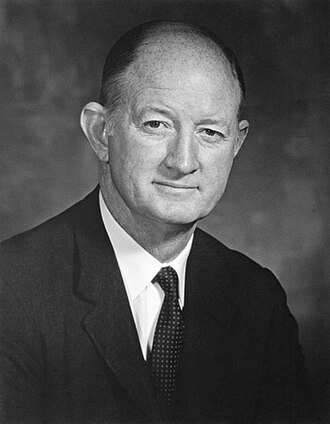
Blount, Winton M. ("Red"), Jr.
Winton M. "Red" Blount, Jr. served as President Nixon's Postmaster General from January 1969 until January 1972. During the taping period, he oversaw the transformation of the U.S. Post Office Department into the independent U.S. Postal Service in 1971, becoming its first director. He was the last person to hold the title of Postmaster General as a cabinet-level position. Blount left the administration in early 1972 to run for a U.S. Senate seat in Alabama.
President Nixon and his Cabinet met to discuss the ongoing military operations in Indochina and the development of the administration's national health reform agenda. Regarding the war, officials reviewed the progress of South Vietnamese incursions into Laos and Cambodia, noting that the strategy was successfully disrupting enemy supply lines while shifting the burden of ground operations away from American forces. The conversation then transitioned to a detailed proposal from Secretary of Health, Education, and Welfare Elliot Richardson regarding healthcare reform, with the group debating the costs, tax implications, and administrative feasibility of implementing Health Maintenance Organizations (HMOs) and national health insurance standards.
President Nixon met with his Cabinet and key staff to discuss the status of the administration's revenue sharing legislative agenda and receive briefings on various international developments. Administration officials reported on their outreach efforts to build public and Congressional support for revenue sharing while addressing opposition from labor and minority groups. Additionally, Cabinet members provided updates on their recent foreign travels, emphasizing the geopolitical successes of the Nixon Doctrine in Southeast Asia and the strengthening of international cooperation on transportation and environmental safety.
President Nixon and a wide-ranging group of Cabinet members, advisors, and Congressional representatives met to discuss the growing national energy crisis and the necessity of transitioning to nuclear power. AEC Chairman Glenn Seaborg and other experts detailed the technological, environmental, and economic advantages of the liquid metal fast breeder reactor, emphasizing its ability to maximize fuel efficiency and provide long-term, pollution-free energy. The participants concluded that a strong national commitment, including significant federal funding and industry collaboration, is essential to accelerate the development of demonstration reactors and ensure future energy independence.
President Nixon met with his Cabinet and key staff to coordinate legislative strategies and manage domestic policy agendas. The discussion focused on securing passage for welfare reform and other administration priorities by engaging directly with congressional leadership and balancing competing interests within the labor market. Participants assessed the challenges of mobilizing support among both Democrats and Republicans and emphasized the necessity of persistent lobbying and effective communication with legislative committees.
President Nixon met with Postmaster General Winton Blount and George Shultz to discuss ongoing U.S. Postal Service labor negotiations and the administration's strategic focus on restoring management rights in exchange for wage increases. The participants also explored strategies for hiring retired military personnel to fill high-level postal reorganization roles, leveraging their organizational discipline. Finally, they touched upon the 1972 election landscape, specifically the potential political impact of George Wallace’s candidacy on Nixon’s electoral prospects in the South and among Northern blue-collar voters.
President Nixon and his Cabinet met to receive a briefing on international affairs and domestic policy, with a focus on Secretary of State William P. Rogers' recent diplomatic travels to the Middle East and the feasibility of desalinization technology. Rogers reported on his efforts to stabilize the Middle East through ceasefire maintenance and discussed the geopolitical concerns of various regional leaders. Dr. Edward E. David Jr. and other experts presented a detailed plan to advance domestic water desalinization and nuclear power capabilities, with the President calling for a major, accelerated federal effort to ensure American technological leadership. The meeting concluded with a brief status report from Treasury Secretary David M. Kennedy regarding the current international monetary situation and the fluctuations of the dollar.
President Nixon met with his Cabinet and key advisors to announce a major breakthrough in Strategic Arms Limitation Talks (SALT) with the Soviet Union, culminating in a joint statement to be released simultaneously in both nations. The agreement establishes a framework to prioritize limiting anti-ballistic missile (ABM) systems while pursuing parallel measures for offensive weapons. Nixon emphasized that the breakthrough was achieved by maintaining a strong U.S. defense posture, and he urged his administration to avoid public speculation or detailed commentary that could complicate sensitive ongoing negotiations.
President Nixon, Vice President Agnew, and a large group of Cabinet members and senior staff met to establish a strategic framework for domestic policy, budget planning for the 1973 fiscal year, and the development of the 1972 Republican legislative and election platform. Participants reviewed polling data regarding national, community, and family concerns, noting that the economy, inflation, and unemployment are primary public priorities while other issues like pollution and consumerism are often driven by media visibility. The President and attendees emphasized the need for better communication to receive credit for administration accomplishments, focusing on a limited number of 'gut issues' rather than overextending on too many programs. Ultimately, the group discussed the necessity of coordinating policy initiatives and messaging to ensure visible progress on key economic and social concerns ahead of the 1972 election.
President Nixon met with Postmaster General Winton M. "Red" Blount to discuss the confirmation of Post Office Board of Governors appointments and potential political strategies for Blount's planned Senate run in Alabama. The President offered instructions for Bryce Harlow to negotiate with Senator Hiram Fong to expedite the stalled confirmation process, while also evaluating the political viability of Alabama Senators John Sparkman and James B. Allen. They concluded by discussing the logistics of Blount’s impending resignation announcement and his electoral prospects, punctuated by informal remarks on Alabama college football.
President Nixon initiated a brief holiday call to Postmaster General Winton M. "Red" Blount to exchange Christmas greetings. Beyond pleasantries, the two discussed the positive reception of a television special featuring Julie Nixon and evaluated the current state of the national economy. Nixon specifically sought Blount’s assessment of the performance of the Pay Board and Price Board as indicators of economic recovery.
President Nixon met with Mark Goode, William Timmons, and senatorial candidates Winton Blount and J. Caleb Boggs to coordinate arrangements for a campaign film session. Following the candidates' departure, the discussion shifted toward the recording of a veto message regarding House Resolution 1. The President consulted with his staff on the messaging strategy and requested a follow-up telephone call to John D. Ehrlichman to finalize the legislative approach.