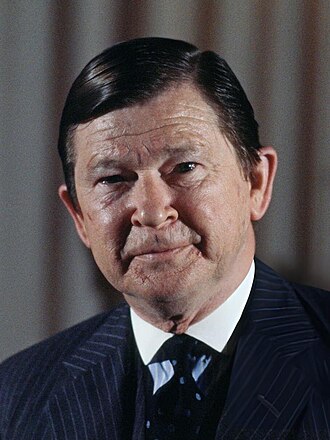
Tower, John G.
John G. Tower was a Republican United States Senator from Texas, serving from June 1961 to January 1985, which spanned the entirety of the Nixon administration. During the White House taping period (February 1971 – July 1973), Tower was a prominent conservative voice on the Armed Services Committee and a staunch defender of President Nixon's Vietnam and national security policies. He also held key leadership roles, transitioning from Chairman of the National Republican Senatorial Committee (January 1969 to January 1971) to Ranking Member of the Senate Banking, Housing, and Urban Affairs Committee (January 1971 to January 1977), and later assuming the Chairmanship of the Senate Republican Policy Committee from January 1973 to January 1985.
President Nixon met with a group of Republican senators and key advisors, including Henry Kissinger, to discuss the political landscape surrounding the Vietnam War and national defense policy. The conversation focused on the erosion of public support for the war, the impact of various congressional anti-war resolutions, and the importance of maintaining American preeminence despite shifting domestic and international pressures. The participants strategized on how to manage the political fallout of the Vietnamization policy and addressed concerns regarding defense preparedness and the administration's foreign policy initiatives in the Soviet Union and China.
President Nixon met with Vice President Agnew, Treasury Secretary John Connally, and Republican Congressional leaders to address critical economic and legislative challenges. The primary focus was the potential bankruptcy of the Lockheed Corporation and the necessary legislative strategy to secure government loan guarantees to prevent a ripple effect of industrial failures and job losses. Additionally, the group reviewed the administration's legislative priorities, including welfare reform, general and special revenue sharing, and the status of various appropriations bills.
President Nixon met with Senator John G. Tower and associates to discuss federal assistance for the severe drought affecting Texas, Oklahoma, and New Mexico. The participants strategized on legislative relief measures, including loan forgiveness and expanded Small Business Administration support, to address the political risks the drought posed to the administration. Additionally, Nixon agreed to record a 30-40 second video message for Tower's upcoming decade-of-service dinner in Dallas and discussed the broader political optics of his administration's response to the crisis.
President Nixon met with Henry Kissinger to finalize the announcement of a breakthrough in the Strategic Arms Limitation Talks (SALT), emphasizing the need for a brief and controlled public presentation. Following this, the President convened a broader group of officials to address domestic policy, specifically focusing on expanding agricultural drought relief for Texas and Oklahoma and managing national economic policy, including interest rates and housing market stability. The meeting concluded with a review of upcoming congressional votes, where administration staff expressed confidence in defeating the Mathias Amendment.
Senator John G. Tower and Howard Payne University President Guy D. Newman met with President Nixon for a brief, ceremonial visit that included the presentation of a university medallion and an honorary gift. The discussion quickly shifted to substantive legislative strategy regarding the pending Lockheed loan guarantee bill. Senator Tower briefed the President on the precarious vote count for cloture, outlining his plan to persist with further petitions if the initial vote failed.
President Nixon held a series of meetings involving staff and administration officials to coordinate on several pressing domestic and economic policy matters. The participants discussed legislative strategy regarding the Lockheed Corporation, the political risks associated with school busing and desegregation litigation in Texas, and the appointment of William D. Eberle as the new Special Trade Representative. Nixon emphasized a transition toward prioritizing domestic interests in international trade negotiations and sought to align his team on messaging regarding the administration's stance on school integration compliance.
President Nixon convened a meeting with Vice President Agnew and a bipartisan group of Congressional leaders to discuss the national economy and his administration's "New Economic Policy." Key topics included the wage-price freeze, investment tax credits, the international monetary situation, and an import surcharge. The discussion focused on the necessity of Congressional cooperation for implementing these measures and their potential impact on inflation, trade, and specific industries like automobiles.
President Nixon met with a bipartisan group of Congressional leaders to discuss the progress of the 90-day wage-price freeze and to seek input on the development of Phase II economic policies. Treasury Secretary George Shultz provided an overview of the administration's administrative efforts, including the roles of the Cost of Living Council and the IRS in enforcing the freeze. The discussion centered on the need for continued cooperation across sectors—including labor, business, and agriculture—and the development of a framework for economic stabilization once the initial freeze expired.
President Nixon met with bipartisan Congressional leadership to outline his post-freeze economic program and announce plans for an upcoming summit in Moscow. He detailed the formation of a tripartite Pay Board, a Price Commission, and a committee on interest and dividends to maintain economic stability through a mix of voluntary cooperation and necessary sanctions. Additionally, the President briefed the leaders on the status of international monetary negotiations and his strategic approach to the May 1972 summit with Soviet leadership regarding arms control and trade.
President Nixon met with a bipartisan group of Congressional leaders to brief them on his recent diplomatic discussions with French President Georges Pompidou and the status of U.S. international economic policy. The conversation focused on efforts to address the global monetary crisis, the necessity of realigning exchange rates to restore the competitive position of American goods, and the importance of burden-sharing among trade partners. Nixon highlighted the recent breakthrough in negotiations with France as a critical step toward stabilizing the international monetary system and advancing domestic economic goals like job creation and inflation control.
President Nixon met with a bipartisan group of legislators and administration officials to discuss a coordinated strategy to address public opposition to forced busing for school desegregation. The participants evaluated various legal and legislative remedies, including executive intervention in pending court cases, the passage of restrictive legislation, and the potential adoption of a constitutional amendment. The meeting concluded without a final decision, as the President tasked his staff and advisors with synthesizing these diverse perspectives into a unified, formal policy proposal for the administration.
President Nixon met with Republican congressional leadership to coordinate administration talking points on sensitive domestic and foreign policy issues. The discussion focused primarily on the ongoing military situation in Vietnam, emphasizing the success of Vietnamization, the importance of maintaining public support, and the necessity of keeping political opposition from undermining the war effort. Additionally, the President and his advisors briefed members on key legislative priorities, specifically the administration's stance against forced busing and efforts to address rising food prices and drug-related crime. The participants discussed strategies for distributing these fact sheets and maintaining a unified front to influence public perception and legislative outcomes.
President Nixon met with bipartisan Congressional leaders to discuss the upcoming Soviet summit and the administration's strategic approach to international relations. The discussion focused on complex issues including trade, Most Favored Nation (MFN) status for the Soviet Union, and the potential for bilateral cooperation despite ideological differences. Nixon emphasized the importance of maintaining a unified stance to ensure the success of the negotiations while managing domestic political expectations.
President Nixon held a large-scale photographic session in the Oval Office with numerous Republican senators, representatives, and congressional candidates. The event was coordinated by technical staff to capture official images of the President with party members. Following the main group session, Clark MacGregor remained for a brief private discussion with the President.
President Nixon met with Senators John Tower and Howard Baker, William Timmons, and photographer Ollie Atkins to discuss 1972 campaign strategies and a photograph session. The participants analyzed the political landscape in Tennessee, focusing on local congressional candidates and polling data regarding George McGovern. Nixon emphasized that the Vietnam War remained a potent campaign issue that would work to his advantage if framed effectively against Democratic opponents.
President Nixon met with several Republican senators to strategize on gaining legislative action against school busing during the remaining session of the 92nd Congress. Nixon encouraged the senators to support the current busing legislation as the most viable vehicle for immediate progress, emphasizing that the Senate should at least proceed to a vote on the merits rather than allowing the bill to stall. The President also discussed the broader political landscape, including his judicial philosophy regarding Supreme Court appointments and his intent to emphasize these themes in upcoming campaign appearances.
President Nixon met with his economic advisors and Republican Senate leadership to coordinate a strategy for securing congressional support for a federal spending ceiling. The discussion focused on the necessity of controlling runaway federal expenditures and the potential use of the presidential veto to enforce a $250 billion spending limit. Nixon and his team evaluated the legislative outlook for the debt limit bill, including strategies for handling amendments and managing potential political fallout regarding domestic programs.
President Nixon, John V. Brennan, and the Camp David operator coordinated technical arrangements to facilitate a private phone call between the President and Senator John G. Tower. The participants discussed the feasibility of monitoring or patching into the call, ultimately confirming that the requested line access was not technically possible. No substantive policy matters were addressed, as the brief exchange focused solely on the logistics of the connection.
President Nixon contacted Senator John G. Tower via a telephone hookup to address a gathering of Texas supporters during the final stretch of the 1972 presidential campaign. Nixon praised Tower’s legislative record, specifically highlighting his support for national defense, fiscal responsibility, and the administration’s goal of 'peace with honor.' The President used the call to solidify political support in Texas and emphasize the necessity of Tower’s continued presence in the Senate for his upcoming second term.
President Nixon held a brief phone conversation with Senator John G. Tower to address a reception held in the Senator's honor. After coordinating technical logistics with John V. Brennan and the Camp David operator, Nixon personally called Tower to offer a strong endorsement of his legislative record. The President emphasized Tower's importance to both Texas and the nation, expressing his anticipation of working together during a second term.
President Nixon met with a bipartisan group of Congressional leaders to provide a detailed briefing on the recently finalized Vietnam Peace Agreement and its implementing protocols. Henry Kissinger explained the strategic nuances of the agreement, including the status of North and South Vietnam, the mechanisms for the International Control Commission, and the timeline for the withdrawal of U.S. forces and the release of prisoners of war. The President emphasized the necessity of bipartisan Congressional support to ensure the agreement's stability and signaled that the administration would work with Congress to frame a positive resolution regarding the end of the war.
President Nixon met with Republican congressional leadership to outline his fiscal strategy for the 1974 budget, emphasizing the necessity of expenditure control to avoid tax increases and curb inflation. Nixon and his advisors discussed the use of budget impoundments to maintain a spending ceiling of $269 billion, framing this approach as a critical move for economic prosperity despite the anticipated pushback from special interest groups. The meeting concluded with a call for Republican leaders to unify behind the administration's fiscal restraint and to clearly communicate that budget cuts are essential for maintaining national economic stability.
President Nixon met with Republican congressional leaders to discuss his administration's legislative priorities, focusing primarily on securing support for a fiscally responsible budget. He emphasized the necessity of cutting spending and utilizing presidential vetoes to combat inflation and avoid tax increases, framing these actions as essential for the nation's economic stability. Additionally, the President and the leaders engaged in an extensive review of recent foreign policy, specifically highlighting the significance of the Vietnam cease-fire and the strategic importance of U.S. global leadership.
President Nixon and Republican congressional leaders met to discuss the administration's legislative agenda, specifically focusing on the "New Federalism" approach to governance. The President emphasized shifting decision-making power from the federal bureaucracy to local and state authorities through programs like the Better Communities Act and the Responsive Government Act. Additionally, the conversation addressed a robust crime-fighting package, including proposed federal death penalty statutes and mandatory sentences for major drug traffickers, while positioning these initiatives as essential to restoring national law and order.
President Nixon met with Republican Congressional leaders and economic advisors to discuss strategies for addressing rising food prices, inflation, and the ongoing transition of the wage-price stabilization program. Key topics included the administration's efforts to increase food supplies and imports, the management of labor-management relations, and the necessity of maintaining party unity to sustain presidential vetoes on spending legislation. The meeting underscored the administration's focus on economic control and the importance of Congressional support in implementing fiscal policy.
President Nixon met with a broad group of Republican Congressional leaders to propose the creation of a bipartisan, independent commission on federal election reform. The President outlined the commission's broad mandate to study and recommend improvements to campaign financing, ethics, disclosure rules, and potentially the length of election campaigns. Nixon emphasized that the commission, which would include both public members and Congressional representatives, should serve as a catalyst for practical reform and generate public support for legislative action without preempting the authority of existing Congressional committees. The meeting focused on establishing a non-partisan framework to address the inefficiencies and technical challenges identified in previous election laws.
President Nixon met with Republican congressional leadership to discuss administration strategy regarding pending agricultural legislation and the proposed Alaska pipeline. The President and his team emphasized the shift toward an export-driven agricultural policy and sought consensus on managing the Senate's version of the farm bill, noting the political risks of introducing a standalone administration proposal. Regarding the Alaska pipeline, the President and Secretary Morton argued for immediate legislative approval to address urgent domestic energy shortages, asserting that current supply crises were exacerbated by previous delays and that alternative Canadian routes were not currently viable. Finally, the President urged the leaders to maintain support for his foreign policy initiatives, highlighting recent successes in Vietnam, China, and the USSR while stressing the need for continued operational security to protect sensitive ongoing negotiations.
President Nixon met with Vice President Agnew and Republican congressional leadership to solidify legislative strategy and enhance communication between the White House and Capitol Hill. Key discussions included Henry Kissinger’s briefing on recent negotiations in Iceland regarding the 'Year of Europe' and the progress of the Vietnam Peace Accord. The group also addressed the need for improved coordination on pending legislation, political appointments, and the management of vetoes to maintain party unity in the face of domestic challenges.
President Nixon met with Vice President Agnew, cabinet members, and a bipartisan group of Congressional leaders to announce an upcoming economic policy address and discuss the administration's new strategy to combat inflation. The President detailed a 60-day price freeze—excluding wages and raw agricultural products—and sought legislative assistance regarding export controls on food and gasoline supply allocations. Additionally, the President arranged for key Congressional leaders to receive ongoing briefings from administration officials during the upcoming summit with Soviet leader Leonid Brezhnev to ensure better oversight of the resulting agreements.
President Nixon met with Vice President Agnew, top economic advisors, and a large group of Republican Congressional leaders to discuss the administration's current 60-day economic freeze and the development of a subsequent "Phase IV" program. The primary challenge identified was managing inflation and supply shortages—particularly in food—while avoiding the long-term economic damage of permanent price and wage controls. The President and his advisors sought Congressional support for a balanced budget and specific legislative measures, such as the release of strategic stockpiles, while acknowledging the significant political difficulty of passing unpopular fiscal reforms. Participants emphasized the need for a careful balance between short-term political relief and long-term economic stability to avoid the pitfalls of past rationing and supply-side distortions.