Nixon, Richard M. (President)
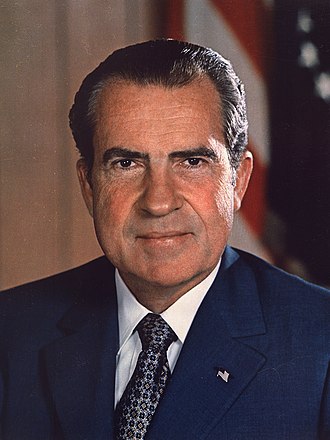
Richard M. Nixon served as the 37th President of the United States from January 1969 until his resignation in August 1974. In February 1971, he ordered the installation of a secret voice-activated taping system in the White House to preserve a historical record of his administration. Until the system's existence was revealed and dismantled in July 1973, the tapes captured Nixon directing major foreign policy initiatives, such as the opening to China, as well as his central role in the Watergate cover-up.
What Nixon talks about on the tapes
White House operations 4,718Presidential scheduling 2,225Public relations 1,784Presidential schedule 1,782Vietnam War 1,693Logistics 1,650Manolo Sanchez 1,626White House communications 1,400White House administration 1,399Presidential communication 1,243Henry Kissinger 1,191Foreign Policy 1,183
Conversations (21,010)
— Page 113 of 211President Nixon met with his aide Stephen B. Bull to coordinate his upcoming daily schedule and manage administrative logistics. Their discussion centered on a planned meeting with Emil “Bus” Mosbacher, Jr. and the organization of official gift presentations. The brief interaction served to finalize these minor executive appointments and clarify pending protocol items.
President Nixon met with Chief of Protocol Emil Mosbacher, Jr. to discuss potential future assignments within the administration, including diplomatic opportunities in Pakistan and Iran. The two reviewed various official contacts, specifically referencing the Shah of Iran and Henry Kissinger regarding the Middle Eastern portfolio. Additionally, the President took the opportunity to present a gift to Mosbacher’s wife, Patricia, during the brief meeting.
President Nixon met with his aide, Stephen B. Bull, to conduct a brief review of his daily schedule. The discussion focused on coordinating upcoming appointments and administrative logistics regarding Cecelia D. Bellinger and speechwriter Raymond K. Price, Jr. The meeting concluded immediately following these scheduling arrangements.
President Nixon met with Cecelia D. Bellinger, Ann M. Morgan, and Raymond K. Price, Jr. to facilitate a brief ceremonial gathering in the Oval Office. During the meeting, the President presented gifts to the attendees while White House photographer Oliver F. Atkins documented the event. The interaction concluded quickly after the exchange of tokens and photographs.
President Richard M. Nixon met with his personal aide, Stephen B. Bull, to discuss upcoming scheduling matters. The brief discussion focused on arranging meetings with Clifford Evans and Press Secretary Ronald L. Ziegler. No formal decisions were recorded during this short administrative session.
President Nixon met briefly with Stephen B. Bull and Ronald L. Ziegler to coordinate administrative arrangements regarding his daily schedule. The discussion focused specifically on the logistics for an upcoming interview. The meeting concluded quickly without any record of major policy shifts or broader strategic decisions.
President Nixon met with Clifford Evans and Press Secretary Ronald Ziegler to discuss the President’s recent writing on baseball history and legends. The conversation centered on Nixon’s personal admiration for iconic players like Lou Gehrig, Red Schoendienst, and Sandy Koufax, as well as his perspective on the 'team concept' in sports. Additionally, the group shared historical anecdotes regarding figures such as Floyd Patterson, Wilt Chamberlain, and the Rev. Martin Luther King, Jr. funeral.
President Nixon met with his aide, Stephen B. Bull, to conduct a review of his upcoming daily schedule. The discussion focused primarily on administrative logistics, specifically regarding a planned meeting or engagement with Anthony T. Rossi. No further substantive policy matters were recorded during this brief scheduling update.
President Nixon held a brief, unscheduled meeting with an unidentified individual in the Oval Office. Due to the lack of an available transcript or recording content, the specific agenda and substantive outcomes of this discussion remain unknown to historical researchers. The interaction concluded within approximately twenty minutes, leaving no documented record of the participants' exchange.
President Nixon met with Rose Mary Woods, Anthony T. Rossi, and Acheille Mongelli to facilitate a brief exchange involving the presentation of gifts. The discussion also touched upon the President's recent diplomatic trip to the Soviet Union and his interview with journalist Clifford Evans. Woods expressed the President's appreciation to the guests before the group concluded their meeting.
President Nixon contacted the White House operator to facilitate a telephone connection with his Special Counsel, Charles W. Colson. The brief interaction served as an administrative request to reach Colson for a follow-up conversation. No further policy or strategic details were exchanged during this brief logistical exchange.
President Nixon, H. R. Haldeman, and Charles Colson met to evaluate the President’s recent press conference performance and discuss broader strategies for countering perceived media bias. The participants scrutinized press hostility toward the administration, specifically analyzing how to manage factual errors in reporting and mobilize an organized response to unfavorable coverage. They also assessed the political implications of George McGovern's campaign statements and debated the effectiveness of past communication styles compared to those of previous administrations.
President Nixon and his personal secretary, Rose Mary Woods, discussed logistical arrangements regarding travel plans for Bebe Rebozo and Robert Abplanalp. Nixon instructed Woods to determine their location and discourage them from traveling to the White House due to ongoing complications, suggesting they remain in Florida or coordinate alternative meeting arrangements. The conversation focused on managing the President’s private schedule and minimizing potential disruptions caused by his close associates.
President Nixon consulted with a White House operator to facilitate an outgoing call to an unidentified individual. While the recipient was not explicitly named in the official record, internal context suggests the call was intended for George P. Shultz. This brief interaction served solely as a logistical bridge to connect the President to his intended party.
President Nixon met with an unknown individual to discuss the status and appearance of his wardrobe. The brief exchange focused on evaluating a selection of suits to determine if the current inventory was sufficient for upcoming public appearances. No major policy decisions were reached, as the discussion remained limited to logistical matters regarding the President's attire.
President Nixon and George P. Shultz briefly discuss the positive outcome of a recent meeting and the necessity of maintaining confidentiality regarding certain developments. The conversation touches upon the public perception of an unnamed trust-related group or club. The President concludes the interaction by requesting that Mr. Coulson be summoned to the Oval Office.
President Nixon met with John Mitchell, H.R. Haldeman, George Shultz, and John Ehrlichman to discuss political strategy and personal staffing matters. A significant focus of the meeting was the potential resignation of John Mitchell and the mounting pressures on his wife, Martha Mitchell, regarding their public life and the 1972 campaign. The participants also discussed administrative policy, specifically welfare reform, and the ideological leanings of recent Supreme Court appointees.
President Nixon contacted the White House operator to facilitate a telephone connection with Caspar W. Weinberger, who was then serving as the Director of the Office of Management and Budget. This brief exchange served exclusively as a logistical administrative step to initiate an official consultation. No further substantive policy discussions occurred during this interaction.
President Nixon consulted with an unidentified staff member regarding his afternoon schedule in the Old Executive Office Building. During this brief interaction, Nixon indicated his intention to take a nap. No significant policy discussions or major administrative decisions were recorded.
President Nixon met with his personal valet, Manolo Sanchez, in the Old Executive Office Building. The discussion focused on coordinating the President's daily schedule and logistical arrangements. No significant policy decisions were recorded during this brief administrative encounter.
President Nixon met with his personal valet, Manolo Sanchez, in the Old Executive Office Building to discuss the President's upcoming schedule. The brief interaction also involved H.R. Haldeman, who participated in the planning of the President's agenda. No significant policy decisions were recorded during this brief administrative exchange.
President Nixon met with Clark MacGregor to discuss the political implications of a potential veto of the Social Security bill, specifically addressing the fiscal impact of the Frank Church amendment and concerns regarding debt ceiling extensions. They strategized on managing Congressional support and navigating the Ways and Means Committee, while also weighing the administration's stance as a campaign issue against Democratic opposition. The meeting concluded with a brief interruption to host Ernesto V. Lagdameo, his wife, and Anna C. Chennault for scheduled greetings and photographs.
President Nixon and Press Secretary Ronald Ziegler met to coordinate the administration's public response regarding the burgeoning Watergate scandal. They specifically discussed managing inquiries about E. Howard Hunt’s involvement, including a potential map of the Democratic National Committee headquarters found on his desk, and formulated a strategy for Ziegler’s upcoming press briefing. Additionally, the pair touched upon the implications of the recent Supreme Court decision on the death penalty and upcoming veto considerations.
President Nixon consulted with OMB Director Caspar Weinberger regarding fiscal constraints and legislative strategies. The President directed a reduction in the public broadcasting budget request from $45 million to previous levels, overriding potential objections from staff like Peter Flanigan. Additionally, they discussed the possibility of vetoing a Social Security bill due to a $3 billion amendment, with Nixon instructing Weinberger to coordinate with Clark MacGregor and George Shultz on the administration's opposition.
President Nixon consulted with the White House operator to facilitate an outgoing call. This brief interaction served as a routine administrative coordination to establish a telephonic connection with another party. No substantive policy discussions or decisions were documented during this exchange.
President Nixon met with H.R. Haldeman, Richard Kleindienst, and Caspar Weinberger to address a wide-ranging agenda including Social Security legislation, death penalty policy following Supreme Court rulings, and security preparations for the upcoming national political conventions. The discussion also covered the health of George C. Wallace and administrative personnel matters. Finally, the group engaged in a detailed dialogue regarding the burgeoning Watergate investigation, specifically focusing on the contents of E. Howard Hunt’s safe, FBI involvement, and potential strategies to manage the political fallout and legal ramifications of the break-in.
President Nixon met with H.R. Haldeman, Stephen Bull, and Richard Moore to discuss the ongoing political and legal fallout following the recent Watergate break-in. The participants evaluated the administration's strategic response to the burgeoning scandal, focusing on controlling the narrative and managing potential investigations. The discussion centered on containment measures and internal assessments of how to mitigate the damage caused by the unauthorized entry at the Democratic National Committee headquarters.
President Nixon, H.R. Haldeman, and Clark MacGregor held an extensive meeting to discuss legislative business, specifically the Social Security bill, alongside a major focus on the emerging Watergate scandal. The participants coordinated efforts to manage the political fallout and investigation regarding the Committee to Re-elect the President, including the involvement of G. Gordon Liddy, E. Howard Hunt, and John Mitchell. They deliberated on creating a strategic 'scenario' to handle the cover-up, addressed campaign finance irregularities, and managed the optics of John Mitchell's potential resignation.
President Nixon requested that the White House operator place a call to Secretary of Housing and Urban Development George W. Romney. This brief interaction served as an administrative directive to establish contact with a cabinet member. No further substantive policy discussions were recorded during this connection.
President Nixon met with his aide, Stephen B. Bull, to request a specific column written by Richard Starnes from the Washington Daily News. During the discussion, Nixon directed Bull to contact Charles W. Colson to join the meeting. This interaction reflects the President's focused interest in monitoring media coverage originating from the National Press Club.
President Nixon and Stephen B. Bull met to review and coordinate the daily schedule of Charles W. Colson. The discussion centered on managing Colson's presence and activities within the Executive Office Building. This meeting served as a routine administrative check-in to ensure proper oversight of senior staff movements.
President Nixon met with Charles Colson, Stephen Bull, and Alexander Butterfield to discuss press relations, pending legislation, and the political fallout of the Watergate break-in. They reviewed strategies for managing the media's coverage of the administration and the Vice President, while also discussing the tactical benefits of leaking information about the RNC files to shape public perception. Additionally, the President reviewed his legislative agenda, ultimately deciding to sign the Social Security bill while considering vetoes on various veterans' bills to manage the federal budget.
President Nixon and H. R. Haldeman met to refine the text and strategic rollout of the President's upcoming July 4, 1972, Bicentennial address. They discussed stylistic edits to the speech, specifically rejecting an overly demanding tone and ordering a reduction in length to approximately 1,500 words. Furthermore, they finalized logistics for the broadcast, including timing arrangements for radio and television coverage and the inclusion of a 90-second film clip for evening news programs.
President Nixon met with H. R. Haldeman and Stephen B. Bull to coordinate the strategic response to John N. Mitchell's resignation as chairman of the Committee to Re-elect the President, specifically discussing the timing of press releases and public statements. The group also addressed administrative scheduling, including the President's attendance at Dabney Hibbert's wedding and coordination with NSC staff regarding anecdotes from his recent trip to the Soviet Union. Additionally, the President discussed budget meetings with Caspar Weinberger and communicated a preference for a saltwater swimming pool over a tennis court in response to a gift offer from Ambassador Walter H. Annenberg.
President Nixon and Stephen B. Bull met to finalize the logistics and scheduling for an upcoming photograph session with youth vocational educational groups. The discussion focused on establishing appropriate talking points and coordinating the participation of the First Family, specifically Julie Nixon Eisenhower, in the event. The meeting ensured that the scheduling requirements for the Vocational Industrial Clubs of America were aligned with the President's public engagement calendar.
President Nixon met with an unidentified individual in the Oval Office to discuss revisions to a draft document. The conversation focused primarily on technical aspects of the text, specifically regarding typing and editorial changes. No major policy decisions or significant developments were recorded during this brief administrative interaction.
President Nixon met with a group of visitors from Kansas City to host a formal photograph session and provide a tour of the White House. The discussion included the display of Soviet gifts presented to the President by Leonid Brezhnev and the distribution of presidential souvenirs to the guests. Additionally, the President reviewed scheduling details regarding upcoming events, including the Future Homemakers Convention and the travel plans of his family members.
President Nixon met with maritime industry leaders and labor union representatives to discuss the status and future of the U.S. shipbuilding and maritime sector. The discussion centered on recent productivity gains, the importance of ship construction for national security and economic competitiveness, and the administration's goals for increasing employment and shipyard output. Nixon emphasized the necessity of a strong, modernized Merchant Marine to maintain U.S. standing in a competitive global market.
President Nixon and U. Alexis Johnson discussed the scheduling and diplomatic priorities for Secretary of State William P. Rogers's upcoming trip to Rome. The primary concern involved coordinating Rogers's meetings with Italian government officials in light of an impending visit by Ronald Reagan and the status of the Italian government. Additionally, they evaluated the diplomatic impact of U.S. recognition of Yemen and potential outreach to Algeria, with Johnson emphasizing the importance of securing the Algerian connection to improve regional diplomatic outcomes.
President Nixon met with his personal secretary, Rose Mary Woods, to coordinate the communication of John N. Mitchell’s resignation. During a brief telephone exchange, Nixon arranged to call Ronald Reagan to discuss the resignation, as well as the strategic value of Reagan's previous trips to Asia and Europe. The discussion prioritized the management of political messaging regarding Mitchell's departure and outreach to key figures like Reagan.
President Nixon held a brief exchange with the White House operator while in the Oval Office. The conversation served primarily as a routine administrative interaction. No substantive policy discussions or significant decisions occurred during this brief communication.
President Nixon consults with U. Alexis Johnson regarding the scheduling and diplomatic priorities for an upcoming overseas trip involving a representative referred to as Bill. The conversation centers on balancing a potential meeting with the Pope against securing a diplomatic opening in Algeria, with Nixon expressing that an Algerian engagement is of higher strategic importance. Ultimately, Nixon instructs Johnson to prioritize the Algerian contact and directs that a meeting with the Pope should only proceed if the Algerian arrangement is finalized.
President Nixon consulted with the White House operator to facilitate communication with members of his administration regarding scheduling conflicts. After failing to reach George W. Romney, who was reportedly traveling in Canada, Nixon requested that the operator connect him with Secretary of Transportation John A. Volpe instead. The brief exchange highlights the administrative logistics involved in managing the President's internal communications and cabinet scheduling.
President Nixon communicated with a White House operator to initiate a telephone call to California Governor Ronald Reagan. The brief exchange served as a logistical step to facilitate the connection between the President and the Governor. No substantive policy discussions or decisions were recorded during this connection process.
President Nixon met briefly with Beverly J. Kaye to discuss her California lodging arrangements before consulting with Alexander P. Butterfield on official administrative matters. The discussion covered a status report on the Vietnam War and logistical planning for providing presidential transportation to Governor George C. Wallace for his travel to the Democratic National Convention. Nixon explicitly prioritized coordinating these travel arrangements through H. R. Haldeman while factoring in Wallace’s current health status.
President Nixon instructed the White House operator regarding the handling of a specific incoming or pending telephone call. The exchange focused on administrative instructions to either drop the connection or maintain the hold status. No substantive policy matters or major developments were discussed during this brief procedural interaction.
President Nixon consulted with the White House operator to facilitate a connection for a specific individual. The brief exchange focused on providing assistance to this person through the operator's services. No major policy decisions were made during this routine administrative coordination.
President Nixon met with his aide Stephen B. Bull to coordinate logistical arrangements for his upcoming travel to California. The discussion focused on scheduling appointments with Charles W. Colson and Caspar W. Weinberger prior to the trip. The President directed Bull to bring a briefing book to ensure necessary documentation was available for the visit.
President Nixon met with Charles Colson, Ronald Ziegler, Caspar Weinberger, and others to strategize on administration policy, political messaging, and pending legislation. The conversation focused on managing the political optics of Social Security increases and federal budget cuts, as well as coordinating a firm stance on Vietnam peace negotiations and prisoners of war. Nixon directed his team to emphasize that any increased federal spending must be balanced by tax increases, and he instructed staff to challenge negative media coverage, particularly regarding Vietnam and administrative integrity.
President Nixon consulted with the White House operator to verify the current location of Secretary of Transportation John A. Volpe, who was visiting the Virgin Islands. The brief exchange served as a logistical coordination effort to facilitate contact with the Secretary. No significant policy decisions were made during this short communication.
President Richard Nixon and Ronald Reagan coordinated the logistics of Reagan's upcoming travel and his scheduled meeting with Henry Kissinger. The discussion centered on aligning schedules and determining the conditions under which Reagan should proceed with specific diplomatic or committee-related objectives. Nixon emphasized the necessity of Kissinger’s involvement to ensure the meetings and itineraries were properly managed.
President Nixon contacted the White House operator to facilitate a personal telephone call to his daughter, Julie Nixon Eisenhower. This brief administrative exchange served solely to initiate the connection between the President and his family member. No policy matters or official government business were transacted during the interaction.
President Richard Nixon and his daughter, Julie Nixon Eisenhower, held a brief, informal telephone conversation. The exchange, which was primarily obscured by administrative withdrawals and incoherent transcript segments unrelated to the participants, served as a personal check-in between family members. No substantive policy matters or official administrative decisions were conducted during this interaction.
President Nixon initiated a brief administrative call via the White House operator to coordinate communication with CIA Director Richard M. Helms. The discussion focused on facilitating a conversation with Helms and referencing ongoing coordination with Henry Kissinger regarding matters to be presented to the President. These arrangements were made in anticipation of Nixon's upcoming travel to San Clemente.
President Nixon and H. R. Haldeman met with Julie Nixon Eisenhower and other staff to discuss the first family's public relations strategy, scheduling for upcoming events, and the political climate. A significant portion of the conversation focused on the resignation of John N. Mitchell, with the President coordinating how the administration would address media inquiries regarding the departure and the ongoing Watergate investigation. They also evaluated the effectiveness of recent speeches given by family members and discussed the political implications of upcoming travels and appearances.
President Nixon instructed the White House operator to facilitate communication with high-level intelligence officials during a brief telephone exchange. After failing to reach CIA Director Richard M. Helms, the President directed the operator to place a call to Lieutenant General Vernon A. Walters instead. This interaction reflects the President's urgent effort to establish contact with intelligence leadership to address ongoing administrative or security matters.
President Nixon initiated this brief call to reach Deputy CIA Director Vernon A. Walters after discovering that CIA Director Richard Helms was unavailable. The primary purpose was to coordinate a forthcoming meeting regarding sensitive matters involving Soviet leadership and concerns over potential information leaks from the State Department. Nixon also signaled an intent to discuss the protection of the CIA and provided specific instructions to be relayed to relevant personnel.
President Nixon met with Deputy Director of the CIA Vernon A. Walters to discuss his adjustment to his new role within the intelligence agency. Nixon inquired about Walters' satisfaction with the position and instructed him to secure assistance in managing specific operational challenges. The conversation emphasized the President's desire for Walters to navigate these internal matters discreetly without unnecessary administrative oversight.
President Nixon met with staff aides Stephen B. Bull and Bruce A. Kehrli to manage administrative tasks, specifically focusing on the review and signing of pending legislation. During the brief session, Nixon verified the identity of the incoming Staff Secretary, identified as Wilson. The participants also coordinated logistical arrangements regarding the President’s upcoming schedule, including travel to California and associated press and well-wishing activities.
President Nixon contacted the White House operator to facilitate a telephone connection with Under Secretary of State for Political Affairs U. Alexis Johnson. The brief exchange served as a logistical request to initiate this high-level communication. No further details regarding the substance of the intended conversation with Johnson were recorded.
President Nixon and Charles W. Colson engaged in a lengthy telephone consultation to discuss sensitive political strategy and administration priorities. While specific transcript details remain unavailable, the discussion served as a private forum for the President to coordinate executive messaging and internal policy oversight with his special counsel. The exchange reinforces the close working relationship between the two men during a critical period of the 1972 election cycle.
President Nixon met with his valet, Manolo Sanchez, in the Oval Office to provide specific directives regarding the organization and management of documents. The discussion centered on the proper placement and filing of sensitive materials, specifically designating certain items for inclusion in a private file. This interaction underscores the President's strict personal oversight of his records and administrative filing systems.
President Nixon met with Alexander P. Butterfield to address administrative matters, including the securing of the President's signature on pending documents. The discussion covered arrangements regarding the death and funeral of William T. Pecora, as well as the appointment of Thomas Bradford Curtis to the Corporation for Public Broadcasting. These brief interactions underscored the routine management of executive personnel and institutional oversight during the Nixon administration.
President Nixon and H. R. Haldeman discussed potential vacation retreats, specifically evaluating Thomas B. McCabe’s Assateague Island property as a private alternative to Camp David. The conversation shifted to media strategy, with Nixon and Haldeman reviewing Ronald Ziegler's approach to press relations, the benefits of Oval Office press conferences, and upcoming political events. Finally, they planned a summit meeting with the Japanese Prime Minister in Hawaii, emphasizing the importance of managing local ethnic sensitivities and coordinating with Senator Hiram Fong.
President Nixon met with Bradford Mills, Thomas S. Sedlar, and Peter M. Flanigan to discuss the operations of the Overseas Private Investment Corporation (OPIC) and its potential role in expanding U.S. business interests in Eastern Bloc countries. The participants explored the legal challenges of providing investment insurance in nations like the Soviet Union, Poland, and Hungary, emphasizing that such economic outreach must be treated as a strategic diplomatic tool. Nixon ultimately directed the group to coordinate with Henry Kissinger to integrate OPIC's capabilities into the broader framework of U.S.-Soviet trade negotiations.
President Nixon met briefly with an unidentified individual in the Oval Office to provide a specific instruction regarding the removal of an unknown item. The meeting concluded immediately following this directive, lasting less than one minute. No further details regarding the nature of the object or the identity of the visitor were recorded.
President Nixon met with his aide, Stephen B. Bull, to coordinate the logistics and scheduling for an upcoming appointment with Arthur S. Flemming. The discussion focused on managing media access, specifically regarding the timing of press photographs and briefings. The brief exchange addressed the administrative delays caused by late funding, ensuring the President's schedule remained organized.
President Nixon met with officials from the Department of Health, Education, and Welfare (HEW) to discuss the administration's efforts to enforce federal standards within the nursing home industry. The participants reviewed progress in state-level surveys and compliance, acknowledging that while many facilities had been brought into line or decertified, the industry remained in need of significant improvement in quality of care. Nixon emphasized that beyond regulatory oversight and federal funding, the government must encourage volunteerism, combat the isolation of the elderly, and elevate the social status of healthcare workers. The meeting concluded with informal discussions regarding the President's personal schedule and recent diplomatic gifts.
President Nixon initiates a brief telephone exchange with the White House operator to request a connection to Charles W. Colson. The call serves as a logistical bridge to facilitate a direct conversation between the President and his special counsel. No substantive policy discussions occur during this short interaction.
President Nixon interacts with a White House operator in the Oval Office to facilitate telephonic communication. The brief exchange serves as a standard administrative check for connecting the President to an external party. No substantive policy discussions or significant political decisions were recorded during this brief technical connection.
President Richard M. Nixon and Charles W. Colson engaged in a lengthy telephone consultation regarding undisclosed matters. Due to the withdrawal of the recorded content for security or personal reasons, no specific administrative decisions or thematic details are accessible. The interaction remains archived as a restricted record within the White House taping system.
President Nixon and Charles Colson met in the Oval Office to discuss political strategy and administrative matters. The conversation focused on internal White House dynamics and the management of sensitive personnel issues. While a specific portion of the discussion remains classified, the meeting reflects the ongoing coordination between Nixon and his special counsel regarding executive priorities during the 1972 election cycle.
President Nixon contacted the White House operator to facilitate a telephone connection. The brief exchange served as a logistical request to initiate a call with Charles W. Colson. No substantive policy discussions or further actions were recorded during this brief communication.
President Nixon contacted the White House operator to facilitate a telephone connection with Charles W. Colson. This brief administrative interaction served as an intermediary step to coordinate communication between the President and his special counsel. The primary action item resulting from the exchange was the successful placement of the call to Colson.
President Nixon met briefly with an unidentified individual in the Oval Office. The participants exchanged brief remarks, during which the President expressed his gratitude. The meeting concluded quickly without the discussion of substantive policy or strategic matters.
President Nixon and Alexander M. Haig, Jr. met in the Oval Office to facilitate communication with domestic advisor John D. Ehrlichman. The primary action taken during this brief interaction was an unsuccessful attempt to contact Ehrlichman by telephone. The session concluded following a technical error resulting in the party reaching the wrong telephone line.
President Nixon and John D. Ehrlichman met to coordinate their upcoming legislative schedule and domestic policy agenda. They specifically discussed the arrangements for a Friday meeting between the administration and congressional leaders. The conversation functioned as a logistical briefing to ensure alignment on pending executive-legislative priorities.
President Nixon and Stephen B. Bull coordinate the scheduling of a meeting with John D. Ehrlichman to discuss pending legislation. Bull seeks clarification on how to manage Ehrlichman’s access and whether a formal appointment is necessary for reviewing specific bills. Nixon instructs Bull on protocols for facilitating this meeting and ensuring efficient communication between the two offices.
President Nixon held a brief, private meeting in the Oval Office with an unidentified individual. A short portion of the conversation, designated as a personal returnable item, was withdrawn from public release. The remainder of the discussion remains undefined due to a lack of available transcriptions or metadata regarding the specific subject matter addressed.
President Nixon met with John Ehrlichman to discuss a broad range of domestic political strategy, upcoming legislative vetoes, and the ongoing investigation into the Watergate break-in. The President emphasized a campaign strategy focused on law and order, specifically highlighting the threat of domestic radicals and the need to capitalize on the administration's judicial appointments. Regarding Watergate, Ehrlichman briefed the President on the potential criminal liabilities of Jeb Stuart Magruder and the legal maneuvers intended to manage the unfolding scandal, including efforts to distance the White House from the burglars and avoid implicating John Mitchell.
President Nixon met with his personal valet, Manolo Sanchez, in the Old Executive Office Building for a brief, private discussion. The exchange consisted of a short, personal interaction that was ultimately withdrawn from public record. No substantive policy discussions or administrative actions were recorded during this brief encounter.
President Nixon communicated briefly with the White House operator to facilitate a telephonic connection. This interaction functioned as a routine administrative request to establish communication with another party. No substantive policy matters or political discussions were addressed during this short exchange.
President Nixon met with his personal valet, Manolo Sanchez, in the Old Executive Office Building. The brief interaction consisted of personal matters rather than substantive policy discussions, as the entirety of the recorded dialogue was withdrawn for personal privacy. No significant administrative decisions or political developments occurred during this brief encounter.
President Nixon consulted with the White House operator to confirm the status of Charles Colson, expressing concern that he may have interrupted the aide's lunch. The operator clarified the circumstances of the previous interaction, reassuring the President. The brief exchange served as an administrative check regarding Nixon's telephonic communications with his staff.
President Nixon consulted with the White House operator to facilitate an outgoing call to an unidentified mayor. This brief interaction served as a logistical bridge to connect the President with local leadership for an undisclosed discussion. The exchange concluded once the operator initiated the connection to the intended party.
President Nixon held consultations with Philadelphia Mayor Frank Rizzo, Charles Colson, and Alexander Haig to discuss political strategy and upcoming events. Nixon praised Rizzo’s recent public performance and sought his counsel regarding the political risks of involving Frank Sinatra in an upcoming state event for the Italian Prime Minister. The participants evaluated the potential fallout regarding Sinatra’s rumored associations and considered the optics of his inclusion in a high-profile Kennedy Center performance.
President Nixon contacted the White House operator to initiate a telephone call to Philadelphia Mayor Frank L. Rizzo. This brief interaction served solely as a logistical request to connect the President with the mayor. No further substantive policy matters or discussions were conducted during this exchange.
President Nixon calls Philadelphia Mayor Frank L. Rizzo to commend him for a recent public statement and to discuss political support from Philadelphia operating engineers. The two leaders also deliberate on the political optics of associating with Frank Sinatra, specifically gauging how law enforcement officials might perceive potential ties between Sinatra and organized crime figures. Finally, the conversation touches upon upcoming scheduling matters, including a potential visit from Italian Prime Minister Giulio Andreotti.
President Nixon and Alexander Haig held a brief discussion regarding the coordination of Henry Kissinger’s schedule as it pertained to ongoing Vietnam negotiations. The exchange focused on managing the timing and logistics of these high-level diplomatic efforts. No formal policy decisions were recorded during this short administrative check-in.
President Nixon contacted the White House operator to facilitate a telephone call to entertainer Frank Sinatra. This administrative interaction reflects the President's efforts to reach out to specific public figures during his term. No further discussion or substantive policy matters were recorded during this brief exchange.
President Nixon consulted with the White House operator to facilitate an outgoing call to entertainer Frank Sinatra. The primary purpose of the communication was to locate Sinatra, who was reported to be in Monte Carlo at the time. This exchange served as an administrative step in the President's attempt to contact the singer.
President Nixon instructed the White House operator to place an outgoing call to Jesse M. Calhoon, the president of the Marine Engineers' Beneficial Association. This brief administrative interaction served as the initiation for the President to communicate directly with the maritime labor leader. No further substantive policy matters were discussed during this brief connection.
President Nixon directs the White House operator to place a call to Jesse Calhoun, who is identified as a staff member within Charles Colson's office. This brief administrative interaction serves as a directive for initiating communication with a specific subordinate. No further policy or strategic developments are discussed in this exchange.
President Nixon initiated this call to commend Frank Sinatra for his effective handling of a recent congressional committee appearance and his management of press scrutiny. The two discussed potential arrangements for Sinatra to provide entertainment for an upcoming White House visit by Italian Prime Minister Giulio Andreotti. Nixon floated the possibility of hosting the performance at the John F. Kennedy Center to better accommodate a larger audience, and the pair briefly touched upon Sinatra's personal schedule and his recent travels.
Frank Sinatra called President Nixon to express support regarding the President's recent handling of a congressional committee and to dismiss allegations of guilt by association. Nixon transitioned the conversation to foreign policy, specifically requesting that Sinatra perform at the White House for an upcoming visit from the new Italian Prime Minister. Sinatra agreed to the request, and the two discussed potential venue logistics between the East Room and the Kennedy Center before concluding with pleasantries about Sinatra’s upcoming travel.
President Nixon and labor leader Jesse Calhoon discuss the political landscape ahead of the 1972 election, focusing on the potential support of building trades union members for the administration. Nixon expresses interest in the unions' opposition to George McGovern, particularly citing concerns regarding McGovern's foreign policy and personal associations. The conversation concludes with a mutual agreement to maintain contact as the administration seeks to bolster labor support and promote job growth.
President Nixon met with Jesse M. Calhoon, president of the Marine Engineers' Beneficial Association, to express appreciation for the union's support and discuss their political alignment. The conversation focused on labor politics, the potential for increased job creation through shipbuilding initiatives, and an appraisal of various organizations' non-endorsement strategies. The President encouraged the expansion of maritime activities and discussed the sociopolitical motivations behind certain groups' refusal to align with opposition policies.
President Nixon met with Charles Colson and other staff members to navigate the ongoing political fallout from the Watergate break-in, specifically focusing on the legal jeopardy of figures like Jeb Magruder and E. Howard Hunt. Beyond the scandal, the participants discussed scheduling entertainment for a visit by Italian Prime Minister Giulio Andreotti, strategic press relations, and potential labor support from the Teamsters. Nixon emphasized maintaining a posture of confidence while directing staff to manage media interactions carefully to avoid appearing defensive.
President Nixon contacted the White House operator to facilitate an urgent communication with special counsel Charles W. Colson. This brief interaction served as a logistical step to initiate a direct conversation between the President and his advisor. The call highlights the President's reliance on the operator to manage his immediate outreach during evening hours.
President Nixon met with Alexander M. Haig, Jr. to coordinate logistics regarding an upcoming meeting with Henry Kissinger. The brief discussion centered on the President's current location within the Old Executive Office Building to ensure the meeting proceeded as scheduled. No broader policy decisions were reached during this short logistical exchange.