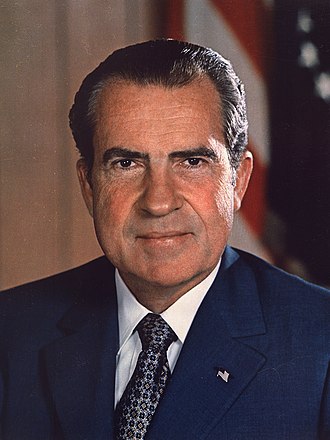
Nixon, Richard M. (President)
Richard M. Nixon served as the 37th President of the United States from January 1969 until his resignation in August 1974. In February 1971, he ordered the installation of a secret voice-activated taping system in the White House to preserve a historical record of his administration. Until the system's existence was revealed and dismantled in July 1973, the tapes captured Nixon directing major foreign policy initiatives, such as the opening to China, as well as his central role in the Watergate cover-up.
What Nixon talks about on the tapes
White House operations 4,718Presidential scheduling 2,225Public relations 1,784Presidential schedule 1,782Vietnam War 1,693Logistics 1,650Manolo Sanchez 1,626White House communications 1,400White House administration 1,399Presidential communication 1,243Henry Kissinger 1,191Foreign Policy 1,183
Conversations (21,010)
— Page 114 of 211President Nixon consulted with the White House operator to facilitate an outgoing telephone call. The brief interaction served as a logistical bridge to connect the President to another party for official business. No substantive policy discussions occurred during this exchange.
President Nixon and Charles W. Colson engaged in a telephonic consultation to discuss sensitive political strategy and White House operations. While specific details remain obscured due to the lack of an available transcript, the dialogue reflects an ongoing exchange regarding administrative priorities and internal management. This interaction serves as a record of high-level advisory communication between the President and one of his closest political aides during a pivotal summer in his presidency.
President Nixon and Charles Colson discuss campaign strategy, focusing on the shifting positions of their political opponents and the media's coverage of these developments. They evaluate the potential impact of middle-income tax proposals on the election and coordinate the release of daily promotional or campaign material. The conversation concludes with an emphasis on maintaining a consistent and aggressive public relations narrative.
President Nixon utilized this session in the Old Executive Office Building to dictate a memorandum for his official records. Although the specific content of the dictation was redacted from the public archive, the recording serves as a formal documentation of presidential internal communication. The session concludes with the President transitioning to subsequent administrative tasks documented in later recordings.
President Nixon, Henry Kissinger, and Alexander Haig met to review recent sensitive negotiations regarding the Vietnam War, including Kissinger's secret meetings with North Vietnamese negotiator Le Duc Tho. The discussion focused on evaluating North Vietnamese diplomatic maneuvering, the political impact of the upcoming 1972 election, and the administration's strategic posture toward the Soviet Union and China. Nixon and Kissinger also addressed concerns about the George McGovern campaign and debated how to manage international perceptions of U.S. foreign policy in Europe and the Middle East.
President Richard M. Nixon held this meeting in the Old Executive Office Building to consult on unidentified matters of administration business. Given the lack of a surviving transcript for this recording, the specific subjects addressed and subsequent action items remain undocumented. The session serves primarily as a record of late-night executive activity during a period of significant transition in the Nixon presidency.
President Nixon met with his aide Stephen B. Bull in the Oval Office to coordinate his daily schedule. The primary focus of the brief discussion centered on managing appointments, specifically concerning Charles W. Colson. This meeting served as a routine administrative briefing to organize the President’s upcoming engagements.
President Nixon and Alexander P. Butterfield met to coordinate the agenda for upcoming strategic meetings with Republican Congressional leaders and Cabinet members regarding the 1972 election. They discussed the structure of breakfast briefings, emphasizing the need for clear communication with key participants like Clark MacGregor and John D. Ehrlichman. The President also reviewed budget planning recommendations from Caspar Weinberger and directed Butterfield to ensure tighter control over public relations and press interactions concerning agency heads.
President Nixon, assisted by Charles Colson and Marjorie Acker, verified the status of correspondence intended for Margaretta “Happy” Rockefeller. The participants confirmed that no letter had yet been sent to Mrs. Rockefeller. This brief administrative check ensured the President was accurately informed regarding the pending status of this specific communication.
President Nixon met with Charles Colson to manage White House correspondence and coordinate political strategy regarding the 1972 election. The discussion covered administrative matters, including a condolence call to Margaretta Rockefeller, and shifted to tactical planning regarding labor union support. They specifically analyzed George McGovern's political rhetoric regarding 'power brokers' and reaffirmed Nixon's strategy for maintaining relations with labor leaders like George Meany.
President Nixon directed the White House operator to place a telephone call to Margaretta “Happy” Rockefeller, the wife of New York Governor Nelson Rockefeller. The brief exchange served strictly as a logistical request to initiate communication with the Governor's spouse. No further political or substantive matters were discussed during this connection.
President Nixon held a brief telephone conversation with Margaretta ("Happy") Rockefeller. The majority of the interaction, lasting approximately one minute and twenty-five seconds, was categorized as a personal, returnable communication. No substantive policy matters or administrative actions were recorded during this brief exchange.
President Nixon instructed the White House operator to facilitate a telephone call between Charles W. Colson and Jay Lovestone of the AFL-CIO. The President specified that the connection should be routed directly to Colson’s line. This brief interaction served as a logistical coordination for an upcoming administrative communication.
President Nixon consulted with an unidentified individual to coordinate his immediate schedule and manage availability for upcoming appointments. The brief discussion focused on reviewing the President's calendar to identify open time slots for potential meetings. No substantive policy decisions were made, as the exchange was limited to logistical planning and scheduling inquiries.
President Nixon met with Alexander P. Butterfield to review the logistics of upcoming official engagements, specifically focusing on the President's schedule. The discussion centered on H.R. Haldeman’s recommendation regarding the inclusion of agency heads in planned breakfast and Cabinet meetings. The President expressed concerns about the optics of these appearances, ultimately weighing whether to proceed with or cancel the planned involvement of agency leadership.
President Nixon and personal secretary Rose Mary Woods discussed their favorable impression of the film *Skyjacked* after viewing it in the White House theater. The President requested that a telegram be sent to actor Charlton Heston expressing their praise for the performance. The conversation concluded with the President voicing his hope that the film would receive an Academy Award.
President Nixon met with businessman Armand Hammer to discuss ongoing trade negotiations with the Soviet Union, the status of Hammer's Occidental Petroleum company, and the possibility of recruiting Marvin Watson to assist the Nixon reelection campaign. Hammer provided detailed accounts of his long-standing history with Soviet leadership, including Lenin and Khrushchev, and updated the President on his efforts to improve U.S.-Soviet relations through art and business ventures. Following Hammer's departure, Nixon and H.R. Haldeman shifted focus to the Watergate scandal, specifically debating the legal strategies regarding immunity for campaign staff members Jeb Stuart Magruder and Hugh Sloan, Jr. to contain further investigations.
President Nixon and Henry Kissinger met to discuss the political implications of providing a security briefing to Democratic presidential candidate George McGovern. They evaluated the potential strategic impact of this action in light of concerns raised by H.R. Haldeman. Ultimately, the two men deliberated on whether to grant the request, weighing the political benefits and risks associated with engaging the opposition.
President Nixon held a brief administrative exchange regarding his upcoming schedule and the availability of his office. He coordinated the logistics for a meeting with Henry A. Kissinger, specifically noting that the discussion would take place in the Oval Office rather than the Executive Office Building. This brief interaction served to organize the President's immediate agenda and confirm the meeting location for his national security advisor.
President Nixon and Henry Kissinger discussed sensitive foreign policy strategies, including the handling of negotiations with Armand Hammer and the management of sensitive documents to avoid bureaucratic leaks. They also analyzed the status of the Vietnam War, concluding that time was working against North Vietnam and that a potential diplomatic deal prior to the 1972 election remained a strategic possibility. Finally, they reviewed briefing arrangements for George McGovern, agreeing on the necessity of maintaining control over the process to avoid political pitfalls.
President Nixon contacted the White House operator to facilitate a telephone call to his daughter, Julie Nixon Eisenhower. The brief exchange served as an administrative request to establish a connection with her. No further policy or political developments occurred during this brief interaction.
President Nixon held a private meeting with his valet, Manolo Sanchez, in the Old Executive Office Building. The conversation primarily consisted of personal, non-substantive matters that were subsequently withdrawn from the public record. No policy discussions or administrative actions were documented during this brief encounter.
President Nixon met with an unidentified individual in the Old Executive Office Building to review the President's upcoming schedule. The brief discussion concluded with a consensus to depart the office, signaling the end of the meeting. No substantive policy matters or major political decisions were recorded during this session.
President Nixon held a brief, informal check-in with his personal aide, Manolo Sanchez, and his personal secretary, Rose Mary Woods, at his Old Executive Office Building office. The discussion focused on coordinating administrative matters and determining if there were any pending issues requiring the President's attention. The exchange functioned as a routine logistical update regarding the President's availability for staff consultations.
President Nixon consulted with a White House operator to facilitate an outgoing telephone connection. This brief interaction served as a logistical bridge to initiate a separate communication with another party. No substantive policy matters or administrative decisions were documented during this exchange.
President Nixon held a brief, personal telephone conversation with his daughter, Julie Nixon Eisenhower. Due to the withdrawal of the primary content from the archival record, the specific topics discussed remain restricted. The interaction served as a private family communication between the President and his daughter.
President Richard Nixon and his daughter, Julie Nixon Eisenhower, met briefly in the President's office for a personal discussion. The conversation was classified as a personal, returnable item, indicating the exchange held no official government or policy significance. Consequently, no state business or administrative decisions were transacted during this meeting.
President Nixon met with Rose Mary Woods and H. R. Haldeman to discuss various administrative and political matters, including the military service records of the sons of political rivals such as Robert F. Kennedy and George McGovern. The group evaluated the performance and loyalty of several administration officials and cabinet members, drawing historical comparisons to the Eisenhower administration. Additionally, they reviewed reports on naval forces and discussed the procurement of American-made music boxes intended as gifts for foreign dignitaries.
President Nixon and H. R. Haldeman engaged in a brief telephone exchange regarding an unidentified matter. Due to the lack of a decipherable transcript, the specific substance of the discussion remains unrecorded. Consequently, no definitive policy decisions or administrative actions can be attributed to this conversation.
President Nixon consults with an unidentified staff member regarding the location of a specific book containing notable historical speeches. The conversation serves as a brief inquiry into the status of this resource, which Nixon intended to identify if the staff member had not yet located it. No further policy or substantive matters were addressed during this short exchange.
President Nixon requested that the White House operator place a telephone call to his special counsel, Charles W. Colson. This brief interaction served solely to facilitate direct communication between the President and a key aide. No further dialogue was captured during this exchange.
President Nixon received a brief call from an unidentified individual via the White House operator. The exchange appears to be a misdirected connection or an inconsequential communication that did not result in substantive policy discussion or administrative action. No significant decisions were made during this brief encounter.
President Richard Nixon and special counsel Charles Colson held a brief telephone discussion to review political strategy and internal administration matters. The conversation focused on ongoing operational concerns and potential actions required to address political challenges facing the White House. No specific, conclusive outcomes were recorded for this exchange beyond the continued coordination between the two men on sensitive political objectives.
President Nixon and Charles Colson discuss scheduling a meeting with an unnamed associate, weighing the merits of a breakfast appointment versus a more informal evening boat ride. The conversation briefly touches on political strategy regarding potential public hostility from younger demographics, as well as vague references to analytical reports and press-related activities. The exchange concludes with logistical coordination regarding upcoming meetings and the status of ongoing political analysis.
President Nixon held a brief, unintelligible telephone conversation with a White House operator. The exchange was captured by the White House taping system but contains no discernible dialogue or substantive policy content. Consequently, no specific actions or decisions were recorded.
President Nixon met with H.R. Haldeman, Charles Colson, and Henry Kissinger to discuss sensitive political and national security matters, specifically the ongoing Watergate investigation and Vietnam peace negotiations. The group reviewed the potential for indictments involving Jeb Stuart Magruder and examined the strategic handling of federal investigations to protect the White House from entanglement. Additionally, the President and Kissinger discussed managing domestic opposition to the war, coordinating press strategy, and preparing for an upcoming meeting with congressional leaders regarding Vietnam.
President Richard Nixon and First Lady Pat Nixon engaged in a brief telephone conversation to discuss personal matters. Due to the sensitive nature of the discussion, the entire content of the call was designated as a personal, returnable item and subsequently withdrawn from public release. No substantive policy matters or official administrative actions were recorded in this exchange.
President Richard M. Nixon engaged in a telephone conversation with an unidentified individual, the content of which remains largely obscured due to the lack of a transcript. The interaction is cross-referenced with Conversation 349-12E, though the specific subject matter and any resulting actions from this exchange are currently unavailable for historical analysis.
President Nixon and Charles Colson spoke via telephone to discuss unidentified matters concerning administration operations. As no transcript is available for this recording, the specific subjects addressed remain unknown to researchers. The conversation serves as a record of direct communication between the President and his special counsel during a period of high-level political activity.
President Richard M. Nixon met briefly with his personal valet, Manolo Sanchez, in the Old Executive Office Building. As the majority of this session involves a withdrawn personal item, the substance of the interaction remains private and undocumented. No significant policy decisions or official developments were recorded during this brief encounter.
President Nixon utilized this session to dictate a memorandum for the official record. The brief recording captures the President documenting specific administrative information for the presidential file. Due to the presence of withdrawn material and the absence of a transcript, the precise nature of the memorandum's content remains restricted.
President Nixon and John D. Ehrlichman engaged in a brief telephone consultation to coordinate administrative activities. Given the lack of a transcript and the cross-reference to a subsequent conversation, the primary focus appears to be the scheduling or redirection of a pending discussion. No substantive policy decisions or developments are documented in this brief exchange.
John D. Ehrlichman approached President Nixon to discuss scheduling a meeting regarding an unspecified matter in New York. Due to the President’s lack of availability at that moment, the conversation concluded immediately without addressing the substantive details. No further decisions or actions were taken during this brief exchange.
President Nixon and John Ehrlichman met to coordinate political and legislative strategy for the upcoming 1972 reelection campaign. They discussed tactics to paint the Democratic opposition as extreme, specifically adopting the term "McGovernites" to emphasize the potential dangers of George McGovern's policies, such as increased government spending and tax hikes. The President emphasized a strategy of holding Congress accountable for fiscal irresponsibility while framing his own platform as a defender against radical change, intending to solidify a massive electoral mandate.
President Nixon met with an unidentified individual in the Old Executive Office Building to facilitate a specific, though currently unknown, logistical request. The discussion centered on the arrangements for sending a particular item to an unnamed recipient. The encounter was brief, concluding within three minutes after the President addressed the request.
President Nixon met with Alexander Butterfield and H. R. Haldeman to coordinate the President’s administrative schedule and discuss political developments. The discussion addressed the transition of John Mitchell following his departure from the Committee to Re-elect the President, specifically touching on his personal difficulties regarding his wife, Martha Mitchell. Additionally, the participants reviewed ongoing 1972 campaign polling data and recent interactions with administration officials.
President Nixon met with his Cabinet and senior staff to discuss strategies for achieving a balanced federal budget by 1975, emphasizing the necessity of immediate spending cuts and potential vetoes of congressional legislation to curb inflation. Budget Director George Shultz outlined the administration’s plan to issue "ceiling letters" to agency heads to enforce strict fiscal guidelines and reduce government deficits. The participants also reviewed recent positive economic indicators, including growth in the Gross National Product and declining unemployment, while noting that the public generally views government spending as a primary driver of inflation.
President Nixon met with H. R. Haldeman, Clark MacGregor, and Robert J. Dole to strategize regarding the upcoming 1972 presidential campaign. The discussion focused on political maneuvering and the coordination of campaign efforts in the lead-up to the election. While a significant portion of the meeting was withdrawn from public record, the session served as a tactical planning assembly for the administration's political team.
President Nixon met with George Shultz and H.R. Haldeman to discuss strategies for leveraging favorable economic news while managing the administration's public image amidst ongoing tensions with Congress. They reviewed the political impact of recent labor developments, specifically addressing the fallout from the withdrawn transportation strikes legislation and planning a coordinated announcement regarding Vice President Spiro Agnew. Throughout the discussion, the President emphasized the importance of media relations and directed staff to prioritize public relations strategies in upcoming legislative conflicts.
President Nixon initiated a call to the White House operator to connect with Secretary of the Treasury George P. Shultz. He explicitly instructed the operator not to interrupt Shultz if he was currently at lunch or otherwise occupied. This brief exchange reflects the President’s management of his schedule and his consideration for the Secretary's availability.
President Nixon initiated a brief call to John Ehrlichman to coordinate their schedules for the remainder of the day. Due to a sudden conflict involving a 2:00 p.m. meeting with Vice President Spiro Agnew, Nixon postponed his discussion with Ehrlichman. The two agreed to reconnect later that afternoon once the President's schedule cleared.
President Nixon and Secretary of Labor George Shultz discussed the political fallout from Senator Robert Packwood’s recent public comments regarding stalled legislation aimed at curbing transportation strikes. Nixon expressed concern that Packwood felt undermined by the administration’s shifting legislative strategy and requested that Shultz speak with the Senator to clarify the administration’s position. Shultz agreed to meet with Packwood to emphasize the need for a new approach to reforming the Railway Labor Act, while Nixon planned to use an upcoming press conference to publicly reframe the administration's stance on the issue.
President Nixon met with H. R. Haldeman, Vice President Spiro Agnew, and John Mitchell to coordinate political strategy for the 1972 reelection campaign. The group discussed campaign logistics, including the use of chartered aircraft, and framed messaging on key issues such as foreign policy, draft-dodgers, and amnesty. Additionally, they reviewed plans for Agnew’s formal renomination announcement, strategies for managing legislative hurdles in Congress, and the importance of engaging with lawmakers to maintain party unity.
President Nixon met briefly with Alexander P. Butterfield in the Oval Office to conduct routine administrative duties. During this short session, the President signed various documents and reviewed his upcoming schedule, specifically focusing on the program for a wedding ceremony taking place on July 22, 1972. The interaction served as a logistical briefing to ensure the President was prepared for his personal and professional engagements.
President Nixon met with his valet, Manolo Sanchez, to coordinate upcoming travel arrangements. The conversation focused on the President's departure schedule and the logistics for a trip to Camp David. Nixon confirmed that Sanchez was included in the party that would travel by helicopter alongside key staff members and advisors.
President Nixon and his personal secretary, Rose Mary Woods, reviewed administrative tasks, including a draft eulogy and various pieces of incoming correspondence. The discussion touched upon political developments, specifically the selection of Thomas Eagleton as the Democratic vice-presidential candidate and concerns regarding his health. Additionally, they coordinated logistics for the President’s upcoming departure to Camp David and managed personal social and schedule-related matters.
President Nixon met with Alexander P. Butterfield to coordinate logistical arrangements for upcoming executive functions. The discussion focused on the specific seating requirements for a meeting at the Executive Office Building and finalized the departure timing for the President’s visit to Camp David. These operational details were essential for managing the President's immediate scheduling commitments.
President Nixon and his personal secretary, Rose Mary Woods, briefly reviewed recent political intelligence and photographic materials. They discussed reports regarding Lyndon B. Johnson’s perspective on the 1972 election and examined photographs taken by Ollie Atkins featuring the President, his dog King Timahoe, and the White House grounds. The discussion concluded with a brief exchange concerning the President's upcoming schedule and his need for rest.
President Nixon initiates a brief telephone call to his daughter, Julie Nixon Eisenhower. The exchange serves solely as a request for the White House operator to facilitate the connection. No further policy or administrative matters were discussed during this interaction.
President Nixon initiated a brief communication through the White House operator to facilitate an outgoing call. The discussion was purely administrative in nature, serving as a logistical bridge to connect the President with an unidentified third party. No substantive policy matters or executive decisions were addressed during this brief exchange.
President Nixon held a brief, informal telephone conversation with his daughter, Julie Nixon Eisenhower. The discussion served as a personal check-in between family members rather than a formal policy consultation. No substantive political decisions or administrative actions were recorded during this exchange.
President Richard Nixon met with his daughter, Julie Nixon Eisenhower, in the Oval Office for a brief, informal personal visit. Given the brevity and the nature of the archival records, the content of their discussion remains private and is categorized under personal returnable materials. No substantive policy decisions or administrative actions were recorded during this brief encounter.
President Nixon contacted the White House operator to facilitate a personal telephone call to his daughter, Tricia Nixon Cox. The conversation serves solely as a brief administrative request to connect the President to her room. No other policy matters or official developments were discussed.
President Nixon consulted with a White House operator to facilitate a telephonic connection. This brief interaction served as a logistical bridge to initiate a separate call, identified in the internal finding aids as Conversation 27-37. No substantive policy matters or major decisions were recorded during this brief administrative exchange.
President Nixon held a brief, informal telephone conversation with his daughter, Tricia Nixon Cox. The exchange served as a personal check-in between family members. No substantive policy matters or official White House business were recorded during this communication.
President Richard Nixon met with his daughter, Tricia Nixon Cox, for a brief personal visit in the Oval Office. The conversation was informal and focused on private family matters rather than official government business or policy. No significant political decisions or administrative actions resulted from this brief interaction.
President Nixon met with his aide Stephen B. Bull to coordinate a brief, time-sensitive meeting with Henry Kissinger. The discussion focused on locating Kissinger, who was stationed in the White House Situation Room, to facilitate his immediate arrival at the Oval Office. Nixon directed Bull to summon Kissinger for a fifteen-minute consultation before the President's scheduled departure.
President Nixon and Stephen B. Bull met briefly to review and finalize Henry A. Kissinger’s upcoming travel schedule. The discussion focused on the logistical arrangements and timing of Kissinger’s commitments. No further actions or major policy decisions were recorded during this short administrative briefing.
President Nixon and Henry Kissinger discussed legislative and political strategies regarding the Vietnam War, specifically focusing on the potential passage of the Mansfield Amendment and its impact on ongoing peace negotiations. Kissinger provided a report on his recent interactions with Senator Mike Mansfield and Eugene McCarthy, noting their willingness to assist the administration. The conversation also covered upcoming diplomatic trips to Moscow and Japan, concerns over negative media coverage of bombing raids, and a review of recent polling data concerning the 1972 election and Senator George McGovern's platform.
President Nixon and John B. Connally held a brief, informal meeting in the Oval Office to coordinate their respective schedules. The discussion touched upon the President’s recent reception of diplomatic credentials and logistical arrangements for Connally’s upcoming trip to Camp David. The brief exchange concluded as both parties prepared to depart for other scheduled engagements.
President Nixon met with his personal valet, Manolo Sanchez, at Camp David to discuss logistical matters related to his official schedule. The conversation primarily focused on verifying the status of an unspecified item from the previous day's itinerary. No significant policy decisions were made during this brief exchange.
President Richard Nixon met with his personal valet, Manolo Sanchez, in the Oval Office during a late-night session. While the majority of the brief encounter consists of withdrawn personal material, the meeting serves as a record of the routine interactions between the President and his long-time staff member. No substantive policy discussions or significant political developments were captured in this exchange.
President Nixon met with his aide Stephen B. Bull to review and refine his upcoming daily schedule. The discussion centered on coordinating meetings with George P. Shultz regarding his recent interactions with AFL-CIO leader George Meany, as well as scheduling time with H.R. Haldeman. This brief session served to finalize key administrative arrangements and personnel consultations for the President's immediate agenda.
President Nixon contacted the Camp David operator to request a telephone connection with Charles W. Colson. This brief administrative interaction served as a communication bridge to facilitate further discussion between the President and his special counsel. No substantive policy or political matters were addressed during this specific exchange.
President Nixon and his valet, Manolo Sanchez, met at the Aspen Lodge at Camp David for a brief, informal discussion. Their conversation focused on personal matters, specifically the wedding of Dabney Hibbert and Barry Wayne Feather, along with a routine exchange regarding coffee. The interaction served as a casual social moment between the President and a long-time member of his personal staff.
President Nixon requested that the Camp David operator contact local police to facilitate an unspecified communication. This brief exchange appears to be a logistical administrative request rather than a substantive policy discussion. No further details regarding the purpose or the specific nature of the police involvement were recorded.
President Nixon and Charles Colson discuss strategies for the 1972 campaign, focusing specifically on the organization and launch of the 'Democrats for Nixon' effort led by John B. Connally. They review potential high-profile Democratic defectors, assess the economic landscape, and analyze the vulnerabilities of George McGovern, particularly regarding his temperament, defense policies, and stance on social issues like marijuana. The conversation highlights the administration's intent to utilize surrogates and aggressive political maneuvering to maintain the President's lead in the polls and prevent McGovern from building momentum.
President Nixon and Charles Colson strategized on campaign tactics for the 1972 election, focusing on leveraging Democratic defections and managing the political momentum of their opponents. They discussed various public relations issues, including unfavorable press coverage and the potential political influence of figures like Bobby Fischer. The conversation concluded with a focus on maintaining campaign pressure and effectively timing their counter-narratives to prevent the opposition from gaining significant momentum.
President Nixon initiated a brief telephone communication through the Camp David operator to facilitate an urgent connection with National Security Advisor Henry A. Kissinger. This interaction served purely as a logistical bridge to establish direct contact for high-level policy consultations. No substantive policy discussions occurred during this exchange, as its primary purpose was the successful routing of the call.
President Nixon and Henry Kissinger discussed political strategy, including coordinating with John B. Connally regarding his upcoming media appearance and his appointment to the President’s Foreign Intelligence Advisory Board. They also reviewed ongoing military operations in Vietnam, agreeing that U.S. air power and B-52 strikes were successfully depleting North Vietnamese forces. Additionally, the pair strategized on how to counter potential campaign attacks from George McGovern concerning U.S. casualties, specifically by emphasizing that a significant portion of fatalities occurred during the previous administration.
President Nixon initiated a request to the Camp David operator to establish a telephone connection with Dr. Henry Kissinger. The primary purpose of this brief interaction was to facilitate direct communication with his National Security Advisor. No further policy discussions or significant developments occurred during this contact.
President Nixon and Henry Kissinger discussed strategic communication tactics regarding the administration’s handling of political opponents and foreign policy optics. The discussion focused on coordinating messaging for an upcoming media appearance by John Connally, specifically regarding his potential appointments to advisory boards and his response to political inquiries. Furthermore, the two men addressed the necessity of maintaining a firm public stance against political criticism concerning the Vietnam War and the deployment of naval assets.
President Nixon contacted the Camp David operator to facilitate an urgent communication. The primary purpose of the brief telephone exchange was to request that White House Press Secretary Ronald L. Ziegler be connected to the President. This administrative action highlights the President's ongoing need for staff coordination while stationed at Camp David.
President Nixon contacted the Camp David operator to establish a connection for an outgoing telephone call. The brief exchange focused on facilitating communication through the White House switchboard system. No substantive policy matters were discussed during this technical interaction.
President Nixon and Press Secretary Ronald Ziegler discuss the positive media reception to Vice President Spiro Agnew’s recent 50-state campaign announcement and his aggressive stance against Democratic nominee George McGovern. They also coordinate a strategic response to McGovern's call for televised debates, deciding that Clark MacGregor should issue a rebuttal highlighting McGovern's past voting inconsistencies and asserting that an incumbent president should not debate an opponent. Nixon emphasizes that a debate would inappropriately elevate McGovern's stature and that current international negotiations make such a forum contrary to the national interest.
President Nixon and Press Secretary Ronald L. Ziegler discuss strategies for avoiding a presidential debate with the Democratic opposition. Nixon emphasizes the need to frame the refusal by highlighting the stark policy differences between candidates and arguing that sensitive, ongoing international negotiations make a public debate contrary to the national interest. They agree on a communication plan to present these arguments to the press, aimed at denying the opponent prime-time exposure.
President Nixon placed a brief telephone call through the Camp David operator to request a connection with H. R. Haldeman. The exchange served primarily as a logistical step to facilitate direct communication with his Chief of Staff. No substantive policy matters or further discussions were addressed during this brief administrative interaction.
President Nixon initiates a brief communication with the Camp David switchboard operator to establish a connection for an outgoing call. The conversation serves as a logistical bridge to facilitate further presidential business. No substantive policy discussions or significant political decisions occur during this brief interaction.
President Nixon contacted H. R. Haldeman at Camp David to discuss the day's leisure activities and local weather conditions. The two men compared the extreme heat in Washington, D.C., with the relatively more comfortable environment at the retreat. They concluded the call by coordinating a brief, informal meeting to address pending administrative matters.
President Nixon and H.R. Haldeman met at the Aspen Lodge at Camp David to briefly discuss their schedules and coordinate a time for a formal briefing. The exchange served as a casual logistical check-in to arrange a follow-up meeting later that day. No substantive policy matters were addressed during this short, introductory dialogue.
President Nixon contacted the Camp David operator to request a telephone connection with his National Security Advisor, Henry Kissinger. The brief exchange served as a logistical bridge to facilitate a high-level discussion on foreign policy or national security matters. No substantive policy decisions were reached during this administrative interaction.
President Nixon communicated with the Camp David operator to manage a scheduled call with National Security Advisor Henry Kissinger, who was en route to visit journalist Stewart Alsop. Nixon decided to cancel the immediate effort to reach Kissinger, noting that the conversation was no longer urgent. The President instructed the operator to inform Kissinger that he could return the call at his own convenience later in the day.
President Nixon placed a call through the Camp David operator to speak with his daughter, Tricia Nixon Cox. The conversation centers on a social update regarding a wedding they both recently attended, with Tricia detailing the reception and the newlyweds' upcoming trip to Bermuda. Nixon expresses his satisfaction with the event and the loyalty of the families involved before closing the call with a warning about the extreme heat.
President Nixon held a brief, informal communication with the Camp David operator to issue a lighthearted reminder regarding the operator's appearance. The exchange served as a casual interaction rather than a formal policy discussion. No significant administrative decisions or developments occurred during this brief encounter.
President Nixon held this brief call with a Camp David operator to manage communication logistics during his stay at Aspen Lodge. The conversation primarily involved confirming the status of non-urgent incoming calls and verifying that his availability remained flexible for the day. No substantive policy or political decisions were made during the interaction.
President Nixon and H. R. Haldeman met at Camp David to conduct a comprehensive review of the 1972 reelection campaign strategy. They discussed tactical decisions, including the refusal to debate George McGovern, the use of Clark MacGregor as a campaign surrogate, and managing media appearances to avoid providing McGovern with excessive national exposure. Additionally, they reviewed potential personnel changes within the administration and the Secret Service, and evaluated polling data regarding key states and voter attitudes toward campaign issues.
President Nixon and his daughter, Tricia Nixon Cox, discuss logistical arrangements for the upcoming wedding of Dabney Jane Hibbert and Barry Wayne Feather. Tricia informs the President about her role as matron of honor, standing in for her sister Julie, and confirms the wedding reception details at The Westchester. The brief personal call also includes a discussion of the couple's travel plans to Bermuda and general remarks regarding the weather.
President Nixon consulted with National Security Advisor Henry Kissinger regarding a proposal to receive representatives from the Baltic republics. Both men agreed that such a meeting would unnecessarily provoke the Soviet Union, with Nixon suggesting Vice President Agnew handle the matter instead to avoid a diplomatic incident. Concluding that maintaining international relations for 'bigger games' was the priority, Nixon officially decided against receiving the delegation and extended an invitation for Kissinger to join him at Camp David.
President Nixon and Henry Kissinger discussed whether to grant a meeting request from representatives of the Baltic republics, a move both men feared would provoke a hostile reaction from the Soviet Union. Nixon expressed his strong preference against a presidential audience, citing recent geopolitical tensions involving Lithuania. The two agreed that the meeting should be deferred to Vice President Spiro Agnew to maintain diplomatic discretion while still acknowledging the petitioners.
President Nixon uses this dictation session to outline key campaign themes for the 1972 election, emphasizing the administration's record on judicial appointments and law enforcement. He discusses political strategy, including the potential future of the Democratic Party and the electoral prospects of figures like Ted Kennedy. Additionally, Nixon reflects on international affairs and logistical details regarding his schedule, specifically mentioning observations relayed by John Connally.