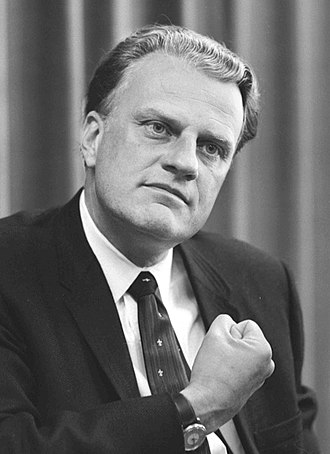
Graham, William F. ("Billy")
William F. "Billy" Graham was a prominent evangelist who served as a close spiritual advisor and informal confidant to President Richard Nixon. During the taping period, Graham frequently communicated with Nixon and his chief of staff, H.R. Haldeman, offering advice on public speeches, the Vietnam War, and the 1972 re-election campaign. A regular White House visitor who often led worship services, his counsel on both spiritual and political matters was captured on the White House tapes, though he held no official titled position.
President Nixon and Reverend Billy Graham spoke to discuss public reaction to Nixon’s recent televised address regarding the Vietnam War. Graham praised the President's sincerity and effectiveness, specifically highlighting the emotional impact of Nixon’s tribute to a young boy. They further discussed an upcoming New York Times editorial by Graham, which aimed to shift the historical blame for Vietnam-era escalation and the overthrow of Ngo Dinh Diem onto the Kennedy administration.
President Nixon and Billy Graham discussed the disruptions caused by Yippie protesters at Graham's recent Chicago crusade, comparing these incidents to broader trends of civil unrest. The conversation also touched upon the upcoming wedding of Tricia Nixon Cox, arrangements for guest Ethel Waters, and the political implications of media bias. Additionally, the participants examined public opinion polling regarding the administration’s handling of demonstrators and critiqued the perceived liberal influence within the press and church institutions.
President Nixon met with William F. Graham, Henry Kissinger, Ronald Reagan, and John Ehrlichman to discuss political strategy, labor relations, and foreign policy. The group addressed public support for the administration, including the President's firm stance against demonstrators, and strategic moves involving maritime unions and grain exports to the People's Republic of China. Nixon and Kissinger further evaluated ongoing Vietnam negotiations and the importance of maintaining military strength to retain political leverage over domestic critics and international rivals.
President Nixon met with Billy Graham and a large delegation of religious and civic leaders, including representatives from the First Baptist Church of Dallas and various educational and charitable organizations, to engage in general conversation and group introductions. The discussion touched upon the President’s recent travels, potential future visits, and coordination for a White House church service. Additionally, the President and Graham briefly discussed the importance of foreign policy briefings and the influence of religious figures in public life.
President Richard Nixon and Billy Graham discuss the President's recent public performance and the political fallout surrounding a press story targeting Charles "Bebe" Rebozo. The conversation touches upon the President's upcoming trip to West Virginia and the inclusion of Treasury Secretary John Connally in future travel plans. Graham also seeks assurance regarding the content of remarks he intends to make about his relationship with the President, which Nixon encourages him to deliver without prior vetting.
President Nixon and Reverend Billy Graham discuss the positive public and media reception of the President's recent appearance in North Carolina. Graham reports on the widespread enthusiasm for the event among his supporters and notes the favorable coverage in various regional newspapers and on CBS. Additionally, the pair discusses the installation of portraits of the Nixon family in Holiday Inn lobbies, an initiative facilitated by Dwight Chapin, and touches upon Graham's upcoming travel schedule.
President Nixon and evangelist Billy Graham engaged in a brief, informal discussion that transitioned from personal pleasantries into a deliberation regarding political strategy and economic messaging. The President solicited Graham’s counsel on a new initiative, emphasizing the need for a private follow-up meeting to refine their approach. Furthermore, Nixon touched upon the political sensitivities of tax restructuring, suggesting that any proposed tax increases must be carefully framed within the broader context of tax reform to maintain public support.
President Nixon and Billy Graham discuss upcoming travel itineraries, international relations, and the political climate in the United States. Nixon shares his views on handling unpopular decisions and his reliance on Treasury Secretary John Connally to manage economic messaging. The President also expresses optimism regarding the conclusion of the Vietnam War and expects improved economic indicators for the coming year.
President Richard Nixon and evangelist Billy Graham discussed a range of political, diplomatic, and cultural topics, including the recent International Monetary Agreement and ongoing trade negotiations led by John Connally. The two also addressed geopolitical tensions, specifically U.S. military retaliatory strikes against North Vietnam and the regional instability caused by the India-Pakistan War. Additionally, Graham expressed his support for the Nixon administration, characterizing the current era as a major religious revival in America while commending the President’s leadership.
President Nixon and Reverend Billy Graham exchanged Christmas greetings and briefly discussed Graham's recent television appearance regarding the White House holiday celebration. The two confirmed plans for Graham and his wife, Ruth, to visit the White House on the following Friday. During the exchange, Nixon also jokingly advised Graham to ensure his wife remained ideologically conservative.
President Nixon and Reverend Billy Graham spoke to discuss the success of First Lady Pat Nixon’s recent diplomatic trip to Africa, specifically her reception in Liberia. The two reflected on the positive impact of the visit and coordinated efforts to host Liberian President William R. Tolbert, Jr. during his upcoming attendance at the National Prayer Breakfast. Nixon noted that he would likely host a formal dinner for Tolbert to reciprocate the hospitality extended to the First Lady.
President Nixon consulted with various administration officials and advisors, including Billy Graham, Melvin Laird, and Raymond Price, to discuss personnel appointments, campaign strategy, and foreign policy communication. Key subjects included potential roles for Edward Korry and Kenneth Rush, the public relations strategy regarding First Lady Pat Nixon's Africa trip, and managing the perceived credibility issues surrounding Henry Kissinger's influence on Middle East and India-Pakistan policy. Additionally, Nixon and Laird deliberated on Vietnam troop withdrawal levels, finalizing a strategy to manage public expectations while maintaining administration control over national security messaging.
President Nixon and Reverend Billy Graham discussed the logistical arrangements and appropriate diplomatic protocol for an upcoming visit by Liberian President William R. Tolbert, Jr. Nixon expressed concerns about the timing and scale of the visit, ultimately deciding against a full state visit due to heavy administrative commitments. The two also briefly touched upon a recent positive article concerning Graham’s travels as highlighted by H.R. Haldeman.
President Nixon met with Billy Graham and H. R. Haldeman to discuss political strategy, the President's upcoming travel, and media relations heading into the 1972 election year. Graham provided advice on maintaining presidential dignity, focusing on controlled, televised appearances rather than frantic campaigning, and offered to help shore up support in key states like Pennsylvania and Texas. The participants also engaged in a lengthy, conspiratorial discussion regarding perceived media bias, specifically alleging that Jewish journalists and editors exerted undue influence on American cultural and political discourse.
President Nixon and Reverend Billy Graham discussed the health of John Connally and shared personal reflections on the current treatment of former President Lyndon B. Johnson by the Democratic Party. Nixon expressed sympathy for Johnson, noting that he had been abandoned by his own party’s presidential candidates, while Graham shared insights from a recent conversation with the former president. The call also touched upon the success of recent U.S. military strikes in the Haiphong area of Vietnam.
President Nixon and his senior staff, including H.R. Haldeman, met to evaluate the public and political reaction to the President's recent televised speech regarding the mining of North Vietnamese harbors. The discussion focused on maintaining a firm, "hawkish" stance to emphasize the administration's resolve and ensuring that supporters mobilize to counteract potential criticism from Congress and the media. Nixon directed his team to maximize public displays of support and address logistical issues, such as jammed Western Union lines, to ensure his message of "iron determination" remained the dominant narrative.
H. R. Haldeman and Billy Graham discussed the public and international reception of President Nixon's recent announcement regarding a naval blockade of North Vietnam. Graham praised the President’s decisive action, expressing confidence that it would galvanize the American public despite anticipated protests. To counter expected opposition, Graham committed to publicly voicing his strong support for the administration during his upcoming press conferences in Memphis and Birmingham.
President Nixon and Reverend Billy Graham engaged in a telephone conversation primarily focused on personal rapport and mutual support. The dialogue included casual exchanges regarding baseball trivia, specifically concerning pitcher Jim Konstanty, before transitioning to a discussion centered on Graham’s ongoing political and personal backing of the President. The conversation served to reaffirm the alliance between the two figures during a period of significant political stress.
President Nixon met with Reverend Billy Graham to exchange pleasantries following Graham's recent travels. The discussion touched upon media influence at the local level and included a brief, ambiguous administrative directive regarding trade quotas and diplomatic gestures. No major policy decisions were reached, as the meeting served primarily as a personal check-in between the two.
President Nixon and Reverend Billy Graham spoke to discuss Graham's upcoming international tour and his offer to support the President's 1972 reelection campaign. Graham outlined his plans to campaign for Nixon's character and integrity, while drawing parallels between contemporary political smears and historical precedents involving past presidents. The President provided a confidential update on Henry Kissinger’s trip to Paris regarding Vietnam peace negotiations, emphasizing his commitment to an honorable settlement. They concluded by discussing recent positive media coverage of the President's stance on amnesty and the Vietnam War.
President Nixon and Billy Graham discuss the positive national reaction to the return of American POWs from Vietnam and express mutual frustration with the anti-war stance of Senators Mark Hatfield and Harold Hughes. The conversation shifts to foreign affairs, specifically condemning Israel’s recent shoot-down of a civilian airliner and the resulting diplomatic tensions ahead of Golda Meir's visit. Finally, the two address growing societal friction regarding Jewish-Christian relations and antisemitism, while briefly discussing their shared desire to challenge the perceived radicalism of the World Council of Churches through a new international religious initiative.
President Nixon held a brief meeting with evangelist Billy Graham in the Oval Office. The two engaged in a short discussion regarding personal and pastoral matters following a brief connection facilitated by the White House operator. No significant policy decisions or administrative actions were recorded during this brief encounter.
President Nixon spoke with evangelist Billy Graham to receive personal encouragement and discuss public support for the administration. They covered various topics, including the positive reception of Graham's recent trip to South Africa, preparations for his upcoming visit to Korea, and efforts to bolster the President's image against political opponents and the developing Watergate investigation. Additionally, the two coordinated on prospective staffing recommendations, specifically regarding Marvin Watson, and discussed maintaining a strictly religious focus for an upcoming White House church service led by Edward V. Hill.
President Richard Nixon met with evangelist Billy Graham to discuss personal correspondence and the President's perspective on the political climate. Nixon dismissed recent political opposition and criticism as temporary setbacks, emphasizing his administration's focus on Vietnam and foreign affairs. The President also expressed concerns regarding an upcoming appearance by Dr. Hill, cautioning that religious forums should not be used for political propaganda related to civil rights.
President Nixon speaks with the White House operator to rectify confusion regarding current call-screening protocols following restrictive instructions issued by Bruce Kehrli. Nixon clarifies that while routine calls should be routed through Rose Mary Woods, he insists that all calls from Cabinet members be put through to him directly. After settling these administrative procedures, the President approves the connection of an incoming call from Reverend Billy Graham.
Reverend Billy Graham called President Nixon to offer encouragement and praise following Nixon's televised address regarding the Watergate scandal and the resignations of H.R. Haldeman and John Ehrlichman. Graham expressed his belief that the President’s performance was sincere and demonstrated commendable humility, noting that it resonated positively with others, including his father-in-law Dr. L. Nelson Bell. Nixon reflected on the personal difficulty of the recent staff dismissals and discussed the mixed reactions from various television networks while maintaining his resolve.