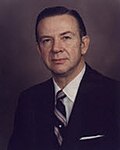
BeLieu, Kenneth E.
During the Nixon White House taping period, Kenneth E. BeLieu transitioned from his role as Deputy Assistant to the President for Congressional Relations, a position he held from January 1969 until September 1971. In September 1971, he was appointed and sworn in as the Under Secretary of the Army. He continued to serve in this capacity throughout the remainder of the taping period, concluding his service in June 1973.
President Nixon met with Republican congressional leaders and cabinet members to discuss rural development initiatives and solicit support for the administration's policy agenda. Secretary of Agriculture Clifford Hardin and staff provided an extensive briefing on the status of rural America, highlighting demographic shifts and explaining the mechanics of proposed federal revenue-sharing programs designed to foster economic growth. Participants also reviewed legislative priorities, including the upcoming vote on the supersonic transport (SST) appropriation and other pending congressional business.
President Nixon met with Vice President Agnew and Republican Congressional leaders to secure support for two of his primary initiatives: the Supersonic Transport (SST) program and a major government reorganization plan. Secretary of Transportation John Volpe advocated for the SST by addressing environmental, economic, and technological concerns, arguing that the project was essential for U.S. aviation preeminence and long-term economic growth. Subsequently, John Connally detailed the work of the Ash Council, urging the legislators to embrace a fundamental restructuring of the executive branch to improve government efficiency, accountability, and public trust. Nixon emphasized that these measures were critical for ensuring that his administration could effectively manage federal programs and maintain the nation's competitive edge.
President Nixon met with Senator John L. McClellan, Clark MacGregor, and Kenneth E. BeLieu to discuss legislative priorities, national defense, and the President's political standing. The participants addressed concerns regarding U.S. military strength relative to the Soviet Union, the importance of maintaining nuclear deterrent credibility, and the economic necessity of supporting American industries like steel and aviation. Additionally, the President and Senator McClellan reviewed the progress of the Arkansas River navigation project and discussed pending appointments and committee activities within Congress.
President Nixon met with Vice President Agnew and Republican Congressional leaders to discuss the administration's legislative and economic agenda. The participants analyzed current economic indicators, including inflation and productivity, and evaluated the implementation of the Task Force for International Development's recommendations regarding foreign and military aid. Additionally, the group addressed the future of the military draft, focusing on pay increases and the transition toward an all-volunteer force while assessing potential legislative hurdles in Congress.
President Nixon met with a group of Republican senators and key advisors, including Henry Kissinger, to discuss the political landscape surrounding the Vietnam War and national defense policy. The conversation focused on the erosion of public support for the war, the impact of various congressional anti-war resolutions, and the importance of maintaining American preeminence despite shifting domestic and international pressures. The participants strategized on how to manage the political fallout of the Vietnamization policy and addressed concerns regarding defense preparedness and the administration's foreign policy initiatives in the Soviet Union and China.
President Nixon met with Vice President Agnew, Treasury Secretary John Connally, and Republican Congressional leaders to address critical economic and legislative challenges. The primary focus was the potential bankruptcy of the Lockheed Corporation and the necessary legislative strategy to secure government loan guarantees to prevent a ripple effect of industrial failures and job losses. Additionally, the group reviewed the administration's legislative priorities, including welfare reform, general and special revenue sharing, and the status of various appropriations bills.
President Nixon met with his Cabinet and Republican Congressional leaders to coordinate the administration's legislative agenda, specifically addressing the ongoing national railroad strike and the upcoming Congressional vote on the military draft. The discussion also focused on foreign policy, with Secretary of Defense Melvin Laird and Henry Kissinger providing briefings on the status of NATO, the credibility of U.S. military commitments in Europe, and the implications of recent Soviet statements regarding mutual force reductions. The President urged the Congressional leaders to maintain a firm stance against unilateral U.S. force withdrawals while emphasizing the need to handle these matters through stable, negotiated frameworks rather than disruptive legislative amendments.
President Nixon met with Republican Congressional leaders to discuss the administration’s new, multi-pronged national strategy for combating drug abuse, emphasizing a shift toward treatment, rehabilitation, and the creation of a centralized Special Action Office. During the discussion, Nixon and his team outlined plans for increased interdiction, expanded military detoxification programs, and a firm, non-permissive stance against the legalization of marijuana. Furthermore, the participants addressed the political climate surrounding the Vietnam War, with Nixon urging support against anti-war amendments and arguing that congressional deadlines for withdrawal would undermine sensitive ongoing negotiations.
President Nixon met with bipartisan Congressional leaders and senior administration officials to discuss the sensitive diplomatic initiative concerning the normalization of relations between the United States and the People’s Republic of China. The President and Henry Kissinger briefed the group on the nature of these confidential negotiations, emphasizing the necessity of absolute discretion to ensure the process remained successful. Nixon and his team requested that participants avoid speculation and maintain a unified, non-partisan front when speaking publicly about the delicate geopolitical implications of this shift in U.S. foreign policy.
President Nixon met with key Congressional leaders, including John C. Stennis and F. Edward Hébert, along with his advisors to discuss the legislative strategy for upcoming draft bills and the political impact of Congressional interference in Vietnam War policy. The participants debated the risks of establishing a firm troop withdrawal date, with Nixon emphasizing that Congressional restrictions could undermine his negotiating leverage and public perception. The President insisted on maintaining executive freedom of action to ensure a favorable peace settlement and signaled that he would not yield on the inclusion of a binding deadline in draft legislation.
President Nixon and his administration met with Republican Congressional leaders to discuss the 1971-1972 economic outlook, focusing on key indicators such as GNP, unemployment rates, and inflation. The discussion centered on evaluating recent economic growth, managing ongoing labor disputes in the steel and transportation sectors, and addressing political concerns regarding the administration's fiscal and wage-price policies. The President and his economic advisors emphasized their commitment to achieving peacetime economic stability and requested support from leadership to convey a positive but measured economic narrative to the public.
President Nixon met with H. R. Haldeman and other aides to manage the political and economic response to his recently announced New Economic Policy. The discussions focused on coordinating with bipartisan congressional leadership to ensure support for the administration's program, highlighting the effectiveness of Treasury Secretary John Connally's public outreach, and monitoring the positive stock market reaction. A key objective was to frame the policy as a proactive leadership move that preempted more damaging legislative actions, while also preparing future speeches and briefings to maintain momentum and public confidence.
President Nixon, H.R. Haldeman, and Kenneth BeLieu coordinated the urgent assembly of a bipartisan congressional leadership meeting. The participants finalized a list of key legislators from the Senate and House, specifically focusing on members of the Appropriations, Ways and Means, and Banking and Currency committees. BeLieu was tasked with contacting the members immediately to arrange the meeting and providing government transportation to facilitate the arrival of lawmakers currently out of town.
President Nixon convened a meeting with Vice President Agnew and a bipartisan group of Congressional leaders to discuss the national economy and his administration's "New Economic Policy." Key topics included the wage-price freeze, investment tax credits, the international monetary situation, and an import surcharge. The discussion focused on the necessity of Congressional cooperation for implementing these measures and their potential impact on inflation, trade, and specific industries like automobiles.
President Nixon met with a large group of Republican Congressional leaders to solicit support for his administration's economic initiatives, specifically the New Economic Policy and tax reform measures. Key topics included the Job Development Tax Credit, depreciation reform, and strategies to secure bipartisan support for the Economic Stabilization Act as the program entered its second phase. The participants also discussed the necessity of public and business cooperation, as well as the international trade context of the President's economic agenda.
President Nixon met with Senator Gordon Allott and other administration and congressional officials to secure the passage of the military draft extension bill. The discussion focused on overcoming legislative stalemates, specifically the concerns surrounding the Mansfield Amendment and the threat of a Senate filibuster. Nixon emphasized that extending the draft was critical to maintaining the United States' international standing and global leverage, and he committed to personally lobbying Senate Majority Leader Mike Mansfield to reach a resolution.
President Nixon met with Kenneth BeLieu, William Timmons, and Clark MacGregor to discuss BeLieu's transition to his new role as Undersecretary of the Army. The President emphasized the need for stronger leadership and management within the Army and stressed the importance of maintaining close coordination between the Pentagon and the White House on legislative defense matters. The participants further deliberated on potential military leadership candidates, including Gen. Creighton Abrams, and reflected on the ongoing political challenges regarding the military draft.