Rockefeller, Nelson A.
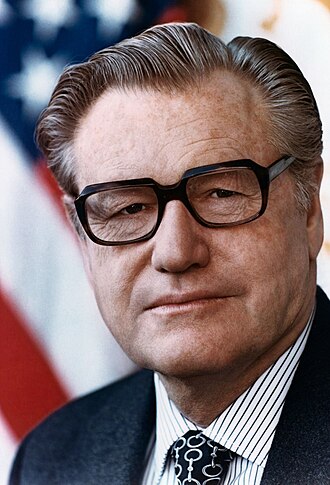
During the Nixon taping period, Nelson A. Rockefeller served as the 49th Governor of New York, a position he held from January 1959 until December 1973. As a prominent leader of the moderate wing of the Republican Party, he undertook special assignments for President Nixon, including a presidential mission to Latin America in 1969. In May 1973, Nixon appointed him chairman of the National Commission on Water Quality. Rockefeller resigned his governorship to establish and lead the Commission on Critical Choices for Americans in 1973, a bipartisan group proposed by President Nixon.
President Nixon initiated this call to thank New York Governor Nelson Rockefeller for his public support of a recent presidential address concerning Southeast Asia and the Vietnam War. Rockefeller praised the effectiveness of Nixon's use of visual charts and emotional appeals in communicating his policy to the public. The two men discussed the importance of maintaining resolve regarding the war, with Nixon hinting at the potential for future diplomatic negotiations.
President Nixon met with H.R. Haldeman and Henry Kissinger to strategize on high-stakes foreign policy issues, including Vietnam peace negotiations, the Berlin Agreement, and the impending US-Soviet summit. The President emphasized his desire to present a firm, blunt ultimatum to the North Vietnamese to force a final resolution, while also discussing the political necessity of ensuring the U.S. is disengaged from ground combat before the 1972 election. The conversation also touched upon domestic political concerns, including the management of the press, the potential impact of Democratic candidates' foreign policy positions, and Nixon's efforts to cultivate support through key allies like Nelson Rockefeller.
President Nixon and New York Governor Nelson Rockefeller consulted on the fiscal and political challenges facing New York City Mayor John Lindsay, particularly concerning rent control policies and municipal budget disputes. The two discussed the potential formation of a commission to investigate city operations, with Nixon strongly recommending Frederick Kappel as an ideal candidate to lead such an effort. They also addressed the possibility of federal financial assistance for New York City police, with Nixon directing John Ehrlichman to coordinate with Rockefeller on the matter.
President Nixon met with New York Governor Nelson Rockefeller to discuss a variety of domestic policy issues, most notably the implementation of federal revenue sharing and strategies to address New York's fiscal challenges. They explored the potential for a Hoover-type commission to examine municipal corruption and inefficiency, and coordinated on the President's upcoming travel plans, including a trip to Rochester. Additionally, the conversation touched upon managing political optics regarding diplomatic visits by foreign leaders and the legislative hurdles for revenue-sharing bills in Congress.
President Nixon and the President’s Foreign Intelligence Advisory Board (PFIAB) met to discuss global foreign policy strategy, with a focus on shifting relationships with the People's Republic of China, the Soviet Union, and Taiwan. The discussion centered on the necessity of intelligence capabilities to navigate future arms agreements and maintain regional stability in the Pacific following the eventual conclusion of the Vietnam War. The participants also reviewed the effectiveness and accelerated timelines of current U.S. intelligence programs under the President’s leadership.
President Nixon and Nelson Rockefeller discussed the positive public reception of Nixon's recently announced wage-price freeze and international monetary policy. The two agreed on the necessity of revaluing foreign currencies, specifically regarding Japan and the Common Market, to ensure American economic competitiveness. Additionally, they arranged a breakfast meeting to address policy conflicts with HEW regarding welfare reform and the use of welfare recipients for state public service jobs.
President Nixon met with Robert Dole, Alexander Haig, and H. R. Haldeman to discuss political strategy, the administration's wage and price freeze, and foreign affairs. A significant portion of the conversation centered on the Attica state prison riots, where Nixon expressed support for Governor Nelson Rockefeller's refusal to grant amnesty to the rioters. Additionally, the participants reviewed Dole's recent trip to the Far East and evaluated potential Democratic opponents and general campaign messaging for the 1972 election.
President Nixon called New York Governor Nelson Rockefeller to commend his firm handling of the recent prison uprising at Attica. Rockefeller provided an update on the successful tactical operation to retake the prison, confirming that seven hostages and thirty-two prisoners had been killed, while emphasizing the necessity of denying amnesty to maintain order. The two discussed the role of external mediators like Tom Wicker and the potential for a national conspiracy, with Rockefeller confirming his support for the President’s reelection.
President Nixon met with H. R. Haldeman, Henry Kissinger, and others to discuss television strategy, public relations for his upcoming foreign summits, and administrative crises. The President emphasized his desire to use live television broadcasts from China to maximize public impact and discussed managing domestic perceptions through news-time appearances. The participants also addressed the Attica Prison riots, coordinating presidential support for Governor Nelson Rockefeller, and discussed policy options regarding Chile and Vietnam, including planning for an upcoming National Security Council meeting.
President Nixon calls New York Governor Nelson Rockefeller to express his full support for the Governor's handling of the violent Attica State Prison riot. The two discuss the tactical necessity of the police response, acknowledging the tragedy of the casualties while agreeing that firm action was required to maintain order. Nixon confirms that he has rallied legislative leaders behind Rockefeller and advises the Governor to remain steadfast against potential media or political criticism.
President Nixon and Nelson Rockefeller discussed the political impact of Robert Finch’s upcoming trip to Latin America in the context of the U.S. 10 percent import surcharge. Rockefeller advised the President that the surcharge's removal should be announced prior to the trip to ensure Finch receives a positive reception. Nixon agreed with the strategy, noting his administration's plan to prioritize Western Hemisphere nations for trade concessions and pledging to have George Shultz coordinate the timing and negotiations.
President Nixon and Nelson A. Rockefeller discuss a strategy to leverage the lifting of U.S. import surcharges as a diplomatic tool to reward allies, specifically focusing on Latin American countries and Canada. Nixon outlines a plan to negotiate oil security commitments with Canada while considering a staggered removal of trade barriers to benefit cooperative nations like Mexico following their support in a recent U.N. vote. The two agree to coordinate these efforts with George Shultz and Robert Finch to ensure that diplomatic visitors can announce the policy changes during upcoming international tours.
President Nixon calls Nelson A. Rockefeller to exchange Christmas greetings and discuss domestic and foreign policy priorities. Nixon requests that Rockefeller contact a discouraged Henry Kissinger to offer support regarding the administration's handling of the India-Pakistan War. Additionally, they discuss the status of federal revenue sharing legislation, with Nixon encouraging Rockefeller to anticipate its passage when planning the New York state budget.
President Nixon and Nelson Rockefeller exchanged Christmas greetings while discussing pressing political and foreign policy concerns. Nixon sought Rockefeller's support in bolstering the morale of Henry Kissinger, who was reportedly depressed over criticism regarding the administration's handling of the Indo-Pakistani War. The two also touched on political strategy for the upcoming election, specifically regarding John Ashbrook, and reaffirmed their commitment to passing revenue sharing legislation in the new year.
President Nixon and New York Governor Nelson Rockefeller discuss Rockefeller’s recent 'State of the State' speech, which criticized New York City Mayor John V. Lindsay and proposed decentralizing city government modeled after London's boroughs. Nixon outlines his strategy for an upcoming 'State of the Union' address, emphasizing a conciliatory approach toward Congress to encourage revenue sharing while warning that he will shift to a more aggressive political stance if legislative progress stalls. Additionally, Rockefeller advises the President to release withheld mass transportation funds to avoid political vulnerabilities during the election year, an action Nixon agrees to discuss with George Shultz.
President Nixon and New York Governor Nelson Rockefeller met to discuss political strategy and domestic policy ahead of the 1972 election cycle. The two leaders coordinated their public messaging, with Nixon advising a conciliatory stance toward Congress to prevent Democrats from casting his administration as partisan while pushing for revenue sharing. They also shared disparaging views regarding political opponents, characterized by their mutual critique of a rival's perceived lack of substance.
President Nixon met with Governors Nelson Rockefeller, Ronald Reagan, William Milliken, and Linwood Holton to formally dictate letters of appreciation following a recent governors' dinner. The conversation highlights the administration's effort to maintain political cohesion and express gratitude for the participants' supportive remarks regarding his peace initiatives and policy agenda. These letters served to acknowledge the governors' contributions and reinforce existing alliances heading into a challenging political period.
Governor Nelson Rockefeller called President Nixon to express strong support for the President’s upcoming historic trip to the People’s Republic of China, emphasizing the initiative's significance for global peace. The two discussed the complex negotiations regarding Taiwan and the positive public reception reflected in recent Gallup polling. To ensure continued collaboration, the President committed to having Henry Kissinger provide Rockefeller with a formal briefing on the trip upon his return.
President Nixon and Nelson Rockefeller met to discuss the upcoming political challenges of the election year, specifically regarding the economy and the administration's foreign policy objectives. Nixon emphasized the importance of international relations between major global powers and solicited Rockefeller's support for his scheduled remarks at an evening dinner. To ensure continued coordination, Nixon committed to having Henry Kissinger provide a briefing to Rockefeller in New York.
President Nixon met with the President's Foreign Intelligence Advisory Board (PFIAB) to discuss the state of the Vietnam War, the American domestic political landscape, and the influence of the national "elite" on public opinion. The discussion centered on the perceived disconnect between the values of the American public and the attitudes of the establishment, including university presidents, media leaders, and big businessmen who were critical of the administration's policies. The President emphasized his desire to communicate directly with the public to bypass this critical elite class, while the board provided counsel on how to manage foreign policy challenges, particularly regarding the Soviet Union and China.
President Nixon initiated this call to apologize to Nelson Rockefeller regarding an unauthorized public release of a presidential letter to Cardinal Cooke concerning abortion, which Nixon blamed on administrative error. The two also discussed Nixon's recent speech on Vietnam, with Rockefeller expressing strong approval of the President's actions and willingness to support the administration despite potential backlash from liberal critics. Nixon reaffirmed his commitment to the Vietnam strategy, noting that he would not proceed with the Moscow summit if Soviet aggression continued, while the two men commiserated over the partisan nature of political opposition.
President Nixon met with Nelson Rockefeller to apologize for an unauthorized letter that caused public embarrassment for the New York Governor. Nixon distanced himself from the leak, labeling it a "coup" and vowing to identify the culprit within his administration. Additionally, the two discussed the geopolitical implications of the upcoming Moscow summit in the context of ongoing international tensions.
President Nixon met with New York political and business leaders, including Nelson Rockefeller and John Volpe, to discuss federal mass transit grants and funding for new subway cars in New York City. The conversation expanded into a wide-ranging policy discussion covering international relations, the defense budget, and the procurement of military hardware like the F-14 fighter jet. In the final portion of the meeting, Nixon and John Ehrlichman reviewed legislative priorities, specifically focusing on welfare reform, the higher education bill, and political strategy regarding the 1972 presidential campaign against George McGovern.
President Nixon and Nelson Rockefeller discussed the positive reception surrounding Clark MacGregor’s recent activities in support of the 1972 reelection campaign. The President briefly shared his experience inaugurating a new satellite communications station with Israeli Prime Minister Golda Meir. The conversation also touched upon administrative logistics and minor technical distractions during the call.
President Richard Nixon and Nelson A. Rockefeller discussed political strategy and the performance of campaign surrogate Clark MacGregor ahead of the 1972 election cycle. The conversation addressed the status of the President's legislative agenda, specifically welfare reform efforts involving Senator Russell B. Long, as well as political climates in key states. Additionally, the two touched upon the financial instability of the Grumman aircraft company and the potential for federal intervention via the Navy to prevent bankruptcy.
President Nixon met with John Ehrlichman and Nelson Rockefeller to coordinate legislative strategy, particularly regarding revenue sharing, federal government reorganization, and NASA space shuttle contracts. The discussion explored ways to build a legislative mandate for a second term, including potential energy and regulatory reforms and strategies to leverage support from key congressional leaders. Later, Pat Nixon and Secretary of the Interior Rogers C. B. Morton joined the session to discuss the administration's national parks agenda, specifically focusing on promoting the centennial of Yellowstone National Park and Mrs. Nixon's upcoming public appearances.
President Nixon met with Henry Kissinger and Nelson Rockefeller to coordinate the administration’s public posture regarding stalled Vietnam peace negotiations ahead of the 1972 election. They discussed North Vietnamese attempts to force a hasty settlement, the status of key sticking points such as troop withdrawals and administrative structures, and the timing of a potential press briefing by Kissinger. Nixon decided to maintain a firm stance against being stampeded into a premature agreement, opting to portray the administration as protecting the national interest while exposing North Vietnamese intransigence.
President Richard Nixon and Nelson Rockefeller spoke following Nixon’s landslide victory in the 1972 presidential election to review preliminary results and the political landscape. They discussed the President’s strong showing in New York, the outcomes of various congressional races, and the failure of George McGovern's campaign. Additionally, Nixon disclosed that North Vietnam had recently agreed to unconditional negotiations, and the two men discussed the importance of post-election national unity.
President Nixon met with Nelson Rockefeller and George H.W. Bush to discuss administrative staffing, public outreach, and the importance of leadership character. The participants evaluated potential candidates for labor-related roles and emphasized the need to effectively communicate government initiatives to the public. Nixon particularly highlighted the need to rebuild national pride and faith in the government, viewing these efforts as a foundational "second American Revolution."
President Nixon met with Nelson Rockefeller, Russell Peterson, and Kenneth Cole to discuss the progress of Rockefeller’s Commission on Critical Choices for Americans, emphasizing the need for bipartisanship and the selection of high-profile contributors. During the discussion, Nixon and Rockefeller pivoted to the Watergate scandal, with Nixon dismissing the involvement of his inner circle as the actions of "cheap crooks" while expressing frustration over the press's focus on the scandal over his 1972 foreign policy achievements. Nixon asserted his innocence regarding the break-in, framing his administration’s prior efforts as necessary measures to stop damaging national security leaks.