Nixon, Richard M. (President)
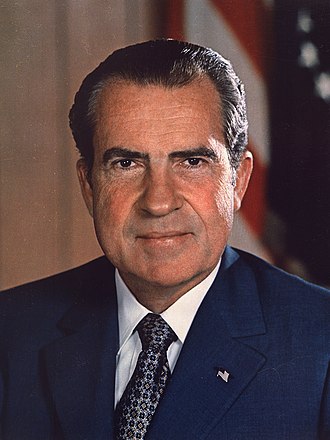
Richard M. Nixon served as the 37th President of the United States from January 1969 until his resignation in August 1974. In February 1971, he ordered the installation of a secret voice-activated taping system in the White House to preserve a historical record of his administration. Until the system's existence was revealed and dismantled in July 1973, the tapes captured Nixon directing major foreign policy initiatives, such as the opening to China, as well as his central role in the Watergate cover-up.
What Nixon talks about on the tapes
White House operations 4,718Presidential scheduling 2,225Public relations 1,784Presidential schedule 1,782Vietnam War 1,693Logistics 1,650Manolo Sanchez 1,626White House communications 1,400White House administration 1,399Presidential communication 1,243Henry Kissinger 1,191Foreign Policy 1,183
Conversations (21,010)
— Page 108 of 211President Nixon held a brief meeting with an unidentified individual in the Old Executive Office Building. Aside from a six-second segment involving personal, returnable materials, the substance of the discussion remains restricted. No further details regarding the participants or the nature of their conversation are available due to the withdrawal of the primary record.
President Nixon and Charles Colson engaged in a wide-ranging strategic assessment of the 1972 presidential campaign, focusing heavily on the political prospects of Democratic front-runner George McGovern. They analyzed McGovern's electoral strengths, ideological vulnerabilities, and potential weaknesses regarding his tax and welfare proposals. The discussion further evaluated voter demographics, polling data from the California primary, and the effectiveness of campaign organization as they formulated the administration's political strategy against the Democratic opposition.
President Nixon and Charles Colson reviewed a draft of a major policy document or speech, focusing on refining its language regarding foreign policy and political messaging. They discussed specific edits to sections on international relations, the arms race, and the Vietnam War to ensure the narrative emphasized traditional values and defensive motives. Nixon tasked Colson with preparing a summary sheet for administration speakers to help them effectively communicate these policy priorities to the public.
President Nixon initiates a request for the White House operator to place a telephone call to former Attorney General and current Committee for the Re-Election of the President head, John N. Mitchell. This brief administrative interaction serves as the preliminary step for the President to consult with a key political advisor. No substantive policy matters or tactical decisions are recorded during this specific bridge to the connection.
President Nixon held a brief administrative exchange with a White House operator while stationed in the Old Executive Office Building. The recording functions primarily as a routine telephonic or logistical interaction typical of White House communications. No substantive policy discussions or significant political decisions were recorded during this brief contact.
President Nixon utilized this session in his Old Executive Office Building suite to dictate content for a memorandum. The primary objective of the recording was to capture his thoughts regarding a specific news column. No further participants were involved in this brief dictation, which served to formalize the President's public messaging strategy.
President Nixon and John Mitchell engaged in a wide-ranging discussion primarily focused on the political landscape of the 1972 presidential campaign. They analyzed the electoral prospects of George McGovern, assessed the implications of primary results and Gallup polling, and reviewed the activities of various campaign staff members, including Charles Colson and Patrick Buchanan. Additionally, the pair touched upon scheduling logistics, including Mitchell’s upcoming media appearance on 'Face the Nation.'
President Nixon consulted with John Mitchell regarding the transition of Mitchell’s professional status and the broader operational dynamics of the Committee for the Re-Election of the President. The two men discussed administrative personnel changes and strategic coordination in the lead-up to the 1972 campaign. No definitive policy actions were finalized, but the discussion focused on managing campaign leadership roles.
President Nixon dictates a memorandum to Charles W. Colson concerning strategic media planning for the upcoming 1972 election. The discussion focuses on television timing and analyzing the support base of George McGovern, incorporating insights from Raymond Price, Patrick Buchanan, and Colson. This effort aims to refine the administration's political messaging to effectively counter the appeal of McGovern's voters.
President Nixon utilized this session to dictate and review a personal memorandum regarding his upcoming schedule and dinner plans. He specifically noted details related to the anniversary of Tricia Nixon Cox's wedding. The recording concludes with the President documenting notes for a speech.
President Nixon dictated a memorandum and reviewed a recording involving a University of California at Berkeley professor to analyze ideological differences between political wings. The discussion focused on the contrasting tactical approaches of left-wing and right-wing figures regarding the acquisition of power, specifically referencing George McGovern. Additionally, the President touched upon foreign policy themes, including the necessity of US military strength and reflections on his recent diplomatic trip to the Soviet Union.
President Nixon met with an unknown individual in the Old Executive Office Building to address technical issues regarding the Oval Office recording equipment. The conversation was cut short due to a malfunction of the dictabelt machine, which prevented a substantive record of the meeting. The brief exchange concluded after a request for coffee was made.
President Nixon held a private meeting with an unidentified individual in the Old Executive Office Building. Due to the lack of available transcripts or descriptive metadata, the specific subject matter, objectives, and any resulting action items from this encounter remain historically undocumented. The interaction was captured by the Dictabelt recording system, but its content is currently inaccessible to researchers.
President Nixon met with speechwriter Raymond K. Price, Jr. to dictate a memorandum regarding the administration's recent activities. The discussion focused on administrative matters concerning the Kennedy Center, the President's recent trip to Moscow, and the drafting of a message of sympathy. Nixon directed Price to utilize specific recording equipment to facilitate the transcription of these official communications.
President Nixon dictated a memorandum to reflect on the reception he received during his recent diplomatic mission to the Soviet Union. He specifically noted the large crowds that greeted him throughout the visit and briefly addressed his return itinerary, potentially mentioning the Ukraine. This dictation serves as an official record of the President's personal assessment of the trip's public reception.
President Nixon held a private meeting with an unidentified individual in his Old Executive Office Building suite. The discussion primarily centered on the President's upcoming scheduling requirements and logistical arrangements. No specific decisions or substantive policy actions were recorded beyond these administrative planning matters.
President Nixon uses this brief recording to dictate a memorandum regarding speech preparation. The discussion focuses specifically on framing commentary related to the Church Committee or political figures associated with Senator Frank Church. No further policy decisions are finalized during this short dictation.
President Nixon recorded a dictated memorandum reflecting on his recent summit in the Soviet Union. He utilized this time to formalize his personal recollections of the trip and his experiences at Camp David. The primary objective was to preserve his official impressions of these significant diplomatic events.
President Nixon and his daughter, Tricia Nixon Cox, engage in a brief personal exchange to coordinate evening plans. The conversation focuses on logistical arrangements for dinner, specifically discussing potential weather complications for dining on the Truman Balcony and the need for alternative arrangements. They also briefly touch upon the President’s schedule involving the Executive Office Building.
President Richard Nixon met briefly with his daughter, Tricia Nixon Cox, in the Old Executive Office Building. The recording is classified as a personal, returnable conversation, and no official business or policy matters were discussed. Consequently, the meeting did not result in any significant political developments or administrative action items.
President Nixon instructed the White House operator to place an outgoing call to Cardinal John Krol. The primary purpose of the communication was to facilitate a direct conversation between the President and the Cardinal. No further substance of the discussion was recorded as the interaction was limited to the initiation of the requested call.
President Nixon consulted with the White House operator to facilitate a telephone call to Cardinal John Krol. The primary purpose of the brief interaction was to verify the Cardinal's current location to ensure the connection could be completed. No substantive policy discussions occurred during this administrative exchange.
President Nixon dictates a memorandum reflecting on his recent summit in the Soviet Union, specifically detailing a return dinner and discussions held with Leonid Brezhnev. The President also notes observations regarding meals at the U.S. Embassy and mentions the purchase of Alaska. Additionally, the President tasks the White House operator with placing a call to John Cardinal Krol.
President Nixon held a brief administrative interaction with the White House operator while working in the Old Executive Office Building. The recording functions primarily as a record of routine communications logistics rather than a substantive policy discussion. No significant political decisions or historical developments resulted from this brief exchange.
President Nixon consulted with a White House operator to facilitate a telephonic connection. This brief interaction served as a routine administrative request to bridge communication between the President and an outside party. No substantive policy matters or historical developments occurred during this exchange.
President Nixon consulted with Cardinal John Krol regarding the domestic and international reception of his recent diplomatic travel, specifically focusing on the reaction of the Polish people to his overseas visits. The two discussed potential future meeting arrangements at Camp David or in California, as well as the President’s upcoming vacation plans. Additionally, the conversation touched upon the travel schedules of Soviet leader Leonid Brezhnev and involved input from Charles Colson regarding church-state relations.
President Nixon met with Cardinal John Krol to discuss impressions from the President's recent diplomatic trip. Nixon recounted an anecdote involving a conversation with a foreign official, identified as Gary, who expressed high regard for Krol's leadership within the American Catholic Church. The interaction served primarily to build rapport and affirm the international standing of the Cardinal.
President Nixon dictated a memorandum regarding ongoing developments in Vietnam, though the recording also captures casual, informal remarks between the President and an unidentified associate. The conversation touches upon the President's heavy workload and his reflections on the constraints of the presidency, specifically his inability to take extended personal time. The dialogue serves as a brief window into the President's exhaustion and the pressures of his office during a period of high-stakes foreign policy management.
President Nixon dictated a memorandum reflecting on his recent diplomatic trip to the Soviet Union. The brief recording serves as a personal record of his recollections regarding the visit. No specific policy decisions were finalized, as the primary purpose was the preservation of presidential observations.
President Nixon utilized this session to dictate a memorandum regarding his recent diplomatic mission to the Soviet Union. The focus of the dictation centered on his interactions with General Secretary Leonid Brezhnev and observations related to intelligence matters. This record serves as a personal summary of high-level geopolitical engagements during the 1972 summit.
President Nixon utilized this session to dictate a memorandum regarding the public persona of Soviet leader Leonid Brezhnev. The President specifically focused on analyzing Brezhnev’s recent media appearance, noting the strategic importance of his smile. This reflection served to inform the administration’s broader strategy for handling diplomatic communications and international public relations.
President Nixon dictates a memorandum regarding his recent diplomatic trip to the Soviet Union. He reflects on his interactions with Soviet leader Leonid Brezhnev and notes specific details concerning an expensive gift. The brief recording also touches upon matters related to Iran.
President Nixon dictated a memorandum regarding his recent diplomatic mission to the Soviet Union. The primary focus of the brief recording was a discussion involving Leonid Brezhnev. The President specifically noted the overwhelming nature of the ceremonial engagements during his visit.
President Nixon met with H. R. Haldeman to dictate a memorandum summarizing his recent telephone conversation with John Cardinal Krol. The discussion focused on Krol’s vocal support for the President, particularly regarding the diplomatic implications of Nixon’s recent travels to the Soviet Union and Poland, as well as the positive reception from the Polish public. The participants also planned a potential future visit for the Cardinal to Washington, D.C., to facilitate meetings with both the President and Charles Colson.
President Richard Nixon met with his aide Stephen B. Bull to review logistical arrangements regarding his official schedule. The discussion focused on administrative details surrounding the President's recent trip to the Soviet Union and plans for an upcoming excursion on the presidential yacht, the Sequoia. No major policy decisions were recorded during this brief administrative check-in.
President Nixon met with Alexander P. Butterfield in the Oval Office to review administrative matters regarding the President’s daily schedule. The primary focus of the discussion centered on coordination with the President's secretary and the management of official appointments. No major policy decisions were recorded during this brief administrative briefing.
President Nixon met with an unidentified woman in the Oval Office to discuss the handling of a specific piece of correspondence. The conversation focused on the administrative processing of a letter, including its file placement, addressing, and the distribution of copies. No further action or broader policy implications were recorded before the visitor departed.
President Nixon met with Marjorie P. Acker to discuss administrative tasks and the handling of sensitive materials. The conversation focused on the transcription of recorded tapes, particularly those related to the President's recent trip to the Soviet Union. They also addressed the filing and organization of memoranda from key White House staff, including John Mitchell, H.R. Haldeman, and Charles Colson.
President Nixon initiates a request to the White House operator to connect him with Dr. William M. Lukash. This brief administrative call serves to facilitate direct communication between the President and his physician. No further substantive matters were discussed during this brief exchange.
President Nixon and H.R. Haldeman discussed the administration’s strategy for securing legislative support for the SALT and ABM treaties, including plans for a presidential television address. The conversation also covered domestic legislative priorities, such as congressional spending ceilings and addressing black lung disease benefits. Additionally, the participants coordinated public relations efforts regarding disaster relief in South Dakota to counter political opposition, and finalized logistics for upcoming swearing-in ceremonies for key cabinet appointments.
President Nixon and H.R. Haldeman met to discuss a diverse range of administrative, political, and cultural issues, including the medical condition of George Wallace and U.S. economic policy. The conversation included consultations with Dr. William M. Lukash regarding health reports and discussions with staff regarding the political philosophy of Irving Kristol and the ideological leanings of the White House staff. Additionally, they reviewed social concerns such as perceived moral permissiveness in media and analyzed the documentation of the President’s recent foreign policy meetings.
President Nixon consulted his physician, William M. Lukash, to receive a medical update on George C. Wallace following his recent assassination attempt. Lukash reported that while Wallace’s morale was improving and he was gaining weight, his paralysis appeared to be permanent and he continued to struggle with a localized infection. The President concluded the call by instructing Lukash to inform the Wallace family that he had inquired about the governor’s condition and expressed his support.
President Nixon held a brief, unscheduled meeting in the Oval Office with an unidentified individual. The discussion primarily centered on matters pertaining to the Attorney General. Due to the lack of available documentation or transcripts, the specific details regarding the agenda and any resulting action items remain unknown.
President Nixon and Alexander Butterfield met to coordinate the logistics and protocol for upcoming cabinet swearing-in ceremonies, specifically focusing on the transitions involving the Treasury and the Justice Department. The discussion covered the scheduling of events, the sequence of oaths for officials such as Richard G. Kleindienst, and the administrative details regarding ceremonial gifts like pens. The President also reviewed the professional history of past Attorneys General and Treasury Secretaries to ensure proper commemorative arrangements.
President Nixon and H. R. Haldeman met to coordinate upcoming administrative events, including cabinet meetings, press conferences, and the President's travel schedule. They extensively reviewed public relations strategies, specifically focusing on managing press coverage of the Vietnam War, Senate ratification of the Strategic Arms Limitation Treaty (SALT), and the administration's image regarding domestic and foreign policy. Additionally, the participants discussed logistical planning for the Nixon family's upcoming travels, including potential trips to the People's Republic of China and Latin America.
President Nixon initiates a request for the White House operator to place a telephone call to Senator James L. Buckley. The brief exchange serves as an administrative coordination to facilitate direct communication between the President and the Senator. No further substantive policy matters or decisions are addressed in this short segment.
President Nixon contacted the White House operator to facilitate a communication regarding the whereabouts of Senator James L. Buckley. The brief exchange focused on coordinating a connection between the President's office and Patricia A. Gleason to track the Senator's location. This call served as a logistical step to manage scheduling and outreach for the administration.
President Nixon held a brief, recorded discussion with an unidentified individual in the Old Executive Office Building. Due to the extremely limited content and significant withdrawal of audio segments, no substantial policy, political, or administrative matters are discernible from the remaining recording. The conversation concludes without any recorded decisions or actionable outcomes.
President Nixon met with his valet, Manolo Sanchez, in the Old Executive Office Building to coordinate his daily schedule. The brief discussion focused on confirming timing for an upcoming appointment with John N. Mitchell. The conversation concluded with Sanchez acknowledging the President’s instruction regarding the afternoon itinerary.
President Nixon met with his personal valet, Manolo Sanchez, in the Old Executive Office Building. The brief interaction focused on the President requesting Sanchez to play the guitar. This informal exchange was a component of the President's daily schedule and internal office activity.
President Nixon consulted with the White House operator to facilitate communication, likely regarding an incoming or outgoing call. During this brief interaction, the President acknowledged information provided by the operator and indicated his intent to speak with a secretary. The exchange served primarily as a logistical coordination step for the President's ongoing administrative and communication tasks.
President Nixon held a brief administrative interaction with the White House operator to facilitate telephonic communications. The exchange focused on managing incoming or outgoing calls to support the President's daily workflow. No substantive policy discussions or significant strategic decisions were recorded during this brief connection.
President Nixon called Patricia Gleason to express his appreciation for a statement made by Senator James Buckley, who was reportedly out of the country. Nixon indicated he was calling to comment on the statement and that he would adjust his own position if necessary upon Buckley's return.
President Nixon initiates a brief telephonic communication through the White House operator to place a call to journalist Dan Rather. This interaction serves as a preliminary administrative step to facilitate direct contact between the President and the media figure. No further substantive policy matters are addressed in this short exchange.
President Nixon consulted with Patricia A. Gleason regarding the whereabouts of journalist Dan Rather. The brief exchange focused on locating Rather, presumably to track his presence at the CBS press room. The conversation concluded with no further policy decisions or significant developments recorded.
President Nixon consulted with a White House operator to facilitate a phone connection, specifically inquiring about the whereabouts of an unidentified individual located at the CBS press room. The brief interaction served to coordinate communication as the President sought to reach a contact. No policy decisions or substantive political developments were established during this administrative exchange.
President Nixon initiates a request to the White House operator to determine the current location of journalist Dan Rather. This inquiry serves as a precursor to a planned return call. No further substantive policy matters are addressed in this brief administrative exchange.
President Nixon consults with the White House operator regarding the logistical feasibility and personal preparation required for an upcoming visit or event. He weighs the benefits of managing the arrangements himself to ensure a smoother execution. The discussion reflects his ongoing concerns regarding the orchestration of his schedule and public engagements.
President Nixon and H. R. Haldeman discussed the strategic logistical requirements and preparation time needed for a potential presidential address to the Senate. Nixon evaluated the relative ease of preparing for a formal address compared to other public appearances, such as a press conference. The discussion centered on balancing the President's personal scheduling preferences with the professional demands of high-level public communication.
President Nixon initiated this brief telephone call with CBS correspondent Dan Rather to express his appreciation for the network's broadcast coverage of Tricia Nixon Cox's wedding. The conversation touched upon the President's personal schedule, specifically his activities aboard the presidential yacht, the Sequoia. The exchange served primarily as a professional courtesy between the President and the media figure.
President Nixon invited journalist Dan Rather to the White House to express his personal appreciation for CBS's coverage of his daughter Tricia's wedding anniversary. The brief, informal conversation focused on the President's positive reception of the broadcast and included some lighthearted personal anecdotes about family memories and wedding reflections. No significant policy decisions were made, though Nixon encouraged Rather to maintain contact with staff member Alexander Haig.
President Nixon contacted the White House operator to facilitate a telephone call to Senator Jacob K. Javits. This brief administrative interaction served as a logistical step to connect the President with the Senator for official business. No further substantive discussion or decision-making occurred during this specific exchange.
President Nixon consulted with the White House operator to determine the current whereabouts of Senator Jacob K. Javits. This brief administrative inquiry served to facilitate immediate executive contact with the Senator. No further substantive policy matters or secondary actions were recorded during this communication.
President Nixon and H. R. Haldeman discuss the strategic considerations of a potential address to the Senate, specifically regarding the optics and impact of such a high-profile appearance. Nixon evaluates the logistics of a proposed two-hour session, emphasizing the need to project strength and secure a decisive legislative vote. They conclude that Alexander M. Haig, Jr. should be consulted to further develop the plan and coordinate the presentation.
President Nixon consulted with the White House operator to facilitate an outgoing call. This brief interaction served administrative purposes to connect the President with another party. No further substantive policy or strategic discussions occurred during this brief communication exchange.
President Nixon consulted with a White House operator to facilitate an outgoing telephonic communication. The interaction focused on the logistics of placing a specific call, serving as a routine administrative coordination between the President and the switchboard staff. No substantive policy discussions or major decisions were recorded during this brief exchange.
President Nixon and Senator Jacob Javits discussed regional Middle East security and the influence of the Soviet Union in the context of ongoing foreign policy and the upcoming 1972 election. They specifically reviewed the implications of George McGovern's campaign, focusing on his potential impact on New York voters and his controversial stance on defense spending and Israeli security. Beyond these geopolitical concerns, the President extended personal congratulations to Javits regarding his son's graduation.
President Nixon and Senator Jacob Javits discussed the Senator's recent public support for the administration and coordinated on upcoming diplomatic efforts regarding Israel. Javits briefed the President on his plans to engage with Yitzhak Rabin to provide reassurance while keeping the matter distanced from the upcoming election cycle. Nixon encouraged the Senator to continue playing a prominent, independent role in foreign policy matters.
President Richard Nixon met with his valet, Manolo Sanchez, in the Old Executive Office Building to facilitate the delivery of unspecified personal or administrative items. The brief interaction focused on these logistical tasks rather than substantive policy matters. No major political decisions or developments resulted from the encounter.
President Richard Nixon met with his personal valet, Manolo Sanchez, in the Old Executive Office Building to discuss the President's upcoming schedule. The brief interaction focused on logistical coordination and the management of Nixon's daily itinerary. No significant policy decisions were recorded during this routine administrative check-in.
President Nixon met with outgoing South Vietnamese Ambassador Bui Diem and Alexander Haig to discuss the status of the North Vietnamese Easter Offensive and the effectiveness of current U.S. military operations. The discussion focused on the resilience of the Army of the Republic of Vietnam (ARVN) at critical locations like An Loc and the broader international implications of the conflict regarding the Soviet Union and China. Nixon underscored his commitment to air power and naval blockades while expressing confidence in the eventual collapse of the North Vietnamese offensive.
President Nixon met with Stephen B. Bull to coordinate administrative tasks and personnel matters. The discussion focused on the current location of H.R. Haldeman and the President's upcoming schedule. Additionally, they addressed background information regarding Michael P. Balzano and the procurement of photographs for Tricia Nixon Cox's first wedding anniversary.
President Nixon met with Charles Colson, Donald Rodgers, and Michael Balzano to strategize on political messaging regarding busing, urban education, and the administration's broader domestic agenda. The participants discussed public relations efforts to counter liberal opposition and analyzed shifting American attitudes toward government roles, youth protest movements, and social values as explored in Irving Kristol's writing. They also examined potential outreach to labor leaders like Peter Brennan to build support for the President's policies among blue-collar voters.
President Nixon met with John Mitchell, H. R. Haldeman, and Henry Kissinger in the Oval Office to address critical administrative and foreign policy matters. The discussion prioritized strategic coordination among top advisors regarding ongoing domestic issues and international diplomatic initiatives. This meeting served to align the President's key inner circle on sensitive executive priorities during a period of intense political and global pressure.
President Nixon and Henry Kissinger met to coordinate U.S. foreign policy strategy, specifically focusing on the ratification of the SALT treaty and managing diplomatic fallout from military actions in Vietnam. They discussed ongoing concerns regarding North Vietnamese bombing campaigns and the potential diplomatic impact of U.S. flight incursions on relations with the People's Republic of China. Additionally, the pair reviewed the President's upcoming public schedule, including potential press conferences to address these sensitive international issues and the administration’s re-election narrative.
President Nixon met with Alexander P. Butterfield to discuss the internal ranking and status of various high-level administration officials. The conversation focused on assessing individuals such as Caspar Weinberger, George Shultz, and Donald Rumsfeld, as well as the organizational structure of the Office of Management and Budget. They also briefly touched upon matters related to the Strategic Arms Limitation Treaty (SALT).
President Nixon met with his aide Stephen B. Bull in the Oval Office to coordinate the day's agenda. The discussion focused on managing the President's schedule, specifically regarding upcoming meetings with Congressional Republican leaders. No further administrative or political actions were recorded during this brief encounter.
President Nixon met with Vice President Agnew and key Republican Congressional leaders to coordinate legislative strategy on critical administration priorities, specifically revenue sharing, the defense procurement bill, and Vietnam-related war powers resolutions. The discussion focused on overcoming Democratic resistance to the President’s revenue-sharing program and maintaining a firm legislative stance on maintaining military strength. Nixon emphasized that American foreign policy, including negotiations with the Soviet Union, remains contingent upon the credibility of U.S. defenses and a unified national commitment.
President Nixon met with Vice President Agnew and Republican Congressional leaders to analyze the current political landscape and formulate electoral strategies heading into the 1972 campaign. A significant portion of the discussion focused on the perceived bias of the media in their treatment of Democratic candidate George McGovern compared to historical GOP figures like Barry Goldwater. Nixon encouraged leadership to coordinate closely on legislative and campaign messaging, noting that the Republican party must remain disciplined to capitalize on the internal divisions within the Democratic party.
President Nixon met with Republican congressional leaders and key aides to strategize on gaining legislative support for the Strategic Arms Limitation Treaty (SALT) and to discuss the timing of its implementation alongside Soviet relations. The participants also reviewed foreign policy priorities, specifically addressing the political dangers of a rapid withdrawal from Vietnam and the importance of maintaining U.S. defense commitments, including security assistance to Israel. Furthermore, the group coordinated on domestic legislative priorities, including Revenue Sharing and House Resolution 1.
President Nixon met with Henry Kissinger, Senator John Stennis, and White House staff to coordinate legislative strategy regarding defense policy and the Vietnam War. The discussion focused on securing support for the military procurement bill and countering congressional efforts, such as the Mansfield amendment, that sought to limit the administration's leverage in Vietnam negotiations. Nixon and Kissinger also updated Stennis on recent diplomatic communications with the Soviet Union and China to ensure a unified front in upcoming SALT II and defense authorization hearings.
President Nixon met with his aide Stephen B. Bull in the Oval Office to discuss the drafting and preparation of an address regarding the Strategic Arms Limitation Treaty (SALT). The brief meeting served to coordinate the final text of the speech for the President's upcoming public presentation. No further policy decisions were recorded during this session.
President Nixon met with Alexander P. Butterfield to review his upcoming schedule and logistical arrangements. Their discussion centered on coordinating the President's public remarks regarding the Strategic Arms Limitation Treaty (SALT). No major policy shifts occurred during the briefing, which functioned primarily as a routine administrative planning session.
President Richard Nixon met with his aide Stephen B. Bull in the Oval Office to address logistical matters. The discussion centered exclusively on reviewing and coordinating Henry A. Kissinger's upcoming schedule. No further policy decisions were recorded during this brief administrative session.
President Nixon held a brief meeting in the Oval Office with an unidentified individual, the substance of which remains inaccessible due to the lack of an available transcript. The interaction included a four-second segment designated as personal and returnable, indicating that the discussion likely did not involve official policy or administrative action. No significant developments or decisions were captured in this recording.
President Nixon, H.R. Haldeman, and Henry Kissinger met to coordinate the administration's public relations strategy regarding the upcoming Strategic Arms Limitation Treaty (SALT) and Nixon's foreign policy initiatives. A primary focus was determining the best format for Kissinger to brief Congress on SALT, weighing the pros and cons of televised sessions versus private testimony to maximize public support and Senate ratification. Additionally, they discussed the timing and messaging for a potential presidential press conference to address domestic issues and updates on Vietnam, carefully synchronizing these announcements with Kissinger's upcoming trip to the People's Republic of China.
President Nixon met with his longtime personal valet, Manolo Sanchez, in the Old Executive Office Building. While the specific details of the discussion remain unrecorded, the meeting served as a private engagement between the President and a trusted member of his domestic staff. No policy decisions or significant political developments were documented during this brief interaction.
President Nixon met with his personal valet, Manolo Sanchez, in the Old Executive Office Building. While the specific details of their discussion remain unrecorded due to the lack of a transcript, the interaction pertains to Sanchez’s personal service and duties within the White House. This meeting represents a routine point of contact between the President and his longtime staff member.
President Nixon held a brief, informal meeting with an unidentified individual within the Old Executive Office Building. The dialogue focuses on specific logistical instructions or the physical placement of documents, marked by ambiguous references to items labeled "1-H-3." No significant policy decisions or substantive political developments are documented in this fragment.
President Nixon met with unidentified individuals in the Old Executive Office Building for a brief exchange that appears to be social or ceremonial in nature. The participants expressed mutual appreciation, characterized by exclamations of "Wow." No substantive policy discussions or significant political decisions were recorded during this brief encounter.
President Nixon held a brief, informal meeting in the Old Executive Office Building with an unidentified individual to discuss the management of his daily schedule. The conversation centered on the pacing and flexibility of the President's upcoming appointments. No significant policy decisions or specific action items were recorded during this brief exchange.
President Nixon met with his personal valet, Manolo Sanchez, in the Oval Office for a brief, one-minute interaction. Due to the lack of a transcript and the immediate departure of both parties, the substance of this meeting remains undocumented in public records. The session primarily involved personal matters, as evidenced by the immediate withdrawal of a segment classified as personal and returnable.
President Nixon met with his senior advisors, including H. R. Haldeman and Henry Kissinger, to coordinate political strategy for the 1972 election and prepare for an upcoming presidential press conference. The discussion focused on monitoring Democratic candidates, particularly the potential for shifting alliances and ticket configurations involving George McGovern, Ted Kennedy, and George Wallace. Additionally, the President and Kissinger refined the administration's messaging on foreign policy and Vietnam negotiations, focusing on maintaining U.S. credibility while managing domestic political pressure.
President Nixon and H. R. Haldeman engaged in a brief telephone consultation regarding scheduling matters. The exchange focused on the President providing specific instructions or guidance concerning his upcoming calendar. No further details were preserved due to the limited duration and audio quality of the recording.
President Nixon requested that the White House operator place a call to Charles W. Colson. This communication served as a brief administrative coordination to facilitate a direct discussion between the President and his special counsel. No further substantive dialogue was captured in this recording.
President Nixon interacted with the White House operator to facilitate an outgoing connection to an unspecified party. The brief exchange served as a logistical step to initiate a telephone call from the Executive Office Building. No further substantive policy matters or decisions were recorded during this brief administrative interaction.
President Nixon and Charles W. Colson engaged in a brief telephone conversation to coordinate their schedules. The primary focus of the exchange was to arrange a subsequent, more detailed meeting between the two men. No substantive policy matters were resolved, as the call served strictly as a logistical bridge to an upcoming discussion.
President Nixon summoned Charles W. Colson to his office in the Old Executive Office Building for a brief, direct consultation. The dialogue serves primarily as an administrative bridge, initiating a more substantive, follow-up meeting between the two men. No specific policy matters or strategic developments were addressed during this brief exchange.
President Nixon met with Charles Colson and H.R. Haldeman to discuss political strategy for the 1972 campaign, focusing specifically on undermining the candidacy of George McGovern. They evaluated methods to frame McGovern as an extremist on issues like defense, amnesty, and welfare, and considered how to leverage voter concerns regarding the Democratic platform to the President's advantage. Nixon also instructed his aides to ensure consistent messaging on key policies, such as the Vietnam War and legislative spending, while emphasizing the need for more aggressive and coordinated political operations.
President Nixon and H. R. Haldeman discussed strategies for managing congressional reactions to White House initiatives. The conversation centered on the potential use of cameras and the drafting of a formal presidential statement to influence legislative perception. This deliberation served to coordinate the administration’s public communication strategy regarding specific congressional relations.