Nixon, Richard M. (President)
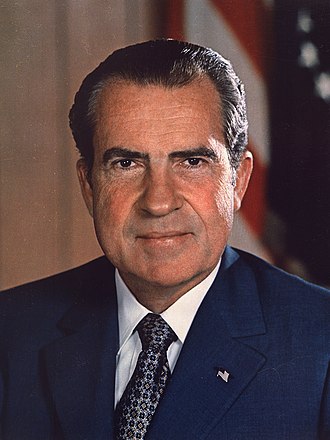
Richard M. Nixon served as the 37th President of the United States from January 1969 until his resignation in August 1974. In February 1971, he ordered the installation of a secret voice-activated taping system in the White House to preserve a historical record of his administration. Until the system's existence was revealed and dismantled in July 1973, the tapes captured Nixon directing major foreign policy initiatives, such as the opening to China, as well as his central role in the Watergate cover-up.
What Nixon talks about on the tapes
White House operations 4,718Presidential scheduling 2,225Public relations 1,784Presidential schedule 1,782Vietnam War 1,693Logistics 1,650Manolo Sanchez 1,626White House communications 1,400White House administration 1,399Presidential communication 1,243Henry Kissinger 1,191Foreign Policy 1,183
Conversations (21,010)
— Page 107 of 211President Nixon contacted the Camp David operator to facilitate a telephone call to Robert H. Finch. This interaction served primarily as a logistical request to establish communication with his advisor. No policy matters or substantive discussions occurred during this brief administrative exchange.
President Nixon initiated a brief interaction with the Camp David operator to request a connection to Robert Bench. This communication served as a routine administrative task to facilitate the President's personal or professional outreach while at the Aspen Lodge. No substantive policy discussions or significant political developments occurred during this brief exchange.
President Nixon and Robert Finch discussed the implications of the 1972 California Democratic primary results, noting that George McGovern's victory was closer than anticipated due to Hubert Humphrey's strong showing in late-reporting conservative districts. They analyzed the impact of the Angela Davis trial and the "Proposition 9" environmental measure, concluding that these events helped create a more favorable political landscape for the President. Nixon emphasized that his administration should focus on his foreign policy accomplishments, particularly regarding the USSR and China, to frame the upcoming election as a test of presidential qualifications.
President Richard Nixon met with advisor Robert H. Finch at Camp David to discuss ongoing political strategies and the administration's objectives. The discussion focused on personnel management and organizational planning for the upcoming election cycle. No specific final decisions were recorded, as the dialogue served primarily as a consultative session regarding the President's internal team structure.
President Nixon and Charles Colson discuss strategies to leverage recent Supreme Court decisions as part of the administration's broader political messaging. They agree to instruct PR staff and administration speakers to emphasize how Nixon’s judicial appointments have fundamentally reshaped the Court. This effort is intended to promote the President's vision of achieving peace both domestically and internationally.
President Nixon initiated a brief telephone communication with the Camp David operator to request a connection to Charles W. Colson. The exchange served exclusively as a logistical step to facilitate direct contact with his special counsel. No substantive policy discussions or decisions occurred during this brief request.
President Nixon held a brief administrative exchange with the Camp David operator while at the Aspen Lodge. The conversation focused on routine communication logistics and telephonic connectivity for the President at the retreat. No policy matters or significant executive decisions were addressed during this short interaction.
President Nixon and Charles Colson confer on campaign strategy, focusing on leveraging the divisions within the Democratic Party to secure electoral advantages. They discuss efforts to keep Edmund Muskie in the race to disrupt George McGovern's momentum and analyze the political benefits of portraying McGovern as a radical. Additionally, they address domestic policy concerns, specifically planning to maintain a hardline stance against busing and discussing the potential for a veto of the Higher Education bill to differentiate the President's platform.
President Nixon contacted the Camp David operator to facilitate a telephone connection to Aspen Lodge. The brief exchange served as a logistical arrangement to reach a specific location or individual within the Camp David complex. No substantive policy matters or major decisions were recorded during this brief administrative interaction.
President Nixon contacted the Camp David operator to facilitate an urgent communication with his National Security Advisor, Henry Kissinger. The brief interaction served exclusively as a procedural request to establish this connection. No substantive policy discussions or decisions occurred during this specific exchange.
President Nixon consults with the Camp David operator regarding the status of the Higher Education Bill and the implications of signing it. The discussion centers on the president's opposition to the bill, specifically its failure to effectively address the busing initiative. Nixon expresses skepticism about the necessity of his signature and probes the operator on how the legislation affects current mandates and public perception.
President Nixon and an unidentified advisor discuss the political ramifications of the Higher Education Act, specifically focusing on its inadequate approach to the busing issue. Nixon expresses strong disapproval of the legislation, labeling it a "monstrosity," and considers vetoing it to challenge liberal leaders. The discussion concludes with a directive to ensure the administration's public messaging on the bill is sufficiently firm, and Nixon requests a meeting with H.R. Haldeman.
President Nixon and H. R. Haldeman met at Camp David to discuss public relations strategies, domestic policy priorities, and the administration's political messaging ahead of the 1972 election. They reviewed the outreach efforts toward supporters following the President’s international trips, as well as the management of domestic issues like busing legislation and the upcoming debt limit negotiations. Additionally, the President issued instructions regarding the reassignment of U.S. Ambassador to Sweden Jerome Holland and evaluated the political viability of various domestic policy stances.
President Nixon communicated with the Camp David operator to facilitate a scheduled call with National Security Advisor Henry Kissinger. Upon learning that Kissinger was temporarily unavailable while at the barber shop, the President instructed the operator to have Kissinger return the call at his convenience. This brief exchange served solely to manage the logistics of the President's ongoing communication with his foreign policy advisor.
President Nixon and Henry Kissinger discussed the positive results of the recent Moscow Summit, noting Soviet leaders' desire to strengthen personal ties with the President. They also assessed the deteriorating situation for North Vietnam, with Nixon reiterating the administration’s strategy to attack presidential candidate George McGovern's proposal to visit Hanoi as a form of surrender. Finally, they coordinated the logistics for announcing Kissinger's upcoming trip to China and his subsequent testimony before the Senate, aiming to minimize political backlash by controlling the timing and narrative.
President Nixon and Henry Kissinger discussed various administrative and political matters, including the successful promotion of the China exhibit and efforts to maintain positive relations with Philadelphia Mayor Frank Rizzo. The conversation shifted to political strategy regarding Democratic challenger George McGovern, with Nixon directing that McGovern be criticized for his potential visit to Hanoi. Finally, they coordinated the timing of an upcoming announcement and testimony to ensure maximum public relations impact and to project that the administration was acting proactively rather than under congressional pressure.
President Nixon contacted the Camp David operator to facilitate a telephone connection with his Chief of Staff, H.R. Haldeman. This brief administrative exchange served to bridge communication between the President and a key advisor during his stay at the retreat. No substantive policy matters were addressed during this logistical interaction.
President Nixon held a private meeting at the Aspen Lodge in Camp David with an unidentified individual to facilitate a delivery from the White House. The discussion and the nature of the items delivered remain undocumented due to the lack of an available transcript. The session concluded when the guest departed the lodge prior to 3:30 pm.
President Nixon met with an unknown female visitor at the Aspen Lodge in Camp David to discuss logistical or administrative matters. The conversation touched upon the arrival of items from a warehouse and the schedule of First Lady Pat Nixon. The discussion also included brief mentions of Lady Bird Johnson and local recreational activities like swimming.
President Nixon held a brief, informal interaction with a Camp David operator to address logistical or communication needs while at the Aspen Lodge. This conversation, recorded via the Hard Wire system, represents a routine administrative check-in between the President and site staff. No substantive policy discussions or significant political decisions were recorded during this exchange.
President Nixon instructed H.R. Haldeman to coordinate with Henry Kissinger regarding a draft statement prepared by Raymond K. Price, Jr. Nixon expressed concern that the document’s tone was excessively euphoric and requested that Kissinger review the text for necessary revisions before his departure. Haldeman agreed to facilitate the review and report back to the President.
President Richard Nixon met with Chief of Staff H. R. Haldeman at Camp David to coordinate administrative activities. This brief encounter served to align the President and his advisor on internal White House operations. No further details regarding specific policy outcomes or strategic shifts were recorded during this session.
President Nixon consulted with First Lady Pat Nixon regarding his concerns over a document concerning price controls. He expressed dissatisfaction with the report's overly optimistic tone and decided to solicit a critique from National Security Advisor Henry Kissinger. The President instructed that a copy of the material be sent to Kissinger for a quick review to inform further revisions.
President Nixon held a meeting at the Aspen Lodge in Camp David with an unidentified individual. Given the lack of a transcript or historical record regarding the substance of the discussion, the specific topics and decisions resulting from this encounter remain unknown. The interaction concluded with the departure of the visitor following initial greetings.
President Nixon and H. R. Haldeman discuss Henry Kissinger’s critical assessment of a pending presidential speech, which Kissinger characterizes as overly euphoric and reminiscent of George McGovern’s tone. Haldeman relays Kissinger’s advice to avoid foreign policy rhetoric to maintain a position of supremacy, a sentiment with which Nixon concurs. The conversation concludes with a brief mention of Charles Colson’s concerns regarding an upcoming appearance at a Rotary event in Houston and an agreement to meet in person to finalize their approach.
President Nixon and H. R. Haldeman convened a brief meeting at the Aspen Lodge study at Camp David. Given the lack of a transcript or record of the discussion, the specific subject matter and substantive outcomes of this exchange remain unidentified. This recording serves primarily to document the high-level communications between the President and his Chief of Staff during this period.
President Nixon contacted the Camp David operator to facilitate an urgent communication with his National Security Advisor, Henry Kissinger. The brief exchange served as a logistical bridge to initiate high-level diplomatic or security discussions. No substantive policy matters were addressed during this connection process.
President Nixon initiated a brief contact with the Camp David operator from the Aspen Lodge study. The interaction served as a routine communication check or request for assistance within the facility's complex. No substantial policy matters or significant administrative decisions were addressed during this short exchange.
President Nixon and Henry Kissinger discuss the strategic importance of Kissinger’s upcoming trip to Japan, focusing on reassuring the Japanese while leveraging the visit to influence Chinese and Soviet relations. They review recent diplomatic channels with the Soviet Union, specifically noting the establishment of a productive, high-level personal relationship with Leonid Brezhnev. Additionally, they critique a draft foreign policy speech for being overly idealistic, agreeing that it requires more realistic language to differentiate their administration’s stance from the perceived surrender-oriented policies of George McGovern.
President Nixon and Henry Kissinger discuss the importance of personal diplomacy and the strategic benefits of Kissinger's upcoming trip to Japan. Nixon emphasizes that Kissinger’s presence will serve to reassure the Japanese government while simultaneously signaling a shift in geopolitical leverage against the Soviet Union and China. The conversation highlights the value of establishing direct, high-level channels to manage international crises, bypassing traditional diplomatic hierarchies to ensure more effective communication.
President Nixon and H. R. Haldeman met at Camp David to discuss the President’s upcoming schedule and the political advisability of delivering a speech to the Rotary Club. Both men, in agreement with the assessments provided by Henry Kissinger and Charles Colson, concluded that the speech lacked substantive news value and risked diminishing the President's current high standing following his recent foreign policy successes. Ultimately, Nixon decided to decline the invitation, opting to maintain his public image of stature and avoid unnecessary appearances that might prove difficult to manage or offer little political gain.
President Nixon contacted the Camp David operator to facilitate a telephone connection with Attorney General Richard G. Kleindienst. The brief exchange served solely as a logistical request to initiate this official communication. No further substantive policy discussions occurred during this brief administrative interaction.
President Nixon initiates a brief communication with a Camp David operator to facilitate a secure, confidential discussion. The interaction serves as a logistical precursor to a planned investigation, with the President explicitly stating his intent to conduct matters quietly. This brief exchange serves to establish the secure channel necessary for sensitive high-level administrative or legal coordination.
President Nixon and an unknown aide coordinate logistics for upcoming meetings and site availability at Camp David. The discussion focuses on the scheduled arrival of John Ehrlichman, the status of the Birch Lodge, and Nixon’s plan to speak with Attorney General Richard Kleindienst. The President concludes by organizing the timing of his administrative tasks and subsequent communications.
President Nixon consulted the Camp David operator to track the travel schedule and current location of Attorney General Richard G. Kleindienst. After confirming that Kleindienst would return to Washington by mid-afternoon, the President coordinated a plan to place a follow-up call to him at that time. This brief exchange served to facilitate direct communication between the President and the Attorney General.
President Nixon contacted the Camp David operator to facilitate an urgent telephone connection. The primary purpose of this brief exchange was to initiate a call to George P. Shultz. No other policy matters or substantive discussions took place during this administrative request.
President Nixon held a brief administrative interaction with the Camp David operator while stationed at the Aspen Lodge. The exchange was limited to routine operational communications regarding the president's telephonic connectivity and logistical requirements at the retreat. No policy matters or significant political decisions were addressed during this brief engagement.
President Nixon held a brief administrative interaction with the Camp David operator while stationed at the Aspen Lodge. The exchange centered on routine communications logistics, as the President coordinated his access to the presidential telephone system. No substantive policy matters or major political decisions were recorded during this brief technical communication.
President Nixon and John Mitchell discussed the political climate following the President’s recent trip to Moscow and its influence on congressional behavior. The conversation centered on the favorable outcome of a recent legislative vote, noting that even political opponents like Senator Charles Percy had shifted their stance. Nixon expressed a desire to maintain a firm, aggressive posture in his administration's dealings, emphasizing that he should not become overly conciliatory or 'tender' following tough confirmation processes.
President Nixon and George P. Shultz discussed the successful Senate confirmation of Richard G. Kleindienst and upcoming Cabinet swearing-in ceremonies. The conversation shifted to critical budgetary concerns, with the President emphasizing the necessity of vetoing environmental and spending bills to curb excessive federal expenditures. Finally, they reviewed international monetary policy, specifically coordinating a stance on gold that diverged from the views held by Federal Reserve Chairman Arthur F. Burns.
President Nixon and George Shultz discuss administrative staffing and the challenges of managing the federal budget amidst congressional opposition. The pair evaluates the fiscal implications of various legislative initiatives, including welfare reform and revenue sharing, while identifying the need for strategic presidential vetoes on environmental spending bills. They also confirm the status of recent appointments and coordinate the upcoming arrival of John Ehrlichman to further address these budgetary and legislative priorities.
President Nixon contacted the Camp David operator to facilitate a telephone connection to John N. Mitchell. This brief exchange served as a logistical step to initiate a direct conversation between the President and the former Attorney General. No substantive policy matters were discussed during this brief request.
President Nixon consulted with a Camp David operator regarding a poker-related matter and the personal circumstances of an individual referred to as Booker. The discussion quickly pivoted to Nixon's concerns about Arthur, specifically emphasizing a need to resist his tenacity regarding an unacceptable deal. The brief exchange concluded with an exchange of pleasantries regarding the upcoming weekend.
President Nixon and John Mitchell discussed political strategy for the 1972 election, focusing on the ongoing Democratic primary contests and the rise of George McGovern. They evaluated the political viability of various Democratic candidates and analyzed internal party fractures, particularly noting the resistance from party elites against McGovern's campaign. Nixon and Mitchell decided to maintain an aggressive stance by framing McGovern as an unpredictable extremist, aiming to exploit his perceived lack of credibility and foster further defections within the Democratic ranks.
President Nixon contacted the Camp David operator to facilitate communication with Charles W. Colson. The primary purpose of this brief exchange was to request that Colson be patched through to the President’s location. This call served as a logistical step to enable direct consultation with one of Nixon's key advisors.
President Nixon and Charles Colson discuss the political fallout of the 1972 Democratic primaries, specifically focusing on the campaign of George McGovern. They analyze recent polling data, the failed attempt by Edmund Muskie to influence the nomination, and strategic efforts to exploit divisions within the Democratic Party. Nixon and Colson also deliberate on campaign messaging, including the use of political surrogates to highlight McGovern's perceived isolationism and vulnerability on social issues.
President Nixon communicated with a Camp David operator to facilitate telephonic connectivity from the Aspen Lodge. This brief interaction served as a routine administrative request to establish communication lines for the President. No substantive policy discussions or major developments were recorded during this technical exchange.
President Nixon met with special counsel Charles W. Colson at Camp David to discuss sensitive political strategy and personnel matters. The conversation focused on internal administration operations and the management of ongoing political concerns. No specific policy decisions were recorded during this brief exchange, though the dialogue underscored the President's reliance on Colson for discreet political maneuvering.
President Nixon initiates a telephone call through the Camp David operator to reach John N. Mitchell. The primary purpose of the contact is to facilitate a direct communication between the President and his former Attorney General. No further substantive policy matters or decisions are recorded during this brief administrative request.
President Nixon consulted with the Camp David operator to facilitate a telephonic connection. The interaction served as a brief administrative coordination for the President's communications while stationed at the Aspen Lodge. No substantive policy discussions or significant political developments were recorded during this brief technical exchange.
President Nixon and John Mitchell discuss the 1972 Democratic primary, focusing on the "stop-McGovern" movement and the potential political fallout from George McGovern's candidacy. They analyze Edmund Muskie's recent critique of McGovern as an opportunity to portray McGovern as an extremist and note that internal Democratic division serves the Nixon campaign's interests. The two also coordinate strategic efforts to recruit Democrats and independents for Nixon in key states, including California and Texas, while brainstorming tactical campaign theater such as using veterans to protest McGovern’s defense policies.
President Richard Nixon met with John N. Mitchell at Camp David to consult on matters regarding the administration's political strategy and ongoing challenges. While specific details of the discussion remain withheld, the meeting underscores the close advisory relationship between the President and his former Attorney General during a sensitive period of the Nixon presidency. No definitive outcomes are recorded, as the conversation remains largely closed to public documentation.
President Nixon contacted the Camp David operator to facilitate a telephone connection with Robert H. Finch. The primary purpose of the call was to locate and reach Finch, who was in California at the time. This exchange served as a logistical coordination effort to initiate a private consultation between the President and his advisor.
President Nixon initiated a brief communication with the Camp David operator to facilitate logistical coordination while residing at Aspen Lodge. The exchange served primarily to establish or verify telephone connectivity between the President and external parties. No substantive policy discussions or political decisions were recorded during this brief administrative interaction.
President Nixon contacted the Camp David operator to request an additional attempt to reach Attorney General Richard G. Kleindienst by telephone. The brief exchange served as a logistical effort to facilitate a high-level communication between the President and the Department of Justice. No further substantive policy matters were discussed during this connection.
President Nixon held a brief administrative interaction with the Camp David operator while stationed at the Aspen Lodge. The conversation functioned as a routine check of communications infrastructure and connectivity for the President at his retreat. No policy matters or significant executive decisions were transacted during this exchange.
President Nixon and Robert H. Finch discuss campaign strategy for the upcoming general election, focusing on the Democratic primary and the perceived political threat posed by George McGovern. They analyze recent California election results, particularly the defeat of John G. Schmitz, and evaluate the effectiveness of labeling McGovern as an extremist associated with radical figures. Finch reports on his recent positive reception during public speaking events in California, while the two men coordinate efforts to frame McGovern as a dangerous isolationist regarding the Vietnam War and the POW issue.
President Nixon and Robert H. Finch conferred at Camp David to discuss potential political liabilities and internal threats to the administration. The brief exchange focused on assessing the danger posed by unspecified individuals or entities deemed "extremely dangerous" to the President’s interests. No formal policy decisions were recorded during the short duration of this meeting.
President Nixon initiates a brief telephone communication through the Camp David operator to request a conversation with H.R. "Bob" Haldeman. The exchange serves as a logistical bridge to facilitate direct contact between the President and his Chief of Staff. No substantive policy matters or broader political developments are addressed during this short administrative connection.
President Nixon consulted with the Camp David operator to facilitate a communications connection. The brief exchange served as an administrative request for the operator to place a phone call. No policy discussions or significant political developments occurred during this interaction.
President Nixon and Attorney General Richard G. Kleindienst discussed recent political developments, including the search for a new Deputy Attorney General and the logistical planning for upcoming national conventions. They evaluated the potential political fallout of a proposed clean water bill veto and the merits of potential candidates for the deputy position, such as William D. Ruckelshaus. Additionally, they reviewed recent political trends, specifically speculating on the chaotic nature of the Democratic National Convention and the presidential campaign of George McGovern.
President Nixon and Attorney General Richard Kleindienst discuss administrative appointments, political strategy, and legislative obstacles at Camp David. The conversation centers on finding an alternative to William Ruckelshaus for a position due to concerns over environmental spending bills and political optics. They also review the success of recent confirmation processes and express satisfaction with the performance of the Supreme Court.
President Nixon and H. R. Haldeman briefly discussed personnel concerns regarding the Department of Justice, specifically John Mitchell's opposition to appointing William Ruckelshaus as Deputy Attorney General. Mitchell prefers a professional with convention experience for the role, while Nixon expresses skepticism about the necessity of that qualification. The conversation concludes with a dismissal of Robert Mardian as a candidate and a focus on utilizing John Dean for related departmental tasks.
President Nixon and H. R. Haldeman discuss the management of upcoming political conventions and the necessity of maintaining control over institutional processes. They touch upon budgetary constraints and emphasize the importance of having professional oversight to handle convention logistics. Nixon explicitly instructs Haldeman to remain detached from specific external pressures and to simply 'let it go' and finish the current political maneuvers.
President Nixon initiated a brief telephone communication with the Camp David operator to request a connection to H. R. Haldeman. The exchange served primarily as a logistical step to facilitate direct communication with his Chief of Staff. No substantive policy discussions or complex decision-making occurred during this administrative interaction.
President Nixon consulted with a Camp David operator to discuss personnel logistics and the management of specific staff roles at the facility. The brief exchange focused on vetting individuals for professional tasks and explicitly excluding a person named Marty from gaining access to a restricted or operational area. No further significant policy decisions were made beyond these directives regarding site access and staffing assignments.
President Nixon and H. R. Haldeman coordinated the logistics for the President's departure from Camp David to the White House. They discussed helicopter standby procedures and established an 8:00 p.m. departure time for the President. Nixon explicitly clarified that he would be traveling alone, noting that other guests remaining at Camp David did not need to accompany him.
President Nixon and H. R. Haldeman held a brief, one-minute meeting at the Aspen Lodge study to address an unspecified administrative or political matter. Given the absence of a transcript and the notation that one item has been withdrawn from the record, the discussion remains classified or restricted. No specific decisions or outcomes are publicly verifiable from this interaction.
President Nixon contacted the White House operator to facilitate an urgent communication with special counsel Charles W. Colson. The call served as a logistical bridge to connect the President with his advisor for further discussion. No substantive policy matters were addressed during this brief exchange as it was strictly an administrative request to establish a line.
President Nixon dictated a memorandum to Patrick J. Buchanan outlining a strategy to discredit the perceived liberal bias of the national media during the 1972 election cycle. The discussion focused on characterizing George McGovern's policy positions on issues like amnesty, defense spending, and abortion as extreme to influence public perception. Nixon directed that this assessment be distributed to his operating staff to counter coverage from major news outlets and strengthen the administration’s reelection campaign.
President Nixon met with an unidentified individual to discuss the organization and transfer of various audio tapes. The President directed that these materials be delivered to Rose Mary Woods or another designated staff member for processing. The brief exchange focused primarily on the logistical handling of these administrative recordings.
President Nixon met with an unknown individual in the Old Executive Office Building to coordinate logistics regarding personal appointments. The President requested that his staff check on the availability of a barber and confirm arrangements for a fire station visit at 12:00 p.m. These instructions were directed to subordinates, including Stephen B. Bull and Rose Mary Woods, to finalize his scheduling needs for the day.
President Nixon met with an unidentified individual to discuss the secure handling and preservation of specific personal audio recordings. The conversation centered on the status of four tapes designated as part of the President's private files. Following the discussion, the unidentified party departed, having ensured the designated materials were properly accounted for.
President Nixon communicated with the White House operator to facilitate an outgoing call. The brief exchange focused on establishing a telephone connection for the President. No further substantive policy discussions or significant political developments occurred during this brief administrative interaction.
President Nixon and Charles W. Colson engaged in a brief telephone communication to coordinate scheduling or administrative details. The conversation remains incomplete in the official record, offering no substantive discussion on policy or political strategy. Consequently, no specific decisions or action items were documented during this short exchange.
President Richard M. Nixon and Charles W. Colson engaged in a brief one-minute meeting in the Old Executive Office Building to discuss current administrative matters. The lack of a transcript prevents specific identification of the subjects addressed during this encounter. No definitive decisions or policy directives were recorded for this session.
President Nixon contacted the White House operator to facilitate a telephone connection with his speechwriter, Raymond K. Price, Jr. This routine administrative request was intended to initiate a direct conversation between the President and a key staff member. The interaction served strictly as a logistical bridge to manage the President's internal communications.
President Richard M. Nixon engaged in a brief, low-quality telephone exchange with a White House operator. The recording is characterized primarily by technical noise and muffled background conversation, rendering the substantive content unintelligible. No formal decisions or significant policy developments were captured during this communication.
President Nixon and Charles W. Colson met to conduct an extensive strategic analysis of the 1972 presidential campaign, focusing on the Democratic primary contests and the political standing of George S. McGovern. They evaluated the media's influence on voter perception, discussed potential fractures within the Democratic Party involving Hubert Humphrey and Edmund Muskie, and assessed the voting patterns of various constituencies, including Jewish and labor groups. Throughout the discussion, the President emphasized the importance of maintaining a focus on his foreign policy accomplishments and long-term peace initiatives to bolster his reelection prospects.
President Nixon initiates a brief, frustrated request for a connection through the White House operator. The exchange consists solely of the President expressing impatience and irritation while attempting to place a call. No substantive policy matters or official developments are discussed during this brief interaction.
President Nixon held a brief telephone conversation with speechwriter Raymond K. Price, Jr. to coordinate scheduling or administrative matters. The dialogue was transitory in nature, lacking substantive policy discussion or recorded actionable content. The exchange serves primarily as a record of communication between the President and a key member of his writing staff during this period.
President Nixon met with speechwriter Raymond K. Price, Jr. to coordinate messaging and strategic themes for upcoming administration priorities. The discussion focused on refining rhetorical approaches and selecting key topics for the President’s domestic and foreign policy agenda. No formal policy shifts were recorded, as the brief exchange served primarily as a consultative session between the President and his senior writing staff.
President Nixon initiates a brief communication with the White House operator to facilitate an outgoing call. The exchange serves as a routine administrative request to connect the President with an unidentified party. No further substantive policy or strategic discussions occur during this brief recorded window.
President Nixon contacted the White House operator to facilitate a personal telephone call to First Lady Pat Nixon. The brief interaction served as a logistical request to establish communication between the President and the First Lady. No substantive policy matters or administrative developments occurred during this brief exchange.
President Nixon contacts the White House operator to determine the current location of First Lady Pat Nixon. The brief interaction serves as a routine inquiry to locate his wife. No significant political matters or policy decisions are addressed during the call.
President Nixon communicated with a White House operator to facilitate an outgoing call. The brief exchange focused on establishing a connection, though the specific intended recipient was not identified in this segment. No further substantive policy or administrative discussions were recorded.
President Nixon and speechwriter Raymond K. Price, Jr. met to edit and refine a forthcoming article for U.S. News & World Report detailing the administration's foreign policy and broader political philosophy. The discussion focused on carefully framing U.S. relations with the Soviet Union, the Vietnam War, and American goals for global stability to counter isolationist critiques and political opponents like George McGovern. Nixon directed Price to prepare the final text for distribution to administration spokespeople, emphasizing the need for concise, quotable passages that could be utilized in future speeches.
President Nixon and First Lady Pat Nixon held a brief, informal telephone conversation. The discussion consisted primarily of personal matters and social arrangements, typical of their private correspondence. No significant policy decisions or administrative actions were recorded during this brief exchange.
President Nixon and Alexander Haig met to review the positive status of the Vietnam conflict, specifically noting that U.S. air and naval strikes were effectively disrupting North Vietnamese supply lines and morale. They discussed diplomatic responses to a recent Chinese grievance in Stockholm, with Nixon deciding on a restrained approach to avoid unnecessary public escalation while maintaining a private channel with Beijing. Additionally, the President and Haig evaluated the successful impact of the U.S. bombing campaign, addressed plans for a posthumous Medal of Freedom for John Paul Vann, and reviewed the favorable political fallout from the President's recent international initiatives.
President Nixon requested that Alexander Haig return to the Oval Office to address a brief, previously overlooked matter. The discussion was cut short as the transcript captures only the initial invitation to reconvene. No substantive policy decisions or specific topics were elaborated upon in this brief interaction.
President Nixon held a brief, five-minute meeting in the Oval Office with an unidentified individual. The interaction was limited to a routine request for coffee and concluded without any substantive policy or political discussions recorded. No further information regarding the visitor's identity or the purpose of the meeting is available.
President Nixon and Alexander Haig met to discuss concerns regarding Secretary of Defense Melvin Laird and his stance on an ongoing, sensitive political or military issue. Nixon expressed a desire to move away from Laird’s current position and instructed Haig to coordinate with relevant staff members to quiet the matter. The pair agreed that maintaining positive reporting would be essential to successfully distancing the administration from this long-term liability.
President Nixon and Alexander P. Butterfield held a brief, informal coordination meeting in the Oval Office to discuss logistics regarding a subsequent engagement. The participants arranged to reconvene at another location, identified as the AOE, after confirming their respective schedules. The discussion focused primarily on managing the President's immediate movements and ensuring the appropriate staff presence for the upcoming meeting.
President Nixon met with Alexander P. Butterfield to inquire about the health status of Speaker of the House Carl Albert. Butterfield confirmed his awareness of Albert's recent hospitalization and initiated efforts to obtain further updates on the Speaker's condition. The discussion was limited strictly to gathering information regarding Albert’s medical situation.
President Nixon met briefly with Alexander P. Butterfield to discuss the health of Speaker of the House Carl Albert. The conversation served to provide the President with a status update regarding the Speaker's medical condition. No major policy decisions were recorded during this brief exchange.
President Nixon met with an unknown individual in the Old Executive Office Building to briefly discuss his daily schedule. The primary purpose of the encounter was to facilitate the President's planned nap. The meeting concluded quickly, with the unidentified participant departing shortly thereafter.
President Nixon contacted the White House operator to facilitate a telephone connection with his Press Secretary, Ronald L. Ziegler. This interaction served purely as an administrative step to initiate further communication between the President and his top aide. No substantive policy matters or tactical discussions occurred during this brief request.
President Nixon and H.R. Haldeman conducted an extensive review of political strategy for the 1972 presidential campaign, focusing on the vulnerability of Democratic candidate George McGovern. They discussed the administration's public relations efforts, including the effective use of television to reach voters and the development of strategies to undermine McGovern's appeal among Middle American voters. Furthermore, they coordinated schedules for official events, reviewed foreign policy milestones like the Moscow summit, and managed administrative staffing to ensure maximum responsiveness to political objectives.
President Nixon contacted the White House operator to facilitate a telephone connection with special counsel Charles W. Colson. This brief administrative exchange served as the precursor to a subsequent private discussion between the two men. No substantive policy or political issues were addressed during this initial operator request.
President Nixon held a meeting with an unidentified male visitor in his Old Executive Office Building suite. Due to the lack of available transcripts or supplementary documentation, the specific subject matter and objectives of this discussion remain unrecorded. Consequently, no definitive policy decisions or developments can be attributed to this exchange.