Nixon, Richard M. (President)
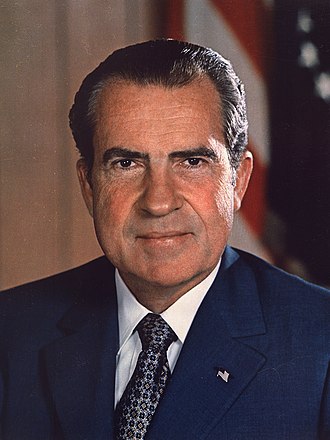
Richard M. Nixon served as the 37th President of the United States from January 1969 until his resignation in August 1974. In February 1971, he ordered the installation of a secret voice-activated taping system in the White House to preserve a historical record of his administration. Until the system's existence was revealed and dismantled in July 1973, the tapes captured Nixon directing major foreign policy initiatives, such as the opening to China, as well as his central role in the Watergate cover-up.
What Nixon talks about on the tapes
White House operations 4,718Presidential scheduling 2,225Public relations 1,784Presidential schedule 1,782Vietnam War 1,693Logistics 1,650Manolo Sanchez 1,626White House communications 1,400White House administration 1,399Presidential communication 1,243Henry Kissinger 1,191Foreign Policy 1,183
Conversations (21,010)
— Page 135 of 211President Nixon initiates a call through the White House operator to contact Robert Galvin, the head of Motorola. The brief exchange serves as a logistical setup to facilitate a direct conversation between the President and the corporate executive. No further policy discussions or significant decisions occur during this brief administrative interaction.
President Nixon met with Stephen B. Bull and Alexander P. Butterfield to coordinate scheduling for an upcoming meeting. The brief discussion facilitated a quick transition in the President’s agenda and included logistics regarding a telephone call from Robert W. Galvin. Following the brief exchange, both aides departed the Oval Office.
President Nixon met with General Creighton Abrams and Melvin Laird to strategize on the ongoing Vietnam peace negotiations and secure South Vietnamese President Nguyen Van Thieu's cooperation. Nixon emphasized that the U.S. would not accept a coalition government, a firm stance he insisted must be communicated to Thieu to ensure South Vietnam's long-term survivability. The participants assessed the military and political pressures facing Hanoi and the urgency of reaching a settlement, while acknowledging the sensitive psychological need to manage Thieu’s concerns regarding U.S. support and his political future.
President Nixon directed the White House operator to initiate telephone calls to W. Clement Stone and Robert W. Galvin. The brief exchange served as a logistical instruction to connect the President with these two individuals. No further policy discussions or substantive developments occurred during this administrative interaction.
President Nixon directs the White House operator to place outgoing telephone calls to Mr. Stone and Mr. Gallin. This brief administrative interaction facilitates the President's personal communication with these two individuals. No other substantive policy or political matters were discussed during this brief exchange.
President Nixon met with Alexander P. Butterfield to discuss administrative logistics regarding the schedule of an unidentified individual. The brief consultation centered specifically on matters related to the Executive Office Building (EOB) Health Unit. No major policy developments were recorded, as the discussion remained focused on internal White House personnel and facility coordination.
President Nixon spoke with major Republican donor and businessman W. Clement Stone regarding ongoing political matters. The conversation was brief and primarily served as a check-in between the President and his financial supporter. Due to the withdrawal of the substantive portion of the transcript, no specific policy decisions or action items remain part of the public record.
President Richard Nixon met with major Republican donor and insurance magnate W. Clement Stone for a brief, one-minute private discussion in the Oval Office. Given the brevity of the meeting and the withdrawal of segments under personal returnable status, the exchange likely concerned sensitive political fundraising or personal matters. No substantive policy decisions were documented during this recorded interval.
President Nixon met with Stephen B. Bull to review a list of potential telephone calls and discuss administrative procedures regarding the President’s schedule. The conversation touched upon the involvement of Rose Mary Woods and the possible scheduling of a meeting with Boston Mayor John Collins, whose name had been recommended by Charles Colson. The participants focused on coordinating these outreach efforts as part of the President's daily agenda.
President Nixon directs the White House operator to place a telephone call to former Boston Mayor John F. Collins. The President notes that Charles W. Colson possesses the necessary contact information for the former mayor. This exchange serves as a brief administrative coordination to facilitate direct communication between the President and Collins.
President Nixon held a brief telephone conversation with Robert A. Forst regarding an administrative matter. The dialogue was short and lacked substantive policy discussion, as the majority of the recorded session consists of a withdrawn personal segment. No specific executive actions or decisions were recorded during this exchange.
President Nixon coordinated with the White House operator regarding the management of incoming telephone calls. The discussion centered on handling a high volume of traffic, with the operator confirming that calls were being held back to prevent a backlog. The President authorized the operator to continue managing the queue as necessary to ensure efficient communication flow.
President Nixon met with his aide Stephen B. Bull to coordinate a series of telephone calls to key political supporters and donors. The discussion centered on contacting W. Clement Stone and Robert W. Galvin to manage outreach. The meeting concluded with instructions regarding the logistical details and expected duration of these communications.
President Nixon held a brief one-minute meeting with Robert A. Forst in the Oval Office. Due to the lack of available transcripts or descriptive logs, the specific subject matter and outcomes of this discussion remain officially undocumented. The interaction stands as a routine administrative or personal engagement captured by the White House taping system.
President Nixon met with his aide, Stephen B. Bull, for a brief administrative exchange. The conversation focused on the handling and processing of a specific letter. The interaction concluded with the President offering well wishes as Bull departed the Oval Office.
President Nixon spoke with William M. Fast regarding the recent grain agreement between the United States and the Soviet Union. Fast expressed his gratitude for the deal, noting its positive impact on the maritime industry. The President emphasized his hope that the arrangement would stimulate domestic employment through increased trade activity.
President Richard M. Nixon met with William M. Fast for a brief discussion in the Oval Office. The conversation was classified as personal and returnable material, and no transcript remains available to confirm specific topics or outcomes. Consequently, the meeting did not result in any publicly recorded policy decisions or formal action items.
President Nixon held a brief telephone conversation with Joseph Townsley to exchange initial greetings and establish contact. Following these introductory remarks, the remainder of the recording was withdrawn from the public record due to its status as a personal, returnable item. No substantive policy discussions or administrative decisions were documented in the available transcript.
President Nixon met briefly with Joseph Townsley to discuss logistical frustrations regarding outgoing telephone communications and the efficiency of the White House switchboard. The conversation centers on the President's desire for improved responsiveness from his staff, specifically regarding instructions previously given to Lacey. The interaction highlights the administrative challenges and pressures Nixon faced in managing his immediate communications workflow during this period.
President Nixon consulted with Stephen B. Bull regarding the status and efficiency of his incoming telephone calls. They discussed the current progress of the switchboard operations and the limited number of operators currently processing his communications. Nixon directed Bull to hold all incoming calls in a queue rather than forwarding them individually.
President Nixon met with his aide Stephen B. Bull to discuss and establish administrative protocols for managing the President's telephone communications. The discussion focused on refining the internal procedures for processing calls, including adjustments to the pace and flow of incoming requests. No major policy decisions were reached, as the meeting served primarily as an operational briefing to ensure greater efficiency in the White House switchboard functions.
President Nixon met with his aide Stephen B. Bull in the Oval Office to coordinate an upcoming meeting with General Alexander M. Haig, Jr. The brief encounter focused on managing the President's schedule and the arrangements for this high-level staff discussion. No significant policy decisions were recorded during this brief exchange.
President Nixon held a brief, informal telephone conversation with media executive Paul Miller to exchange pleasantries regarding their recent schedules. The discussion focused on Miller's recent trip to Augusta and his current presence in New York. No substantive policy matters or official business were addressed during this short social check-in.
President Nixon held a brief, informal telephone conversation with Paul Miller to inquire about Miller’s activities and golf plans. The discussion remained personal and social in nature, serving as a check-in rather than a deliberation on official policy or administrative matters. No significant decisions or action items were addressed during the brief exchange.
President Nixon held a brief meeting with Paul Miller in the Oval Office to address an undisclosed matter. The conversation occurred as an ongoing discussion, though the specific substance remains unavailable due to the lack of a transcript and the withdrawal of one item from the record. No definitive actions or decisions were captured in the available documentation for this short exchange.
President Nixon and Alexander Haig met to strategize on the Vietnam peace negotiations, specifically focusing on pressuring South Vietnamese President Nguyen Van Thieu to accept a proposed settlement. Nixon directed that General Creighton Abrams act as a primary advocate to convince Thieu that the deal was honorable and necessary, while explicitly stating that rejection of the agreement would result in a loss of presidential confidence and support. The discussion also addressed the timing of a potential announcement ahead of the 1972 election and the importance of maintaining the support of POW families by ensuring the terms prevented the collapse of South Vietnam.
President Nixon initiated this call to thank newspaper magnate William R. Hearst for the editorial support his publications provided during the 1972 presidential campaign, particularly regarding foreign policy. The two discussed a recent meeting Hearst had with former President Lyndon B. Johnson, noting Johnson’s private support for Nixon’s reelection and his disdain for Democratic challenger George McGovern. Additionally, they critiqued the anti-war efforts of McGovern and J. William Fulbright, agreeing that such opposition had unfairly prolonged the Vietnam War.
President Nixon and Alexander Haig coordinate telephone logistics involving Robert Galvin while managing ongoing communication regarding sensitive Vietnam negotiations. The discussion touches upon the strategic posture of South Vietnamese President Nguyen Van Thieu amidst the delicate diplomatic climate. The call concludes with administrative directives to ensure the President remains reachable for further updates on these high-stakes foreign policy matters.
President Nixon initiated this brief telephone call to speak with Motorola executive Robert W. Galvin. The conversation was interrupted by technical difficulties, resulting in a disconnected line after less than a minute of usable audio. Due to the withdrawal of the substantive portion of the recording for personal privacy reasons, no policy matters or specific outcomes are discernible from the remaining transcript.
President Nixon spoke with Detroit News editor Martin S. Hayden to express appreciation for the newspaper's editorial support during his 1972 reelection campaign. The two discussed the perceived detachment of the national press from public sentiment and analyzed favorable polling data for Nixon in Minnesota and Michigan. Nixon also noted that he would increase his public campaign activities following his upcoming veto of the Federal Water Pollution Control Act Amendments, which he intended to use to highlight his efforts to prevent excessive government spending.
President Nixon met with his aide Stephen B. Bull to coordinate a series of upcoming telephone calls to various individuals, including John F. Collins, John T. Connor, Francis Scumaci, and Fred Gualtieri. The discussion focused on establishing the proper scheduling and timing for these communications. Nixon specifically instructed Bull that these calls should be placed between 6:00 pm and 7:30 pm.
President Nixon and Stephen B. Bull reviewed the President’s upcoming schedule and administrative coordination. The discussion focused on organizing a telephone call to Richard M. Scaife and determining the availability for a potential meeting with H.R. Haldeman. Bull provided input on Haldeman’s current whereabouts to facilitate these arrangements.
President Nixon and H.R. Haldeman met to review 1972 election polling data, discuss campaign strategy against George McGovern, and coordinate the administration's response to negative press coverage concerning campaign practices. They assessed the political impact of McGovern’s Vietnam peace proposals and determined that the President should distance himself from allegations of political sabotage by keeping the campaign focused on substantive issues like welfare and foreign policy. Additionally, they reviewed Vice President Spiro Agnew’s upcoming schedule and finalized plans for Agnew to represent the President at the Al Smith dinner.
President Nixon and Joseph J. Staszak engaged in a brief, cordial exchange regarding the diplomatic activities of John Cardinal Krol, specifically his ongoing visit to Poland. Staszak relayed greetings to Vice President Spiro Agnew, who was actively campaigning for the administration at the time. The conversation concluded with Nixon inviting Staszak to visit the White House in the future.
President Nixon initiates a brief telephone call to Vice President Spiro T. Agnew through the White House operator. The primary objective of the communication is to establish a direct line of contact with the Vice President. No substantive policy matters or further developments were recorded in this short exchange.
President Nixon and Vice President Spiro Agnew discussed the strategy for the final weeks of the 1972 presidential campaign, emphasizing a focus on foreign policy, national defense, and the credibility of opponent George McGovern. They coordinated Agnew's upcoming schedule, including a revenue sharing event in Philadelphia and his attendance at the Alfred E. Smith dinner, where Nixon suggested Agnew deliver a speech highlighting the historical nature of political attacks. Nixon also provided guidance on how to deflect domestic issues while maintaining an aggressive stance against McGovern’s positions on welfare and amnesty.
President Nixon and Charles Colson reviewed the highly positive network television coverage of the President's appearance earlier that day before the National League of Families of American Prisoners and Missing in Southeast Asia. They agreed that the footage, which highlighted Nixon's emotional connection to the families and his firm stance against amnesty for draft evaders, was a significant political success that contrasted sharply with the more strident and negative campaign coverage of George McGovern. Furthermore, the two discussed campaign strategy, concluding that Clark MacGregor’s effective counter-attacks regarding political smear charges successfully neutralized allegations against the Nixon campaign in the public eye.
President Nixon directed the White House operator to place a call to Reverend Billy Graham. During the brief interaction, the President also declined an offer to speak with Stephen B. Bull, noting that he had already received the information he required from another source. This exchange served purely as a logistical coordination of the President's personal and professional communications.
President Nixon contacted the White House operator to place a personal telephone call. He requested to be connected to his daughter, Tricia Nixon Cox. The conversation concluded immediately after the operator acknowledged the request.
President Richard Nixon spoke with his daughter, Tricia Nixon Cox, in a brief personal telephone call. Because the substantive portion of the conversation was withdrawn for privacy reasons, no policy discussions or administrative decisions are documented. The exchange serves primarily as a record of familial communication within the White House.
President Nixon and Reverend Billy Graham spoke to discuss Graham's upcoming international tour and his offer to support the President's 1972 reelection campaign. Graham outlined his plans to campaign for Nixon's character and integrity, while drawing parallels between contemporary political smears and historical precedents involving past presidents. The President provided a confidential update on Henry Kissinger’s trip to Paris regarding Vietnam peace negotiations, emphasizing his commitment to an honorable settlement. They concluded by discussing recent positive media coverage of the President's stance on amnesty and the Vietnam War.
President Nixon directs the White House operator to initiate a series of scheduled telephone calls immediately following the conclusion of his conversation with Charles Colson. This brief administrative exchange confirms the President's ongoing management of his communications workflow. No substantive policy matters or further action items beyond the coordination of his call log were addressed during this interaction.
President Nixon instructed the White House operator to delay placing a series of scheduled telephone calls. He requested that the operator remain on standby, stating that he would reconnect in approximately 15 minutes to proceed with the communications. This brief exchange served to coordinate the President's evening call schedule.
President Nixon contacted the White House operator to issue administrative instructions regarding his schedule. He authorized the operator to begin initiating a series of outgoing telephone calls. This brief communication served to activate the President's evening telecommunications workflow.
President Nixon initiated a brief telephone call to Frank Scumaci to establish contact. The exchange was limited to verifying the identity of the participants and greetings. No substantive policy matters or official developments were discussed before the connection concluded.
President Nixon initiated this call to Nashville Mayor C. Beverly Briley to discuss the implementation and impact of the newly enacted federal revenue sharing program. The President emphasized that these funds would provide essential financial support to the city, while Mayor Briley confirmed his administration's commitment to utilizing the resources responsibly for long-term sustainability. The brief exchange served to strengthen political ties between the White House and local leadership regarding domestic policy priorities.
President Nixon held a brief telephone conversation with Richard M. Scaife to exchange personal greetings. The majority of the recorded interaction consists of a withdrawn segment, leaving no substantive policy discussions or actionable decisions on the public record. The exchange served primarily as a brief interpersonal communication between the President and the philanthropist.
President Nixon and baseball legend Ted Williams engaged in a brief, informal social call to exchange pleasantries and discuss current events. The conversation touched upon Williams’ recent hunting trip in Vermont, their mutual interest in the World Series, and the status of the Texas Rangers. Williams concluded the call by expressing his political support for the President’s reelection campaign.
President Nixon initiated this brief telephone call to speak with business executive and former Secretary of Commerce John T. Connor. Following standard initial greetings, the conversation was interrupted by a significant withdrawn segment that encompasses the majority of the recording. No substantive policy discussions or actionable items were finalized during the remaining accessible portion of the call.
Former Boston Mayor John F. Collins advised President Nixon to hold the signing ceremony for the revenue sharing bill in Lowell, Massachusetts, to symbolize support for mid-sized American cities. Collins argued that this venue would effectively counter criticisms of Nixon’s urban policy and demonstrate broad appeal among smaller municipalities. The President expressed interest in the proposal, and the two agreed to further consider the logistical details of the signing ceremony.
President Nixon initiated a brief telephone conversation with John W. Mulcahy, Jr. to engage in a discussion that was subsequently classified as a personal returnable item. Due to the withdrawal of the recorded content from the public record, the specific substance and outcomes of this communication remain restricted for historical review. No public policy decisions or administrative actions were documented in the surviving transcript of this exchange.
President Nixon consulted with the White House operator regarding the status of pending calls to Fred Gualtieri and Ralph Marrinson, learning that both individuals were currently unavailable. The President authorized the operator to postpone these attempts until the following day. Additionally, Nixon used the opportunity to express his personal appreciation to the operator for the hard work performed by the entire telephone staff.
President Nixon initiates a brief telephonic interaction with the White House operator to place an outgoing call. The President specifically requests to be connected with Ralph Marrinson. This administrative exchange serves as the logistical precursor to establishing a conversation with the designated party.
President Nixon consulted with the White House operator to manage his morning itinerary. The primary focus of the brief interaction was the coordination of his daily schedule. The President specifically sought to arrange a potential meeting with Alexander M. Haig, Jr. to address pressing administrative matters.
President Nixon met with an unidentified woman in the Oval Office to briefly discuss scheduling logistics. The conversation included references to upcoming meetings with Alexander M. Haig, Jr. and Ronald L. Ziegler. The encounter concluded shortly thereafter, with the visitor departing before the President continued with his daily agenda.
President Nixon met with Press Secretary Ronald Ziegler to coordinate the administration’s strategy for the final weeks of the 1972 campaign. The discussion centered on efforts to discredit the media’s coverage of the administration and emphasized the importance of contrasting the perceived patriotism of the President's supporters—such as labor, farmers, and military families—against that of the liberal establishment and academics. The two also reviewed logistical planning for upcoming public appearances, potential radio addresses regarding tax reform, and updates on Henry Kissinger’s diplomatic activities.
President Nixon met with H. R. Haldeman and Alexander Haig to discuss the critical state of Vietnam peace negotiations, emphasizing that any potential bombing halt or move to Hanoi by Henry Kissinger must be strictly contingent upon a finalized, successful agreement. The participants expressed deep frustration with South Vietnamese leader Nguyen Van Thieu's resistance to settlement terms and discussed the necessity of maintaining leverage without allowing electoral politics to dictate foreign policy. Nixon also instructed that proposed settlement documents be tightly controlled within the White House to prevent unauthorized leaks or critiques from State Department officials. Beyond the Vietnam situation, the group addressed the timing of potential military aircraft deals with Israel, the political implications of upcoming congressional vetoes, and strategic messaging to ensure positive public reception of the President's actions through the final stretch of the election cycle.
President Nixon contacted Ralph Marrinson to express personal appreciation for his campaign contributions and advocacy work regarding nursing home issues. The discussion centered on the importance of improving conditions within these facilities, reflecting the President's stated personal concern for the elderly. No specific policy actions were decided, as the call served primarily as a gesture of political recognition and encouragement for Marrinson's efforts.
President Nixon met with H.R. Haldeman and other aides to manage the political fallout of the Watergate scandal and coordinate the public messaging regarding Vietnam peace negotiations. Nixon emphasized adopting a low-key, defensive posture toward Watergate allegations while directing staff to manage public perception of Henry Kissinger's upcoming trip to Saigon. Additionally, the President stressed the importance of maintaining a stern public image for Kissinger during his diplomatic travels, specifically warning against any optics that might suggest friendliness toward the North Vietnamese.
President Nixon met with his senior advisors and staff to coordinate public relations messaging and diplomatic strategy. The discussion focused on refining the narrative surrounding the administration's recent outreach to labor leaders and establishing talking points for Ron Ziegler regarding Henry Kissinger's upcoming trip to Saigon. Nixon emphasized the importance of framing Kissinger's travel as a routine, pre-planned mission to avoid public speculation about a diplomatic "breakthrough" or a shift in policy toward South Vietnamese President Nguyen Van Thieu.
President Nixon met with the National Advisory Council for Drug Abuse Prevention to discuss the administration's ongoing strategies for combating drug use, including law enforcement, treatment programs, and international cooperation. The President emphasized the importance of the Council's expertise in generating effective policy ideas and highlighted the prevalence of drug-related crimes among the youth population. During the meeting, Nixon presented awards to the members in recognition of their contributions to the national anti-drug effort.
President Nixon requested that the White House operator place a telephone call to his daughter, Julie Nixon Eisenhower. He also asked to be connected to Marcellona Spain, the wife of his former personal aide, Don Spain. This brief exchange served solely to facilitate personal communications between the President and these individuals.
President Nixon consulted with the White House operator to facilitate an outgoing call. This routine interaction served as a technical precursor to further presidential communication, as noted by the cross-reference to a subsequent conversation. No substantive policy discussions occurred during this brief exchange.
President Nixon and Stephen B. Bull reviewed the President’s upcoming schedule, specifically focusing on potential meetings with the National Federation of Business and Professional Women’s Clubs and former NFL star Gale Sayers. Bull provided updates on Robert J. Brown’s efforts to secure Sayers's public endorsement, noting his perceived value as a representative with broad appeal. The President expressed reservations about pressuring Sayers, ultimately deciding to adopt a hands-off approach while awaiting further word on the athlete's intentions.
President Nixon directs the White House operator to contact John D. Ehrlichman to request an immediate meeting. The primary objective is to bring Ehrlichman to the Oval Office for a consultation. No further substantive matters are addressed during this brief exchange.
President Nixon consulted with the White House operator to facilitate an outgoing call. This brief interaction served as a routine logistical step for the President to connect with another party. No further substantive policy matters or specific decisions were recorded during this brief exchange.
President Nixon met with his aide Stephen B. Bull to coordinate the scheduling of John D. Ehrlichman. The discussion focused on ensuring Ehrlichman was intercepted early to prevent an unscheduled or inconvenient meeting. This brief exchange served to manage the President's accessibility and control the flow of staff interactions.
President Nixon met with his personal valet, Manolo Sanchez, in the Oval Office to briefly coordinate the logistics of the President’s daily schedule. The exchange served as a routine administrative check-in to ensure the President's upcoming commitments were understood. No major policy decisions or significant developments resulted from this short interaction.
President Nixon met with Alexander M. Haig, Jr. to coordinate the flow of information regarding ongoing Vietnam peace negotiations. The President directed Haig to ensure that all relevant reports and updates from Henry Kissinger are immediately relayed to him. Nixon emphasized his desire to remain personally involved and informed by reviewing all incoming intelligence on the diplomatic progress.
President Nixon met with Manolo Sanchez and John D. Ehrlichman to coordinate the President's upcoming schedule. The primary focus of the meeting involved preparations for a forthcoming audio message and the arrangement of a subsequent private meeting with Ehrlichman. The discussion concluded as the participants departed the Oval Office shortly thereafter.
President Nixon met with John Ehrlichman to coordinate the administration's legislative strategy, focusing on upcoming vetoes of the water and spending bills and potential responses to Congress. The President also discussed tax reform communication strategies and initiatives to secure support from Catholic leadership regarding parochial school aid. Later, Nixon hosted football star Gale Sayers and aides to discuss minority business programs, the role of minority athletes as positive role models, and the potential for retired athletes to transition into community service and business leadership roles.
President Richard Nixon spoke with his daughter, Julie Nixon Eisenhower, in a brief personal telephone call. The conversation was largely administrative in nature as the participants were connected by White House operators. Due to the withdrawal of the substantive content from the public record, no policy matters or specific decisions are preserved in this transcript.
President Nixon initiates a request through the White House operator to place a telephone call to Corinne "Lindy" Boggs, the wife of House Majority Leader Hale Boggs. This brief interaction serves as a logistical bridge to facilitate communication with Mrs. Boggs. No further political or policy substance is addressed during this short exchange.
President Nixon called Lindy Boggs to offer his personal condolences and support following the disappearance of her husband, Representative Hale Boggs, whose plane had gone missing. The President assured Boggs that the federal government was fully committed to the ongoing search efforts and encouraged the family to maintain their faith. This brief exchange served as a gesture of comfort from the President and First Lady to the Boggs family during their crisis.
President Nixon met with representatives from the National Federation of Business and Professional Women’s Clubs (BPW) to discuss their organization's role and the Administration's efforts regarding women's appointments. The conversation included a photo opportunity, a discussion on the importance of economic equality and the elimination of discrimination, and a brief comparison of Chinese cultural apparel. During the visit, the participants exchanged gifts, including 1896 Republican National Convention tickets presented to the President by Jeanne Squire.
President Nixon consulted with his aide Stephen B. Bull regarding the scheduling of an upcoming meeting with Dr. William O. Chase and Dr. Carl Laughlin. They discussed whether a press photograph should be taken during the session and considered the availability of White House photographer Oliver F. Atkins. The brief exchange focused primarily on logistical arrangements for the President's public image and daily calendar.
President Nixon met with representatives from the American Dental Association (ADA), including Dr. Carl Laughlin and Dr. William O. Chase, to discuss the state of American dentistry, proposed federal health legislation, and the profession's potential role in providing dental care to disadvantaged children. The participants evaluated the quality of U.S. dental care compared to international standards and explored issues related to the distribution of dentists and the role of genetics in public health. Nixon encouraged the ADA to adopt a public resolution supporting dental initiatives for children to improve the profession's public image, while the guests invited the President to address their upcoming national convention.
President Nixon met with his aide Stephen B. Bull and personal aide Manolo Sanchez to coordinate logistical details regarding his immediate schedule. The discussion centered on the President's upcoming movements between the Oval Office and the Executive Office Building. The primary action item was facilitating a planned meeting with John B. Connally.
President Nixon met with his personal valet, Manolo Sanchez, in the Old Executive Office Building. The conversation consisted of a brief, personal exchange that was subsequently withdrawn from public release. Due to the lack of a transcript and the classified nature of the discussion, no substantive policy decisions or political developments were recorded.
President Nixon met with his personal valet, Manolo Sanchez, in the Old Executive Office Building. The brief interaction, lasting only four seconds, was categorized by NARA as containing personal material. No substantive policy discussions or administrative decisions were recorded during this encounter.
President Nixon met with his personal valet, Manolo Sanchez, in the Old Executive Office Building. The brief interaction consisted primarily of personal matters rather than substantive policy discussions or administrative business. No significant official actions or political developments resulted from this brief encounter.
President Nixon met with his valet, Manolo Sanchez, in the Old Executive Office Building to discuss administrative matters. During the brief interaction, Sanchez conveyed a request to arrange a meeting between the President and special counsel Charles W. Colson. No further significant policy decisions were recorded during this exchange.
President Nixon and Charles Colson met to discuss campaign strategy for the upcoming election, focusing heavily on undermining Democratic challenger George McGovern. They evaluated the political impact of various social and economic issues, including amnesty, taxation, and aid to parochial schools, while strategizing on how to best frame the President's policy positions and vetoes to the public. The discussion also included logistical considerations regarding the messaging of campaign surrogates and the management of regional media reports.
President Nixon and Alexander M. Haig, Jr. conferred briefly regarding the ongoing Vietnam negotiations. The discussion focused specifically on the scheduling requirements for Henry A. Kissinger's upcoming diplomatic engagements. Haig committed to providing the President with necessary updates as the situation progressed.
President Nixon met with his aide Stephen B. Bull in the Oval Office to coordinate logistics and preparations for an upcoming meeting with John B. Connally. The discussion focused on finalizing scheduling arrangements to ensure the session with Connally proceeded as planned. No further policy-related actions were recorded during this brief encounter.
President Nixon, H.R. Haldeman, and John Connally met to strategize on campaign fundraising and address the growing political fallout from the Watergate scandal. The participants discussed methods for securing large donations from high-profile contributors and analyzed the potential impact of Connally’s forthcoming foreign policy broadcast. Additionally, Nixon sought to distance the White House from the Segretti-led sabotage operations and Watergate, while framing the upcoming election as a critical opportunity to repudiate the values of the "Eastern Establishment" and liberal media.
President Nixon met with H.R. Haldeman, John Connally, and other advisors to discuss campaign messaging, the effectiveness of recent political television broadcasts, and the President's upcoming schedule. The group evaluated the impact of Nixon’s defense and foreign policy messaging, deciding to forgo the release of a new tax plan to avoid unnecessary controversy. Nixon and his team also strategized on the handling of upcoming legislative vetoes, particularly a water bill, while weighing the benefits of presidential travel versus remaining in Washington to maintain a 'presidential' public image.
President Nixon initiated a brief telephone request to the White House operator to be connected with First Lady Thelma C. ("Pat") Nixon. The call served as an administrative directive to establish communication with his wife. No further substantive policy matters or political developments were addressed during this short exchange.
President Nixon initiates a brief telephonic communication through the White House operator to place an outgoing call. The interaction serves as a routine administrative step to facilitate a connection for the President. No substantive policy discussions or decisions occurred during this brief exchange.
President Nixon met with Alexander P. Butterfield to discuss the administration's schedule and specific legislative priorities. The primary focus of the brief conversation centered on the potential veto of an upcoming water bill. No further actions or broader policy developments were recorded during this brief administrative exchange.
President Nixon met with Stephen B. Bull in the Oval Office to review and coordinate upcoming scheduling matters regarding Pegge Begich and Lindy Boggs. During the brief session, the President also held a short telephone conversation with First Lady Pat Nixon. The discussion served primarily as an administrative update to finalize the President's immediate agenda.
President Nixon requested that the White House operator place a telephone call for him. This brief administrative interaction served to facilitate presidential communication. No further substance was recorded beyond the request to initiate the connection.
President Richard Nixon and First Lady Pat Nixon engaged in a brief telephone conversation. The majority of the recording consists of a withdrawn segment classified as personal and returnable material. No substantive political or administrative policy discussions are documented in the available transcript.
President Nixon contacted the White House operator to place a personal call to the wife of Congressman Nick Begich. The Congressman had recently gone missing following an airplane disappearance in Alaska. The President's request served as an expression of concern for Mrs. Begich during the ongoing search and rescue efforts.
President Nixon telephoned Pegge Begich to express his personal sympathies following the disappearance of her husband, Representative Nicholas Begich, and Representative Hale Boggs in a plane crash. The President offered comfort and encouraged her to maintain hope during the ongoing search efforts, while also inquiring about her children. This call served as a gesture of support from the White House to the families affected by the tragedy.
President Nixon met briefly with Pegge Begich to offer personal condolences and moral support following the recent disappearance of her husband, Representative Nick Begich, whose plane had gone missing in Alaska. The President expressed sympathy regarding the family's dual crises of the missing aircraft and the illness of her children. He concluded the brief exchange by encouraging her to remain hopeful during this difficult period.
President Nixon and H. R. Haldeman engaged in a brief exchange regarding the logistics of Haldeman's schedule and a pending request for a meeting with the President. The dialogue served to coordinate the President's availability and manage administrative priorities. No substantive policy decisions were reached during this short interaction.
President Nixon held a brief meeting with his personal valet, Manolo Sanchez, in the Oval Office. The conversation was extremely short, lasting less than a minute, and concerned personal matters rather than official policy. No substantive administrative or political decisions were recorded during this interaction.
President Nixon consulted with H. R. Haldeman and Alexander Haig regarding critical foreign and domestic policy matters, most notably the status of Vietnam peace negotiations. Nixon instructed Haig to ensure Henry Kissinger avoided traveling to Hanoi unless a final agreement was secured, while expressing concerns about North Vietnamese military maneuvers near Saigon. Additionally, the President and his staff discussed managing the optics of his 1972 re-election campaign, specifically defending the strategy of remaining in the White House to focus on official duties rather than traditional public campaigning.
President Nixon contacted the White House operator to facilitate a telephone connection with H.R. "Bob" Haldeman. This brief administrative interaction served as a routing request to reach his Chief of Staff. No substantive policy discussions or decisions occurred during this exchange.