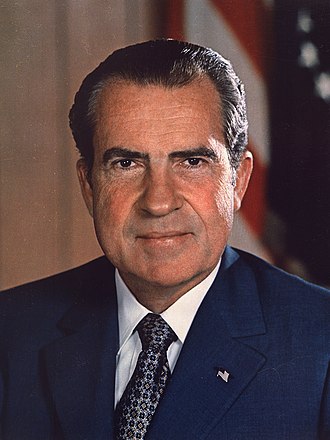
Nixon, Richard M. (President)
Richard M. Nixon served as the 37th President of the United States from January 1969 until his resignation in August 1974. In February 1971, he ordered the installation of a secret voice-activated taping system in the White House to preserve a historical record of his administration. Until the system's existence was revealed and dismantled in July 1973, the tapes captured Nixon directing major foreign policy initiatives, such as the opening to China, as well as his central role in the Watergate cover-up.
What Nixon talks about on the tapes
White House operations 4,718Presidential scheduling 2,225Public relations 1,784Presidential schedule 1,782Vietnam War 1,693Logistics 1,650Manolo Sanchez 1,626White House communications 1,400White House administration 1,399Presidential communication 1,243Henry Kissinger 1,191Foreign Policy 1,183
Conversations (21,010)
— Page 149 of 211President Nixon met with his valet, Manolo Sanchez, and aide Stephen B. Bull to coordinate logistical arrangements for an upcoming trip to Camp David. The discussion focused primarily on the scheduling and timing of the helicopter transport required for the President's transit. No substantive policy matters were addressed, as the conversation was strictly limited to the mechanics of the President's personal itinerary.
President Richard Nixon met with his personal valet, Manolo Sanchez, in the Old Executive Office Building to discuss the President's upcoming daily schedule. The conversation served as a routine administrative coordination regarding official appointments and logistics. No major policy developments were recorded, as the meeting focused exclusively on personal and professional planning.
President Nixon met with his aide Stephen B. Bull to coordinate logistical arrangements for upcoming events. The discussion focused on scheduling travel to Camp David via helicopter and planning the seating arrangements and protocol for a reception and dinner honoring California administration officials. Specific attention was given to the role of H.R. Haldeman in managing these functions and overseeing guest interactions.
President Nixon instructed the Camp David operator to facilitate a telephone call to the Apollo 17 astronauts. He specifically requested to speak with Commander Eugene A. Cernan at 9:30 pm, confirming that the entire crew would be available together for the conversation. This interaction served as a logistical arrangement to establish official contact with the crew during their final lunar mission.
President Nixon consulted with the Camp David operator to facilitate a new telephonic connection. The brief exchange focused on administrative logistics regarding the routing of an upcoming call from the Aspen Lodge. No substantive policy or political discussions took place during this short administrative interaction.
President Nixon held a phone conversation with the Apollo 17 crew—Eugene Cernan, Ronald Evans, and Harrison Schmitt—at Camp David to offer his well wishes before their upcoming mission. The discussion touched on the significance of the final moon landing, the roles of the individual crew members, and the importance of the mission to the nation. Nixon also briefly discussed his ongoing efforts regarding Vietnam peace negotiations, while the crew expressed their support for his second term.
President Nixon met with the crew of Apollo 17—Eugene Cernan, Ronald Evans, and Harrison Schmitt—to offer his best wishes and support prior to their upcoming lunar mission. The conversation focused on the significance of the final moon landing, the inclusion of civilian scientist Harrison Schmitt, and the crew's operational roles. Amidst the well-wishes, Nixon briefly noted the difficulty of the ongoing Vietnam peace negotiations, expressing his commitment to achieving a lasting settlement.
President Nixon contacted the Camp David operator to facilitate an urgent telephone connection with his special counsel, Charles W. Colson. The brief exchange served strictly as a logistical request to initiate this private communication. No substantive policy matters were discussed during this interaction.
President Nixon dictates a memorandum regarding urgent Vietnam negotiations and the necessity of escalating military action. He references key advice from Henry Kissinger and John Connally, emphasizing the need for a firm stance following the administration's recent success in the 1972 election. The President uses this time to formalize his strategic directives and reflections on the ongoing peace process.
President Nixon uses this brief session to dictate notes and reflections while residing at Camp David. The primary focus involves the President recording his thoughts and administrative updates for later transcription. No specific policy decisions are reached, as the segment serves as a personal logging of presidential activities.
President Nixon initiates a communication request while staying at the Aspen Lodge at Camp David. The President directs the Camp David operator to establish a telephone connection with his special counsel, Charles W. Colson. This brief administrative interaction serves solely to facilitate a private consultation between the President and a key advisor.
President Nixon dictated a series of memoranda while at Camp David, continuing his administrative workflow during a period of transition. The recording captures the President documenting specific instructions and scheduling details as part of his official record-keeping process. These dictations served to formalize presidential directives and manage the executive agenda during the final weeks of 1972.
President Nixon and Charles Colson discuss the political fallout and public relations strategy surrounding an impasse in the ongoing Vietnam peace negotiations. While Henry Kissinger advises the President to deliver a televised address to rally public support, both Nixon and Colson express concern that such a move would unnecessarily escalate the war as a domestic issue and potentially signal weakness to the North Vietnamese. Ultimately, they decide to maintain a firm stance and avoid a major public statement, concluding that the American public is generally satisfied and would prefer to avoid further drama regarding the conflict.
President Nixon and Charles Colson discuss the political implications of addressing the nation regarding the status of ongoing peace negotiations in Vietnam. Nixon expresses caution about the potential for a televised address to escalate domestic war protests and unnecessarily revive the influence of the anti-war opposition. Ultimately, the two weigh the merits of signaling strength through decisive action versus the risk of political fallout from prematurely rallying the public.
President Nixon consulted with Charles Colson regarding ongoing legal strategy and public messaging tactics concerning a judge. The conversation focused on interpreting specific points raised during judicial proceedings to influence the narrative surrounding the administration's legal challenges. The exchange served to coordinate legal arguments and political posturing in response to the judge's inquiries.
President Nixon met with his aide, Stephen B. Bull, at the Aspen Lodge study to review and coordinate the President's upcoming daily schedule. The primary focus of the brief discussion was the logistics regarding a pending meeting with H. R. Haldeman. No further substantive policy issues were addressed during this administrative check-in.
President Nixon met with his personal valet, Manolo Sanchez, at the Aspen Lodge in Camp David to conduct administrative tasks. During this brief interaction, Sanchez requested the President's formal authorization to file certain documents. Nixon granted the permission, resulting in the successful processing of the materials.
In this meeting at Camp David, President Nixon consulted with H. R. Haldeman and Ronald Ziegler regarding a wide-ranging agenda for his second term, including the status of Vietnam peace negotiations, the reorganization of executive branch personnel, and the planning for the 1973 Inauguration. Nixon emphasized the necessity of ensuring loyalty within federal agencies and directed the creation of a '1,000 days' schedule to maintain urgency throughout his second term. The group discussed public relations strategies, specifically regarding the handling of potential setbacks in the ongoing Paris peace talks, and finalized logistical details for inaugural events like the 'Spirit of '76' theme.
President Nixon contacted the Camp David operator to inquire about the arrival status of his daughter, Julie Nixon Eisenhower. The operator agreed to investigate the request immediately to facilitate communication between the President and his daughter. This brief exchange served as a logistical coordination effort to locate a family member at the presidential retreat.
President Nixon consulted with the Camp David operator regarding the arrival schedule of his daughter, Julie Nixon Eisenhower. Following the confirmation that her arrival was delayed until the next day, Nixon requested to be connected to his other daughter, Tricia Nixon Cox. The brief exchange served exclusively to coordinate logistics for family communications and visit planning.
President Nixon contacted the Camp David operator to inquire about the whereabouts of his daughter, Julie Nixon Eisenhower. The brief interaction served as a personal request to locate a family member during the President's stay at the Aspen Lodge. No substantive policy or administrative decisions were made during this exchange.
President Nixon speaks with the Camp David operator to coordinate personal communications while stationed at Aspen Lodge. The brief exchange focuses on scheduling a call to his daughter, Tricia Nixon Cox, which the President requests for the following day. No substantive policy matters or administrative decisions are addressed during this interaction.
President Nixon held a brief phone conversation with his daughter, Tricia Nixon Cox, and his wife, Pat Nixon, while staying at Camp David. The call touched on family travel preparations, including Edward Cox's recent bar exam results, and logistical planning for the 1973 inaugural events. Additionally, the President and Mrs. Nixon discussed minor administrative matters regarding White House office aesthetics, specifically the lighting requirements for photography and the search for a new, comfortable office chair.
President Nixon and his daughter, Tricia Nixon Cox, engage in a brief, informal check-in at Camp David to discuss personal and logistical matters. The conversation centers on congratulating Tricia’s husband, Edward Cox, for passing the bar exam and coordinating preliminary details regarding the upcoming second presidential inauguration. Nixon also provides brief instructions regarding lighting procedures for official photography sessions.
President Nixon contacted the Camp David operator to facilitate a telephone call to his Chief of Staff, H.R. Haldeman. The brief exchange served as a routine administrative request to establish communication with a senior advisor. No further substantive policy discussions occurred during this specific interaction.
President Nixon and H.R. Haldeman discuss the scheduling and coordination of events for the 1973 inauguration, specifically focusing on functions for family members. The President directs Haldeman to ensure that Stephen Bull or the relevant staff clearly communicate the planned itinerary to First Lady Pat Nixon, including the proposed Sunday afternoon reception. The objective is to confirm the schedule for Mrs. Nixon so she remains informed of the events while minimizing her personal involvement in the planning logistics.
President Nixon requested that the Camp David operator confirm the locations of Secretary of Defense Melvin R. Laird and Secretary of State William P. Rogers. He specifically sought to verify if both officials were attending a NATO conference, while explicitly noting he did not wish to speak with either of them. The President directed the operator to consult the National Security Council staff to resolve the inquiry and call him back with the information.
President Nixon consulted with the Camp David operator to confirm the current location of Secretary of Defense Melvin Laird and Secretary of State William Rogers. The operator verified that both officials were in Brussels at the time of the inquiry. This brief exchange served to track the whereabouts of key cabinet members during a period of ongoing international diplomatic activity.
President Nixon initiates a telephone call through the Camp David operator to reach Congressman Gerald R. Ford. The brief exchange serves as a logistical bridge to connect the President with Ford for further discussion. No substantive policy matters are addressed in this transit communication.
President Nixon and Representative Gerald Ford discussed the upcoming reorganization of the Republican National Committee and the administration’s cabinet. Nixon confirmed that George H.W. Bush would be appointed as RNC Chair to replace Robert Dole, while Ford provided updates on managing internal party friction regarding other leadership roles, specifically balancing regional representation. The two also addressed personnel shifts, including the transition of John Volpe to Ambassador to Italy and the difficulty of vetting candidates for high-level government positions due to background check concerns.
President Nixon initiates a phone call from Camp David to request a direct connection with Colonel Richard T. Kennedy. This brief interaction serves as a logistical bridge to facilitate a subsequent conversation with the National Security Council staffer. No substantive policy discussions occur during this short exchange with the operator.
President Nixon initiates a brief communication with the Camp David operator from the Aspen Lodge study. The interaction serves to facilitate necessary telecommunications support for the President while he is in residence at the retreat. No substantive policy matters or major developments are recorded during this brief administrative exchange.
President Nixon and H. R. Haldeman discuss the management of First Lady Pat Nixon's schedule and her communication with personal secretary Rose Mary Woods regarding upcoming public appearances and rallies. Nixon expresses concern that his wife lacks sufficient information about scheduled events, specifically a planned Sunday church service, and requests that staff ensure she is better informed. The conversation concludes with the President dismissing the technical quality of the recording equipment as the two coordinate these logistical administrative details.
President Nixon directed the Camp David operator to confirm the current whereabouts of Secretary of Defense David Packard and Secretary of State William Rogers. He specifically requested that the operator verify their attendance at a NATO meeting through the National Security Council staff. The President explicitly noted that he did not intend to speak with either official, seeking only to track their locations.
President Nixon consulted with a Camp David operator to verify the familial relationship between two unidentified individuals. This brief inquiry centered on clarifying the status of the pair, specifically whether they were brothers. The interaction concluded after the President received confirmation regarding their sibling status.
President Nixon held a brief administrative interaction with the Camp David operator while stationed at the Aspen Lodge. The conversation involved basic communication logistics, though the lack of an available transcript precludes a detailed analysis of specific policy discussions. This exchange served primarily to facilitate the President's connectivity from the retreat.
President Nixon and Gerald Ford met to coordinate staffing and leadership changes within the Republican Party and the administration. The conversation centered on the planned appointment of George H.W. Bush as Republican National Committee chairman and the strategic necessity of balancing party leadership across various geographic and ideological lines. They also discussed administrative personnel changes, specifically the appointment of John Volpe as Ambassador to Italy and the vetting challenges associated with potential high-level appointments.
President Nixon initiates a brief communication through the Camp David operator to establish a connection with Colonel Kennedy. This administrative exchange serves the primary purpose of facilitating a specific phone call for the President. No further policy discussions or substantive developments occur during this brief interaction.
President Nixon and Col. Richard T. Kennedy discuss strategies regarding ongoing Vietnam peace negotiations led by Henry Kissinger in Paris. Nixon rejects Kissinger's inclination to break off talks and initiate a dramatic, long-term bombing campaign to secure the release of prisoners of war, citing the potential for damaging Congressional relations and the inability to guarantee South Vietnam's survival through such an escalation. Instead, Nixon directs Kennedy to draft a message instructing Kissinger to pursue a reasonable settlement and keep negotiations open, while ensuring that the U.S. minimum conditions—such as a withdrawal clause—are clearly placed on the record.
President Nixon met with Col. Richard T. Kennedy to discuss the ongoing, frustrating Vietnam peace negotiations and Henry Kissinger's impulse to break off talks in favor of a hard-line military response. Nixon argued against this dramatic approach, reasoning that escalating bombing campaigns to secure the return of prisoners would be politically untenable with Congress and the public over a long timeframe. Instead, the President directed that negotiators should continue the dialogue, seek the best possible agreement, and avoid issuing ultimatums that would force a premature collapse of the peace process.
President Nixon initiates a brief telephonic request to the Camp David operator to summon H. R. Haldeman to Aspen Lodge. The call serves as a logistical directive to facilitate an immediate in-person meeting between the President and his Chief of Staff. No further policy matters are discussed during this administrative exchange.
President Nixon contacted the Camp David operator to facilitate a telephone connection with Colonel Richard T. Kennedy. This brief administrative exchange served as the precursor to a substantive discussion between the President and the Colonel. The conversation concluded with the operator processing the requested call to ensure the two parties could be connected.
President Nixon met with his personal valet, Manolo Sanchez, at Camp David to discuss logistical arrangements for the evening. The conversation focused primarily on finalizing the schedule for dinner. No further significant policy or administrative developments were recorded during this brief encounter.
President Nixon held a brief exchange with the Camp David operator to facilitate telephonic communications while staying at the Aspen Lodge. The conversation served a purely administrative purpose regarding the operational status of the facility's switchboard system. No substantive policy discussions or significant political decisions were recorded during this brief interaction.
President Nixon and H. R. Haldeman met to review a cable from Henry Kissinger regarding a discussion between Colonel Richard T. Kennedy and Soviet Ambassador Anatoliy F. Dobrynin. The two men critically evaluated the emotional tone and content of recent interviews given by Kissinger, specifically criticizing his remarks to Oriana Fallaci. This exchange served as a debriefing session on diplomatic communications and the potential political fallout from Kissinger's public commentary.
President Nixon consulted with the Camp David operator to determine the availability of specific facilities or accommodations at the retreat. This brief administrative interaction served to verify logistical arrangements during the President's stay at Aspen Lodge. No substantive policy discussions or major decisions were recorded during this exchange.
President Nixon directed Colonel Richard T. Kennedy to draft guidance for a message to Henry Kissinger regarding ongoing Vietnam peace negotiations. The President expressed a preference for testing "minimum conditions" in a settlement agreement to secure the release of American prisoners of war, weighing this against Kissinger's inclination to break off talks and resume bombing to increase pressure on North Vietnam. Nixon and Kennedy discussed the strategic risks of these approaches, ultimately deciding to formalize these instructions for further review and editing.
President Nixon directed Colonel Richard T. Kennedy to draft a cable outlining his strategic guidance regarding ongoing peace negotiations. The President expressed a preference for offering minimum conditions to facilitate the potential release of prisoners of war, while simultaneously weighing the optics of breaking off talks to justify a resumption of bombing. Nixon requested that Kennedy prepare a draft for his personal review and refinement to ensure the message reflected these complex tactical considerations.
President Nixon contacted the Camp David operator to facilitate an urgent communication with his Chief of Staff, H. R. Haldeman. The primary purpose of this brief telephone exchange was to secure a direct line to his senior advisor. This call reflects the administrative process Nixon utilized to manage his inner circle while stationed at Camp David.
President Nixon and H. R. Haldeman met to discuss the deteriorating status of Vietnam peace negotiations and Henry Kissinger’s recent communications regarding potential strategies. They evaluated the risks of two primary options: either forcing a breakdown in talks to resume bombing, or accepting a less favorable settlement to secure the return of American POWs. Concerned that Kissinger was becoming overly discouraged and impulsive, the President decided to maintain the negotiating channel while tasking Haldeman and John Ehrlichman with developing a more cohesive strategy to avoid a premature collapse of the talks.
President Nixon dictated a memorandum for National Security Advisor Henry Kissinger outlining instructions for upcoming negotiations with North Vietnam. The President emphasized that the U.S. must avoid appearing responsible for breaking off talks, instructing Kissinger to maintain diplomatic flexibility while documenting North Vietnamese intransigence for historical purposes. Nixon also evaluated the potential consequences of a massive bombing campaign, weighing the objective of securing POW releases against the risks of congressional opposition, domestic unrest, and strained relations with China and the Soviet Union.
President Nixon met with his personal valet, Manolo Sanchez, at Camp David to provide specific formatting instructions for a draft message intended for National Security Advisor Henry Kissinger. Nixon directed Sanchez to prioritize getting the rough draft typed quickly, emphasizing that minor errors were acceptable at this stage. The conversation focused on the logistical requirements for the document, including double-spacing and administrative routing.
President Nixon coordinated an upcoming meeting at Camp David with H. R. Haldeman and John D. Ehrlichman. The primary purpose was to organize a sequence of consultations, first meeting privately with his staff and subsequently conferring with Col. Richard T. Kennedy. Haldeman confirmed the arrangement, ensuring the President's schedule and the briefing order were firmly established.
President Nixon and H.R. Haldeman briefly coordinate a follow-up meeting to take place at the Aspen Lodge. Nixon specifically requests that Haldeman bring John Ehrlichman to the session to facilitate further discussion. This short interaction serves as an administrative bridge to organize a more substantive policy or strategy consultation.
President Richard Nixon and H.R. Haldeman met at the Aspen Lodge in Camp David to discuss the President's upcoming schedule. The brief consultation focused on logistical arrangements for presidential meetings. No further substantive details regarding policy or personnel were recorded during this session.
President Nixon and his valet, Manolo Sanchez, discuss personal arrangements at Camp David, including the maintenance of the fireplace and the management of wine storage. The President also reviews movie options in preparation for the arrival of his daughter, Julie Nixon Eisenhower. Additionally, the pair briefly coordinates the handling of the President's eyeglasses.
President Nixon initiated a telephone call from Camp David through the operator to reach speechwriter and aide Raymond K. Price, Jr. The primary purpose of the brief exchange was to facilitate communication with his staff during his retreat. No further substantive policy matters were recorded in this brief logistical interaction.
President Nixon contacted the Camp David operator to request assistance with a telecommunications matter. The interaction was brief and perfunctory, serving primarily to facilitate a connection or request logistical support from the operator. No substantive policy discussions or major administrative decisions occurred during this brief exchange.
President Nixon met with his personal valet, Manolo Sanchez, at Camp David to discuss the evening's entertainment plans. The two reviewed potential selections for movie screenings, focusing on the distinction between general comedies and family-oriented films. Sanchez provided synopses for the President's consideration, and Nixon gave final instructions regarding the presentation and selection process.
President Nixon and his valet, Manolo Sanchez, met at Camp David to coordinate the evening's entertainment and social plans. The President consulted with Sanchez regarding the selection of a film, specifically prioritizing movies that his daughter, Julie Nixon Eisenhower, would enjoy. They also discussed extending invitations to White House staff members, including several secretaries, to attend the screening.
President Nixon dictated a series of memoranda regarding his administration's handling of Vietnam peace negotiations, administrative staffing, and key political appointments. He analyzed Henry Kissinger's role in the stalled Paris talks and discussed potential military options, including bombing North Vietnam, while balancing the political risks of a breakdown. Additionally, Nixon addressed personnel matters for the Cost of Living Council, the IRS, and the Treasury Department, emphasizing the need for loyal, effective leadership to advance his legislative and regulatory agenda.
President Nixon consulted with a Camp David operator to determine the current location of aide Raymond K. Price, Jr. After learning that staff had been unable to reach Price, the President issued a direct order to cancel his meeting scheduled for the following day. This brief exchange reflects the President's administrative management of his schedule while at Camp David.
President Richard M. Nixon met with his daughter, Julie Nixon Eisenhower, for an informal private discussion at the Aspen Lodge in Camp David. Due to the extensive withdrawal of the recording's content and the absence of a transcript, the specific substance of their dialogue remains classified or inaccessible. No policy decisions, historical developments, or actionable items can be derived from the available record of this meeting.
President Nixon initiated a brief administrative call via the Camp David operator to establish communication with Charles W. Colson. The interaction served as a logistical step to connect the President with his special counsel. No further substantive policy matters were discussed during this brief exchange.
President Richard Nixon met with his daughter, Julie Nixon Eisenhower, for a private conversation at the Aspen Lodge during their stay at Camp David. As the content of this discussion was entirely withheld for personal privacy reasons, no specific political or administrative decisions were documented. The meeting served as a familial interaction between the President and his daughter.
President Nixon and his daughter, Julie Nixon Eisenhower, met at Camp David to discuss the President's upcoming consultation with Press Secretary Ron Ziegler. Julie encouraged her father to solicit Ziegler's private perspective on an unspecified proposal or idea. The President agreed to speak with Ziegler and keep his daughter informed of the outcome.
President Nixon instructed the Camp David operator to contact the police. This brief directive served as the entirety of the recorded exchange. No further context or details regarding the nature of the request were captured on the recording.
President Nixon and Charles Colson discussed administrative appointments, media relations, and political strategy at the end of 1972. They analyzed the favorable public reaction to the appointment of Labor Secretary Peter Brennan and planned to leverage that success to boost support among ethnic and working-class demographics. Additionally, the two reviewed the positive impact of 1972 campaign advertisements, discussed the tragic death of Dorothy Hunt, and strategized on ways to weaken the influence and credibility of the press, particularly CBS and the 'establishment' media.
President Nixon and Charles W. Colson discussed strategies for consolidating political power and marginalizing the traditional Washington establishment. Nixon emphasized the importance of building an alternative 'kitchen cabinet' of advisors to bypass established legal and media firms, specifically instructing Colson to coordinate with Charlie Walker. The conversation also touched on the administration's efforts to cultivate support among the working class through targeted appointments and the ongoing goal of undermining the credibility of major media outlets, particularly CBS.
President Nixon contacted the Camp David operator to facilitate a telephone call with Charles W. Colson. After being informed of Colson's whereabouts at Princeton University, the President instructed the operator to have Colson reach out to him as soon as he became available. This brief exchange served as an administrative arrangement to establish communication between the President and a key advisor.
President Nixon contacted the Camp David operator to facilitate a telephone call to his special counsel, Charles W. Colson. The interaction served as a brief administrative bridge to connect the President with his advisor. No substantive policy discussions occurred during this exchange as the operator worked to establish the connection.
President Nixon and his valet, Manolo Sanchez, coordinated the logistics for beverages to be served during an upcoming social gathering at Camp David. The discussion focused on selecting an appropriate wine from the available inventory, with Sanchez confirming that he had secured additional stock for the President's guests. The exchange concluded with the determination to reserve the German wine specifically for the event attendees.
President Nixon and Charles Colson discuss the political fallout of the 1972 election, focusing on the ongoing leadership instability within the Democratic National Committee. They analyze the impact of Nixon's campaign strategy and his cultivation of a centrist coalition, contrasting this success with the perceived political obsolescence of the McGovernites. The pair also touches on the status of Vietnam peace negotiations, public optimism regarding the national economy, and the diminished presence of radical campus protests.
President Nixon contacted the Camp David operator to facilitate a telephone connection with his Chief of Staff, H.R. Haldeman. This brief administrative exchange served solely as an operational request to connect the President with his key advisor. No substantive policy matters or further political discussions were addressed during this specific communication.
President Nixon and H. R. Haldeman discussed logistics regarding Alexander Haig’s upcoming arrival and the President’s return to Washington. They reviewed the uncertain status of Democratic National Committee leadership following John Connally's assessment of potential internal voting shifts. Additionally, the pair strategized on integrating Julie Nixon Eisenhower into the administration's second-term public relations operations by creating a formal role that avoids direct press responsibilities.
President Nixon consulted with his personal valet, Manolo Sanchez, regarding the procurement of a specific wine that the President favored. During the brief exchange, Nixon expressed his preference for this particular selection over the red wine he had previously consumed and confirmed that Sanchez had already placed an order for additional cases. The conversation served to address personal logistical arrangements for the President's hospitality needs at Camp David.
President Richard Nixon and his personal valet, Manolo Sanchez, spoke via telephone while the President was stationed at Camp David. The discussion served as a routine communication between the President and a member of his domestic staff regarding administrative or personal logistics. No official policy decisions were recorded during this brief exchange, as the transcript remains unavailable for public review.
President Nixon and his daughter, Julie Nixon Eisenhower, engaged in a casual, personal interaction while spending time together at Camp David. The conversation centered on the progress of a leisure activity or game, likely a sport or card game, as evidenced by their discussion of ongoing scoring. No significant policy decisions or official business were addressed during this informal exchange.
President Nixon and his valet, Manolo Sanchez, briefly discuss a televised football game while at Camp David. The conversation focuses on the lopsided score and the President's casual commentary regarding the nature of the blowout. No policy matters or official business are addressed during this informal exchange.
President Nixon and his daughter, Julie Nixon Eisenhower, held a brief personal exchange while at Camp David. The conversation primarily served as an informal interaction between the two family members as they coordinated their immediate plans. No substantive policy matters or official business were addressed during this short segment.
President Nixon and Charles Colson met at Camp David to discuss political strategy and public relations regarding the Democratic Party and media figures. The conversation includes discussions on political messaging, the potential neutralization of political opponents, and general administrative staffing concerns. While the dialogue is frequently interrupted by background noise and commentary on a televised football game, the two focused on maintaining an aggressive posture toward their critics.
President Nixon and H. R. Haldeman meet at Camp David to discuss staffing, public relations strategies, and the integration of Julie Nixon into official social roles to bolster the administration's image. The pair also engages in casual conversation regarding political appointments and professional football, highlighting the President's desire to leverage family members for political optics. No definitive personnel decisions are finalized, but they agree on the potential positive impact of Julie’s increased public presence.
President Nixon met with his personal aide, Manolo Sanchez, at Camp David to discuss personal preferences regarding wine selections. During the brief exchange, the President complimented a specific wine and instructed Sanchez to order additional cases for his stock. The conversation concluded with the two men briefly discussing the President's transition from white to red wine for health considerations.
President Richard Nixon met with his longtime valet, Manolo Sanchez, at the Aspen Lodge during a stay at Camp David. The interaction, which occurs primarily within a withdrawn segment, reflects the personal dynamic between the President and his personal staff member. No policy-related developments or substantive administrative decisions were captured in the available record of this brief meeting.
President Nixon and his daughter, Julie Nixon Eisenhower, gathered at the Aspen Lodge study at Camp David to watch a televised professional football game. The pair engaged in informal conversation regarding the unfolding drama of the Washington Redskins versus Dallas Cowboys matchup, noting the Redskins' significant comeback. The discussion remained focused exclusively on the sports event, serving as a brief period of personal leisure for the President.
President Nixon met with his longtime valet Manolo Sanchez at Camp David to discuss personal matters and leisure activities. The brief exchange focused specifically on the ongoing Washington Redskins football game and its current score. No major policy decisions or political developments were addressed during this informal interaction.
President Nixon met with his daughter, Julie Nixon Eisenhower, at the Aspen Lodge in Camp David to discuss personal scheduling arrangements. The conversation focused on coordination for an upcoming event or commitment, with the President encouraging Julie to proceed without him. The brief exchange concludes with an agreement for the President to join her shortly thereafter.
President Nixon held a brief administrative exchange with the Camp David telephone operator while working from the Aspen Lodge. The conversation served primarily as a routine operational check to ensure the functionality of the facility's communications network. No significant policy decisions or substantive political matters were discussed during this brief interaction.
President Nixon consulted with his personal valet, Manolo Sanchez, while at Camp David. The brief exchange concerns routine logistical or personal arrangements, though the specific substance remains undocumented due to the limited available record. No significant policy decisions or historical developments were recorded during this segment of the conversation.
President Nixon and his valet, Manolo Sanchez, engage in a brief, personal interaction at Camp David during a period of apparent emotional distress. The President provides instructions regarding the placement of items in the study and offers words of comfort to Sanchez. No formal policy decisions are addressed, as the exchange focuses entirely on the President's support for his staff member.
President Nixon and his valet, Manolo Sanchez, discuss an unspecified matter involving the police. Nixon explicitly instructs Sanchez not to proceed with contacting law enforcement. The exchange serves as a brief directive regarding the handling of a sensitive or logistical issue.
President Nixon and his daughter, Julie Nixon Eisenhower, engaged in a private telephone conversation while at Camp David. As this segment of the recording is restricted under a deed of gift, the specific substance of their discussion remains unavailable for public review. The interaction reflects the personal nature of their communications during the President’s working retreats at the presidential compound.
President Nixon and his valet, Manolo Sanchez, engage in a brief, informal exchange at Camp David. The conversation consists of a short, cryptic discussion involving references to figures such as 'Mister Kennedy' and the 'coroner Kennedy.' No substantive policy decisions or administrative actions are recorded in this fragment.
President Nixon initiates a telephonic request to the Camp David operator to connect him with Colonel Richard T. Kennedy. This brief interaction serves as a logistical bridge to facilitate communication with a key member of the National Security Council staff. No substantive policy discussions occur during this short exchange beyond the placement of the call.
President Nixon met with his personal valet, Manolo Sanchez, at Camp David to manage the arrangement of his study desk. The two discussed the placement of specific personal items, including books, candy, and a reference to Julie Nixon Eisenhower. The brief interaction focused exclusively on these logistical and domestic arrangements within the private workspace.
President Nixon met with his personal valet, Manolo Sanchez, at Camp David to discuss logistical arrangements for the evening. The discussion focused on furniture placement within the lodge and coordinating a movie screening for Julie Nixon Eisenhower. Nixon also indicated he would be occupied with telephone calls to H.R. Haldeman before potentially joining the movie.
President Nixon met with his personal valet, Manolo Sanchez, at Camp David to discuss personal logistics and evening arrangements. The conversation focused on the President's eyeglasses and the scheduling of a movie. No significant policy decisions were recorded during this informal encounter.
President Richard Nixon and his daughter, Julie Nixon Eisenhower, met informally at Camp David to discuss personal matters. The conversation was largely private, with significant portions restricted from public release due to their personal nature. No major policy decisions or administrative actions were recorded during this brief family engagement.
President Nixon held an informal meeting with his personal valet, Manolo Sanchez, at the Aspen Lodge study during a retreat at Camp David. The discussion remained private and personal, serving as a brief check-in during the President's stay. No significant policy decisions or administrative actions were recorded as outcomes of this interaction.
President Nixon requested that the Camp David operator connect him to Carol Kennedy via telephone. This brief interaction served as a logistical attempt to initiate a private communication. No further substantive policy matters or political developments were discussed during the exchange.