Nixon, Richard M. (President)
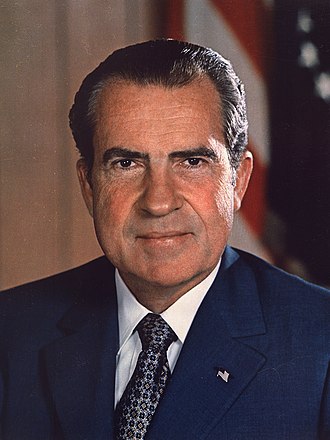
Richard M. Nixon served as the 37th President of the United States from January 1969 until his resignation in August 1974. In February 1971, he ordered the installation of a secret voice-activated taping system in the White House to preserve a historical record of his administration. Until the system's existence was revealed and dismantled in July 1973, the tapes captured Nixon directing major foreign policy initiatives, such as the opening to China, as well as his central role in the Watergate cover-up.
What Nixon talks about on the tapes
White House operations 4,718Presidential scheduling 2,225Public relations 1,784Presidential schedule 1,782Vietnam War 1,693Logistics 1,650Manolo Sanchez 1,626White House communications 1,400White House administration 1,399Presidential communication 1,243Henry Kissinger 1,191Foreign Policy 1,183
Conversations (21,010)
— Page 148 of 211President Nixon met with his personal valet, Manolo Sanchez, at the Aspen Lodge to coordinate logistics regarding the President’s upcoming schedule. The discussion focused specifically on the timing and entry arrangements for an unidentified visitor arriving through a side door. No significant policy decisions were recorded during this brief administrative exchange.
President Nixon met with his personal aide, Manolo Sanchez, at the Aspen Lodge during a stay at Camp David. The brief exchange focused on domestic logistics, including the President's upcoming schedule and the provision of refreshments. During the interaction, the two also briefly addressed the health status of a dog that had sustained an injury.
President Nixon dictates a memorandum for H.R. Haldeman reflecting on the public relations strategy of his administration and the 1972 re-election campaign. He critiques his staff’s tendency toward over-caution and scripted events, arguing that these approaches often result in dull or anticlimactic public appearances that fail to generate genuine public enthusiasm. Nixon emphasizes the need for more spontaneous engagement with the public and directs a reorganization of staff responsible for personal relations and office access to better reflect his desired image for his second term.
President Richard Nixon met with his personal valet, Manolo Sanchez, at the Aspen Lodge study at Camp David. The interaction consisted primarily of brief, routine greetings between the President and his staff member. No substantive policy discussions or significant political decisions were recorded during this segment of the conversation.
President Nixon and H. R. Haldeman coordinate the retrieval of missing briefing materials intended for the President’s upcoming meeting with South Vietnamese official Nguyen Phu Duc. Following the President's frustration regarding the missing documents, Haldeman facilitates a call to Lawrence M. Higby to locate and deliver the necessary paperwork. This brief exchange highlights the administrative oversight required to ensure the President was adequately prepared for sensitive diplomatic discussions.
President Nixon and H. R. Haldeman met at Camp David to strategize the reorganization of the White House for the second term, specifically focusing on personnel changes, cabinet appointments, and the establishment of an outside "New Majority" operation. They discussed the replacement of H. R. Haldeman’s office, the transition of roles for staff like Charles Colson and various cabinet members, and the strategic importance of managing public relations and congressional outreach. Additionally, the President provided directives regarding his schedule, the need for increased professionalism in public appearances, and the imperative to settle pending administrative decisions before his second term began.
President Nixon contacted the Camp David operator to facilitate an urgent communication with his Chief of Staff, H. R. Haldeman. This brief administrative interaction served as the necessary step to bridge the connection between the President and his top aide. No substantive policy matters were discussed during this specific exchange.
President Nixon contacted the Camp David operator to facilitate a telephone call to George H.W. Bush. The primary purpose of the conversation was to initiate communication with the Ambassador. No further substantive policy matters were discussed during this brief administrative request.
President Nixon contacted the Camp David operator to facilitate a telephone call to Charles W. Colson. This interaction served primarily as a logistical request to establish communication with a key White House aide. No substantive policy discussions occurred during this brief exchange.
President Nixon and Charles Colson discuss the final phase of staffing for the second presidential term and political strategy following the 1972 election. They review the successful appointment of Peter J. Brennan as Secretary of Labor and coordinate personnel planning for cabinet and subcabinet positions, specifically targeting Catholic, Democratic, and minority representation. Additionally, the President tasks Colson with working alongside H.R. Haldeman and John Ehrlichman to develop a strategic game plan for political operations and administration retention during an upcoming visit to Camp David.
President Nixon contacted the Camp David operator to inquire about the status of a pending phone connection. This brief interaction reflects the logistical arrangements and communication management required while the President was working from the Camp David retreat. No substantive policy matters were addressed during this exchange.
President Nixon consulted with George H.W. Bush to secure his commitment to serve as the new Chairman of the Republican National Committee (RNC). Nixon outlined a delicate strategy to replace the incumbent, Bob Dole, by framing the transition as a necessary change to a full-time chairmanship to ensure Dole's graceful exit. The President instructed Bush to coordinate closely with John Ehrlichman and H.R. Haldeman regarding the timing of the announcement and emphasized the importance of maintaining a unified front with party leadership, including Gerald Ford, to finalize the appointment.
President Nixon contacted the Camp David operator to facilitate a telephone connection with National Security Advisor Henry Kissinger. This brief administrative exchange served as the necessary logistical step to initiate a high-level policy consultation. No further substantive discussions occurred between the President and the operator during this brief communication.
President Nixon and Henry Kissinger coordinate strategy for an upcoming meeting with South Vietnamese representatives regarding the ongoing Vietnam peace negotiations. Nixon emphasizes the need for a "tough" and "brutal" stance to ensure the South Vietnamese adhere to the proposed schedule and final agreement. They discuss the potential for a future meeting between Nixon and President Thieu, ultimately deciding to resist pressure for such a summit unless it is contingent upon Thieu's guaranteed cooperation.
President Nixon and H. R. Haldeman coordinated the transition of George H. W. Bush from his role as UN Ambassador to Chairman of the Republican National Committee. The discussion focused on managing Robert Dole’s potential resistance to the leadership shift, with Nixon directing Haldeman to use a firm approach to ensure a seamless succession by the 20th of December. They also strategized the timeline for public announcements and transition periods to avoid conflicts with ongoing Middle East negotiations.
President Nixon contacted the Camp David operator to facilitate official communication. The primary purpose of the brief interaction was to place a telephone call to White House Chief of Staff H. R. Haldeman. No substantive policy matters were discussed during this brief administrative request.
President Nixon and H. R. Haldeman coordinate adjustments to the President’s daily schedule to ensure sufficient time for upcoming diplomatic and political meetings. Nixon explicitly mandates extending the duration of a meeting with South Vietnamese representatives and postpones a session with black administration officials to 5:00 p.m. for strategic optics. The call concludes with the confirmation of a brief subsequent meeting with Dr. W. Kenneth Riland.
President Nixon initiates a request to the Camp David operator to connect him with George H.W. Bush, who was serving as the United States Ambassador to the United Nations at the time. The brief exchange serves as an administrative bridge to facilitate direct communication between the President and his UN representative regarding ongoing international policy matters. No further substantive discussion occurs during this segment beyond the initiation of the call.
President Nixon spoke with the Camp David telephone operator to discuss administrative logistics while residing at the Aspen Lodge. The brief exchange primarily concerned operational connectivity and communication requirements for the President during his stay. No significant policy decisions or substantive political matters were addressed during this interaction.
President Nixon and Charles Colson met at Camp David to discuss staffing and administrative strategy following the 1972 election. They reviewed personnel decisions regarding various appointments, including the retention of Erwin Griswold and the strategic selection of individuals based on demographics such as religion, geography, and gender. Nixon directed Colson to coordinate with colleagues on building political capital in the House and establishing the framework for the administration's future organizational and foundation goals.
President Nixon consults with George H.W. Bush regarding his appointment as the new chairman of the Republican National Committee. Nixon outlines a political strategy to ease the transition by replacing the current chairman, Bob Dole, while maintaining party unity and securing consensus from figures like Gerald Ford. Nixon instructs Bush to hold a firm stance on the timing of his departure from the United Nations to ensure a clean, immediate transition into his new role following the committee's vote.
President Nixon held a brief exchange with the Camp David operator from the Aspen Lodge to address logistical or communications needs. The interaction primarily focused on routine administrative support required during the President's stay at the retreat. No significant policy decisions or substantive political developments resulted from this brief communication.
President Nixon and Henry Kissinger met at Camp David to coordinate strategy for an upcoming, high-stakes meeting, emphasizing a firm and uncompromising tone to resolve lingering political or diplomatic frustrations. The discussion focused on narrowing the agenda to essential points to ensure maximum impact and maintaining a facade of lengthy, serious negotiations to signal the end of a conflict. Nixon also directed Kissinger to stay in a private residence in Florida to avoid media scrutiny while finalizing these sensitive arrangements.
President Nixon and H. R. Haldeman coordinate the transition of George H.W. Bush from his role at the United Nations to a new position as National Chairman of the Republican National Committee. The discussion focuses on the strategic timing of this announcement to ensure a seamless transition that avoids any operational gap in party leadership. Nixon instructs Haldeman to manage the process carefully, ensuring that the official appointment coincides with the committee's actions while managing public perception.
President Nixon held a meeting at Aspen Lodge while stationed at Camp David, involving an unidentified individual and coordination with the Camp David operator. The discussion primarily centered on the President's daily schedule, including a planned session with John D. Ehrlichman. The recording remains largely unindexed due to the presence of unidentified participants and incomplete transcript records.
President Richard Nixon and H. R. Haldeman met at the Aspen Lodge at Camp David to discuss administrative matters and ongoing White House operations. As the transcript for this conversation remains undefined, the specific substantive details and directive outcomes are unavailable for historical analysis. The exchange serves as a record of high-level coordination between the President and his Chief of Staff during a period of transition in the second Nixon administration.
President Nixon consulted with an associate at Camp David regarding scheduling logistics for an upcoming meeting with Robert J. Brown and John D. Ehrlichman. The discussion focused on coordinating the timing of these appointments relative to the President's scheduled 2:00 PM departure for Washington, D.C. The participants finalized instructions to ensure Brown was properly briefed and prepared for his interaction with the administration staff.
President Nixon met with Alexander P. Butterfield to review the scheduling of upcoming meetings, specifically focusing on a discussion with Henry Kissinger. The brief conversation served to verify the availability of time slots preceding the President’s scheduled engagement with South Vietnamese representatives Nguyen Phu Duc and Tran Kim Phuong. Butterfield confirmed the timeline, ensuring the President's agenda remained organized ahead of these critical diplomatic sessions.
President Nixon met briefly with an unidentified male visitor in the Oval Office. The exchange consisted of brief pleasantries and greetings. No substantive policy discussions or administrative actions were recorded before the visitor departed.
President Nixon met with Henry Kissinger, Nguyen Phu Duc, and Tran Kim Phuong to discuss the final stages of the Vietnam peace negotiations and coordinate strategy for the upcoming agreement. Nixon emphasized the necessity of finalizing terms by December 1972 to secure Congressional support for military and economic aid, warning that failure to settle would likely lead to a legislative cutoff of funds. Nixon underscored his commitment to enforcing the agreement through resumed bombing if North Vietnam violated the ceasefire and urged the South Vietnamese leadership to present a unified, confident front to the American public and Congress.
President Nixon met with a large group of African American administration officials and staffers to discuss their roles in the administration, career advancement, and broader racial issues within the government and society. Nixon expressed his appreciation for their support and work, specifically highlighting the efforts of Robert J. Brown, while addressing the need to create more opportunities for minorities in both government and private industry. The discussion touched upon the importance of merit-based professional growth, the recruitment of young people into public service, and the President's commitment to improving representation and progress over his next term.
President Nixon and H. R. Haldeman coordinated scheduling logistics for the President's upcoming trip to Florida and Pat Nixon's attendance at the Rose Parade, while discussing various personnel and administrative matters. They reviewed potential candidates for FBI leadership, specifically debating the merits of Richard B. Ogilvie over Evelle J. Younger, and strategized on managing Robert Dole and George H.W. Bush regarding political appointments. Additionally, the pair assessed the positive public reception of Peter J. Brennan's appointment as Labor Secretary and discussed concerns raised by Alexander M. Haig Jr. regarding Henry Kissinger's psychological state and need for a vacation following the conclusion of Vietnam peace negotiations.
President Nixon contacted the White House operator to facilitate an urgent connection to Alexander M. Haig, Jr. via a secure communications channel. This brief exchange served as a logistical instruction to initiate a direct line of communication with his deputy assistant. The primary action item was the successful establishment of this secure link.
President Nixon contacted the White House operator in an attempt to reach General Alexander M. Haig, Jr. Upon learning that Haig was away from his desk, the President instructed the operator to have Haig call him back upon his return. No further substantive policy matters were discussed during this brief administrative exchange.
President Nixon and Alexander Haig coordinated an upcoming meeting involving General Robert E. Cushman, Jr. and the Joint Chiefs of Staff. The pair discussed the ongoing, difficult Vietnam peace negotiations, emphasizing the necessity of maintaining a firm stance against South Vietnamese resistance to ensure progress before the January 3 deadline. Nixon instructed Haig to monitor Henry Kissinger’s efforts during their forthcoming mission to Paris to ensure the negotiations remained on track.
President Nixon initiated a brief telephone communication through the White House operator to request an outgoing call to Charles W. Colson. The exchange serves as a logistical coordination to facilitate direct contact between the President and his special counsel. No substantive policy discussions or decisions occurred during this brief request for operator assistance.
President Nixon contacted the White House operator to request an outgoing call to H. R. Haldeman. The brief exchange was limited to the President issuing instructions for the operator to connect him with his Chief of Staff. No further substantive discussion occurred during this short communication.
President Nixon requested a telephone connection with special counsel Charles W. Colson to discuss administrative or political matters. Upon learning that Colson was currently commuting, the President authorized the operator to instruct Colson to return the call once he reached home. This brief exchange served solely as a logistical arrangement to facilitate a future private conversation between the two men.
President Nixon and H. R. Haldeman discussed coordinating First Lady Pat Nixon’s solo attendance at the Rose Parade. The President directed Haldeman to ensure the invitation from Herbert G. Klein was properly extended to facilitate her travel from Florida for the event. Haldeman committed to managing the necessary logistics to finalize the appearance.
President Nixon and Charles Colson discuss the overwhelmingly positive reception to the appointment of Peter J. Brennan as Secretary of Labor, noting his effective television appearance and the strategic appeal of his "hardhat" background to the administration's constituency. The two strategize on organizational changes within the Department of Labor, specifically targeting the removal of Bureau of Labor Statistics personnel and the potential recruitment of George D. Webster for a position within the IRS. Additionally, Colson provides an update on the final 1972 election results, expressing confidence that the President's victory margin will remain at 61.1 percent.
President Nixon contacted the White House operator to place an outgoing call to Colonel Richard T. Kennedy. The brief interaction served as an administrative request to facilitate communication between the President and the Colonel. No further substantive policy matters were discussed during this brief exchange.
President Nixon, Rose Mary Woods, and Zosimo T. Monzon met to coordinate the administrative processing of presidential correspondence and official White House mail. The discussion focused on establishing protocols for drafting, reviewing, and tracking responses to ensure letters were not duplicated or handled improperly. Additionally, the group briefly addressed logistical matters concerning the maintenance and condition of official pens used by the President.
President Nixon met with Rose Mary Woods, Stephen B. Bull, and Zosimo T. Monzon to discuss a wide range of administrative, personal, and scheduling matters. Key topics included office supply procurement, preparations for the 1973 Inauguration, holiday travel plans, and the management of family-related requests. The President also discussed foreign visitor scheduling, the selection of state gifts, and personnel issues involving members of his extended family.
President Nixon met with Ronald Ziegler, H. R. Haldeman, Henry Kissinger, and Stephen Bull to coordinate the second-term reorganization of the State Department and other federal agencies. The group discussed managing press leaks, the implementation of a 'youth movement' to bring fresh talent into government, and the strategic replacement of several senior officials, including the transition of leadership at the Republican National Committee from Robert Dole to George H. W. Bush. Additionally, the President reviewed the status of Vietnam peace negotiations with Kissinger, emphasizing the need for strict confidentiality and preparing contingency plans for responding to potential North Vietnamese treaty violations.
President Nixon met with his senior military and national security leadership, including Henry Kissinger, Melvin Laird, and the Joint Chiefs of Staff, to align the administration on the status and defense of pending Vietnam peace negotiations. The discussion focused on the current terms of the settlement agreement, the importance of maintaining public and congressional support, and the necessity of contingency planning should North Vietnam violate the terms. Nixon emphasized that the agreement was the best obtainable outcome and instructed his team to present a unified, positive front while preparing for potential retaliatory actions if the cease-fire collapsed.
President Nixon met with Stephen B. Bull to coordinate logistical adjustments to his official schedule. The discussion centered on delaying a meeting with Nguyen Phu Duc and arranging the timing for a presidential helicopter trip to Florida. Nixon provided specific instructions for Bull to relay to Henry Kissinger regarding these itinerary changes.
President Nixon met with Zosimo T. Monzon in the Oval Office to briefly discuss scheduling logistics and coordination regarding personnel located in the Roosevelt Room. The conversation focused on directing individuals, including John D. Ehrlichman, to adjust their positioning to avoid potential interference with ongoing proceedings. The exchange concluded with the participants coordinating the movement of staff members before Monzon departed the office.
President Nixon met with Stephen B. Bull to conclude a budget discussion and review his upcoming schedule, specifically regarding a meeting with Nguyen Phu Duc. Following Bull's departure, Alexander P. Butterfield entered to facilitate a meeting between the President and George P. Shultz. Nixon instructed Butterfield to delay his helicopter departure so that Shultz could accompany him for an informal walk.
President Nixon and Stephen B. Bull coordinated the scheduling of several urgent meetings, specifically involving Henry Kissinger, Nguyen Phu Duc, and Tricia Nixon Cox. Nixon instructed Bull to arrange a noon meeting with Kissinger and to determine if his daughter could visit the Oval Office immediately or receive a telephone call instead. The conversation focused on managing the President's immediate agenda and ensuring clear lines of communication with his staff and family.
President Nixon met with his aide Stephen B. Bull to coordinate his upcoming daily schedule. The primary focus of the discussion was planning an appointment with the President's daughter, Tricia Nixon Cox. No further administrative actions or policy decisions were recorded during this brief logistical consultation.
President Richard M. Nixon met with his personal valet, Manolo Sanchez, in the Oval Office. The brief interaction focused on the service of coffee. No significant policy discussions or administrative developments occurred during this exchange.
President Nixon met with his daughter, Tricia Nixon Cox, and NSC staffer Jeanne Wilson Davis to plan Tricia's upcoming private travel itinerary through the Soviet Union, the Middle East, and Europe. The President provided specific guidance on balancing public appearances with private exploration, advising against university visits to avoid potential heckling while emphasizing cultural and historical sites. Additionally, they briefly discussed staffing arrangements for First Lady Pat Nixon, with the President offering support for maintaining her current team.
President Nixon and his personal secretary, Rose Mary Woods, discussed the preparation of reading materials and folders for his upcoming travel. The President ensured that all necessary documents were secured in his briefcase for his scheduled trip, which included meetings with George P. Shultz and Henry Kissinger. They briefly coordinated the logistics of managing his paperwork while he remained occupied with official duties during his time away.
President Nixon and his personal secretary, Rose Mary Woods, discuss the logistics of procuring high-end gifts, specifically music boxes, for cabinet members and major political contributors. Nixon reviews song lists for the boxes and instructs Woods to coordinate orders while maintaining discretion regarding the recipients. The pair also considers the acquisition of high-quality writing pads during Woods' upcoming trip to New York to ensure appropriate presidential gift-giving materials.
President Nixon and Henry Kissinger discussed the ongoing negotiations regarding the Vietnam settlement agreement and the status of diplomatic communications with South Vietnamese officials, Nguyen Phu Duc and Tran Kim Phuong. Nixon emphasized his firm position that the North Vietnamese must accept the existing terms, ruling out further changes to the agreement. Furthermore, they considered the strategic necessity of a direct meeting between Nixon and President Nguyen Van Thieu to reinforce U.S. commitments regarding retaliatory action against potential cease-fire violations.
President Nixon met with Henry Kissinger, Alexander Haig, and South Vietnamese representatives Nguyen Phu Duc and Tran Kim Phuong to finalize the U.S. position on Vietnam peace negotiations. Nixon emphasized that the U.S. would not continue military or economic aid if the South Vietnamese government rejected the current settlement framework, stressing that congressional opposition made further support unsustainable. The President proposed a meeting with President Nguyen Van Thieu at Midway to provide personal assurances of U.S. retaliation against potential North Vietnamese ceasefire violations, while instructing his team to continue pressuring Saigon to accept the agreement terms.
President Nixon, Henry Kissinger, and key staff members met to discuss communication strategy and the status of ongoing peace negotiations. The discussion focused on managing public perception regarding diplomatic briefings and the potential implications of Congressional opposition to current foreign policy goals. Kissinger affirmed that the administration had achieved more success than initially projected, while the group considered the risks and tactical necessity of continuing high-level diplomatic meetings.
President Nixon and Colonel Richard T. Kennedy discuss the status of stalled Vietnam peace negotiations in Paris, following a report from Henry Kissinger regarding North Vietnamese intransigence. Nixon instructs Kennedy to relay a firm message to Kissinger: the U.S. must maintain its previously agreed-upon positions and be prepared to break off negotiations if the North Vietnamese refuse to comply. Furthermore, Nixon rejects Kissinger’s proposal for a nationally televised address to justify a potential return to intensive bombing, noting that the domestic political climate and intense press scrutiny make such a public appeal a non-viable option.
President Nixon contacted the White House operator to initiate a telephone call to his Chief of Staff, H.R. Haldeman. The brief exchange served as a routine administrative request to establish a line of communication with his senior aide. No substantive policy matters were discussed during this brief connection.
President Nixon and H. R. Haldeman discussed the stalling Vietnam peace negotiations and the potential for a diplomatic breakdown. They evaluated Henry Kissinger’s suggestion that the President deliver a televised address to rally public support for intensified military action, with both men ultimately agreeing that a television appearance was inadvisable and unlikely to be effective. Instead, Nixon decided to maintain a hard-line stance in negotiations and opted to simply escalate bombing operations if necessary, without formally announcing the shift to the public.
President Nixon contacted the White House operator to place an outgoing call to Colonel Richard T. Kennedy. The brief interaction served solely to facilitate the connection between the President and the National Security Council staffer. No further substantive discussion occurred during this exchange.
President Nixon instructed Col. Richard T. Kennedy to relay specific directives to Henry Kissinger regarding the ongoing Vietnam peace negotiations. Nixon emphasized that if the North Vietnamese remained intransigent, Kissinger should ensure the record clearly blamed them for the breakdown due to disputes over political agreements and the presence of North Vietnamese forces. Nixon decided against a televised address to the American public in the event of failure, preferring to let a significant escalation in military action, including B-52 strikes on the Hanoi-Haiphong complex, demonstrate U.S. resolve.
President Nixon instructed the White House operator to contact Colonel Richard T. Kennedy regarding a scheduling request. He directed the operator to determine when Kennedy arrived at his office and to arrange for him to report to the Executive Office Building for a meeting. This conversation served as a logistical coordination effort to facilitate a direct briefing with Kennedy.
President Nixon held a brief exchange with the White House operator to facilitate an outgoing call. This interaction served a purely administrative purpose as part of the President's routine daily communications. No substantive policy discussions or significant decisions were recorded during this brief technical connection.
President Nixon met with aide Patrick J. Buchanan to discuss the President's health and coordinate political strategy regarding recent press coverage of the 1972 campaign. They reviewed a critical New York Times article and analyzed the internal divisions within the Democratic Party. Nixon specifically instructed Buchanan to continue emphasizing the association between George McGovern and Edward M. Kennedy to prevent the latter from distancing himself from the failed campaign.
President Nixon contacted the White House operator to facilitate an urgent communication with Charles W. Colson. The primary purpose of the brief exchange was to place a telephone call to the Special Counsel to the President. No further substantive policy discussions were recorded during this brief administrative request.
President Nixon met with his staff and advisors, primarily Colonel Richard T. Kennedy and H.R. Haldeman, to assess the status of Vietnam peace negotiations following an impasse in Paris. The discussion focused on the breakdown in talks regarding North Vietnamese troop withdrawals and the potential for a resumed bombing campaign against North Vietnam. Nixon emphasized the need for a firm military and psychological response to North Vietnamese intransigence while also coordinating PR strategies to manage domestic credibility and Congressional relations. Additionally, the President issued directives for reorganizing staff and maintaining political loyalty heading into his second term.
President Nixon and Charles Colson discuss a recent Louis Harris poll regarding public sentiment toward Vietnam War settlement options. Nixon requests that Colson bring the specific polling data to his office for review. The conversation serves to facilitate immediate access to information concerning domestic reactions to ongoing peace negotiations.
President Nixon and Col. Richard T. Kennedy discuss the status of ongoing Vietnam peace negotiations following Henry Kissinger’s decision to postpone meetings in Paris. Concerned about appearing weak, Nixon emphasizes that Kissinger must avoid a 'begging' posture and considers ordering retaliatory airstrikes on North Vietnam. Nixon also instructs Kennedy to brief Vice President Agnew on the current diplomatic stalemate while ordering a 48-hour delay for both the briefing and the Vice President’s travel plans.
Tricia Nixon Cox and President Richard M. Nixon discussed travel arrangements for an upcoming trip to Europe. Addressing concerns over terrorism and hijacking, Tricia sought the President’s guidance on whether to utilize military or commercial aircraft. Nixon ultimately directed that commercial flights be used for the European portion of the travel, while granting flexibility for flights within the Soviet Union.
President Nixon contacted the White House operator to request a telephone connection with his personal aide, Stephen B. Bull. This brief administrative interaction served to facilitate direct communication with a key staff member. No further substantive policy matters were discussed during this specific call.
President Nixon held a brief, abrupt interaction with a White House operator in the Executive Office Building. The President dismissed the operator immediately, requesting that they leave the office. No further official business or substantive policy matters were conducted during this exchange.
President Nixon met with his aide, Stephen B. Bull, to review and finalize his upcoming daily schedule. The two men discussed the logistics and photo opportunities for several meetings, including sessions with Horacio Rivero regarding his credentials as ambassador to Spain and Henry O. Dormann of the National Enquirer. They also coordinated the timing for various other appointments, including a reception at Blair House and a meeting with George P. Shultz and John D. Ehrlichman.
President Nixon met with George Shultz and John Ehrlichman to discuss the administration's economic strategy and preparations for the second-term transition. The conversation focused heavily on the management of wage and price controls, inflation mitigation, and labor relations, including potential appointments to the Productivity Commission and the Commission on Industrial Peace. Additionally, the group addressed the reorganization of the Treasury Department, international trade policy, and the potential role of Peter G. Peterson as a special representative for economic affairs.
President Nixon met with his aide Stephen B. Bull to coordinate his upcoming schedule and address pending logistical decisions. The discussion primarily focused on planning for the Christmas season and arranging a time to review the President's calendar in greater detail. Nixon directed Bull to involve Lucy A. Winchester in the planning process to expedite administrative approvals.
President Nixon met with H. R. Haldeman and staff members to coordinate the details of the White House holiday schedule, including press tours, receptions, and religious services. The discussion then shifted to a strategic review of a proposal from Henry Kissinger regarding a potential televised address following the breakdown of Vietnam peace negotiations. Nixon expressed skepticism toward Kissinger’s suggested approach, fearing it would be perceived as a failure and ultimately decided to have Charles Colson and John Connally review the materials before finalizing his public response.
President Nixon met with Admiral Horacio Rivero, Jr., the new U.S. Ambassador to Spain, to provide guidance on his diplomatic objectives and assess the political future of the Spanish regime under General Francisco Franco. Nixon emphasized the importance of strengthening U.S.-Spanish relations through trade and mutual cooperation, while positioning Spain as a significant European power. The discussion also covered the transition to a post-Franco government, the necessity of maintaining a robust U.S. Sixth Fleet to ensure global stability, and the potential for Spain to serve as a diplomatic bridge between the United States and the Arab world.
President Nixon met with Henry O. Dormann and Herbert G. Klein to discuss media coverage and exchange personal gifts. The discussion touched on the circulation and content of the National Enquirer, including the involvement of Edward Nixon and potential photo features. Nixon expressed his appreciation for Dormann’s ongoing support and authorized the publication of various photographs featuring himself and his visitors.
President Nixon met with his aide Stephen B. Bull to finalize logistical details regarding an upcoming photograph session. The discussion focused on coordinating the President's schedule to accommodate a meeting with M. Harvey Taylor, Leroy S. Zimmerman, and Alexander P. Butterfield. Following these administrative arrangements, Bull departed the Oval Office.
President Nixon met with Pennsylvania political figure M. Harvey Taylor and District Attorney Leroy S. Zimmerman, accompanied by Alexander P. Butterfield, for a courtesy visit to the Oval Office. The discussion focused on Pennsylvania politics, reflections on the 1972 election results, and the exchange of gifts and presidential mementos. During the meeting, Nixon encouraged Taylor to return for future visits and touched upon Zimmerman’s potential future career path in the judiciary.
President Nixon and Stephen B. Bull met to coordinate upcoming schedule logistics, specifically focusing on an impending trip to New York. The discussion centered on arrangements for the President's barber, Milton Pitts, and the timing and location for a meeting with John B. Connally. They ultimately determined that the session with Connally should take place at the Executive Office Building.
President Nixon and Stephen B. Bull engaged in a brief, administrative exchange involving the coordination of logistics or scheduling, specifically referencing an individual named Tom. The conversation concludes with Bull acknowledging the President's instructions before departing. No major policy or political developments are recorded during this short interval.
President Nixon instructed aide Stephen B. Bull to coordinate upcoming scheduling arrangements for First Lady Pat Nixon directly with Lucy Winchester. The President emphasized the need to ensure all plans met Mrs. Nixon's approval and were integrated into the administration's broader agenda. Nixon also expressed satisfaction with a recent meeting he held with Winchester, noting that direct communication had successfully resolved outstanding administrative concerns.
President Nixon contacted the White House operator to facilitate a telephone connection with his aide, Stephen B. Bull. This routine administrative interaction served the purpose of initiating a direct communication line between the President and a member of his staff. No further substantive policy matters were addressed during this brief request.
President Nixon initiated a brief communication through the White House operator to facilitate a connection to another party. This interaction served a purely administrative function to coordinate official telephonic access. No substantive policy discussions or significant decisions occurred during this brief exchange.
President Nixon met with his aide, Stephen B. Bull, to conduct a brief check-in regarding ongoing administrative arrangements and logistical oversight. Nixon inquired about any potential issues arising within the staff's operations to ensure organizational stability. The conversation concluded with the President confirming his readiness to proceed with upcoming tasks and delegating specific follow-up actions to Bull.
President Nixon met with his valet, Manolo Sanchez, in the Old Executive Office Building to coordinate his professional schedule. The discussion focused primarily on timing the President's upcoming meeting with Charles W. Colson. The exchange also briefly involved logistical tasks related to office equipment and telephone usage.
President Nixon met with his valet, Manolo Sanchez, in the Old Executive Office Building to review the President's upcoming schedule. The discussion also touched upon an interview and a related news story. Following the consultation with Sanchez, the President placed a call to Chief of Staff H. R. Haldeman.
President Nixon met with his personal valet, Manolo Sanchez, to discuss the logistics of his upcoming daily schedule. The conversation focused on coordinating an impending meeting with Charles W. Colson and H. R. Haldeman. This brief interaction served to manage the President's internal administrative appointments for the afternoon.
President Nixon initiates a brief telephone call through the White House operator to contact his aide, Stephen B. Bull. The interaction serves solely as a logistical request to establish communication with Bull. No further substantive policy matters or official developments are discussed during this brief exchange.
President Nixon met with Charles Colson, H.R. Haldeman, and later John Connally to discuss the breakdown of Vietnam peace negotiations and the potential for a presidential television address. Nixon expressed skepticism toward Henry Kissinger’s recommendation to use a TV appearance to shift blame for the impasse onto North Vietnam and to rally public support for continued military action. The participants also consulted on administrative personnel changes for the second term, including the departures of Peter Peterson and Donald Rumsfeld, and Connally explored strategies for building a political coalition beyond the traditional Republican base.
President Nixon, H.R. Haldeman, and Charles Colson met to discuss strategies for managing press relations and addressing the current breakdown in Vietnam peace negotiations. Nixon expressed skepticism toward Henry Kissinger’s recommendation that the President make a televised address to explain the impasse, fearing it would project weakness and imply that the administration's policies were failing. Instead, the President favored maintaining a firm stance, signaling a commitment to ongoing military action, including continued bombing, to ensure an honorable peace rather than appearing to negotiate from a position of desperation.
President Nixon and Stephen B. Bull discussed the scheduling logistics for an upcoming reception involving California administration officials, ultimately confirming the start time. The President also inquired about Bull's ongoing coordination with Lucy Winchester regarding her scheduled meeting with First Lady Pat Nixon. Nixon instructed Bull to maintain his role as the primary point of contact and to manage the interpersonal dynamics of these arrangements smoothly.
President Nixon contacted the White House operator to issue a directive regarding his staff. He requested that Press Secretary Ronald L. Ziegler be summoned to the Executive Office Building for a meeting. This brief exchange served solely to facilitate the coordination of the President's schedule with a key advisor.
President Nixon met with Zosimo T. Monzon in the Old Executive Office Building for a brief discussion regarding the President's upcoming scheduling arrangements. The conversation focused on preparations for a reception involving California administration officials, including the handling of specific folder materials. No major policy decisions were recorded during this brief encounter.
President Nixon and Alexander Butterfield met briefly to coordinate administrative logistics and the President's upcoming schedule. They discussed the arrangements for a meeting with H.R. Haldeman and a reception for California administration officials. Additionally, the pair reviewed the physical placement of furniture and finalized the timing for a document requiring the President’s signature.
President Nixon contacted the White House operator to facilitate a personal call to his daughter, Tricia Nixon Cox. The brief interaction served exclusively as a procedural request to initiate this private communication. No further substantive policy matters or administrative decisions were addressed during the exchange.
President Nixon met with H. R. Haldeman to discuss the breakdown of Vietnam peace negotiations and the potential for a televised address to explain the situation to the public. They evaluated recommendations from Henry Kissinger and other advisors regarding military strategy, public relations, and the political implications of a potential impasse. The discussion also addressed second-term administrative reorganizations, including ambassadorships, and coordinated the President's upcoming schedule, which involved various meetings and social obligations.
President Nixon and his daughter, Tricia Nixon Cox, discussed logistics regarding the President’s travel plans to Blair House and Camp David, as well as upcoming family engagements. The conversation highlighted personal news that Tricia’s husband, Edward R. F. Cox, had successfully passed the bar exam. Additionally, the President noted that he would be reviewing pending diplomatic messages regarding Tricia’s upcoming travel to embassies.
President Nixon and H. R. Haldeman met to deliberate on the status of Vietnam peace negotiations and the potential resignation of Henry Kissinger. The discussion focused on evaluating internal and external perceptions regarding a possible departure by Kissinger. No final actions were finalized, but the participants weighed the strategic implications of such a resignation on the ongoing diplomatic efforts.