Nixon, Richard M. (President)
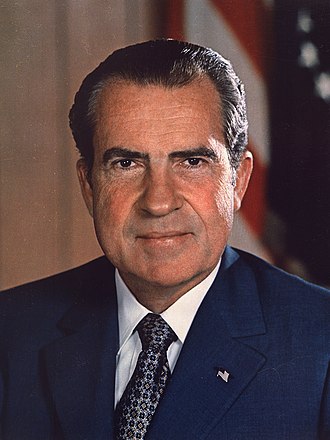
Richard M. Nixon served as the 37th President of the United States from January 1969 until his resignation in August 1974. In February 1971, he ordered the installation of a secret voice-activated taping system in the White House to preserve a historical record of his administration. Until the system's existence was revealed and dismantled in July 1973, the tapes captured Nixon directing major foreign policy initiatives, such as the opening to China, as well as his central role in the Watergate cover-up.
What Nixon talks about on the tapes
White House operations 4,718Presidential scheduling 2,225Public relations 1,784Presidential schedule 1,782Vietnam War 1,693Logistics 1,650Manolo Sanchez 1,626White House communications 1,400White House administration 1,399Presidential communication 1,243Henry Kissinger 1,191Foreign Policy 1,183
Conversations (21,010)
— Page 150 of 211President Nixon and Colonel Richard T. Kennedy discuss a communication strategy regarding ongoing Vietnam peace negotiations. Nixon approves a message for Henry Kissinger that commends his recent negotiating performance while emphasizing the critical importance of the Demilitarized Zone (DMZ) issue. The two also coordinate the arrival of Alexander Haig, scheduling a follow-up meeting at Camp David to discuss developments with Soviet Ambassador Anatoliy Dobrynin.
President Nixon and Colonel Richard T. Kennedy coordinated logistics for the arrival and scheduling of Alexander Haig, who was expected to return late that night. Nixon instructed Kennedy to ensure Haig rested upon his arrival before traveling to Camp David to meet with the President the following afternoon. This brief exchange served to finalize the itinerary for upcoming consultations regarding the administration's ongoing objectives.
President Nixon and his daughter, Julie Nixon Eisenhower, met informally at Camp David to discuss the quality of an event or performance they had recently attended. Their brief exchange focused on personal reactions to the experience and a preference for hosting future events in a major metropolitan setting. No significant policy decisions or administrative actions were recorded during this brief social encounter.
President Nixon met with his daughter, Julie Nixon Eisenhower, and Helene Drown at the Aspen Lodge in Camp David to discuss logistical arrangements for an upcoming departure. The conversation focused on coordinating the timing of their exit in relation to local weather conditions. No significant political decisions were recorded during this brief informal exchange.
President Nixon initiates a request for the White House operator to place a telephone call to Charles W. Colson. This brief communication serves purely as an administrative instruction to establish contact with his aide. No substantive policy discussions or decisions occur during this exchange.
President Nixon held a brief, five-minute meeting with an unidentified individual in his Old Executive Office Building suite. The primary focus of the discussion concerned the President's personal schedule and administrative planning. No specific actions or significant policy decisions were documented during this short engagement.
President Nixon consulted with a White House operator to facilitate an outgoing telecommunication request. This brief interaction served an administrative purpose, functioning as a logistical bridge to connect the President to an external party. No substantive policy discussions or significant political decisions occurred during this brief exchange.
President Nixon and Charles Colson discuss the political fallout from Robert S. Strauss’s election as Democratic National Committee chairman. They analyze the impact on John B. Connally’s future, specifically noting concerns that the event might provide Connally an excuse to retreat from his political transition toward the administration. Nixon directs Colson to encourage Connally to commit to a decisive shift, while also emphasizing the importance of maintaining strong support from labor leaders like George Meany and Frank Fitzsimmons.
President Nixon and Charles Colson discuss political strategy regarding labor union leadership, specifically focusing on the influence of AFL-CIO President George Meany. Nixon directs Colson to contact a target individual to exert pressure and ensure they do not align with the Democratic left. The conversation highlights the administration's concern with managing labor figures to prevent political opposition from consolidating power.
President Nixon and H. R. Haldeman met to discuss personnel changes for the second term, administrative reorganization, and strategies for managing the press and Congress. They reviewed the status of Vietnam peace negotiations, specifically focusing on the President's firm stance against North Vietnamese compromises regarding the Demilitarized Zone. The conversation also touched on the ongoing Watergate fallout and the need to maintain a strong, confident public posture while finalizing key staff appointments.
President Nixon instructed the White House operator to place an outgoing call to Soviet Ambassador Anatoliy F. Dobrynin. This brief administrative exchange served as the precursor to a diplomatic discussion between the two parties. No further substantive policy matters were addressed during this short connection.
President Nixon and Ambassador Anatoliy Dobrynin engaged in a diplomatic call to address a final sticking point in the Vietnam peace negotiations regarding the status of the Demilitarized Zone (DMZ). Nixon expressed his firm insistence on returning to previously agreed-upon language, emphasizing that this resolution was essential to removing an irritant from U.S.-Soviet relations and enabling future cooperation. Accompanied by Alexander Haig, Nixon requested that Dobrynin convey this position to Moscow and Hanoi, resulting in a decision to coordinate a follow-up meeting to finalize technical details.
Tricia Nixon Cox speaks with Mrs. Howard Cox regarding the logistics and social itinerary for her upcoming international travel. The conversation focuses on Tricia's planned visits to the Soviet Union and the United Kingdom, specifically discussing lodging proximity to the Kremlin and high-profile social engagements. Key events noted include a dinner at 10 Downing Street with Prime Minister Edward Heath and attendance at J. Paul Getty's 80th birthday celebration.
President Nixon contacted the White House operator to place a personal telephone call to Hobart D. “Hobe” Lewis. The brief interaction served exclusively as a logistical request to connect the President with Lewis. No substantive policy discussions or administrative decisions occurred during this connection.
President Nixon instructed the White House operator to place a call to Hobart D. Lewis. The operator informed the President that Lewis was currently in transit and requested that the President wait approximately ten minutes for him to arrive at his destination. Nixon acknowledged the delay, setting the stage for the operator to facilitate the connection once Lewis became available.
President Nixon held a phone conversation with Hobart D. Lewis to discuss Lewis’s recent trip to the Soviet Union and the positive impact of the President’s earlier visit on trade relations. The two men also touched on the media industry, specifically the financial struggles of Life magazine and the outlook for Reader’s Digest, as well as the future career path of David Eisenhower. Finally, Nixon discussed his plans for executive branch reorganization and expressed his intent to host Lewis and his associates for a weekend gathering once the pressures of the Vietnam negotiations subsided.
President Nixon directed the White House operator to place a telephone call to George H. W. Bush. This brief interaction served as a logistical request to initiate communication with the Ambassador. No substantive policy matters were discussed during this initial contact.
President Nixon met with H. R. Haldeman, Robert Dole, and various staff members to discuss political appointments, including the selection of George H. W. Bush as the new Republican National Committee Chairman and the departure of Robert Dole. The group also evaluated strategies for a second-term administration reorganization, emphasizing the need for loyal, creative personnel and improved administrative control over the bureaucracy. A significant portion of the discussion focused on managing the public relations fallout of the Watergate scandal and Segretti's campaign sabotage operations, with the President weighing whether to issue a statement to distance the White House from these controversies.
President Nixon, H.R. Haldeman, and George H.W. Bush discussed the strategic plan for transitioning Bush from his position as UN Ambassador to Chairman of the Republican National Committee (RNC). The group coordinated a public narrative intended to frame the appointment as a necessary move to broaden the party's base and improve coordination between national and congressional committees, while emphasizing Bush's initial reluctance to leave his diplomatic post. They finalized a plan for an announcement to be issued from the White House, clarifying that Bush would remain at the UN until the current session concluded on December 19th and confirming the President's full support for his new role.
President Nixon instructed the White House operator to facilitate a telephone call to McDill "Huck" Boyd, a newspaper publisher for the Phillipsburg Review in Kansas. The primary purpose of the brief interaction was to provide the operator with the necessary contact details to initiate this communication. No further business was discussed during this administrative exchange.
President Nixon attempted to reach Republican operative McDill “Huck” Boyd via the White House operator. Upon learning that Boyd was temporarily unavailable, the President instructed the operator to have him return the call. No substantive political or policy matters were discussed during this brief administrative exchange.
President Nixon and McDill "Huck" Boyd discussed the planned resignation of Robert J. Dole as Republican National Committee (RNC) Chairman and his replacement by George H.W. Bush. Nixon explained that the transition was a strategic move to allow Dole to focus on his Senate responsibilities and future political battles. The conversation also covered the President's vision for the "New Majority," emphasizing the need for early candidate selection and the recruitment of diverse, high-quality candidates to ensure future electoral success.
President Nixon and Alexander P. Butterfield met to review and refine the President's upcoming scheduling commitments and logistical arrangements. The discussion focused on coordinating various high-profile meetings, including appointments with business leaders and media figures, as well as managing the President's personal health checkup at Bethesda. Additionally, they addressed the timing for a meeting with Spanish-speaking administration officials regarding the second-term agenda.
President Nixon met with his personal valet, Manolo Sanchez, to discuss personal matters and logistical arrangements. The conversation focused on the schedule of Julie Nixon Eisenhower, including her walking plans, as well as the involvement of Fina Sanchez and Helene Drown. The participants also touched upon press relations and the President's personal appreciation for his staff.
President Richard Nixon met with Alexander Haig to receive updates regarding ongoing Vietnam peace negotiations, specifically focusing on the status of Henry Kissinger's efforts. The discussion centered on a critical remaining point of contention regarding the Demilitarized Zone and the potential for a compromise involving the withdrawal of North Vietnamese troops from South Vietnam. Nixon expressed concerns about the negotiation process while assessing the current diplomatic position.
President Nixon met with his longtime valet, Manolo Sanchez, to discuss scheduling logistics and personal arrangements. During the brief interaction, the President requested that Sanchez wait for further instructions regarding his upcoming activities. The conversation functioned primarily as a routine administrative check-in between the President and his personal staff.
President Nixon met with his personal aide, Manolo Sanchez, to discuss mundane personal matters within the Old Executive Office Building. The conversation primarily focused on the temperature of the workspace and the ongoing physical discomfort Nixon was experiencing due to a sore foot. No significant policy or administrative decisions were made during this brief, informal interaction.
President Nixon held a brief, informal coordination meeting with an unidentified individual in his Old Executive Office Building office. The discussion centered on logistics for arranging a follow-up meeting with a specific third party. No substantive policy matters were resolved, as the exchange focused primarily on scheduling availability.
President Nixon met with his personal valet, Manolo Sanchez, in the Old Executive Office Building for an informal discussion. The conversation reflected on the rapid passage of time and touched upon the upcoming holiday season. No major policy decisions were made during this brief, personal exchange.
President Nixon met with Alexander P. Butterfield and Alexander M. Haig, Jr. to coordinate administrative logistics for upcoming White House holiday events and to conduct a critical strategic review of Vietnam peace negotiations. The President expressed frustration with the progress of talks and explored the potential for resuming intensive bombing campaigns if North Vietnam continued to delay or reject a final settlement. Nixon and Haig also discussed the administration's tense relationship with South Vietnamese President Nguyen Van Thieu and considered a possible diplomatic mission to Saigon to secure his cooperation.
President Nixon initiates a brief telephonic communication through the White House operator to facilitate an outgoing call. The exchange serves as a logistical step to connect the President with another party, as indicated by the subsequent reference to a follow-up conversation. No substantive policy matters or decisions were discussed during this operator-assisted connection.
President Nixon consulted with the White House operator to facilitate an outgoing call. This brief interaction served an administrative purpose to connect the President to another party. No substantive policy discussions or major decisions occurred during this connection.
President Nixon and Press Secretary Ronald Ziegler reviewed daily press coverage of key administration announcements, including economic initiatives led by George Shultz and the appointments of George H.W. Bush and Robert Dole to the Republican National Committee. The discussion also covered the status of ongoing Vietnam peace negotiations in Paris following the President’s meeting with Alexander Haig, as well as upcoming staff changes at the Department of Agriculture. Finally, the President addressed personal scheduling matters and issued a firm directive to ban the Washington Post from attending any events at his private residences.
President Nixon and Press Secretary Ronald L. Ziegler held a brief meeting to discuss the handling of sensitive, undisclosed information referred to as the "Michelle thing." Nixon explicitly instructed Ziegler to maintain confidentiality and ensure the matter remained unpublicized until the outcome was certain. Additionally, Nixon emphasized the need for strict security regarding the documentation of these proceedings, insisting that the records be preserved and kept out of the reach of the press.
President Nixon instructed the White House operator to place a telephone call to his daughter, Julie Nixon Eisenhower. The brief interaction served solely as a logistical request to connect the President with his family member. No further policy or administrative matters were discussed during this brief exchange.
President Nixon held a brief meeting with an unidentified male visitor in the Old Executive Office Building. The discussion centered on an incoming telephone call from the President's daughter, Julie Nixon Eisenhower. The visitor departed shortly after the arrival of this communication.
President Nixon met with his personal valet Manolo Sanchez to address matters concerning presidential refreshments and scheduling, specifically regarding Charles W. Colson. Following Sanchez's departure, the President briefly spoke with his daughter, Julie Nixon Eisenhower, to check on personal family matters. The session concluded with the President coordinating a follow-up meeting later that evening to resolve outstanding logistical and financial arrangements.
President Nixon and his daughter, Julie Nixon Eisenhower, exchanged updates on personal matters, including the successful reception of the First Lady’s Christmas show and the President’s physical recovery from stiffness. The pair coordinated a brief meeting for later that evening to discuss Julie’s professional career and employment situation. This conversation served primarily as a check-in to confirm scheduling for their upcoming in-person consultation.
President Nixon met with an unidentified individual to discuss his upcoming schedule and personal appointments. The brief discussion addressed planned interactions with Julie Nixon Eisenhower and Helene Drown, as well as a scheduled conversation with Alexander M. Haig, Jr. No major policy decisions were recorded during this brief administrative briefing.
President Nixon met with Charles Colson, H.R. Haldeman, Alexander Haig, and Julie Nixon Eisenhower to discuss political strategy and administrative appointments for the second term. The participants analyzed the perception of the Republican Party, debated the potential for a political coalition involving John Connally, and reviewed candidate selections for key positions, specifically within the Department of Labor. Nixon emphasized the importance of ensuring high-level appointees were strategically aligned with the administration’s policy goals and internal machinery.
President Nixon and Alexander Haig discussed Henry Kissinger's report of North Vietnamese intransigence during ongoing peace negotiations in Paris. Nixon expressed concern over Kissinger's tactical threat to depart prematurely, instructing Haig to ensure that negotiations continue rather than breaking off, provided there is any possibility of a settlement. They agreed that shifting talks to normal diplomatic channels would be a mistake and decided that a resumption of bombing operations against the North would be necessary if the North Vietnamese maintained their obstructive stance.
President Nixon contacted the White House operator to place an outgoing call to Alexander M. Haig, Jr. The brief exchange served as a procedural request to facilitate a direct line of communication with his aide. No further policy or strategic matters were discussed during this brief administrative interaction.
President Nixon communicated with a White House operator to facilitate an outgoing call. This brief interaction served as a logistical step to connect the President with another party. No substantive policy discussions or significant executive decisions occurred during this brief exchange.
President Nixon and Alexander Haig discuss the emotional instability of Henry Kissinger during the ongoing, high-stakes Vietnam peace negotiations in Paris. Nixon directs Haig to join Kissinger to provide stability and act as a firm counterbalance to the North Vietnamese negotiators' tactical manipulation of Kissinger's mood. They decide to abandon a potential mission for Vice President Spiro Agnew and agree that if the talks remain stalled, Kissinger should request a recess without issuing threats before returning home.
President Nixon and Alexander Haig discuss the frustration and difficulties associated with ongoing administrative negotiations and message management. Nixon expresses a desire to move away from the current, tortuous process of dealing with outside parties who are failing to conform to established frameworks. The President indicates he will take a short recess to regroup and prepare for a more decisive approach to these challenges.
President Nixon contacted the White House operator to request a telephone connection with his Press Secretary, Ronald L. Ziegler. The brief exchange served as a procedural step to facilitate a direct communication line between the President and his senior staff member. No further policy or strategic discussions took place during this brief administrative interaction.
President Nixon and his daughter, Julie Nixon Eisenhower, discussed potential roles for Julie within the administration, including the possibility of her joining the White House staff to assist with the President's schedule and organizational flow. They also debated strategies for enhancing First Lady Pat Nixon's public profile, with Julie proposing that her mother should focus on a single, major project to build a more lasting legacy. Additionally, the participants touched upon personnel management, the potential for acquiring a private residence for the family, and the importance of maintaining the President's physical health through regular exercise.
President Nixon and Alexander Haig discussed the stalled Vietnam peace negotiations and the potential for a diplomatic breakdown with North Vietnam. The two reviewed the possibility of taking the stalled talks public, though Nixon expressed skepticism about such an approach. Nixon emphasized the need for a firm military response to North Vietnamese intransigence, suggesting an escalation of the bombing campaign should a negotiated settlement remain out of reach.
President Nixon met with his daughter, Julie Nixon Eisenhower, to discuss her potential professional role during his second term and her desire to contribute to the administration. They explored various employment options for Julie and her husband, David Eisenhower, while touching upon administrative reorganization, including the appointment of George H. W. Bush as Chairman of the Republican National Committee. The discussion also covered logistical concerns regarding White House staff and the President’s personal schedule.
President Nixon and Julie Nixon Eisenhower discuss domestic living arrangements and renovations within the White House residence. The conversation centers on the practical necessity of installing a refrigerator in the President's bedroom to provide late-night convenience and privacy, away from the custodial staff and potential intruders. They also evaluate ongoing modifications to the kitchen, dining areas, and bathroom facilities to improve the comfort and security of the First Family's private quarters.
President Nixon and Alexander Haig met to discuss escalating military pressure on North Vietnam, specifically focusing on the urgent need to reseed mines and intensify the frequency of B-52 bombing raids. Nixon expressed frustration with the progress of ongoing negotiations and emphasized his desire for a more aggressive tactical approach to gain leverage. The two concluded that the administration should prioritize consistent, nightly military strikes to force a breakthrough in the stalled peace process.
President Nixon met with Julie Nixon Eisenhower and White House aide Manolo Sanchez to discuss domestic arrangements and personal projects at the White House. The conversation focused on logistical plans for a third-floor movie projection area and the installation of a small refrigerator in the President's living quarters for refreshments. They also briefly touched on upcoming travel preparations, including Julie's interest in potential visits to the People's Republic of China, and general family matters.
President Nixon met with Manolo Sanchez and Julie Nixon Eisenhower to discuss domestic logistics and minor household improvements within the Executive Office Building and the White House. The conversation focused on the installation of storage and appliances, including a new refrigerator, alongside coordination for upcoming Christmas preparations and entertainment plans. The participants also touched upon scheduling and various administrative directives for White House staff regarding personal items and facilities.
President Nixon expressed intense frustration to Press Secretary Ronald L. Ziegler regarding the presence of Washington Post reporters at the White House Christmas tree display. Reasserting a previous ban on the newspaper's staff, the President ordered Ziegler to contact Connie Stuart to demand an explanation for the breach and to threaten her with immediate termination should such an unauthorized access occur again. Ziegler was instructed to verify the situation and report back to the President promptly.
President Nixon directs Press Secretary Ronald Ziegler to implement a total ban on Washington Post reporters and photographers within the White House, excluding only formal press conferences. Nixon insists that the restriction apply to all events, including church services and activities involving First Lady Pat Nixon, and emphasizes that the order is absolute under threat of termination. The discussion follows a report from Connie Stuart regarding the absence of a Post reporter at a recent ceremony, prompting Nixon to enforce the directive immediately.
President Nixon met with his valet, Manolo Sanchez, in the Oval Office to discuss the President's upcoming daily schedule and agenda. The brief exchange focused on administrative logistics regarding Nixon's movements for the day. No significant policy decisions were reached during this informal logistical coordination.
President Nixon met briefly with his valet, Manolo Sanchez, in the Oval Office to provide specific instructions. Sanchez acknowledged the directives given by the President before departing the room shortly thereafter. The interaction served as a routine administrative exchange between the President and his personal staff member.
President Nixon held a brief, private meeting with an unidentified individual to arrange the handling of personal items. During the encounter, the President instructed the visitor to place a specific bag inside his private bedroom. This exchange reflects the logistical management of personal belongings within the residential quarters of the White House.
President Nixon met with an unknown woman to discuss a ceremonial visit from the Mayor of Whittier, California, Blake Sanborn. The dialogue centers on the receipt of a scroll presented by the Mayor, which the President intends to acknowledge formally. The participants briefly coordinate the scheduling of this interaction and the inclusion of First Lady Pat Nixon and Alexander Haig.
President Nixon held a brief, unscheduled meeting in the Oval Office with unidentified participants to address urgent administrative or political matters. Given the brevity of the encounter and the lack of a transcript, the specific agenda remains officially unverified. The discussion likely concerned time-sensitive executive business or internal scheduling, though the absence of documentation precludes confirmation of any formal decisions.
President Nixon initiates a brief request to the White House operator to summon Press Secretary Ronald L. Ziegler to the Oval Office. This administrative instruction serves as a precursor to a scheduled meeting between the two men. No further substantive policy matters were discussed during this brief exchange.
President Nixon directs the White House operator to facilitate the arrival of unnamed individuals to his office. This brief administrative interaction serves as a logistical instruction to manage the President's immediate schedule. No broader policy matters or significant political developments are addressed during the exchange.
President Nixon and Alexander Haig evaluated the status of Vietnam peace negotiations following a critical speech by South Vietnamese President Nguyen Van Thieu, which rejected key provisions of the proposed settlement. The President expressed frustration with North Vietnamese intransigence and emphasized that the U.S. must remain firm in its resolve to secure an agreement, even if it requires pressuring Thieu to accept terms. The pair discussed potential tactical responses to a stalemate, including a possible recess in talks, the potential for a diplomatic mission by Vice President Agnew, and the eventual resumption of intensified military pressure, such as mining and bombing, should the North Vietnamese continue to withhold cooperation.
President Nixon dictated a formal letter of appreciation to Blake Sanborn, Mayor of Whittier, and Donald Kemp, President of the Whittier Chamber of Commerce. The correspondence acknowledges a congratulatory scroll signed by 5,000 residents of his hometown following his 1972 election victory. Nixon expressed that the overwhelming support from his community over the past 25 years remained a source of deep personal gratitude, noting that the scroll would be preserved for his future presidential library.
President Nixon and Press Secretary Ronald Ziegler met to coordinate public messaging regarding the administration's second-term reorganization and ongoing press relations. The discussion covered the upcoming announcement of personnel changes in the Department of Agriculture, strategies for shaping public perception of staff cuts, and the management of Christmas-related events at the White House. Additionally, they reviewed recent media coverage, specifically critiquing inaccuracies in news magazine reports concerning administrative departures and the performance of George P. Shultz in communicating economic policy.
President Nixon met with personal secretary Rose Mary Woods and aide Stephen B. Bull to address administrative matters and the management of various gifts received by the White House. The discussion covered the categorization and placement of presidential mementos, including a gold album, a watch, and other personal items designated for different presidential residences. Additionally, the participants briefly touched upon incoming correspondence, including a message from Henry Kissinger regarding Vietnam negotiations and a letter from Whittier, California.
President Nixon and H. R. Haldeman met to discuss the potential role of Julie Nixon Eisenhower within the White House during the second-term reorganization. Nixon expressed a strong desire to utilize his daughter in a capacity where she could manage public relations planning and help coordinate his and the First Lady’s schedules more effectively. The two also addressed operational concerns regarding the President’s scheduling process, specifically criticizing staff failures to handle significant symbolic events and high-level visits appropriately.
President Nixon met with his aide Stephen B. Bull to provide specific instructions regarding his upcoming schedule and administrative details. The discussion focused on managing photograph sessions, including specific requirements for the attire of a female guest, and confirming the duration of a scheduled meeting with W. Clement Stone. The brief interaction served as a logistical briefing to ensure the President's public appearances and private meetings were handled according to his preferences.
President Nixon met with W. Clement Stone, Douglas K. Kinsey, and Leonard Garment to evaluate the progress and future leadership of the National Center for Voluntary Action (NCVA). The discussion focused on revitalizing the organization through the potential involvement of George Romney, improving private sector financial support, and shifting the focus toward specific, actionable community goals. Additionally, Nixon and Stone addressed public speculation regarding a potential ambassadorship for Stone, with Nixon confirming his intent to retain the current ambassador and advising Stone to focus on his non-political volunteer initiatives.
President Nixon met with his aide Stephen B. Bull to discuss an injury to the President’s foot and the associated press coverage. Additionally, the two reviewed the President’s upcoming schedule, specifically addressing a planned meeting with J. Willard Marriott and the involvement of Dwight L. Chapin. The discussion concluded shortly thereafter as Bull departed the Oval Office.
President Nixon met with J. Willard Marriott, Jeb Stuart Magruder, and Dwight L. Chapin to discuss the organizational preparations for the 1973 presidential inauguration. The conversation included a presentation of gifts for the President, specifically a Hopi Indian doll, and a review of various commemorative items, including watches, cuff links, and presidential glassware. The participants coordinated photograph sessions and touched upon the administrative logistics and fundraising efforts associated with the upcoming inaugural events.
President Nixon met with H. R. Haldeman and Stephen B. Bull to discuss operational planning for the 1973 Inauguration, including venue logistics and the President's public appearances. The participants also reviewed second-term staff reorganization, focusing on potential roles for Julie Nixon Eisenhower and the need for stronger executive support for congressional liaison William Timmons. Additionally, they addressed the sensitive transition of Richard Helms from the CIA to an ambassadorship and expressed frustration over Henry Kissinger’s recent press interactions.
President Nixon met with Hobart D. Lewis, John H. Kauffmann, and Michael J. O'Neill to discuss their recent experiences and observations from a trip to the Soviet Union. The participants exchanged views on the stark differences between Soviet and American systems, the challenges of managing U.S.-Soviet trade and information programs, and the necessity of maintaining a realistic, self-interested foreign policy. Nixon also explored potential future professional opportunities for his son-in-law, David Eisenhower, and evaluated leadership options for the U.S. Information Agency and the Bicentennial Commission.
President Nixon met with Alexander M. Haig, Jr. to discuss the status of stalled Vietnam peace negotiations and potential military escalations. They analyzed North Vietnamese tactics, including the recent breakdown in talks and the perceived influence of Soviet and Chinese pressure on Hanoi. The President and Haig reviewed target lists for renewed bombing operations, specifically emphasizing the necessity of using B-52s and precision munitions to compel North Vietnam to reach a settlement.
President Nixon initiates a call to Speaker of the House Carl B. Albert through the White House operator. The conversation serves solely as a brief administrative request to connect with the Speaker for further discussion. No substantive policy matters or decisions were finalized during this exchange.
President Nixon met with his personal valet, Manolo Sanchez, in the Oval Office for a brief, informal encounter. The primary purpose of the meeting involved the delivery and consumption of refreshments, specifically consommé. No significant political or policy decisions were documented during this short exchange.
President Nixon and H. R. Haldeman met to discuss White House staff reorganization, upcoming inauguration ceremonies, and public relations strategy. They reviewed the logistics of the inaugural worship service—specifically balancing religious representation—and debated how to manage personnel departures, including Dwight Chapin and Alexander Butterfield, to avoid political damage. Additionally, the President expressed reluctance to issue formal statements regarding the Watergate and Segretti controversies before trial proceedings concluded, opting instead to maintain a low profile to protect his credibility.
President Nixon contacted the White House operator to place an outgoing call to General Alexander M. Haig, Jr. This brief interaction served solely as a logistical request to establish communication with Haig. No further substantive discussion occurred during this recording.
President Nixon and H. R. Haldeman discuss the management and social protocols surrounding invitations for upcoming White House Cabinet and staff dinners. Nixon expresses frustration with the perception that staff members must attend every social event to maintain their professional standing, specifically questioning the necessity of including certain advisors like Peter Flanigan. He instructs Haldeman to shift these customs to avoid the implication that attendance is mandatory for job security or status.
President Nixon met with Alexander Haig to formulate firm instructions for Henry Kissinger regarding the stalled Vietnam peace negotiations in Paris. Disturbed by North Vietnam's reneging on prior positions and the resulting delays, Nixon directed Haig to inform Kissinger that all previous understandings were void and that no further U.S. concessions would be offered. Nixon emphasized his readiness to pursue military options if a favorable settlement could not be reached, asserting that he prioritized securing the "right kind of peace" over any specific timeline.
President Nixon and John Ehrlichman met with Jewell R. LaFontant to discuss her recruitment for a high-level role in the Justice Department as part of the administration's second-term reorganization. Nixon offered LaFontant the position of Deputy Solicitor General to build her federal legal experience, explicitly framing this appointment as a stepping stone toward a future nomination to the federal judiciary. The meeting also addressed the administration's desire to appoint more minority and female judges, the strategic challenges of navigating the American Bar Association, and coordination with legal staff to facilitate her transition to Washington, D.C.
President Nixon met with his aide Stephen B. Bull to coordinate updates to his daily appointment schedule. The discussion specifically addressed the logistics of arranging meetings with Gordon C. Strachan and H. R. Haldeman. This brief exchange served to finalize the President's immediate agenda.
President Nixon met with H. R. Haldeman and Gordon C. Strachan to discuss personnel strategy and the challenges of implementing a second-term reorganization within the federal bureaucracy, specifically the United States Information Agency (USIA). Nixon emphasized the difficulty of finding staff who possess both professional competence and political loyalty, lamenting that many conservative talents remain in the private sector while liberals dominate government service. The participants evaluated the performance of Frank Shakespeare at the USIA, debating the effectiveness of reassigning versus removing career bureaucrats who were viewed as unaligned with the administration's goals.
President Nixon met with H.R. Haldeman and Gordon Strachan to discuss personnel strategies for his second term, emphasizing the need to purge disloyal bureaucrats and replace them with loyal, courageous appointees. The conversation then shifted to a meeting with Frank Shakespeare and James Keogh, where they evaluated the loyalty of State Department and USIA officials, discussed potential appointments, and lamented the perceived cultural elitism within the media and government bureaucracy. Later, Alexander Haig joined the President to review the status of Vietnam peace negotiations, with Nixon firmly insisting that options for resuming intensive bombing must remain open despite ongoing diplomatic consultations.
President Nixon and Alexander Haig discussed the status of Vietnam peace negotiations following an update from Henry Kissinger, focusing on the administration's frustration with Hanoi's delays and the need to pressure South Vietnamese President Nguyen Van Thieu. Nixon directed Haig to initiate a subtle, low-key communication with Soviet Ambassador Anatoliy Dobrynin to cancel the upcoming visit of Tricia Nixon Cox to the Soviet Union. This action was intended as a calculated diplomatic signal to the Soviets that the U.S. was preparing to resume significant military activity in Vietnam.
President Nixon contacted the White House operator to facilitate a telephone connection with his special counsel, Charles W. Colson. The call served as a routine administrative request to reach a high-level advisor. No further substantive discussion or policy decisions were recorded during this brief administrative interaction.
President Nixon instructed the White House operator to place a telephone call to Manolo Sanchez, his longtime personal valet. This brief communication served solely as a directive to initiate contact with a member of the President's personal staff. No other substantive policy or political matters were discussed during this interaction.
President Nixon consulted with the White House operator to determine the location and availability of Charles W. Colson. Upon learning that Colson was attending an event at the Motion Picture Association, the President decided against immediate contact. He ultimately opted to defer the communication until the following day.
President Nixon contacted his valet, Manolo Sanchez, to relay a request for refreshments for a guest staying in the Lincoln Room. Nixon instructed Sanchez to deliver brandy to the visitor immediately. Sanchez acknowledged the order and committed to fulfilling the request promptly.
President Nixon and Alexander Haig met to discuss the status of ongoing Vietnam peace negotiations. The conversation focused on evaluating potential compromises regarding the peace process, specifically touching upon the role and efforts of Henry Kissinger. This discussion highlights the administration's strategic deliberations aimed at resolving the conflict as the negotiations reached a critical juncture.
President Nixon held a brief meeting in the Old Executive Office Building with an unidentified male visitor. The available records contain no substantive documentation or transcript of the discussion, as the segment was restricted under a deed of gift. Consequently, no specific topics, policy decisions, or action items are available for historical analysis.
President Nixon met with his personal valet, Manolo Sanchez, in the Old Executive Office Building. The brief interaction focused on routine service, specifically the provision of coffee. No policy matters or significant administrative decisions were recorded during this segment.
President Nixon instructed the White House operator to contact General Alexander M. Haig, Jr. to arrange a meeting. The President directed that this meeting take place at his Executive Office Building workspace. This brief exchange served as a logistical coordination to facilitate an immediate consultation with his aide.
President Nixon held a brief administrative interaction with the White House operator to facilitate an outgoing call. This exchange served as a routine communication task, acting as a precursor to a more substantive discussion designated as a separate conversation. No policy decisions or significant political developments occurred during this brief request for operator assistance.
President Nixon and Alexander Haig met to discuss the status of stalled Vietnam peace negotiations and strategies for dealing with South Vietnamese President Nguyen Van Thieu's resistance to a potential bilateral US-North Vietnam settlement. The conversation focused on the tactical necessity of exerting maximum pressure on Thieu to sign an agreement, including the possibility of the US moving forward with a deal independently if South Vietnam refused. Nixon expressed significant frustration with Henry Kissinger’s public relations management and his reliance on "smiling" press appearances, while also dismissing the current limited bombing campaign as ineffective and inadequate.
President Nixon met with his valet, Manolo Sanchez, to request coffee and coordinate his upcoming schedule. During the brief interaction, the President instructed Sanchez to summon H. R. Haldeman for a meeting once he became available. The conversation served primarily as a routine administrative coordination of the President's morning agenda.
President Nixon met with an unknown individual, likely White House valet Manolo Sanchez, to facilitate the delivery of materials from H.R. Haldeman. The brief interaction served as an administrative exchange of documents or items within the Executive Office Building. No substantive policy discussions were recorded during this short encounter.
President Nixon contacted the White House operator to facilitate a personal telephone call to his daughter, Julie Nixon Eisenhower. The brief interaction served exclusively as a request to connect with her. No further policy or administrative matters were discussed during this exchange.
President Nixon met with H. R. Haldeman, Alexander Haig, and Ronald Ziegler to discuss the status of Vietnam peace negotiations, the reorganization of the White House staff for the second term, and various public relations strategies. A significant portion of the discussion focused on Henry Kissinger’s conduct and emotional state regarding the negotiations, with the President expressing frustration over Kissinger’s perceived lack of objectivity and his tendency to act outside of established policy. Additionally, they coordinated the roles of First Lady Pat Nixon's staff, including Julie Nixon Eisenhower, and reviewed plans for upcoming executive appointments and holiday receptions.
President Nixon and H. R. Haldeman met to coordinate extensive second-term personnel changes, including appointments within the State Department and the IRS, while managing political friction with the tax bar. They also discussed the President’s public relations strategy, his upcoming diplomatic schedule, and potential roles for Julie Nixon Eisenhower in the East Wing. The conversation concluded with a brief check-in with Julie Nixon Eisenhower regarding personnel transitions and family matters.