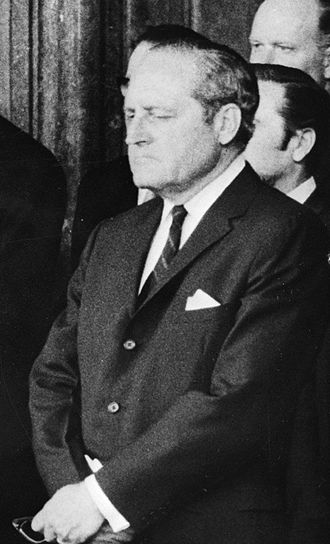
Smith, Gerard C.
Gerard C. Smith served as the Director of the Arms Control and Disarmament Agency (ACDA) throughout the Nixon taping period, a position he held from 1969 until 1973. In this capacity, he was also appointed as the chief U.S. negotiator for the Strategic Arms Limitation Talks (SALT I) with the Soviet Union, which began in 1969. His leadership during these negotiations was instrumental in achieving the Anti-Ballistic Missile (ABM) Treaty in 1972. Smith resigned from his government posts in 1973 following the conclusion of the treaty.
President Nixon met with Gerard C. Smith and General Alexander M. Haig, Jr. to facilitate a photo opportunity during the signing of a private letter containing instructions for the U.S. ambassador. The discussion touched upon the administration's public diplomatic position and the prospects for the Strategic Arms Limitation Talks (SALT). Nixon expressed skepticism regarding immediate progress, suggesting that negotiations would likely remain stalled until the conclusion of the Soviet Party Congress.
President Nixon met with Henry Kissinger, Gerard C. Smith, and a group of defense and foreign policy advisors to discuss the status of the Strategic Arms Limitation Talks (SALT). The group reviewed the progress toward an Anti-Ballistic Missile (ABM) agreement with the Soviet Union, evaluating verification concerns, technological competition, and the potential impact of troop reductions in Europe. Additionally, the President emphasized the importance of maintaining a neutral, balanced diplomatic stance toward both the Soviet Union and the People's Republic of China while exploring minor trade gestures to improve relations with the Soviets.
President Nixon met with his Cabinet and key advisors to announce a major breakthrough in Strategic Arms Limitation Talks (SALT) with the Soviet Union, culminating in a joint statement to be released simultaneously in both nations. The agreement establishes a framework to prioritize limiting anti-ballistic missile (ABM) systems while pursuing parallel measures for offensive weapons. Nixon emphasized that the breakthrough was achieved by maintaining a strong U.S. defense posture, and he urged his administration to avoid public speculation or detailed commentary that could complicate sensitive ongoing negotiations.
President Nixon met with Vice President Agnew and a bipartisan group of Congressional leaders to announce a significant diplomatic breakthrough in the Strategic Arms Limitation Talks (SALT). Nixon informed the attendees of a forthcoming joint statement with the Soviet Union pledging to focus on limiting anti-ballistic missile (ABM) systems and certain offensive strategic weapons. While some lawmakers advocated for immediate unilateral U.S. defense cuts to demonstrate good faith, the President and his advisors successfully urged the leaders to maintain existing defense programs during the negotiations to avoid losing vital bargaining leverage.
President Nixon met with his SALT delegation, including Henry Kissinger and Gerard C. Smith, to strategize for upcoming negotiations in Helsinki and manage public and bureaucratic expectations. The discussion focused on maintaining a firm stance on the 'Safeguard' ABM program while emphasizing the need to keep details confidential to prevent premature leaks and political opposition. Nixon stressed that the delegation should project strength and avoid defensiveness, ultimately aiming to finalize a comprehensive treaty that would serve American security interests.
President Nixon met with his National Security Council to discuss strategy for Mutual and Balanced Force Reduction (MBFR) negotiations with the Soviet Union, emphasizing the importance of verification and maintaining allied unity. The President and his advisors examined how to use these potential force reductions to counter domestic congressional pressure for unilateral troop withdrawals. Additionally, the group addressed the ongoing crisis surrounding the publication of the Pentagon Papers, with Nixon expressing a need to strengthen penalties for leaking classified information and to defend the executive branch's ability to maintain secure communications.
Henry A. Kissinger and Gerard C. Smith conferred to establish clearance protocols for an individual under review. Kissinger instructed Smith to adhere to standard vetting criteria, specifically directing that a single negative evaluation should not be weighted heavily when the vast majority of findings are favorable. Smith agreed to follow these instructions and proceed with the clearance accordingly.
President Nixon, Henry Kissinger, and John Connally meet to discuss diplomatic strategy regarding upcoming high-level international travel and sensitive foreign policy issues. A primary focus is planning a trip to Asia for Connally to reassure allies—specifically Indonesia, Japan, and Vietnam—about U.S. commitment in the region amid concerns regarding the President’s pending diplomatic initiatives with China. The group also addresses tactical considerations for the China summit, the importance of maintaining a strong public image, and the selection of a new U.S. representative to the United Nations.
President Nixon and members of the National Security Council met to coordinate the United States' strategy regarding ongoing arms control negotiations with the Soviet Union. The discussion centered on the complexities of Anti-Ballistic Missile (ABM) systems, the status of Safeguard and hard site defenses, and the comparative capabilities of Soviet and American submarine-launched ballistic missiles (SLBMs) and ICBMs. Participants evaluated potential congressional reactions and internal administration messaging while addressing the strategic implications of Soviet negotiating positions.
President Nixon met with Henry Kissinger, William Rogers, and Gerard C. Smith to coordinate strategy for the upcoming Strategic Arms Limitation Talks (SALT) in Vienna. The discussion focused on balancing domestic political pressures—specifically from conservative groups and Congress—against the objective of securing a verifiable arms control agreement with the Soviet Union. Nixon directed his team to treat the ABM agreement as a formal treaty while handling other components as executive agreements, and emphasized the need to project a position of strength to maintain public and legislative support.
President Nixon and members of the National Security Council met to evaluate strategic options for the ongoing Strategic Arms Limitation Talks (SALT), focusing on ABM site deployments and the potential inclusion of submarine-launched ballistic missiles (SLBMs). Nixon emphasized the political necessity of securing an agreement that prevents Soviet strategic superiority, while participants debated the relative merits of "hard-site" defense versus current safeguard proposals and the impact of these negotiations on Congressional support. The discussion underscored a shared concern regarding the erosion of U.S. bargaining leverage and established a firm directive to pursue an agreement based on the principle of strategic equivalency.
President Nixon met with Gerard Smith and Alexander Haig to discuss the strategic approach and political risks regarding the upcoming Soviet summit and potential arms control agreements. The President emphasized that while an agreement is desirable, it must be robust enough to withstand political attacks from the right wing, which he viewed as a greater threat than critics on the left. The participants assessed the implications of including submarine-launched ballistic missiles (SLBMs) in the deal and discussed tactics for managing congressional reactions and maintaining bargaining power ahead of the Moscow summit.
President Nixon met with his national security team, including Henry Kissinger, Admiral Thomas Moorer, and Secretary of Defense Melvin Laird, to receive a comprehensive military briefing on the ongoing North Vietnamese Easter Offensive. Admiral Moorer provided a detailed regional analysis of the conflict, noting that while South Vietnamese forces were facing intense pressure and heavy casualties, they were holding key positions with the crucial assistance of U.S. air power and naval support. The President emphasized that the conflict would remain difficult but reaffirmed his commitment to maintaining air support and striking military targets in North Vietnam until the offensive subsided.
President Nixon met with administration officials, including Myles J. Ambrose and Egil Krogh, Jr., primarily to discuss the administration's progress in federal narcotics enforcement and to arrange a photo opportunity. The participants reviewed charts detailing drug seizures and arrests, using a football analogy to characterize the government’s offensive position in the ongoing drug war. Following reports of federal agents being wounded in Texas, the President committed to writing letters of support to the injured personnel and emphasized the need for more effective public relations messaging regarding the federal government's efforts.
President Nixon met with H. R. Haldeman and Gordon C. Strachan to discuss personnel strategy and the challenges of implementing a second-term reorganization within the federal bureaucracy, specifically the United States Information Agency (USIA). Nixon emphasized the difficulty of finding staff who possess both professional competence and political loyalty, lamenting that many conservative talents remain in the private sector while liberals dominate government service. The participants evaluated the performance of Frank Shakespeare at the USIA, debating the effectiveness of reassigning versus removing career bureaucrats who were viewed as unaligned with the administration's goals.
President Nixon and Henry Kissinger met with Gerard C. Smith to discuss Smith's transition out of government and his future plans involving international research councils. The conversation covered the development of a collaborative executive committee focused on US, European, and Japanese relations, with a particular emphasis on the critical role of energy security and the necessity of constructively integrating Japan into Middle Eastern diplomacy. Nixon expressed his support for Smith's new endeavors and promised to lend presidential backing to the formation of the research council, while also discussing the historical context of global governance and the League of Nations.