Nixon, Richard M. (President)
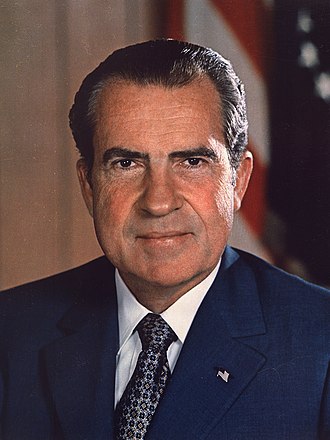
Richard M. Nixon served as the 37th President of the United States from January 1969 until his resignation in August 1974. In February 1971, he ordered the installation of a secret voice-activated taping system in the White House to preserve a historical record of his administration. Until the system's existence was revealed and dismantled in July 1973, the tapes captured Nixon directing major foreign policy initiatives, such as the opening to China, as well as his central role in the Watergate cover-up.
What Nixon talks about on the tapes
White House operations 4,718Presidential scheduling 2,225Public relations 1,784Presidential schedule 1,782Vietnam War 1,693Logistics 1,650Manolo Sanchez 1,626White House communications 1,400White House administration 1,399Presidential communication 1,243Henry Kissinger 1,191Foreign Policy 1,183
Conversations (21,010)
— Page 124 of 211President Nixon and Henry Kissinger met at Camp David to review and refine the draft of the President's upcoming acceptance speech. The discussion focused on sharpening the rhetoric regarding foreign policy, specifically addressing Vietnam troop levels, the status of draft evaders, and the necessity of maintaining bipartisan support for international allies. They made several editorial adjustments to emphasize the administration's achievements, including the cessation of drafting men for combat and the pursuit of historic foreign policy initiatives despite the complexities of the war.
President Nixon initiates a brief telephonic connection with the Camp David operator from the Aspen Lodge study. The interaction serves as a routine administrative request to facilitate communication. No substantive policy matters or strategic developments are discussed during this brief exchange.
President Nixon, Charles Colson, and Henry Kissinger discuss George McGovern's recent interview, in which the Democratic candidate advocated for a communist-dominated coalition government in South Vietnam. The participants express disbelief at McGovern's political strategy, labeling his comments as extreme and amateurish, while predicting that such rhetoric will alienate voters. Nixon encourages Colson to bolster Kissinger's morale following recent public attacks, viewing the opposition's focus on his aides as a sign of desperation.
President Nixon met with Charles Colson and Henry Kissinger at Camp David to conduct a detailed review and refinement of his upcoming acceptance speech. The discussion focused on sharpening the address's rhetoric regarding defense spending, the necessity of negotiating from a position of strength, and contrasting the administration's vision against the platform of George McGovern. Additionally, the participants deliberated on the inclusion of the 'peace dividend' concept and agreed to excise certain segments to ensure the speech maintained a strong, patriotic, and positive tone.
President Nixon initiated a brief communication with the Camp David operator to request that H.R. Haldeman be located. The President intended to notify his Chief of Staff that he was departing for the Aspen Cabin. This interaction served primarily as a logistical coordination of the President's movements while on the presidential retreat grounds.
President Nixon met with his valet, Manolo Sanchez, at Camp David to review logistical preparations for his upcoming presidential acceptance speech. The discussion focused on coordinating essential materials, including tapes and correspondence managed by Rose Mary Woods, and the involvement of Henry Kissinger. The pair also reviewed the President's personal schedule leading up to the event to ensure all necessary administrative arrangements were finalized.
President Nixon met with his personal valet, Manolo Sanchez, at the Aspen Lodge during a weekend at Camp David. The interaction served as a brief, informal encounter between the President and a member of his household staff. No substantive policy discussions or administrative decisions were recorded, as the brief segment of the conversation was designated as a personal matter.
President Nixon met with his valet, Manolo Sanchez, at Camp David to coordinate the President's daily schedule and logistical arrangements. The discussion focused primarily on the whereabouts and availability of National Security Advisor Henry Kissinger. Nixon tasked Sanchez with locating Kissinger to arrange for his presence at the presidential residence.
President Nixon communicated with a Camp David operator from the Aspen Lodge study to address logistical or telecommunications needs. As no transcript is available, the specific nature of the request remains unrecorded. This interaction serves as a routine administrative exchange typical of the president’s operations while in residence at Camp David.
President Nixon and Henry Kissinger met at Camp David to refine the closing remarks for Nixon's upcoming presidential nomination acceptance speech. They evaluated draft language, critiquing specific segments for sounding too "professorial" or "maudlin" while discussing the need to project a confident, strong, and forward-looking image. Ultimately, the two agreed on a rhetorical strategy that contrasted Nixon’s optimism against the perceived "whining" and frustration of his opponent, George McGovern.
President Nixon and H. R. Haldeman met at Camp David to deliberate on the content, tone, and emotional impact of Nixon's upcoming 1972 acceptance speech. The discussion focused on refining the closing remarks, specifically debating the effectiveness of incorporating the story of Tanya Savicheva—a symbol of wartime suffering—to evoke a sense of global peace and national unity. The pair sought a narrative that contrasted Nixon’s vision for American leadership with that of his opponent, George McGovern, ultimately aiming for a message that would inspire the public while avoiding the perceived emotional voids in drafts provided by Raymond Price and others.
President Nixon contacted the Camp David operator to facilitate communication with his Chief of Staff, H.R. Haldeman. He requested that Haldeman be located and directed to the President’s location at the Aspen Cabin. This brief exchange served solely as an administrative arrangement to initiate a direct consultation between the President and his senior aide.
President Nixon communicated with the Camp David operator to address logistical requirements during his stay at the Aspen Lodge. This brief interaction served as a functional exchange to coordinate telephonic needs or facility support services. No substantive policy matters or political discussions were recorded in this brief administrative exchange.
President Nixon met at Camp David to rehearse his upcoming acceptance speech for the Republican National Convention. He focused on refining thematic elements of the address, specifically emphasizing his vision for a new structure of global peace and the historical opportunity for American leadership. The session served as a final rhetorical preparation for his renomination campaign efforts.
President Nixon and H. R. Haldeman met to review and refine the draft of the President's upcoming acceptance speech. The discussion focused on balancing a strong defense posture with the pursuit of international peace, specifically referencing the Tanya Savicheva story and various domestic programs. They also strategized on rhetorical structure and the integration of historical references, including past speeches and religious themes, to strengthen the speech's impact.
President Richard Nixon utilized his time at Camp David to rehearse his acceptance speech for the upcoming Republican National Convention. He focused on refining thematic elements of the address, specifically emphasizing his vision for a new global structure of peace and the importance of American leadership. The session served as a final preparation to ensure the delivery aligned with his strategic messaging for the 1972 campaign.
President Nixon utilized this session to record a memorandum for the file regarding undisclosed administrative matters. Due to the withdrawal of the recorded content and the absence of a transcript, the specific substance of the memorandum remains restricted. The recording serves as an official internal documentation effort conducted by the President while at Camp David.
President Nixon initiates a brief communication via the Camp David internal telephone system to reach an operator. The interaction consists solely of an administrative request for the operator to hold the line while he manages his telephonic correspondence. No substantive policy matters or political developments are addressed during this brief exchange.
President Nixon contacted the Camp David operator to facilitate a telephone connection with his Chief of Staff, H.R. Haldeman. This brief interaction served solely as a functional administrative request to bridge communication between the President and his senior aide. No substantive policy matters or political strategies were discussed during this exchange.
President Nixon and H. R. Haldeman consulted regarding revisions to the President’s forthcoming acceptance speech. Nixon confirmed that he had implemented specific structural changes to the text and requested that Haldeman review the updated version for final approval. The two agreed to meet at Laurel Cabin to facilitate the review process.
President Nixon and H. R. Haldeman briefly conferred at the Aspen Lodge to coordinate a recent suggestion regarding administrative or scheduling arrangements. The participants discussed the implementation of a shift in strategy or personnel placement, with Nixon confirming his approval of the adjustment. The conversation served as a quick check-in to ensure alignment on logistical modifications.
President Richard M. Nixon utilized the recording system at Camp David to dictate a memorandum for the official record. This action served as a continuation of previous deliberations, documenting his personal assessment or administrative directives. No other participants were present during this brief recording session.
President Nixon met with his personal valet, Manolo Sanchez, at Camp David to coordinate administrative tasks. The discussion focused on Sanchez's work schedule and the organization and filing of the President's Dictabelt recordings. The meeting concluded with the finalization of these clerical responsibilities.
President Nixon met with his personal valet, Manolo Sanchez, at the Aspen Lodge study at Camp David to attend to administrative duties. The discussion focused primarily on the organization and filing of personal or official documents. The interaction concluded with Sanchez departing the study to carry out these requested clerical tasks.
President Nixon and Henry Kissinger discussed a proposal from Richard Goodwin to use figures like Eugene McCarthy or Edward Kennedy to communicate with the North Vietnamese regarding peace negotiations. Nixon dismissed involving Kennedy but agreed to have Kissinger potentially use McCarthy to emphasize the necessity of settling the war before the U.S. election. The two also addressed political strategies against George McGovern, refinements to the President’s upcoming acceptance speech, and their determination to reject calls for a unilateral bombing halt in Vietnam.
President Nixon met with his personal valet, Manolo Sanchez, at the Aspen Lodge during a brief period at Camp David. The interaction served as a routine check-in for the President while he awaited a scheduled telephone communication from National Security Advisor Henry Kissinger. No substantial policy discussions or administrative decisions were recorded during this brief encounter.
President Nixon and Henry Kissinger discussed the political landscape surrounding the 1972 election, including potential critiques from figures like Eugene McCarthy and the administration's strategic response. The conversation focused on refining the rhetoric for an upcoming presidential speech, with Nixon emphasizing a shift away from specific domestic policy promises in favor of broader, more cautious language. Additionally, Nixon firmly rejected the possibility of a bombing halt in Vietnam prior to the election, arguing that such a move would be strategically counterproductive and misaligned with public sentiment.
President Nixon initiated a brief telephone communication through the Camp David operator to establish contact with his National Security Advisor, Henry Kissinger. The primary purpose of this call was to facilitate an immediate discussion regarding sensitive foreign policy or national security matters. This interaction served as an administrative bridge to connect the President with his key advisor.
President Nixon communicated with the Camp David operator to coordinate scheduling with his National Security Advisor, Henry Kissinger. Upon learning that Kissinger was attending a hydrofoil ceremony, the President requested that Kissinger place a return call to him immediately upon his return. This brief administrative exchange ensured the President maintained direct contact with his advisor regarding pressing policy matters.
President Nixon initiated a brief exchange with the Camp David operator from the Aspen Lodge study. The interaction primarily involved logistical coordination regarding communication services while the President was in residence. No substantive policy matters or major administrative decisions were recorded during this brief technical check.
President Nixon consulted with the Camp David operator to facilitate a telephone connection. The brief exchange focused exclusively on establishing the communication link required for the President to conduct official business. No substantive policy discussions or major decisions were recorded during this brief administrative interaction.
President Nixon and Henry Kissinger consulted regarding the rhetoric and messaging for the President’s upcoming acceptance speech, specifically addressing the number of draft evaders in Canada and the terminology used to describe U.S. foreign relations with allies in Europe, Asia, and Latin America. They further refined the language concerning the South Vietnamese military's defensive capabilities to ensure accuracy regarding the continued necessity of U.S. air support. Additionally, Kissinger provided a brief intelligence update on Soviet and Chinese attitudes toward the Vietnam War, noting that both nations are increasingly motivated to see a settlement reached.
President Nixon and Henry Kissinger reviewed specific language for an upcoming address, focusing on political messaging and foreign policy rhetoric. The pair finalized the phrasing regarding draft evaders and debated how to characterize U.S. relationships with various global regions to ensure diplomatic inclusion. They also reached a consensus on the wording used to describe South Vietnam's military capacity to resist enemy offensives.
President Nixon met with his valet, Manolo Sanchez, at Camp David to discuss the administrative preparation of his forthcoming acceptance speech. The primary focus involved ensuring a copy of the draft was delivered to Rose Mary Woods. No other substantive policy matters were recorded during this brief encounter.
President Nixon met with his valet, Manolo Sanchez, at the Aspen Lodge in Camp David to discuss the President's personal schedule. During the brief interaction, Nixon provided specific instructions regarding the availability of H. R. Haldeman. This exchange served primarily as an administrative coordination of the President's staff movements during his retreat.
President Nixon met with his personal valet, Manolo Sanchez, at Camp David to facilitate the delivery of a specific item. The discussion primarily concerned the logistics of this delivery, which involved Rose Mary Woods. No further policy or political developments were recorded during this brief administrative interaction.
President Nixon met with his personal valet, Manolo Sanchez, to discuss logistical arrangements for an upcoming trip to Miami. The conversation focused on the President's travel itinerary and specific wardrobe requirements for the visit. During the exchange, Nixon requested that Sanchez pack a sport coat for the trip.
President Nixon held a brief, recorded session in the Old Executive Office Building with one or more unidentified individuals. Due to the lack of intelligible dialogue in the available transcript, the specific subject matter and any resulting executive decisions remain unknown. This recording serves primarily as an archival placeholder documenting the President's daily administrative activity.
President Nixon met with Marjorie P. Acker and briefly communicated with Indianapolis Mayor Richard G. Lugar to coordinate a series of administrative phone calls. The primary focus involved managing logistics for outgoing communication with various political figures, including Ronald Reagan, Edward W. Brooke, and Anne L. Armstrong. The conversation concluded with arrangements to reconnect with Mayor Lugar later in the day to facilitate further political outreach.
President Nixon instructed the White House operator to initiate a telephone call to Congressman John J. Rhodes. This brief interaction served as an administrative request to facilitate communication between the President and the Representative. No further substantive matters were recorded during this brief exchange.
President Nixon met with Senator Edward W. Brooke to discuss the messaging strategy for his upcoming acceptance speech, specifically emphasizing his administration's pursuit of peace in Vietnam. The two also reflected on the President’s recent diplomatic outreach to the People's Republic of China. No formal policy decisions were recorded during this brief exchange, which served primarily as a check-in regarding the administration's key political priorities.
President Nixon and Ronald Reagan consult on the messaging strategy for Nixon's upcoming acceptance speech. The pair specifically discusses the political positioning regarding the amnesty issue, ultimately deciding to pivot away from the topic to emphasize honoring and respecting those who served in the military. This brief exchange serves to align their views on prioritizing patriotic messaging for the remainder of the campaign.
President Nixon consulted with the White House operator to facilitate a telephone connection. The President specifically requested that the operator place a call to an unidentified individual, potentially H.R. Haldeman. This brief interaction served as an administrative necessity to initiate communication regarding internal White House business.
President Nixon and his personal secretary, Rose Mary Woods, held a brief meeting to discuss administrative logistics. The primary focus of the discussion was a request for Marjorie P. Acker to deliver a specific speech draft. The exchange served to coordinate the handling of sensitive clerical materials required by the White House staff.
President Richard M. Nixon met with counselor Anne L. Armstrong in the Executive Office Building to discuss administrative matters. The conversation was brief and classified as a personal, returnable item, resulting in no public record of the specific dialogue. Consequently, no substantive policy decisions or action items were documented for this interaction.
President Nixon and H. R. Haldeman convened in the Old Executive Office Building for a brief meeting. The vast majority of this session remains unavailable due to the withdrawal of personal or sensitive materials. Consequently, no substantive policy decisions or dialogue details are preserved in the public record for this interaction.
President Richard M. Nixon held a brief, two-minute meeting with Marjorie P. Acker in his Old Executive Office Building suite. The entire duration of this interaction was marked as a withdrawn personal or returnable item, precluding public access to the specific subject matter discussed. Consequently, there are no recorded developments or action items available for historical review.
President Nixon and H. R. Haldeman convened in the Old Executive Office Building to conduct a brief administrative consultation. The discussion focused on internal White House management and the coordination of presidential priorities during the ongoing 1972 campaign season. No specific policy decisions were recorded during this brief five-minute interaction.
President Richard M. Nixon held a brief, five-minute meeting with an unidentified individual in the Old Executive Office Building. Due to the lack of an available transcript and the unintelligible nature of the audio, the specific subject matter and any resulting decisions remain unrecorded. This encounter serves as a placeholder in the historical record of the Nixon presidency's private office consultations.
President Nixon held a brief, informal exchange with an unidentified individual regarding an individual's presence or current status. The brief dialogue centers on confirming whether a specific person is inside the office or has moved outside. No substantive policy matters or administrative decisions were documented during this short interaction.
President Nixon consulted with the White House operator to facilitate a telephone connection with Senator Barry M. Goldwater. This administrative interaction served as a logistical step to initiate a direct line of communication between the President and the Senator. No further substantive policy matters were recorded during this brief exchange.
President Nixon and H. R. Haldeman engaged in an extensive review and refinement of the President's upcoming acceptance speech. The discussion focused on balancing the tone of the address, incorporating themes of peace and national leadership, and finalizing specific anecdotes, such as the story of Tanya Savicheva, to emphasize his foreign policy achievements. Additionally, they addressed campaign finance reporting issues involving Maurice Stans and the General Accounting Office, as well as strategies for highlighting the reduction in Vietnam casualty rates compared to the previous administration.
President Nixon met with an unidentified individual in the Old Executive Office Building to review materials intended for his briefcase. The discussion focused on the preparation and selection of specific documentation for the President's personal use. Due to the withdrawal of personal items from the record, the precise nature of the briefing remains undocumented.
President Nixon consulted with an unidentified individual regarding specific numerical data required for an upcoming presidential speech. After confirming that the necessary figures had been successfully obtained, the President opted to cancel a planned call to National Security Advisor Henry Kissinger. This exchange reflects the logistical preparation involved in the administration's strategic communication efforts.
President Nixon met with his personal secretary, Rose Mary Woods, to discuss matters pertaining to his administrative schedule and daily operations. The brief interaction focused on logistical coordination and the management of the President's upcoming appointments. No significant policy decisions were recorded during this exchange, which served primarily to facilitate the clerical workflow of the White House.
President Nixon met with his personal valet, Manolo Sanchez, to discuss the location and retrieval of his briefcase. The President directed Sanchez to coordinate with Rose Mary Woods to ensure the briefcase was brought to his office immediately. This interaction focused on securing essential materials for the President's ongoing work.
President Nixon and H. R. Haldeman met in the Old Executive Office Building to discuss administrative matters and potential staffing adjustments. The conversation focused on internal White House management and high-level personnel concerns. Due to the lack of an available transcript and the presence of a withdrawn segment, the specific directives resulting from this discussion remain classified or inaccessible.
President Nixon and his valet, Manolo Sanchez, discuss logistical arrangements regarding the transportation of the President’s dogs. The conversation focuses on the complexities of air travel to Florida and Chicago, with Nixon deciding that the dogs will accompany Sanchez to Florida rather than traveling to Chicago. The exchange concludes with a resolution on the pets' travel itinerary to avoid complications associated with the flight arrangements.
President Nixon met with his aide, Stephen B. Bull, to coordinate logistics for an upcoming event. The two reviewed the contents of the President’s briefcase, which included his acceptance speech and event tickets. This brief discussion served to ensure that the necessary documentation and materials were prepared for the President's scheduled appearance.
President Nixon and H.R. Haldeman met to discuss strategies for the upcoming presidential acceptance speech, focusing on contrasting Nixon's platform with George McGovern's national defense positions. The participants evaluated the use of teleprompters in political delivery, analyzing McGovern’s technique compared to Nixon’s, while also processing a backlog of legislative bills. Additionally, the President reviewed the visual impact of wearing flag lapel pins during television appearances, ultimately deciding against their use due to visibility concerns.
President Nixon utilized this session in the Oval Office to dictate a memorandum for the official record. The recording primarily consists of personal reflections or administrative documentation rather than a collaborative discussion. Following a brief period of withdrawn content, the President concluded the entry, serving to preserve his perspective on contemporary executive matters.
President Nixon met with Henry Kissinger, William Rogers, Alexander Haig, and other advisors to coordinate the administration’s response to the terrorist murder of Israeli athletes at the Munich Olympics. The discussion focused on balancing a display of international concern and U.S. empathy with the need to avoid politicizing the games or creating a precedent for national mourning that could be exploited. Nixon decided against a formal national day of mourning but agreed to monitor the situation closely, coordinate with Israeli officials, and seek potential international action against states that harbor terrorist organizations through the UN Security Council.
President Nixon met briefly with an unidentified woman in the Oval Office to discuss the scheduling of National Security Advisor Henry A. Kissinger. This brief encounter lasted less than five minutes and concluded with the woman departing the office. No further details regarding specific logistical arrangements or policy implications are available from the recording.
President Nixon utilized this short Oval Office session to listen to a dictabelt recording. The meeting functioned as a period of private administrative review. Due to the withdrawal of the recorded material, no substantive policy discussions or specific action items were captured for the historical record.
President Nixon met with Henry Kissinger, H.R. Haldeman, and other staff to coordinate the administration's response to the murders of Israeli athletes at the Munich Olympics, prioritizing public diplomacy and private US support for Israel. The participants also strategized on the 1972 presidential campaign, focusing on delegating attacks against George McGovern to surrogates while emphasizing positive administration accomplishments. Finally, the group discussed ongoing foreign policy objectives, including Kissinger’s upcoming trip to Moscow and potential Vietnam peace negotiation tactics to ensure favorable optics for the election.
President Nixon consulted with the White House operator to facilitate a telephonic connection with Secretary of Defense Melvin R. Laird. This administrative interaction served solely to initiate official communication between the President and the head of the Department of Defense. No further substantive policy matters were discussed during this brief exchange.
President Nixon utilized time in his Executive Office Building office to dictate memoranda before requesting that the White House operator place a return call to Secretary of Defense Melvin R. Laird. The interaction largely focused on administrative tasks and executive communication. Following the brief telephone connection, the President resumed his dictation process.
President Nixon met with Alexander P. Butterfield to coordinate logistical details regarding a forthcoming meeting with John B. Connally. The discussion focused on scheduling the session for the Oval Office and ensuring H.R. Haldeman’s attendance. This brief exchange served to align the President's calendar with his key advisors.
President Nixon utilized this meeting to dictate a memorandum to an unidentified staff member. While the specific details of the recording remain unintelligible due to a lack of transcript, the session served as an administrative task to capture official presidential directives. This interaction highlights the President's reliance on dictated correspondence for managing executive communications within the Old Executive Office Building.
President Nixon met with an unidentified individual in the Old Executive Office Building to discuss administrative or political matters. Due to the unintelligible nature of the recording and the absence of a transcript, the specific substance of the dialogue remains unpreserved. Consequently, no definitive policy decisions or historical action items can be attributed to this exchange.
President Nixon held an undocumented meeting in the Old Executive Office Building with unidentified individuals to discuss matters that remain obscured due to the lack of an available transcript. Given the absence of official records or audio documentation of the dialogue, the specific substance of the exchange, any policy decisions reached, or strategic action items remain unknown to historical researchers. This recording serves as a placeholder in the White House taping system, representing an uncharacterized interaction during the President's tenure.
President Nixon and Charles Colson met to discuss political strategy and media relations, focusing on negative coverage from journalists such as Max Frankel and the perceived philosophical leanings of the New York Times. The discussion also addressed political maneuvering regarding R. Sargent Shriver and George McGovern. Additionally, they reviewed intelligence concerning North Vietnamese efforts to support guerrilla operations and hijacking activities during the ongoing conflict in Vietnam.
President Nixon and Henry Kissinger discussed a range of foreign policy and administrative issues, focusing on the U.S. approach to the recent murder of Israeli athletes at the Munich Olympics and the resulting diplomatic tensions. They coordinated strategy for Kissinger’s upcoming trip to Moscow, aiming to secure agreements on trade and security issues while ensuring the President receives credit for diplomatic breakthroughs. Additionally, the pair engaged in preliminary post-election planning, emphasizing the President's desire to overhaul personnel in the State Department and other key agencies to ensure greater loyalty and alignment with his administration's goals.
President Nixon met with H.R. Haldeman, John Connally, and other staff members to discuss political messaging and administrative strategy ahead of the 1972 election. The group coordinated the President's upcoming speech to the International Monetary Fund and formulated a specific rebuttal to George McGovern's tax proposals by emphasizing the administration's own record of tax relief. Additionally, the President discussed potentially recruiting Eugene McCarthy for a federal role and reviewed the political benefits of ongoing Soviet and Japanese grain and trade deals.
President Nixon met with H.R. Haldeman and John Connally to discuss political strategy, campaign media coverage, and administrative matters. They reviewed a sensitive political intelligence report regarding a potential issue in Fort Wayne, with Nixon emphasizing the need for discretion and strict containment of the information. Additionally, the President discussed his desire for a concise daily political news summary and agreed with Connally’s assessment that the administration should avoid outlining specific second-term programs to prevent providing political opponents with targets to attack.
President Nixon met with his aide Stephen B. Bull in the Oval Office for a brief, early-morning administrative check-in. The discussion primarily served as a logistical coordination session to organize the President's schedule and immediate tasks for the day. No specific policy decisions were recorded during this short exchange, as the session concluded with the President departing shortly thereafter.
President Nixon and John Ehrlichman met to coordinate political strategy, focusing primarily on debunking the budget proposals of Democratic challenger George McGovern. They discussed refining arguments regarding McGovern's welfare plans and revenue gaps while also strategizing on how to dismiss a civil suit brought by John Gardner and Common Cause. Additionally, the pair reviewed the administration's response to the Munich Olympic tragedy and aligned their messaging on economic policy to deflect criticism regarding property taxes.
President Nixon met with Vice President Agnew and Republican Congressional leaders to coordinate legislative strategy ahead of the upcoming election, specifically focusing on the status of pending bills and the management of the Congressional schedule. Key priorities included securing a federal spending ceiling, advancing revenue sharing, and emphasizing anti-busing legislation as a must-pass measure to counter Democratic-led policies. The President urged the leadership to maintain a unified front on fiscal restraint, framing opposition to Republican economic proposals as reckless and warning that Democrats should bear the political cost for failing to curb government spending.
Senator Peter H. Dominick and Thomas C. Korologos met with President Nixon to present a commemorative gift from Nancy Dominick and discuss political strategy. The conversation emphasized the importance of leveraging the Senator’s extensive campaign experience to benefit the administration’s electoral goals. The session concluded with a brief photograph opportunity facilitated by Oliver F. Atkins.
President Nixon held an undocumented meeting with unidentified individuals in the Cabinet Room to address logistical and administrative preparations for an upcoming event or briefing. The discussion focused on room setup requirements, specifically addressing lighting and the scheduling of meeting arrivals. Due to the lack of a transcript, the precise nature of the meeting’s agenda and any subsequent action items remain historical unknowns.
President Nixon and H. R. Haldeman discussed logistics for a memorial service following the terrorist attack on Israeli athletes at the Munich Olympic Games. They coordinated the President’s attendance at a planned service, specifically addressing the timing and location requirements. The discussion focused on finalizing arrangements for a Catholic mass to be held at the U.S. Capitol.
President Nixon met with H.R. Haldeman and John Ehrlichman to discuss several political and administrative matters, including the handling of a recent terrorist attack at the Munich Olympics and public reaction to potential presidential appearances at related interfaith services. The group addressed strategies for undermining the organization Common Cause through tax investigations and political pressure. Additionally, Nixon directed the administration to provide Secret Service protection for Senator Edward Kennedy, while simultaneously tasking his aides with ensuring the detail gathered intelligence on Kennedy’s personal conduct and travel habits.
President Nixon met with his personal aide, Stephen B. Bull, to review the President's upcoming daily schedule. The primary focus of the brief discussion was a scheduled meeting with Treasury Secretary George P. Shultz. No further substantive policy matters were recorded during this brief administrative check-in.
President Nixon met with George Shultz, John Ehrlichman, and others to discuss international economic policy ahead of an upcoming International Monetary Fund (IMF) meeting. Shultz presented a systematic plan for currency convertibility and reserve management, which Nixon approved for use in his upcoming IMF address. The conversation also covered the potential for wage and price control adjustments following the 1972 election and finalized the decision to provide Secret Service protection for Senator Edward M. Kennedy based on specific threats.
President Nixon met with representatives of the International Conference of Police Associations, including Edward J. Kiernan and Egil Krogh, to discuss the administration's support for law enforcement. The conversation focused on the need for greater public respect for police officers, the impact of police review boards, and concerns regarding legal protections for officers in the line of duty. The meeting concluded with an exchange of presidential gifts as a gesture of goodwill toward the organization.
President Nixon met with his aide Stephen B. Bull in the Oval Office to discuss administrative logistics and the President's daily schedule. The brief interaction focused on coordinating upcoming appointments and managing the President’s time. No major policy decisions were recorded during this session.
President Nixon met with his personal valet, Manolo Sanchez, in the Oval Office to coordinate logistics for the President's upcoming activities. The discussion focused primarily on managing the President's schedule and his movements to and from the Executive Office Building. No significant policy decisions were recorded during this brief administrative exchange.
President Nixon met with H. R. Haldeman and later Ronald L. Ziegler to discuss campaign strategy, press relations, and upcoming economic messaging. The President expressed frustration with the administration's communication failures regarding tax policy, specifically the Value-Added Tax (VAT), and directed his staff to clarify that there would be no tax increases in his second term. Additionally, they reviewed recent polling data on the Vietnam War—which showed strengthening support for Nixon’s policies over George McGovern’s—and discussed how to frame upcoming press conferences to pivot toward attacking McGovern’s economic proposals.
President Nixon met with his personal valet, Manolo Sanchez, in the Old Executive Office Building. Due to the lack of a transcript and the existence of a withdrawn segment, the specific substance of their interaction remains unavailable for analysis. The meeting appears to be a private engagement between the President and a member of his domestic staff.
President Richard Nixon met with his personal valet, Manolo Sanchez, in his office at the Old Executive Office Building. The brief interaction consisted of a short, personal exchange, as the vast majority of the recording was designated as a withdrawn personal item. No substantive policy discussions or significant political developments were documented in the surviving record of this encounter.
President Nixon met with his personal valet, Manolo Sanchez, in the Old Executive Office Building to discuss administrative details regarding the President's daily schedule. The conversation focused primarily on coordinating an upcoming meeting with Charles W. Colson. No further significant policy developments were recorded during this brief administrative encounter.
President Nixon and Charles Colson met to discuss strategies for managing public relations and campaign messaging in light of recent international and domestic developments. The conversation focused on mitigating the political impact of negative news stories surrounding John B. Connally and leveraging the ongoing Middle East conflict—specifically the aftermath of the Munich Olympic attack—to influence voter sentiment. Nixon directed Colson to organize a coordinated defense of Connally by key allies and underscored the importance of suppressing unfavorable press coverage to maintain political momentum.
President Nixon met with his economic advisors Arthur Burns and George Shultz, later joined by John Ehrlichman, to deliberate on fiscal policy and political messaging during the 1972 election season. The discussion centered on establishing a federal spending ceiling, managing the national debt, and formulating a strategy to counter Democratic candidate George McGovern's tax proposals. Nixon and his team specifically sought to differentiate their economic stance from their opponent by framing their own initiatives as "tax reform" while avoiding any perception of a general tax increase.
President Nixon, Stephen B. Bull, and John D. Ehrlichman met to coordinate the President's upcoming interactions with Republican candidates. The discussion focused on managing political messaging, specifically regarding the sensitive issue of public housing funding. Nixon decided to adopt a non-committal public stance on the topic to avoid potential controversy during his meetings with GOP congressional and gubernatorial candidates.
President Nixon hosted a group of Republican candidates and officials for a photograph session, followed by a policy discussion with key economic advisors including George P. Shultz, Arthur F. Burns, and John D. Ehrlichman. The latter portion of the meeting focused on 1972 presidential campaign strategy, specifically addressing George McGovern’s recent public statements and potential outreach to George Meany. Participants also reviewed proposals regarding tax reform and broader economic policy in the context of the upcoming election.
President Nixon met with George Shultz, Arthur Burns, and John Ehrlichman to discuss economic strategy, focusing on tax reform and property tax relief. The group evaluated the political risks of pursuing tax changes before the election, debating how to frame their proposals without being perceived as increasing taxes. Additionally, the President and H. R. Haldeman discussed administrative logistics, including the potential for a cruise on the Sequoia to discuss strategy and the implementation of Secret Service protection for Senator Edward Kennedy.
President Nixon and H.R. Haldeman met to discuss ongoing political crises, including the Watergate investigation, the fallout from the Soviet grain deal, and the management of their 1972 reelection campaign. Nixon instructed Haldeman to develop a strategy for discrediting political opponents and hostile media figures, specifically tasking Charles Colson with building a loyalist 'Nixon-Washington establishment' after the election. The conversation also covered personnel shifts within the Executive Office, the management of Cabinet meetings, and the potential political impact of the murder of Israeli athletes at the Munich Olympics.
President Nixon and Stephen B. Bull reviewed the President's upcoming daily schedule, focusing on coordination for meetings with General Marader Panggabean, Henry Kissinger, and Maurice Stans. The discussion emphasized logistical planning for a campaign tour of the Committee to Reelect the President (CRP) headquarters, including the management of press coverage and internal communication between Clark MacGregor and H.R. Haldeman. The session concluded with final arrangements regarding the President's departure for Camp David.
President Nixon met with Henry Kissinger and General Marader Panggabean of Indonesia to reinforce the United States' commitment to Indonesian security and military strength in Southeast Asia. Nixon identified Indonesia as a critical strategic partner against communist expansion and promised continued support, noting that formalizing specific military aid requests should be deferred until after the 1972 election to avoid political controversy in Congress. The meeting included a ceremonial photograph session and the exchange of presidential gifts, underscoring the personal and diplomatic ties between the two nations.
President Nixon met with his aide Stephen B. Bull to review his upcoming daily schedule. The brief discussion focused on logistical arrangements for an afternoon meeting involving Myles J. Ambrose, Egil Krogh, and legal counsel. Following the coordination of these appointments, the two departed the Oval Office to attend to the President's scheduled engagements.