Nixon, Richard M. (President)
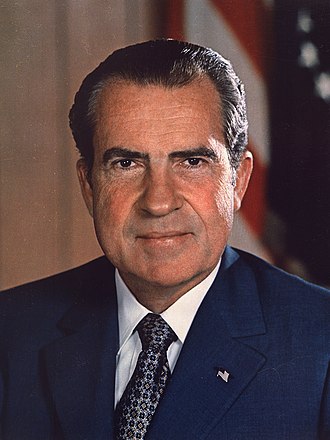
Richard M. Nixon served as the 37th President of the United States from January 1969 until his resignation in August 1974. In February 1971, he ordered the installation of a secret voice-activated taping system in the White House to preserve a historical record of his administration. Until the system's existence was revealed and dismantled in July 1973, the tapes captured Nixon directing major foreign policy initiatives, such as the opening to China, as well as his central role in the Watergate cover-up.
What Nixon talks about on the tapes
White House operations 4,718Presidential scheduling 2,225Public relations 1,784Presidential schedule 1,782Vietnam War 1,693Logistics 1,650Manolo Sanchez 1,626White House communications 1,400White House administration 1,399Presidential communication 1,243Henry Kissinger 1,191Foreign Policy 1,183
Conversations (21,010)
— Page 125 of 211President Nixon met with a large group of young attorneys participating in the Office of Drug Abuse Law Enforcement (ODALE) program to review progress in federal drug prosecutions and discuss strategies for combating narcotics distribution. The discussion focused on the challenges posed by lenient sentencing, the importance of maintaining pressure on heroin traffickers, and the need to align federal and state judicial attitudes with the administration's tough stance on law enforcement. Nixon explicitly directed the attorneys to track judicial leniency, expressed support for reinstated mandatory sentencing, and encouraged the attendees to continue their high-intensity efforts despite the difficult and often unglamorous nature of their work.
President Nixon met with his aide, Stephen B. Bull, to coordinate logistical details regarding a scheduled visit with Charles R. Jonas of Charlotte, North Carolina. The conversation focused on ensuring the President appeared presentable for the upcoming meeting following his time at the Carolina Center. The discussion served as a brief administrative check to maintain proper appearances before the scheduled engagement.
President Nixon and Stephen B. Bull met to finalize logistical arrangements for an upcoming public event involving several Congressmen and Senators. The discussion centered on a planned outdoor walking tour, ensuring the inclusion of photographer Oliver F. Atkins to document the proceedings. Bull received explicit instructions regarding the sequence and flow of the event to ensure the photography session proceeded as scheduled.
President Nixon and Rose Mary Woods discussed the political implications of providing Secret Service protection to Senator Edward M. Kennedy. The conversation centered on the visibility of such security details, with Woods analyzing how Kennedy’s status might draw more public attention than Democratic opponent George McGovern. Stephen B. Bull joined briefly to coordinate the President's upcoming schedule with various senators.
President Nixon met with Mark I. Goode to coordinate the logistical details for an upcoming promotional filming session. Goode outlined specific movements and blocking for the President, including interactions with Senators John G. Tower and Howard H. Baker, Jr. The President approved the choreography while emphasizing the need to keep the total filming duration strictly limited to approximately five minutes.
President Nixon met with Senators John Tower and Howard Baker, William Timmons, and photographer Ollie Atkins to discuss 1972 campaign strategies and a photograph session. The participants analyzed the political landscape in Tennessee, focusing on local congressional candidates and polling data regarding George McGovern. Nixon emphasized that the Vietnam War remained a potent campaign issue that would work to his advantage if framed effectively against Democratic opponents.
President Nixon met with his aide, Stephen B. Bull, to review and finalize the details of his upcoming daily schedule. The primary focus of the discussion concerned meetings with National Security Advisor Henry Kissinger and Representative Robert L. F. Sikes. The exchange concluded with plans for a formal photograph with Representative Sikes.
President Richard Nixon met with his personal valet, Manolo Sanchez, in the Oval Office for a brief, five-minute encounter. The conversation consisted of personal matters, as indicated by the withdrawal of the discussion from the public record for being of a personal, returnable nature. No substantive policy matters or administrative decisions were documented during this short meeting.
President Nixon and Henry Kissinger met to coordinate foreign policy strategies and political messaging leading up to the 1972 election. They discussed the administration's response to the Munich Olympic massacre, secret negotiations with Egypt, and the management of a proposed bipartisan delegation to the People's Republic of China. Additionally, the two finalized plans for upcoming Soviet relations, including high-level visits by Andrei Gromyko, prospective trade agreements, and the timing of announcements for SALT II and other diplomatic initiatives to maximize domestic political impact.
President Nixon met with his aide, Stephen B. Bull, to discuss updates regarding the President’s official schedule. The primary focus of the brief conversation concerned logistical arrangements for an upcoming engagement involving Representative Robert L.F. Sikes and his wife. No major policy decisions were recorded during this exchange.
President Nixon met with Representative Robert L.F. Sikes and his wife to discuss the political climate of the 1972 campaign and the importance of maintaining a strong national defense. Sikes expressed his support for Nixon’s policies, particularly regarding defense spending, while criticizing the platform of Democratic challenger George McGovern as potentially damaging to U.S. global standing. The brief meeting also included a photo opportunity, the presentation of presidential gifts, and casual conversation regarding White House history and the administration’s views on wealth distribution.
President Nixon met with Alexander P. Butterfield to discuss adjustments to the President's upcoming schedule. The conversation focused on coordinating logistics and commitments for the two-week period following the meeting. No major policy decisions were reached, as the discussion remained centered on administrative oversight of the President’s calendar.
President Nixon met with an unknown woman in the Oval Office to briefly discuss the schedule of domestic policy advisor John D. Ehrlichman. The conversation appears to be a formal or routine interaction regarding administrative arrangements. No major policy decisions or significant developments were recorded during this brief encounter.
President Nixon and John Ehrlichman met to coordinate political strategy ahead of the 1972 election, focusing on tax policy reform, the potential veto of a water pollution bill, and the administration's response to the Watergate scandal. Nixon emphasized a proactive, offensive campaign strategy—advocated by aides like Charles Colson and Melvin Laird—that prioritizes attacking political opponents over defensive postures. Additionally, the President and Ehrlichman discussed gathering damaging financial information on Lawrence O'Brien and McGovern campaign associates to neutralize political pressure.
President Nixon met with his personal valet, Manolo Sanchez, in his Old Executive Office Building workspace. The interaction lasted for less than a minute and was ultimately designated as a personal returnable item. Due to the withdrawal of the audio content, there is no substantive record of topics or decisions made during the encounter.
President Nixon met with his personal aide, Manolo Sanchez, to organize materials and documentation within the Executive Office Building. During the brief interaction, the President provided specific instructions regarding the arrangement of files, including those related to a blockade in Burma. The exchange focused primarily on administrative logistics and the management of the President's immediate workspace.
President Nixon consulted with the White House operator to facilitate a telephone connection. The primary purpose of the brief interaction was to request a call to Stephen B. Bull, a personal aide to the President. No further policy or administrative matters were addressed during this exchange.
President Nixon and John Ehrlichman briefly coordinate upcoming scheduling logistics following a meeting regarding drug abuse law enforcement. The discussion focuses on arranging a follow-up appointment with Egil Krogh Jr. to further examine specific proposals developed during the earlier session. Nixon explicitly instructs Ehrlichman to keep the subsequent meeting with Charles Colson efficient and brief.
President Nixon and Charles Colson met to discuss campaign strategy and political messaging for the upcoming 1972 election. They reviewed polling data, economic issues, and strategies to counter George McGovern, while also addressing ongoing concerns regarding Watergate and the Vietnam War. A key outcome included the President instructing his speechwriters to develop more effective, aggressive responses to political attacks and allegations of a 'cover-up.'
President Nixon met with John Ehrlichman and Egil Krogh to strategize on a public relations campaign aimed at addressing national concerns over crime, drug abuse, and judicial leniency. Nixon proposed a radio address to explicitly criticize "soft-headed" judges, prosecutors, and probation officers who he felt were undermining law enforcement efforts despite legislative and financial support from the administration. The participants discussed drafting this statement to mobilize public opinion, and also engaged in a brief, wide-ranging conversation about the 1972 Munich Olympic Games and athletic performance.
President Nixon and H.R. Haldeman briefly conferred to coordinate the President's upcoming schedule. The primary focus of the discussion was the planning and logistics for an impending meeting with Maurice H. Stans. No further policy decisions were recorded during this brief administrative exchange.
President Nixon met with his personal secretary, Rose Mary Woods, to discuss the details of a letter intended for John D. Ehrlichman's son regarding law school. During the brief consultation, the President referenced his own experience graduating from law school in 1935 as a point of reflection for the correspondence. The conversation served to coordinate the drafting and content of this personal communication.
President Nixon met with H. R. Haldeman and Maurice Stans to evaluate the 1972 re-election campaign's status, discussing polling data, fundraising, and strategic responses to George McGovern. The participants reviewed campaign finance regulations, media advertising efforts, and the political impact of the Watergate scandal on the Washington establishment. Additionally, they coordinated the President's upcoming schedule, including the production of campaign-related audio recordings and outreach to business and labor leaders.
President Richard M. Nixon met with his personal aide Stephen B. Bull in the Cabinet Room to address administrative or logistical matters. Due to the lack of an available transcript and the unintelligible nature of the audio, the specific details of their discussion remain unknown. This brief exchange appears to be a routine interaction within the Executive Office, though its exact substance cannot be confirmed.
President Richard Nixon met with his daughter, Julie Nixon Eisenhower, at the Aspen Lodge at Camp David. The interaction served as a private, personal visit between family members during a presidential retreat. No policy matters or administrative decisions were recorded, as the brief segment of the conversation was designated as a personal, returnable item.
President Richard Nixon met with First Lady Pat Nixon and their daughter Julie Nixon Eisenhower at the Aspen Lodge in Camp David for a brief period of personal time. Due to the withdrawal of the primary segment of this recording under the category of personal material, the substantive details of their discussion remain restricted. The interaction reflects a private family gathering during the President’s stay at the presidential retreat.
President Nixon contacted the Camp David operator to facilitate an urgent telephone connection with Charles W. Colson. The exchange served as a logistical request to initiate a direct conversation between the President and his special counsel. No substantive policy matters were discussed during this brief administrative interaction.
President Nixon communicated with a Camp David operator from the Aspen Lodge study to address routine logistical or telecommunications needs. The exchange served as a brief administrative interaction regarding the operational status of the White House internal communication systems. No policy decisions or significant political developments resulted from this brief contact.
President Nixon and Charles Colson discuss campaign strategies, specifically emphasizing the necessity for Cabinet members and the administration to proactively attack George McGovern's positions rather than defending against media criticism. The conversation touches upon the political impact of the grain deal, the perceived shift in atmosphere on university campuses, and the potential electoral benefit of highlighting controversies surrounding black athletes at the Olympics. Additionally, the pair evaluates the political risks of presidential outreach to Olympic figures like Mark Spitz versus the established support of Bobby Fischer.
President Nixon and Charles Colson met at Camp David to discuss potential public remarks and White House outreach strategies. The conversation focused on evaluating the political risks of specific public statements and managing external invitations. They concluded by coordinating logistics for a future meeting and reviewing ongoing administrative tasks.
President Richard Nixon met with his personal valet, Manolo Sanchez, at the Aspen Lodge during a weekend retreat at Camp David. The interaction, which included a brief segment designated as personal and returnable, primarily concerned routine presidential support and personal logistics. No official policy matters were discussed, and the encounter concluded with both individuals departing the study together.
President Nixon met with his personal valet, Manolo Sanchez, in the Oval Office to discuss the President’s daily schedule. During the brief morning interaction, the two addressed arrangements involving an unidentified woman scheduled to meet with the President. No major policy decisions were recorded, as the discussion focused primarily on personal staff coordination and logistics.
President Nixon met with an unknown woman in the Oval Office to provide specific instructions regarding the handling of a special item. Although the exact nature of the item remains undocumented due to the lack of a transcript, this brief interaction highlights a confidential administrative task conducted by the President. The meeting concluded quickly, with the unidentified visitor departing the office shortly thereafter.
President Nixon met with an unidentified individual in the Oval Office to conduct private business or official consultations. The meeting, which lasted no more than twenty-two minutes, remains undocumented regarding its specific agenda or outcomes due to the absence of a transcript. Consequently, the nature of the topics discussed and any resulting executive decisions are currently unavailable for historical analysis.
President Nixon and H. R. Haldeman meet to discuss a wide-ranging agenda including reactions to the 1972 Munich Olympics, specifically the controversial U.S.-Soviet basketball game and athlete conduct regarding the national anthem. They transition to a detailed review of the ongoing Watergate investigation, focusing on media leaks, the potential identity of sources, and maintaining a firm public line denying White House involvement. The conversation concludes with discussions on administrative staff reductions, the management of presidential trips to disaster areas, and political strategy for managing congressional inquiries.
President Nixon and Peter Flanigan met to organize the agenda and strategy for an upcoming Council on International Economic Policy meeting regarding trade relations with Europe. They discussed the necessity of aligning trade policy with broader national security and political interests, specifically regarding the U.S. grain trade and upcoming OECD negotiations. Nixon decided to avoid premature policy commitments, instructing Flanigan to focus the meeting on posing critical questions rather than reaching final decisions.
President Nixon met with Deputy Assistant to the President Alexander P. Butterfield in the Oval Office to address administrative duties. The primary purpose of the brief encounter was to review and process official items requiring the President’s signature. No further policy discussions or significant developments were recorded during this brief administrative session.
President Nixon met with the Council on International Economic Policy and senior advisors to discuss U.S. trade relations with an expanding European Community. The group debated four strategic options ranging from maintaining the status quo to aggressive confrontation, with the President ultimately directing that the administration maintain a firm, "tough" stance while avoiding specific, provocative threats until after the upcoming election. Nixon emphasized that trade policy should not be viewed in isolation but as a component of a broader strategy concerning global power balances and U.S. national security commitments in Europe.
President Nixon met with his personal secretary, Rose Mary Woods, in the Oval Office to address personal administrative matters. The conversation was brief and primarily concerned the handling of private, returnable materials. No significant policy decisions or executive actions resulted from this interaction.
President Nixon consulted with the White House operator to determine the status of a pending telephone call to sportscaster Chris Schenkel. The brief exchange focused solely on verifying the connectivity and progress of this outgoing communication. No other policy or administrative matters were discussed during this interaction.
President Nixon met with Alexander P. Butterfield to review administrative and scheduling matters. The discussion focused on coordinating the President's upcoming call to Chris Schenkel and finalizing details for H.R. Haldeman’s political meeting. These logistics were managed to ensure the smooth operation of the President's daily agenda.
President Nixon met with ABC broadcaster Chris Schenkel to offer formal commendation for the network's coverage of the 1972 Summer Olympics. Nixon praised the production quality and the commentators' overt support for the United States, noting that his family and staff found the broadcast particularly engaging. The two discussed specific athletic highlights and the competitive spirit of various international teams, with the President authorizing Schenkel to share his positive feedback publicly.
President Nixon met with his personal secretary, Rose Mary Woods, and briefly with aide Stephen B. Bull to discuss correspondence regarding General James Doolittle and the film *Thirty Seconds Over Tokyo*. The participants shared reflections on the cinematic depiction of the Doolittle Raid and its broader implications for American leadership. Additionally, the meeting touched upon administrative matters, including the President's schedule and an upcoming appointment with Russell E. Train.
President Nixon met with Russell E. Train and Alexander P. Butterfield to discuss Train’s upcoming diplomatic mission to the Soviet Union focused on environmental cooperation. The conversation centered on strategies for engaging Soviet officials on issues like Arctic pipeline technology and urban air quality, while emphasizing the importance of building personal rapport with foreign counterparts. Nixon encouraged Train to leverage his delegation, which included prominent conservationists, to gain deeper insights into Soviet political figures and environmental management practices.
President Nixon contacted the White House operator from the Oval Office to place an outgoing call. The primary purpose of the communication was to reach his daughter, Julie Nixon Eisenhower, at the Essex House. No further policy or administrative matters were discussed during this brief administrative exchange.
President Nixon and Stephen B. Bull discussed the distribution of an article concerning the concept of the 'Finlandization of Europe.' The President directed that the materials be sent to Secretary of State William P. Rogers and Peter M. Flanigan for review. This document was intended to serve as background information for upcoming meetings of the Council on International Economic Policy.
President Nixon consulted with the White House operator to facilitate an outgoing telephone communication. This routine interaction served as a logistical bridge to connect the President with an unidentified party. No further substantive dialogue or policy decisions were captured in this brief administrative exchange.
President Nixon, Rose Mary Woods, and Stephen B. Bull discussed the 1972 Olympics, specifically praising ABC's coverage and expressing strong disapproval of American athletes who protested during the medal ceremony. The conversation transitioned into personnel management and administrative matters, including the handling of job requests and the vetting of individuals seeking White House positions. Nixon also reviewed ceremonial gift-giving protocols, focusing on the distribution of presidential mementos such as watches and ashtrays to visitors.
President Nixon met with Representative James R. Mann and Stephen B. Bull in the Oval Office for a brief, informal session that included a photo opportunity. The discussion touched upon regional interests in South Carolina, specifically concerns regarding the textile industry and trade relations with Japan. The President used the meeting to present gifts to Mann and maintain political rapport with the congressman.
President Nixon met with Stephen B. Bull to coordinate the President's upcoming schedule and manage logistical arrangements for incoming visitors. The discussion focused on confirming appointments for Joseph T. DeSilva, William F. Rhatican, and Charles W. Colson. Bull facilitated these scheduling updates to ensure the President's daily agenda remained organized.
President Nixon met with labor leader Joseph T. DeSilva, Willie J. Usery, Jr., and Charles W. Colson to discuss labor support for his reelection campaign and economic policies. DeSilva offered his personal endorsement, critiquing current union leadership while advocating for wage stabilization and increased job opportunities over welfare. The participants examined strategies for securing support among working-class voters and the political landscape regarding Nixon's administration.
President Richard M. Nixon and personal aide Stephen B. Bull met briefly in the Oval Office to coordinate the President's daily agenda. The discussion focused exclusively on administrative logistics regarding Nixon's upcoming appointments and schedule management. No major policy decisions were recorded during this short briefing.
President Nixon met with AMVETS representatives Joseph N. Sanson and William F. Rhatican to discuss his administration's policies regarding the Vietnam War, national defense, and amnesty. The dialogue emphasized the President's alignment with veterans' groups and labor leaders against the positions held by George McGovern and figures like Jane Fonda. The meeting concluded with a gift presentation and a brief discussion regarding potential future appearances by the President at veterans' events.
President Nixon and Alexander Butterfield met to finalize logistical arrangements for an upcoming breakfast meeting with campaign staff and committee members. They discussed the guest list, including the exclusion of certain staff to keep the group size manageable, and evaluated the physical seating configuration of the room to ensure an effective presentation. The President specifically requested adjustments to the service style to maintain a streamlined environment for the discussion.
President Nixon consulted with a White House operator to facilitate communication with his staff. The President specifically requested that Charles W. Colson be contacted regarding Patrick J. Buchanan. This brief interaction served as a logistical step to coordinate internal administrative outreach.
President Nixon met with his personal valet, Manolo Sanchez, in the Old Executive Office Building. The brief interaction, lasting less than four minutes, involved personal matters rather than substantive policy discussions or political business. No official actions or strategic decisions resulted from this short, private encounter.
President Nixon and Charles Colson met to strategize on the 1972 presidential campaign, with a primary focus on countering negative press regarding the Watergate break-in and shifting the political conversation toward foreign policy and Vietnam. They discussed aggressive tactics to damage Democratic opponent George McGovern's credibility, including questioning his handling of campaign finances and his stance on the US-Soviet grain deal. Nixon instructed his team to emphasize a "new majority" theme and utilize leaks or disclosures to force McGovern onto the defensive, drawing parallels to past political scandals to minimize the administration's own vulnerabilities.
President Nixon held a meeting with his valet, Manolo Sanchez, in the Old Executive Office Building. The recorded interaction was brief and limited to personal matters, as indicated by the withdrawal of sensitive or private content from the official record. No substantive policy discussions or administrative decisions were documented during this exchange.
President Nixon held a brief, informal meeting with Manolo Sanchez in the Executive Office Building. The conversation primarily consisted of perfunctory exchanges and casual dialogue. No significant policy decisions, strategic developments, or substantive administrative actions were recorded during this interaction.
President Nixon consulted with the White House operator to facilitate a telephone call to Reverend Joseph H. Jackson of the National Baptist Convention in Chicago. The brief interaction focused solely on securing the necessary contact information to establish this line of communication. No further policy discussions or significant political developments occurred during this administrative exchange.
President Richard Nixon met with his personal valet, Manolo Sanchez, in the Old Executive Office Building. The brief interaction, which included a segment restricted for personal privacy, primarily concerned personal or logistical matters related to the President's immediate needs. No significant policy decisions or historical developments were recorded during this session.
President Nixon held a brief, unidentified meeting in his Old Executive Office Building suite to review his upcoming daily schedule. Due to the lack of transcript content, no specific policy discussions or executive actions were documented during this interval. The conversation appears to be administrative in nature regarding the President's immediate appointments.
President Nixon met with an unknown individual in the Old Executive Office Building to discuss his daily schedule. The conversation centered on managing the President's availability and logistical arrangements for his upcoming commitments. No specific policy decisions were recorded during this brief administrative exchange.
President Nixon met with his personal valet, Manolo Sanchez, in the Old Executive Office Building to handle private affairs. The brief interaction concluded with the withdrawal of personal materials, indicating the session served a strictly domestic or administrative function rather than a policy-oriented purpose. No substantive political or governmental decisions were recorded during this brief encounter.
President Nixon met with H.R. Haldeman, Charles Colson, and other staff members to discuss political campaign strategy, personnel changes within the State Department and the administration, and the ongoing fallout from the Watergate break-in. The group explored potential responses to Democratic criticisms and lawsuits, specifically weighing the merits of appointing an independent, bipartisan commission led by former Supreme Court Justices to review the federal investigation. This strategy was intended to neutralize charges of a 'whitewash' and demonstrate that the administration was conducting an exhaustive, unbiased inquiry into the scandal.
President Nixon met with H.R. Haldeman, Charles Colson, and later Ronald Ziegler to discuss campaign strategy, press relations, and the political fallout of the Watergate scandal. The group evaluated the President’s recent public appearances in Pennsylvania, analyzed negative media coverage, and strategized on how to influence networks—specifically targeting CBS—to provide more favorable coverage. Additionally, they reviewed potential indictments related to Watergate and discussed the necessity of coordinating financial disclosure statements for the President and Vice President Agnew to contrast with their political opponents.
President Nixon and Stephen B. Bull discussed logistical arrangements for an upcoming reception for the Committee to Re-elect the President (CRP). They reviewed specific seating plans for the East and Blue Rooms and coordinated the schedule for Vice President Spiro T. Agnew. It was determined that the Vice President would remain in the State Senate rather than joining the President on the main platform.
President Nixon and his personal secretary, Rose Mary Woods, discussed administrative details and public relations strategies regarding upcoming family appearances. The conversation focused on coordination efforts for Julie Nixon Eisenhower, Pat Nixon, and Tricia Nixon Cox, specifically concerning their media engagements and travel to Ohio. They also touched upon the President’s health and the management of family-related public reporting.
President Nixon met with his aide, Stephen B. Bull, to review administrative logistics and daily scheduling matters. The discussion centered on coordinating the calendars of H.R. Haldeman and Charles W. Colson to facilitate upcoming meetings. The conversation served primarily as a briefing to organize the President's priorities and manage the flow of staff interactions.
President Nixon met with his personal aide, Stephen B. Bull, to discuss administrative matters. The primary focus of the brief meeting involved reviewing the schedule of General Walter R. Tkach, the President's personal physician. No other significant policy decisions were recorded during this session.
President Nixon met with his personal physician, General Walter R. Tkach, in the Oval Office to discuss personal health matters. The brief encounter was primarily focused on a private medical update or consultation, as evidenced by the withdrawal of the discussion as personal and returnable material. No further administrative or political actions were recorded during this brief meeting.
President Nixon met with Charles Colson, H.R. Haldeman, and Stephen Bull to coordinate aggressive legal and public relations strategies regarding the Watergate scandal, including the use of counter-suits and depositions against the Democratic National Committee. The participants discussed establishing a commission to preemptively control the investigation's narrative, while also strategizing media management to shift focus away from Watergate. Toward the end of the meeting, the President shifted focus to personal matters, specifically discussing architectural renovations and the modernization of kitchens and private quarters in the White House.
President Nixon met with Dr. Anne Kibrick and several associates representing the nursing profession for a photo opportunity and an honorary membership presentation. During the meeting, the participants discussed the vital importance of the nursing field and the need for nurses to take on more responsibilities to address healthcare accessibility issues. Nixon shared personal reflections on his mother's experience as a nurse and praised the supportive role nurses play in patient recovery.
President Nixon met briefly with his personal aide, Stephen B. Bull, to discuss administrative logistics. The conversation centered on the President's upcoming schedule, specifically coordinating a meeting with Congressman John Jarman. Additionally, the President issued a directive regarding the handling of insurance-related matters.
President Nixon met with Representative John Jarman and aide John E. Nidecker to express his appreciation for the support of conservative Democrats in Congress. The discussion focused on the necessity of bipartisan cooperation regarding national defense, foreign policy, and the Vietnam War. Nixon emphasized the importance of prioritizing national interests over party lines, citing historical precedents of Democratic support for Republican administrations.
President Nixon met with his aide Stephen B. Bull to coordinate logistical details for his upcoming schedule. The discussion centered on organizing a high-level meeting involving Clark MacGregor, Walter J. Hickel, and John D. Ehrlichman. Additionally, they arranged for a press photograph to be taken as part of these proceedings.
President Nixon met with Walter Hickel, Clark MacGregor, and John Ehrlichman to discuss campaign strategy and the political climate leading up to the 1972 election. Hickel shared insights from his domestic travels, emphasizing the need for a strong electoral mandate to overcome Congressional gridlock and implement domestic reforms, particularly regarding urban development and transportation. The participants also explored foreign policy issues, including potential future diplomatic visits to China and the Soviet Union, and strategic concerns regarding resource competition in Asia.
President Richard Nixon met briefly with his personal valet, Manolo Sanchez, to coordinate the logistics of his movement to the Executive Office Building. The conversation served primarily as an administrative check-in to confirm the President's immediate transition to the EOB. Following this brief exchange, the President departed to continue his scheduled duties.
President Nixon and his valet, Manolo Sanchez, met briefly in the Oval Office. The conversation was limited to an exchange of pleasantries and routine staff interaction. No substantive policy discussions or significant administrative decisions occurred during this brief encounter.
President Richard Nixon met with his personal valet, Manolo Sanchez, in the Old Executive Office Building. The brief discussion primarily concerned personal matters, as indicated by the withdrawal of the recorded segment for privacy reasons. No substantive policy or political developments resulted from this interaction.
President Nixon held a brief, private meeting with his valet, Manolo Sanchez, in the Old Executive Office Building. The recording contains only a short duration of personal, non-substantive material that was subsequently withdrawn. No policy discussions or formal administrative decisions occurred during this interaction.
President Nixon and his personal secretary, Rose Mary Woods, discuss the logistical planning of his upcoming campaign travel schedule. They evaluate the political strategy of visiting specific towns and the objective of targeting all fifty states to bolster the President's reelection efforts. Nixon directs Woods to organize his travel materials for use during appearances in Washington, D.C., and other key regional locations.
President Nixon held a brief, informal meeting in the Old Executive Office Building with an unidentified woman. The discussion remained peripheral to policy, consisting primarily of casual social exchanges regarding scheduling and personal plans. The meeting concluded when the woman departed shortly before the President transitioned to subsequent engagements with H.R. Haldeman.
President Nixon met with H.R. Haldeman, Ronald Ziegler, and Zosimo Monzon to coordinate administration strategy, including preparations for a major foreign policy speech and the handling of the upcoming 1972 election campaign. The participants discussed media relations, the management of White House personnel and correspondence, and the security features of the presidential limousine. Additionally, the President reviewed his schedule regarding various events, including a potential meeting with Olympic swimmer Mark Spitz and observances for National Heritage Day.
President Nixon met with his personal valet, Manolo Sanchez, at the Aspen Lodge study at Camp David. The conversation, which lasted less than ten seconds, consists primarily of an undefined exchange. Due to the limited audio content and the withdrawal of personal material, no substantive policy or political developments were recorded.
President Nixon held a private meeting with his personal valet, Manolo Sanchez, at the Aspen Lodge study in Camp David. The discussion, classified as a personal returnable item, consisted of an informal dialogue between the President and a long-time member of his domestic staff. No policy decisions or official government business were recorded during this brief, personal interaction.
President Nixon contacted the Camp David operator to facilitate an urgent telephone call to his Chief of Staff, H.R. Haldeman. This brief administrative interaction served as a logistical step to establish communication between the President and his top aide. No substantive policy matters were discussed during this request for external connection.
President Nixon communicated with the Camp David operator regarding an incoming telephone call from his Chief of Staff, H.R. Haldeman. Nixon declined the operator’s offer to interrupt the line or facilitate an immediate connection. He directed the operator to have Haldeman call him back at a later time.
President Nixon initiates a brief communication with the Camp David operator to establish a connection for a subsequent phone call. This routine interaction served as a logistical bridge to reach another party, identified in the records as continuing the dialogue from a previous conversation. No substantive policy matters were discussed during this brief exchange.
President Nixon consulted with the Camp David operator via a direct line to address logistical or communication needs while residing at the Aspen Lodge. The brief interaction focused on the functional management of presidential telecommunications from the retreat. No significant policy decisions or substantive political matters were recorded during this technical exchange.
President Nixon and H. R. Haldeman discussed strategic adjustments to the President's upcoming campaign itinerary to maximize media impact and crowd optics. Nixon proposed adding a stop at an Indianapolis monument to leverage his ties to the Midwest and secure favorable television coverage, weighing this against the scheduled event at Rio Grande High School. The two agreed to evaluate the trade-offs in national versus regional coverage to ensure a stronger public display of support compared to George McGovern.
President Nixon and H.R. Haldeman discuss the strategic potential of a campaign trip to Texas, framing it as an opportunity for the President to deliver a non-political address regarding urban issues. Nixon emphasizes the sentimental value of returning to his mother's home state to launch his campaign appearances while contrasting the anticipated Texas audience with crowds in the Midwest. Haldeman agrees to investigate the logistics of the trip following the President's suggestion.
President Nixon contacted the Camp David operator to facilitate a personal telephone call to his daughter, Tricia Nixon Cox. The conversation was strictly administrative, serving solely as a request to connect the President with his daughter. No further policy or political matters were discussed during this brief exchange.
President Richard M. Nixon initiated a brief communication with the Camp David operator from the Aspen Lodge study. The interaction served to facilitate logistical operations or technical support for the President’s stay at the retreat. No substantive policy matters or major historical developments were recorded during this brief exchange.
President Nixon and his daughter, Tricia Nixon Cox, discussed her upcoming campaign schedule and travel logistics. They reviewed her planned appearances, including a visit to the Leah Rose Residence for Senior Citizens in Nashville and a meeting with students at Vanderbilt University. The conversation also touched upon her husband Edward Cox’s recent interaction with Philadelphia Mayor Frank Rizzo ahead of the Mayor's scheduled meeting with the President.
President Richard Nixon met with his daughter, Tricia Nixon Cox, during a private session at Camp David. Given the brevity of the exchange and the absence of a transcript, the discussion primarily focused on personal or family matters rather than substantive policy issues. No specific administrative decisions or political action items resulted from this brief interaction.
President Nixon contacted the Camp David operator to initiate an urgent telephone call to Charles W. Colson. This brief communication served solely as a logistical request to facilitate a private discussion between the President and his special counsel. No further substantive policy matters or tactical decisions were discussed during this interaction.
President Nixon initiates a brief communication with the Camp David operator from the Aspen Lodge study. The interaction serves to manage logistical connectivity and facilitate the President’s operational needs while residing at the retreat. No substantive policy discussions or major developments occur during this brief exchange.
President Nixon and Charles W. Colson discussed 1972 re-election strategy, specifically focusing on framing the contest as a referendum on voter trust and confidence. They evaluated the performance of Agriculture Secretary Earl L. Butz in defending the administration against George McGovern's accusations regarding the Soviet grain deal. Nixon and Colson concluded that McGovern’s perceived lack of sincerity and consistency would ultimately alienate voters, leading them to prioritize a campaign strategy centered on the President's perceived stability over reactive partisan attacks.
President Nixon and Charles Colson briefly discuss the political implications of public outbursts, specifically referencing an individual named Lutz. Nixon posits that such negative displays can ironically serve the administration's interests by highlighting the dissatisfaction of opponents in contrast to the public's general perception that the country is doing well. The conversation remains speculative and concludes without any formal policy directives or significant operational decisions.