Nixon, Richard M. (President)
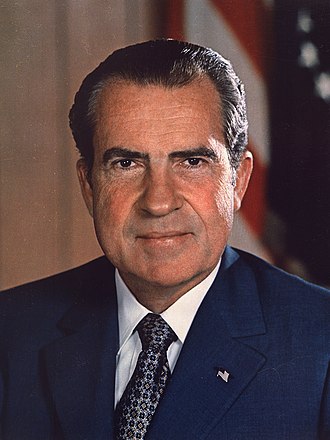
Richard M. Nixon served as the 37th President of the United States from January 1969 until his resignation in August 1974. In February 1971, he ordered the installation of a secret voice-activated taping system in the White House to preserve a historical record of his administration. Until the system's existence was revealed and dismantled in July 1973, the tapes captured Nixon directing major foreign policy initiatives, such as the opening to China, as well as his central role in the Watergate cover-up.
What Nixon talks about on the tapes
White House operations 4,718Presidential scheduling 2,225Public relations 1,784Presidential schedule 1,782Vietnam War 1,693Logistics 1,650Manolo Sanchez 1,626White House communications 1,400White House administration 1,399Presidential communication 1,243Henry Kissinger 1,191Foreign Policy 1,183
Conversations (21,010)
— Page 138 of 211President Nixon held a brief, informal communication with the Camp David operator from the Aspen Lodge study. The interaction served as a logistical check-in regarding telephone services and connectivity. The brief exchange concluded with the President indicating his intention to place a follow-up call at a later time.
President Nixon contacted the Camp David operator to initiate a telephone call to General Alexander M. Haig, Jr. This brief exchange served solely to facilitate communication between the President and his deputy assistant for national security affairs. No further policy discussions or significant substantive matters were addressed during this interaction.
President Nixon held a brief, informal interaction with a Camp David switchboard operator while working from the Aspen Lodge. The exchange centered on routine administrative coordination regarding the President's immediate communication needs. No substantive policy matters or major historical developments were addressed during this brief encounter.
President Nixon and Alexander Haig discussed the status of Vietnam peace negotiations following Hanoi's public disclosure of sensitive information, which the President viewed as a breach of trust. Haig reported that he had confronted Soviet Ambassador Anatoliy Dobrynin regarding the leaks and their potential to derail the progress made by Henry Kissinger. The pair emphasized the need to strictly control press access, specifically warning Secretary of State William P. Rogers to prevent further leaks to outlets like the Washington Post. They also affirmed that they would explicitly avoid using the term "coalition government" in any public characterization of the ongoing political settlement.
President Nixon and Alexander Haig held a brief, late-night meeting at Camp David to discuss ongoing negotiations and the potential risks of appearing to withdraw or concede. The two men coordinated their stance on avoiding entanglement in current developments that could negatively impact the administration's political standing. Nixon emphasized that their primary concern regarding the situation was the potential for domestic repercussions rather than immediate external threats.
President Nixon initiated a brief telephonic communication with the Camp David operator to request an outbound call to his Chief of Staff, H.R. "Bob" Haldeman. The exchange served strictly as a logistical facilitation for the President to reach a key advisor. No substantive policy matters were discussed during this brief administrative interaction.
President Nixon consulted with an unidentified staff member at Camp David to manage logistical arrangements regarding his upcoming daily schedule. The participants briefly coordinated the timing and delivery of specific documents or materials required for the President's immediate agenda. This brief exchange focused on administrative efficiency to ensure the President's obligations were addressed before the start of his day.
President Nixon contacted the Camp David operator to facilitate a phone call with an individual identified as Holloman. The brief exchange served as a routine administrative request to connect the President with this specific party. No further policy or substantive matters were discussed during this short communication.
President Nixon and H. R. Haldeman discuss the deteriorating state of Vietnam peace negotiations following South Vietnamese President Nguyen Van Thieu's resistance to a proposed settlement. Nixon expresses a firm intent to finalize a deal with North Vietnam regardless of Thieu’s objections, fearing that continued delays or a failed diplomatic mission by Henry Kissinger to Hanoi would be politically damaging before the upcoming election. They agree that Kissinger must be restrained from traveling to Hanoi, opting instead to manage the situation through private pressure on the Soviet Union to prevent a public propaganda crisis.
President Nixon and H. R. Haldeman met at Camp David to coordinate their departure schedules and discuss concerns regarding an unnamed individual’s overly optimistic perception of current events. Nixon expressed skepticism toward this individual's outlook, noting a tendency to ignore harsh realities. The two agreed on the necessity of collaborating to manage the narrative surrounding an unspecified "hell of a story" involving potential intruders.
President Nixon contacted the Camp David operator to facilitate a telephone connection with General Alexander M. Haig, Jr. This brief exchange served as a routine administrative request to establish communication with his key advisor. The conversation concluded immediately after the President issued the directive to initiate the call.
President Nixon contacted the Camp David operator to facilitate an immediate outgoing communication. The brief exchange focused on establishing a phone connection from the Aspen Lodge study. No substantive policy matters or political discussions were addressed during this logistical interaction.
President Nixon and Alexander Haig coordinate their strategy regarding ongoing Vietnam peace negotiations and the potential for a direct meeting between the President and Soviet Ambassador Anatoliy Dobrynin. Nixon expresses concern over a recent Soviet leak that alienated South Vietnamese President Nguyen Van Thieu and stresses that Henry Kissinger must avoid traveling to Hanoi before the 1972 election to prevent the appearance of a political surrender. The two decide to meet later that day at the Executive Office Building to finalize their approach for stabilizing US-Soviet relations and maintaining pressure on Hanoi to reach a military settlement.
President Nixon and Alexander Haig meet at Camp David to strategize on ongoing diplomatic negotiations regarding the Vietnam War. Nixon expresses strong reservations about finalizing an agreement before the upcoming presidential election, fearing it will be perceived as a surrender. The two men discuss maintaining a firm stance with their counterparts, emphasizing that the U.S. will continue to negotiate while refusing to be pressured into a premature settlement that could undermine their political or military position.
President Nixon and Alexander M. Haig, Jr. met to coordinate their upcoming schedules and ensure alignment on executive priorities. The conversation focused on the logistical planning for their subsequent meetings. This brief interaction served to establish Haig's availability and facilitate direct communication regarding the President's immediate agenda.
President Nixon and Alexander Haig met to strategize on ongoing Vietnam peace negotiations and the complexities of managing South Vietnamese President Nguyễn Văn Thiệu's resistance to a potential ceasefire. They discussed the tactical use of bombing halts and the necessity of maintaining a firm U.S. position to ensure North Vietnamese cooperation regardless of the upcoming 1972 election. The primary objective was to coordinate a cohesive message for Hanoi that reaffirmed U.S. commitment to the draft agreement while signaling that the administration remained fully focused on achieving a negotiated settlement.
President Nixon held a private meeting in the Old Executive Office Building with an unidentified individual. The discussion remains inaccessible to researchers due to the lack of an available transcript and the presence of a withdrawn personal segment. Consequently, no specific substantive topics, decisions, or action items can be verified from this recording.
President Richard Nixon met with his valet, Manolo Sanchez, in the Old Executive Office Building to discuss personal matters. The conversation remains restricted due to its sensitive, private nature, as indicated by the withdrawal of the recorded segment. No policy discussions or administrative decisions were noted in the available record of this interaction.
President Nixon and Alexander Haig coordinate the diplomatic response to the stalling Vietnam peace negotiations, specifically focusing on managing the fallout from recent North Vietnamese leaks and South Vietnamese President Nguyen Van Thieu's resistance. Nixon instructs Haig to inform Soviet Ambassador Anatoliy Dobrynin that North Vietnam must cease public disclosures to avoid a total breakdown of talks before the upcoming election. Furthermore, the President orders a discreet, unannounced halt to the bombing north of the 20th parallel and adjusts Henry Kissinger’s travel schedule to ensure their meeting occurs after Nixon returns from campaigning in New York.
President Nixon contacted the White House operator to place an outgoing call to H.R. “Bob” Haldeman. The brief exchange served as a routine administrative request to facilitate communication between the President and his Chief of Staff. No substantive policy discussions or decisions occurred during this brief telephonic connection.
President Nixon and H. R. Haldeman discussed adjustments to the President's upcoming schedule to ensure his availability for critical international matters. Nixon instructed that his planned meeting with George Shultz proceed without his attendance to avoid unnecessary distractions. Furthermore, the President coordinated the timing of Henry Kissinger’s return, specifically directing Alexander Haig to delay Kissinger’s arrival until Nixon had returned from New York.
President Nixon contacted the White House operator to place an urgent call to General Alexander M. Haig, Jr. The brief exchange served solely as a logistical request to establish communication with his close advisor. No further substantive policy matters were discussed during this brief administrative interaction.
President Nixon and Alexander Haig discuss the status of Vietnam peace negotiations, emphasizing the importance of remaining resolute against North Vietnamese pressure tactics and avoiding rushed concessions. The President instructs Haig to coordinate a response through Charles Colson to counter George McGovern's public allegations regarding the administration's negotiation motives. They also address the logistical complications in communicating with Soviet Ambassador Anatoliy Dobrynin and reinforce the need to prevent leaks from the State Department, confirming that Secretary of State William Rogers is aligned with the President's strategy.
President Nixon contacted the White House operator to request a telephone connection with George Allen, the head coach of the Washington Redskins. The primary purpose of the call was to facilitate communication between the President and the NFL coach. No further business was transacted during this brief administrative interaction.
President Richard Nixon called Washington Redskins head coach George E. Allen to congratulate him on the team's come-from-behind victory over the Dallas Cowboys. The two discussed specific game highlights, including the performance of key players and the team's defensive efforts, while briefly touching on personnel needs and potential trades before the league deadline. Nixon declined an invitation to attend future games during the campaign season to avoid the appearance of exploiting the team's success for political gain.
President Nixon contacted the White House operator to initiate an urgent telephone call to Secretary of State William P. Rogers. This brief administrative interaction served as a logistical step to facilitate direct communication between the President and his top diplomat. No further substantive policy matters were discussed during this brief exchange.
President Nixon and Secretary of State William P. Rogers discussed the complex status of Vietnam peace negotiations, specifically addressing the recalcitrance of South Vietnamese President Nguyen Van Thieu and the need to manage public perceptions leading up to the 1972 election. They agreed on the strategic necessity of avoiding an announced bombing halt while keeping Henry Kissinger's negotiations alive to prevent the perception that the U.S. was forcing a hasty, politically motivated settlement. Ultimately, they decided to maintain pressure on Thieu while ensuring that any potential deal was perceived as substantive rather than an election-year tactic.
President Nixon met with his valet, Manolo Sanchez, in the Old Executive Office Building to coordinate the delivery of specific items. The discussion involved staff members Raymond K. Price, Jr. and David R. Gergen. The brief interaction focused on the logistics of these materials, though the transcript remains largely incoherent regarding the specific nature of the items handled.
President Nixon met with speechwriter Raymond K. Price, Jr. to dictate instructions for a upcoming television address titled "Look to the Future." The President emphasized the inclusion of themes regarding moral and religious values, equal opportunity, and the importance of American revitalization. Nixon specifically directed Price to incorporate his "one child" rhetorical device, which he had successfully utilized in previous campaigns and policy initiatives.
President Nixon held a brief meeting with an unidentified individual, during which he directed the transmission of materials to Mr. Wilson. The primary administrative focus centered on the handling of specific documentation intended for legal or presidential counsel. No further substantive policy discussions were captured during this brief exchange.
President Nixon met with his aide Stephen B. Bull to coordinate logistics for an upcoming trip to New York. The President specifically directed that the traveling party travel by helicopter to Nelson D. Rockefeller’s estate upon their arrival. The discussion focused on these travel arrangements and potential engagements with Rockefeller and John B. Connally.
President Nixon and Alexander Haig met to discuss the status of ongoing Vietnam peace negotiations and strategies for managing South Vietnamese President Nguyen Van Thieu's resistance to a potential settlement. The conversation emphasized the necessity of securing a peace agreement without appearing to abandon South Vietnam, while acknowledging the political importance of finalizing a deal or maintaining steady progress leading up to the 1972 election. Nixon expressed a firm desire to bring the conflict to a close and directed Haig to ensure that State Department bureaucracy or leaks would not undermine the administration's delicate diplomatic efforts.
An unidentified visitor met with President Nixon to request an audience with White House Chief of Staff H.R. Haldeman. The President facilitated the connection, though the specific nature of the visitor's business remains undocumented in the transcript. This brief interaction highlights the gatekeeping role the President played in managing access to his inner circle during the lead-up to the 1972 election.
President Nixon and H.R. Haldeman met to discuss the status of Vietnam peace negotiations and the strategic timing of a potential settlement in relation to the 1972 presidential election. The discussion covered the roles of Henry Kissinger and Alexander Haig, the challenges posed by South Vietnamese President Nguyen Van Thieu, and concerns regarding a potential coalition government. Additionally, they coordinated public relations efforts and campaign messaging to address Democratic challenger George McGovern's critiques.
President Nixon met with his personal valet, Manolo Sanchez, to discuss the President's upcoming schedule. The conversation included a brief mention of Charles W. Colson’s role regarding these arrangements. The meeting concluded with Sanchez departing the office shortly thereafter.
President Nixon met with his personal valet, Manolo Sanchez, in the Old Executive Office Building to discuss administrative matters. The conversation centered primarily on the President’s daily schedule, specifically coordinating a forthcoming meeting with Charles W. Colson. No major policy decisions were recorded during this brief administrative encounter before Sanchez departed.
President Nixon met with Alexander P. Butterfield to address scheduling matters regarding Henry Kissinger and William Rogers. The discussion focused on coordinating the availability and official engagements of these key administration figures. This brief interaction served to align the President’s calendar with the respective travel or meeting schedules of his Secretary of State and National Security Advisor.
President Nixon and Alexander Haig met to discuss the status of Vietnam peace negotiations and the strategic timing of an announcement regarding a potential ceasefire. They assessed the volatile behavior of South Vietnamese President Nguyen Van Thieu and determined that the administration should publicly emphasize the progress made in negotiations without finalizing a settlement before the 1972 election to avoid political complications. The President also reviewed positive feedback regarding his recent trip to New York and reaffirmed the necessity of maintaining pressure on North Vietnam to secure a favorable agreement.
President Nixon met with Henry Kissinger and Alexander Haig to review the status of Vietnam peace negotiations following Kissinger's recent trip. The discussion focused on the favorable terms achieved in the draft agreement, contrasted with the erratic and obstructionist behavior of South Vietnamese President Nguyen Van Thieu, who feared the implications of the settlement. Nixon and his advisors decided to maintain a tactical delay in concluding the deal until after the upcoming presidential election, while agreeing to pressure Thieu into compliance and using military options as necessary leverage.
President Nixon contacted the White House operator shortly after midnight to request a phone connection with Secretary of State William P. Rogers. This brief administrative interaction served as the initiation of a late-night communication between the President and his top diplomat. No further substantive discussion occurred during this specific exchange as the operator acted to place the requested call.
President Nixon briefed Secretary of State William P. Rogers on recent negotiations with North Vietnam following his return from New York and a meeting with Henry Kissinger. The discussion focused on the extreme paranoia and recalcitrance of South Vietnamese President Nguyen Van Thieu, who had accused the U.S. of conspiring against his administration. Nixon emphasized that securing a viable peace settlement was a long-term strategic necessity for U.S. foreign policy—not a campaign-driven deadline—and urged Rogers to remain calm in upcoming meetings to prevent the collapse of the negotiations.
President Nixon contacted the White House operator to facilitate a telephone connection with special counsel Charles W. Colson. The brief exchange served as a routine administrative request to initiate communication between the President and his aide. No further substantive policy matters were discussed during this brief interaction.
President Nixon and Charles Colson discussed political campaign strategies and the effectiveness of their messaging against George McGovern's supporters. They reviewed recent public appearances, specifically praising Vice President Spiro Agnew’s stance on amnesty and reflecting on Nixon’s own successful use of a wreath-laying ceremony in New York to counter hecklers. The conversation focused on the political potency of contrasting amnesty for draft resisters with honoring those who served in the military.
President Nixon met with his personal valet, Manolo Sanchez, in the Oval Office to discuss personal matters and scheduling. The brief interaction, which was already in progress when the recording began, concluded with Sanchez departing the office shortly thereafter. No substantive policy matters or political decisions were addressed during this exchange.
President Nixon met with his aide, Stephen B. Bull, to coordinate his daily agenda and administrative arrangements. The primary focus of the brief discussion was the scheduling of a meeting between the President and Dwight L. Chapin. Bull was tasked with facilitating this request as part of the President's ongoing staff appointments.
President Nixon met with Dwight L. Chapin to discuss the logistics of the President’s recent campaign travel and the preparation of commemorative certificates for supporters. The conversation focused on the administrative distribution of these materials to police, bands, and local figures in towns visited during the tour. Nixon emphasized the importance of these gestures as a strategic effort to bolster electoral support.
President Nixon met with H.R. Haldeman and other staff members to discuss security concerns and public relations strategies regarding his upcoming travel schedule and motorcades. The participants evaluated the risks associated with motorcades versus rallies, specifically addressing threats posed by protestors and the need for improved crowd control measures. Additionally, they touched upon political strategy regarding the ongoing Watergate investigation and coordinated the handling of press inquiries concerning upcoming Vietnam peace negotiations.
President Nixon initiates a brief telephonic request through the White House operator to be connected with John K. Andrews, Jr. This administrative interaction serves to facilitate direct communication between the President and his staffer. No further substantive policy matters or decisions were discussed during this short exchange.
President Nixon instructed John K. Andrews, Jr. on the thematic structure and messaging for his upcoming speech to farmers. He emphasized moving beyond a list of policy items to highlight the American farmer’s record-setting productivity, the benefits of recent grain deals with China for world peace, and the moral and spiritual values of rural communities. Andrews committed to completing a draft of the speech for the President’s review.
President Nixon met with Henry Kissinger, William Rogers, and Ronald Ziegler to discuss the status of stalled Vietnam peace negotiations following a volatile meeting between Kissinger and South Vietnamese President Nguyen Van Thieu. Kissinger reported that Thieu, reacting with intense emotional outbursts, perceived the proposed peace terms as a betrayal and a threat to his government. Nixon and his advisors weighed the risks of proceeding with a settlement against the possibility of domestic political fallout if they pushed too hard before the upcoming election, ultimately deciding to maintain a posture of cautious progress while managing the erratic behavior of both North and South Vietnamese leadership.
President Nixon met with his aide, Stephen B. Bull, to review and finalize scheduling arrangements. The brief discussion centered on upcoming appointments with Henry A. Kissinger and Fritz G.A. Kraemer. No major policy decisions were recorded during this logistical session.
President Nixon, Henry Kissinger, and advisor Fritz Kraemer discussed the strategic complexities of ongoing Vietnam peace negotiations and the importance of maintaining a firm bargaining position despite the upcoming U.S. election. Kraemer emphasized the necessity of understanding communist psychology and ensuring that any cease-fire terms include effective international supervision to prevent North Vietnamese exploitation of the transition period. Nixon reaffirmed his commitment to securing an honorable settlement that protects U.S. credibility, noting that he would continue to utilize his advisors' intellect and character to navigate these delicate diplomatic and military challenges.
President Nixon and Press Secretary Ronald Ziegler met briefly to finalize administrative details regarding the President’s public schedule and official statements. They specifically discussed the approval of a formal statement concerning the death of Jackie Robinson and coordinated the logistics for upcoming White House photography sessions. The discussion included preferences for managing the duration and atmosphere of these photo opportunities involving figures such as Henry Kissinger and representatives of the police force.
President Nixon met with Stephen B. Bull to finalize logistical arrangements for an upcoming Rose Garden event featuring police officers. The discussion focused on establishing specific procedures for the group's arrival and the protocol for official photographs. This brief planning session ensured the meeting would proceed according to the President's scheduling requirements.
President Nixon met with the Policeman of the Year award winner and several honorable mention honorees to recognize their contributions to law enforcement. Accompanied by staff members including Egil Krogh, the President engaged in casual conversation regarding the honorees' various jurisdictions and the importance of police work in protecting the innocent. The meeting concluded with a ceremonial photograph session, the presentation of Presidential gifts to the officers, and a tour of the White House.
President Nixon and H.R. Haldeman reviewed internal polling data regarding public sentiment toward Vietnam, specifically focusing on the implications of a ceasefire, prisoner of war releases, and the potential for a communist takeover. They shifted their focus to strategic campaign planning, prioritizing security for Nixon's remaining public appearances by favoring controlled environments like military bases over high-risk motorcades. Finally, the pair discussed their public messaging strategy for the Watergate controversy, aiming to counter perceived smear campaigns by distributing a formal 'White Paper' to editors and campaign surrogates.
President Nixon, H.R. Haldeman, and Manolo Sanchez met briefly in the Oval Office to finalize logistical arrangements for an upcoming bill-signing ceremony honoring veterans. The participants discussed the scheduling of the event and their presence at the Executive Office Building for the following week. The conversation focused on ensuring the successful execution of these commitments as the administration neared the end of the legislative session.
President Nixon met with Charles W. Colson to refine the administration's political strategy regarding the 1972 presidential campaign and Vietnam War negotiations. They discussed intensifying attacks on George McGovern's policy inconsistencies and campaign ethics, while planning the release of a financial analysis highlighting the costs of McGovern’s proposed policies. Additionally, the President reviewed upcoming public relations efforts, including messaging for a Veterans Day event and the use of audio recordings to solidify public support for his administration's Vietnam policy.
President Nixon directed the White House operator to place a call to Joseph M. Margiotta, the Republican chairman of Nassau County, New York. The President instructed the operator to obtain the necessary contact information through Dwight L. Chapin's office to facilitate the communication. This brief exchange served as a logistical coordination effort to connect the President with a key regional political figure.
President Nixon instructed the White House operator to facilitate a telephone call to Nassau County Republican leader Joseph M. Margiotta. The operator informed the President that Margiotta was currently at a luncheon and could be reached at a restaurant. Nixon directed the operator to proceed with connecting him to the restaurant, prioritizing immediate contact over waiting for Margiotta's expected return to his office.
President Nixon instructed the White House operator to place a call to Joe Margiotta, the Republican leader of Nassau County. The purpose of the request was to facilitate communication with Margiotta or Dwight Chapin’s office regarding political matters. No further discussion or substantive policy decisions occurred during this brief administrative request.
President Richard Nixon met with Chief of Staff H. R. Haldeman in the Executive Office Building to discuss administrative matters. The recording contains a withdrawn segment of personal material, indicating the conversation included sensitive or private subject matter. No further details regarding policy or political decisions are accessible due to the lack of an available transcript.
President Nixon and H.R. Haldeman convened in the Old Executive Office Building to conduct official administrative business. While the initial portion of their meeting was withdrawn for personal privacy, the session primarily served to facilitate high-level internal coordination between the President and his Chief of Staff. No further details regarding specific policy outcomes or actionable directives are available due to the lack of a transcript.
President Richard Nixon met with his longtime valet, Manolo Sanchez, in the Old Executive Office Building. The conversation, which lasted less than a minute, was categorized as a personal returnable item, indicating it lacked official policy or administrative significance. No transcript or record of the meeting's substance remains available due to its personal nature.
President Nixon instructed the White House operator to delay his scheduled outgoing calls until 3:00 pm. This brief exchange served to manage the President's afternoon availability and coordinate his administrative workflow. The operator acknowledged the instruction and agreed to hold the calls as requested.
President Nixon contacts the White House operator to follow up on the status of pending telephone calls directed to New York. The brief exchange serves as a logistical inquiry to expedite communications. No substantive policy matters are discussed beyond these administrative arrangements.
President Nixon coordinates with the White House operator to facilitate a return call to Joseph M. Margiotta, a prominent Long Island political figure. The exchange serves as a brief logistical bridge to establish direct contact between the President and Margiotta. No substantive policy matters were addressed during this administrative interaction.
President Nixon initiates a brief administrative interaction with the White House operator to facilitate a telephonic connection. This recording functions primarily as a logistical bridge to a separate, substantive conversation involving other parties. No policy matters or significant executive decisions are discussed during this brief exchange.
President Richard Nixon met with his personal valet, Manolo Sanchez, in the Old Executive Office Building. The brief interaction consisted of a personal, non-substantive exchange that was subsequently withdrawn from public record. No policy discussions, official decisions, or administrative actions were documented during this meeting.
President Richard Nixon met with his personal valet, Manolo Sanchez, in the Old Executive Office Building. The recording of this encounter consists entirely of a withdrawn segment classified as a personal returnable item. Consequently, no substantive policy discussions or administrative actions were documented or preserved for public review.
President Nixon held an brief, unrecorded meeting with an unidentified individual in the Old Executive Office Building to facilitate a specific request for a telephone call. Due to the lack of available transcripts or descriptive metadata, the substantive details regarding the nature of the requested communication or the identity of the visitor remain unknown. This encounter reflects the routine management of the President's personal and political communications during the 1972 election cycle.
President Nixon instructs the White House operator regarding his availability for upcoming communications. He specifically informs the operator that he will be unavailable at 3:00 pm. This brief exchange serves to manage the President's schedule and call screening procedures.
President Nixon met with an unknown individual in his Old Executive Office Building office to coordinate his upcoming schedule. The discussion centered on arrangements for a forthcoming meeting with White House Special Counsel Charles W. Colson. No substantive policy or political developments were recorded beyond this brief administrative logistical planning.
President Nixon met with an unknown individual to coordinate his upcoming schedule and handle logistics for forthcoming telephone calls. The brief discussion served to finalize the President's availability for the following morning. No substantive policy matters were addressed during this administrative exchange.
President Nixon consulted with the White House operator to facilitate outgoing telephone communications. This routine interaction served as a logistical bridge, allowing the President to initiate contact with other parties as part of his daily executive duties. No specific policy decisions or substantive discussions were recorded during this brief administrative exchange.
President Nixon met with Alexander P. Butterfield to coordinate the President's administrative schedule and upcoming correspondence. The discussion focused on the management of official papers and the preparation for planned telephone calls to New York. The meeting concluded after four minutes, serving as a brief logistical check-in regarding presidential communications and daily workflow.
President Nixon consulted with Nassau County Republican leader Joseph M. Margiotta to discuss political strategy and grassroots organizing efforts in the final weeks before the 1972 presidential election. The discussion focused on maximizing voter turnout and solidifying local support within New York. No specific policy decisions were finalized, as the conversation served primarily to coordinate partisan campaign operations.
President Richard Nixon met with Joseph M. Margiotta, the Nassau County Republican Chairman, to discuss local political strategy and campaign efforts shortly before the 1972 presidential election. The brief exchange focused on strengthening party support within the region to ensure favorable turnout. This meeting served as a direct coordination effort between the White House and local leadership to solidify electoral margins in a key suburban territory.
President Nixon instructed the White House operator to place a telephone call to Edwin G. Michaelian, the County Executive of Westchester County, New York. The President sought to contact Michaelian directly, confirming that the operator should have the necessary contact information on file to facilitate the connection.
President Nixon consulted with the White House operator to clarify the technical procedures for receiving incoming calls within his office. The discussion focused on establishing effective communication protocols for managing telephone traffic. No significant policy decisions were reached during this brief administrative inquiry.
President Nixon called Westchester County Executive Edwin G. Michaelian to express his personal appreciation for Michaelian’s efforts regarding a recent presidential campaign trip to New York. The discussion focused on the success of the tour through Westchester, specifically highlighting staff coordination in Yonkers and Eastchester. Nixon emphasized his gratitude for Michaelian’s logistical support and discussed the political importance of securing a strong plurality in Westchester County for the upcoming election.
President Richard Nixon met with Westchester County Executive Edwin G. Michaelian for a brief discussion in the Old Executive Office Building. While specific details remain restricted, the meeting likely focused on regional political developments or administrative matters concerning Westchester County. The brief nature of the engagement suggests a ceremonial or perfunctory consultation rather than an extensive policy deliberation.
President Nixon requested that the White House operator place a telephone call to Edwin M. Schwenk. The operator provided the necessary contact number, 516-475-2300, to facilitate the connection. This exchange was a brief administrative action to initiate communication with Schwenk.
President Nixon consulted with the White House operator to facilitate an outgoing call to Edward Swain. The brief exchange focused on securing the specific telephone number for Swain. This administrative interaction highlights the routine logistical procedures required for the President to place direct external communications.
President Nixon consulted with the White House operator to facilitate a communication with Edwin M. Schwenk. Upon learning that Schwenk was currently traveling and not expected to reach his office until 4:30 p.m., the President instructed the operator to have Schwenk return the call at that time. This brief exchange served as a routine administrative coordination for a follow-up conversation.
President Nixon met with his personal valet, Manolo Sanchez, in the Old Executive Office Building to facilitate the delivery of an item. The brief interaction likely involved the transfer of materials associated with the office of speechwriter Raymond K. Price, Jr. No major policy decisions were recorded during this brief administrative exchange.
President Nixon consulted with the White House operator to facilitate an outgoing communication. This brief interaction served an administrative purpose, likely intended to connect the President with another party for official business. No substantive policy discussions or decisions occurred during this brief exchange.
President Nixon met with an unknown individual to facilitate the transfer of sensitive documentation intended for Alexander P. Butterfield. The discussion focused on the delivery of specific papers, which were retrieved from the President’s office for immediate transport. This administrative exchange underscores the logistical handling of internal White House records during this period.
President Nixon met with an unknown individual to coordinate administrative tasks and manage his immediate schedule. The discussion focused on the delivery of documents to Alexander P. Butterfield and the handling of incoming telephone calls. Nixon explicitly instructed the staffer to notify him regarding the arrival of visitors while ensuring that his subsequent meetings would not be interrupted by further calls.
President Nixon met with his aide Stephen B. Bull to discuss adjustments to his official daily schedule. The two reviewed logistical arrangements and upcoming commitments to ensure the President's time was effectively managed. No major policy decisions were reached, as the discussion remained focused on administrative planning and itinerary coordination.
President Nixon met with his aide Stephen B. Bull in the Old Executive Office Building to coordinate the President's upcoming professional schedule. The discussion focused on the logistical arrangements and preparations for a forthcoming meeting. No further substantive policy matters were recorded during this brief administrative encounter.
President Nixon met with his senior advisors and campaign staff to coordinate strategy for the final weeks of the 1972 presidential election, focusing heavily on the political ramifications of ongoing Vietnam peace negotiations. The President expressed a firm commitment to securing a durable peace that ensured the survival of South Vietnam, while advisors discussed how to counter George McGovern’s criticisms regarding the war and economic issues. The conversation also covered campaign media tactics, including radio and television appearances, and touched upon concerns regarding press coverage of Watergate-related controversies like the Segretti activities.
President Nixon, H. R. Haldeman, and John Connally met to assess the political fallout from a forthcoming Washington Post story concerning secret campaign funds and Watergate-related disbursements. The discussion centered on allegations that Haldeman authorized payments from these funds to individuals such as G. Gordon Liddy and E. Howard Hunt, based on grand jury testimony from Hugh Sloan. The participants evaluated the potential impact of this press coverage and the threat posed by leaks from the grand jury and federal investigations.
President Nixon met with his personal valet, Manolo Sanchez, in the Old Executive Office Building to conduct private business. While the specific nature of their discussion remains unclear due to the absence of a transcript and the brevity of the recording, the meeting centers on personal assistance or administrative tasks. The encounter concluded shortly after they were joined by an unidentified individual.
President Nixon initiates a request through the White House operator to place a telephone call to General Alexander M. Haig, Jr. This brief interaction serves as a logistical bridge to facilitate direct communication between the President and his senior aide. No further policy or strategic matters were discussed during this connection.
President Nixon directs Alexander Haig to prevent Henry Kissinger from traveling to Hanoi, fearing that such a trip before the 1972 election would be politically devastating and project a sign of weakness. Nixon mandates a hardline stance in Vietnam peace negotiations, explicitly rejecting a coalition government and instructing Clark MacGregor to publicize this firm position. The President expresses his firm resolve to block the Hanoi visit, emphasizing that any further diplomatic activity must occur only after the election.
President Nixon utilized this session in his Old Executive Office Building office to dictate a memorandum for the permanent record. The recording primarily consists of personal remarks that were subsequently withdrawn from the public archive. No other participants were present for this administrative task.
President Nixon interacts with a White House operator in the Old Executive Office Building to facilitate a telephone connection. The brief exchange serves as a functional request to initiate communication with another party. No substantive policy matters or strategic decisions were discussed during this brief procedural interaction.
President Nixon contacted the White House operator to facilitate a telephone connection with his Press Secretary, Ronald L. Ziegler. The brief exchange served as a routine administrative request to initiate official communication with a key staff member. No further policy discussions or substantive developments occurred during this brief interaction.
President Nixon directed Ronald Ziegler to emphasize his prior public praise of Jackie Robinson's athletic versatility, specifically requesting that Ziegler highlight these comments to the press. The two also coordinated a rebuttal to negative news coverage regarding H.R. Haldeman and the Watergate investigation, aiming to challenge the accuracy of reports concerning FBI questioning. Finally, Nixon instructed Ziegler to launch a "vicious" public attack against George McGovern, accusing the candidate of sabotaging ongoing Vietnam peace negotiations.