Nixon, Richard M. (President)
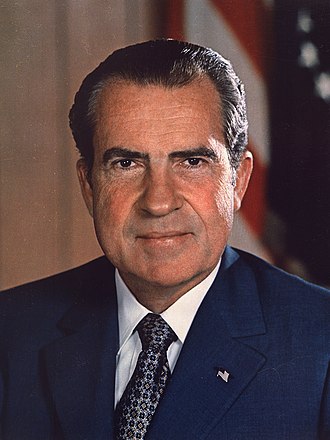
Richard M. Nixon served as the 37th President of the United States from January 1969 until his resignation in August 1974. In February 1971, he ordered the installation of a secret voice-activated taping system in the White House to preserve a historical record of his administration. Until the system's existence was revealed and dismantled in July 1973, the tapes captured Nixon directing major foreign policy initiatives, such as the opening to China, as well as his central role in the Watergate cover-up.
What Nixon talks about on the tapes
White House operations 4,718Presidential scheduling 2,225Public relations 1,784Presidential schedule 1,782Vietnam War 1,693Logistics 1,650Manolo Sanchez 1,626White House communications 1,400White House administration 1,399Presidential communication 1,243Henry Kissinger 1,191Foreign Policy 1,183
Conversations (21,010)
— Page 143 of 211President Nixon and aide Stephen B. Bull coordinate the scheduling of an upcoming telephone call with the Soviet ambassador. Nixon expresses concern regarding the timing of the engagement while verifying that his administrative staff has addressed necessary preparatory communications. The brief interaction focuses on ensuring the President is available to receive the call as intended.
President Nixon contacted the White House operator to arrange an immediate meeting with his Chief of Staff, H.R. Haldeman. The President requested that Haldeman join him at the Executive Office Building to discuss administrative or policy business. The operator promptly confirmed the request to facilitate the briefing.
President Nixon consulted with the White House operator to facilitate an outgoing call. This interaction served a logistical purpose, enabling the President to establish a connection with an unspecified party. No further policy or administrative developments were recorded during this brief exchange.
President Nixon met with Charles Colson and H.R. Haldeman to coordinate final campaign strategies, discuss media relations, and finalize his upcoming 'Look to the Future' speech. The conversation also touched upon concerns regarding the Watergate controversy, the status of Vietnam peace negotiations, and the need to mobilize support among blue-collar voters. Additionally, Nixon placed brief follow-up calls to Jack Miller and William Scott to encourage their campaign efforts and emphasize the importance of high voter turnout in their respective regions.
President Nixon initiates a request to the White House operator to facilitate a meeting with special counsel Charles W. Colson. The brief exchange serves as an administrative directive to bring Colson into the Oval Office. No further policy or substantive matters were addressed during this short coordination call.
President Nixon spoke with the White House operator to facilitate an outgoing call. This brief interaction served as a logistical step to connect the President with another party. No substantive policy discussions or significant political developments occurred during this exchange.
President Nixon reached out to Senator Jack Miller of Iowa to request that Miller emphasize the importance of voter turnout during his final campaign appearances before the upcoming election. Nixon argued that a strong electoral mandate would bolster his administration's leverage and credibility in pursuing ongoing foreign policy initiatives, particularly those aimed at achieving global peace. Miller agreed to relay this message to his constituents, confirming he would present the President's personal interest in the election as a significant factor in his outreach.
President Nixon telephoned Virginia congressional candidate William L. Scott to offer final words of encouragement and electoral support just days before the 1972 election. Nixon expressed regret that he could not personally campaign in Virginia but highlighted Vice President Spiro Agnew’s scheduled appearance in Richmond as a strategic effort to bolster Scott’s Senate bid. The two discussed their shared commitment to national defense and foreign policy, with Nixon reaffirming his endorsement to help secure Scott's victory.
President Nixon and H.R. Haldeman discuss a Washington Star article concerning the 1968 bugging of Nixon's campaign, strategizing on how to address the allegations. They weigh the necessity of official denials and conclude that the burden of clarification lies with former President Lyndon B. Johnson rather than the White House. The conversation reflects a tactical decision to avoid direct involvement in the controversy while pressuring the Johnson camp to address the story.
President Nixon met with his aide, Stephen B. Bull, to coordinate logistics for an upcoming meeting with Mstislav V. Keldysh. The discussion centered on administrative arrangements, specifically involving Henry Kissinger and the protocol for seating configurations. The President emphasized the need to adhere to strict time constraints during the scheduled appointment.
President Nixon met with his personal aide, Stephen B. Bull, to discuss administrative directives regarding Rose Mary Woods. The conversation focused on the status of ongoing document retyping projects and established follow-up procedures for staff assignments. No major policy decisions were reached, as the discussion primarily served to coordinate internal workflow and ensure the completion of clerical tasks.
President Nixon met with Soviet Ambassador Anatoliy Dobrynin and Soviet scientist Mstislav Keldysh to discuss the expansion of U.S.-Soviet cooperation in non-military sectors, including science, health, space, and trade. The participants emphasized that fostering these positive collaborative ties was essential for building a lasting peace beyond mere arms control agreements like SALT I. Nixon also highlighted his intent to further develop these relationships and pursue productive diplomatic engagements, including a potential visit to the Soviet Union, during his anticipated second term.
President Nixon and Stephen B. Bull discussed logistical arrangements for the recording of a campaign speech. The conversation focused on coordinating the technical setup for the recording session to follow other scheduled obligations. Nixon emphasized the need for Bull to manage the scheduling and necessary preparations for this production.
President Nixon met with Stephen B. Bull to coordinate the scheduling of an upcoming meeting with the Council on Environmental Quality (CEQ). The President emphasized the need to adhere to strict time constraints for this engagement. Bull was instructed to facilitate the logistics for the meeting, resulting in the finalization of the President's schedule.
President Nixon met with members of the Council on Environmental Quality (CEQ), including Russell E. Train and Beatrice Willard, for a formal photograph session and a discussion regarding environmental policy. The President requested that the Council provide material for his upcoming State of the Union address by December 1, 1972. During the exchange, Nixon also emphasized his commitment to conservation measures, such as energy-saving practices and paper recycling, while briefly touching upon his California background and campaign interests.
President Nixon and H. R. Haldeman discuss reports regarding a 1968 bugging incident and potential FBI involvement during the transition period. Haldeman relays information from George Christian regarding Lyndon B. Johnson’s desire to avoid public confrontation over allegations of Nixon campaign interference in peace talks. The two also address concerns about internal FBI leaks and touch upon Johnson’s health and his public stance regarding the 1972 election.
President Nixon held a brief, unscheduled meeting in the Oval Office with an unidentified individual. Given the lack of a transcript or meeting logs, the specific subject matter and objectives of this brief encounter remain unknown. The interaction concluded within six minutes, leaving no documented record of decisions or action items.
President Nixon met with an unknown individual and subsequently with Stephen B. Bull to coordinate logistical details regarding a scheduled visit by Erie, Pennsylvania Mayor Louis J. Tullio. The discussion focused on the sequence of events for the meeting, including the Mayor's arrival and a photo opportunity involving the Mayor and his wife, Gracie Tullio. These brief sessions served to finalize the President's public schedule for the day.
President Nixon met with Erie, Pennsylvania Mayor Louis J. Tullio, his wife Grace, and aide William F. Rhatican to discuss the 1972 presidential campaign and local municipal issues. The discussion covered Tullio's political support for Nixon despite his Democratic affiliation, as well as specific federal assistance for infrastructure projects in Erie, including railroad track removal. Additionally, the group addressed the recent death of Grace Tullio’s brother in the Vietnam War, with the President offering condolences and discussing the administration's policy regarding military settlements.
President Nixon met with his aide Stephen B. Bull to review and manage his daily schedule. The discussion focused on coordinating an upcoming appointment with National Security Advisor Henry Kissinger. Additionally, the President reviewed the logistical details and duration of a recent meeting he held with Louis J. and Grace Tullio.
President Nixon and Henry Kissinger met to strategize on public relations regarding the Vietnam War, specifically addressing potential criticism from George McGovern that the ongoing peace negotiations were a hoax. They evaluated the pros and cons of holding a background press briefing to counter these claims and reinforce the narrative that "peace is at hand." Ultimately, the President directed staff to coordinate the logistics for such a session while remaining cautious about the tone and timing of the messaging to ensure it served the administration's goals.
President Nixon initiates a brief administrative request to the White House operator to place a telephone call to Charles W. Colson. This communication serves as a standard operational task to connect the President with one of his key political advisors. No further substantive policy matters or decisions are recorded during this brief exchange.
President Nixon and Charles Colson discuss the final stages of the 1972 presidential campaign, focusing on the President's positive momentum, strong polling data, and the apparent disintegration of George McGovern's campaign. The two men review the political landscape in key states like Michigan and Massachusetts, evaluate recent campaign rhetoric regarding Vietnam, and finalize a decision to cancel Vice President Agnew's appearance on CBS to avoid crossing a picket line. They also note the significance of rising stock market figures as a reflection of public confidence in the President's reelection.
President Nixon contacted the White House operator to facilitate a telephone connection with his Press Secretary, Ronald L. Ziegler. This brief administrative interaction served as the necessary step to initiate a direct conversation between the President and his senior staffer. No further substantive policy matters were discussed during this request.
President Nixon directs the White House operator to connect him to an unidentified party. This brief administrative interaction serves as a routine call-handling request to facilitate communication with an external individual. No further substantive dialogue is recorded during this brief exchange.
President Nixon and Press Secretary Ronald Ziegler discuss the administration's public relations strategy regarding Vietnam peace negotiations and George McGovern's accusations of deception. Nixon emphasizes the need for Secretary of State William Rogers and Secretary of Defense Melvin Laird to aggressively rebut McGovern's claims, while maintaining a firm posture against being rushed into an unsound agreement. They also evaluate the efficacy of the President's recent media coverage, concluding that television remains a more effective medium for their messaging than the press.
President Nixon and Press Secretary Ronald Ziegler discuss media coverage and the framing of recent political developments shortly before the 1972 election. The conversation focuses on managing public perception regarding diplomatic negotiations and potential unrest, with Nixon emphasizing the need for precise messaging. They also touch upon the professional status and challenges of specific unidentified individuals within the administration.
President Nixon initiated a phone call to request an immediate meeting with his Chief of Staff, H.R. Haldeman. The brief exchange focused primarily on scheduling this consultation to address current administrative matters. The conversation served as a logistical precursor to further private deliberations between the two men.
President Nixon contacted the White House operator to initiate a telephone call to Secretary of State William P. Rogers. This brief exchange served exclusively as a procedural request to facilitate communication between the President and the Secretary. No further policy discussions or substantive developments occurred during this brief interaction.
President Nixon communicated with a White House operator to confirm that a task regarding the National Football League had been successfully completed. This brief exchange appears to be a follow-up on a specific administrative or personal request involving the NFL. No further substantive policy matters were discussed during this brief interaction.
President Nixon consulted with a White House operator to facilitate an outgoing telephone call. The exchange was limited to technical instructions regarding the placement of the call. No substantive policy matters or political developments were addressed during this brief operational communication.
President Nixon and Secretary of State William P. Rogers discuss how to frame ongoing Vietnam peace negotiations in response to political attacks from George McGovern ahead of the 1972 election. Nixon emphasizes that his administration has reached a breakthrough on key principles but refuses to rush into a flawed agreement, drawing historical parallels to the failed 1968 bombing pause. They agree that Rogers will characterize McGovern's criticisms as irresponsible and desperate when he appears on 'Meet the Press,' while maintaining a confident public stance regarding the inevitability of a final, durable settlement.
President Nixon and Secretary of State William P. Rogers met to discuss the status of ongoing peace negotiations regarding the Vietnam War just days before the 1972 presidential election. Nixon emphasized his commitment to achieving 'peace with honor' while ensuring that ceasefire terms were durable and enforceable. The discussion touched upon the necessity of maintaining a unified team approach to these diplomatic challenges and briefly addressed the President's upcoming campaign activities.
President Nixon contacted the White House operator to facilitate a telephone connection with his aide, Stephen B. Bull. The brief exchange served as an administrative request to initiate communication with a staff member. No policy matters or significant strategic decisions were addressed during this interaction.
President Nixon held a brief, informal communication with the White House operator to initiate a transition or secure movement. The exchange consisted of cryptic, preparatory remarks regarding an immediate change in location or activity. No substantive policy or political discussions took place during this short interaction.
President Nixon instructed his aide, Stephen B. Bull, to arrange a meeting with H.R. Haldeman. The President requested that Haldeman come to his location as soon as he became available. This brief exchange served as a routine administrative request to facilitate immediate communication between the President and his Chief of Staff.
President Nixon and Stephen B. Bull engage in a brief, informal exchange regarding the personal schedule and whereabouts of a staff member. This interaction highlights the routine management of personnel availability within the White House. No formal policy decisions or major strategic developments occurred during this brief check-in.
President Nixon met with Stephen B. Bull and Alexander P. Butterfield to coordinate the logistics and protocol for upcoming telephone calls. The discussion focused on establishing the timing and procedural workflow for these calls, specifically clarifying John D. Ehrlichman’s role in the process. Nixon emphasized the requirement for Bull to perform a pre-call check with him to ensure proper preparation before the scheduled outreach.
President Nixon and H. R. Haldeman met to coordinate final 1972 campaign strategies and manage the administration's response to a recent speech by George McGovern. They evaluated the effectiveness of McGovern’s public presentation and discussed the involvement of key aides, including Charles Colson, in shaping the campaign's messaging. Additionally, the pair reviewed upcoming scheduling requirements, specifically regarding calls involving New Jersey political figures like William T. Cahill and Clifford P. Case.
President Nixon met with an unidentified individual in the Executive Office Building to discuss matters that remain undocumented due to the lack of an available transcript. As the recording captures only brief interaction between the President and an unknown participant, no specific policy decisions or action items can be verified. The nature of this meeting remains a subject of historical uncertainty regarding the President's private deliberations just days before the 1972 election.
President Nixon and H.R. Haldeman participated in a brief, fragmented telephone exchange involving unknown participants shortly before the 1972 election. The dialogue lacks substantial policy discussion, consisting primarily of greetings and administrative coordination, including a reference to placing a call to Raymond Price. No significant decisions or substantive developments were recorded during these brief segments.
President Nixon contacted the White House operator to initiate an outgoing call to Connecticut Governor Thomas J. Meskill. This brief exchange served solely as a functional administrative request to connect the President with the governor. No further policy discussions or substantive developments occurred during this brief interaction.
President Nixon and his senior staff, H. R. Haldeman and John Ehrlichman, coordinated campaign messaging in the final days before the 1972 election. Much of the discussion focused on refuting George McGovern’s criticisms regarding Vietnam, specifically emphasizing the administration's stance that they had achieved a breakthrough toward "peace with honor" while clarifying that remaining "central points" were merely details requiring resolution. To reinforce these themes, Nixon made a series of telephone calls to various Republican candidates across the country to offer his endorsement, boost morale, and provide talking points for their final campaign appearances.
President Nixon called Connecticut Governor Thomas J. Meskill to express appreciation for his political support and to encourage a strong finish to the 1972 campaign. The two discussed Republican prospects in Connecticut's congressional and state legislative races, as well as the importance of maintaining voter turnout. Nixon specifically authorized Meskill to share his enthusiastic endorsement of local candidates with the press and emphasized the administration's commitment to achieving "peace with honor" in Vietnam and full employment.
President Nixon communicated with the White House operator to manage outgoing telephone calls to New Jersey Governor William T. Cahill and political operative Wesley Powell. The operator informed the President that the connection to Cahill was delayed, prompting Nixon to prioritize the call with Powell. This interaction illustrates the President's direct involvement in coordinating political outreach during the final days of the 1972 election cycle.
President Nixon calls Wesley Powell to offer encouragement and support for his New Hampshire Senate campaign during the final days of the 1972 election. The President expresses his appreciation for Powell's past political support, emphasizes his commitment to "peace with honor," and acknowledges the campaign efforts of his own family members in the state. Beverly Powell joins the call briefly to receive the President's praise for her role in the campaign, while the President reiterates his desire to visit New Hampshire after the election.
President Nixon contacted the White House operator to initiate a telephone call to Senator J. Caleb Boggs. This brief exchange served as an administrative request to facilitate communication between the President and the Senator. No further substantive policy matters were discussed during this brief connection.
President Nixon held a brief campaign-focused telephone call with Senator J. Caleb Boggs and Congressman Pierre S. DuPont shortly before the 1972 election. Nixon expressed his support for their respective candidacies in Delaware, highlighting his appreciation for their past cooperation and his affinity for the state. The participants discussed the final stages of the campaign, and Nixon briefly outlined his own upcoming travel schedule to North Carolina, New Mexico, and California.
President Nixon initiated this call to Georgia Congressman S. Fletcher Thompson to express his support for Thompson's candidacy during the final days of the 1972 election cycle. The two discussed their shared political platform, specifically emphasizing peace with honor, national strength, and the enforcement of law and order. Nixon encouraged Thompson to continue his campaign efforts in Georgia, expressing optimism that the "Thompson-Nixon" ticket would succeed in the upcoming vote.
President Nixon called Wisconsin campaign chairman John K. MacIver to express his appreciation for the local organization's efforts and to encourage a strong voter turnout in the final days of the 1972 election. The two discussed campaign themes, including the President's commitment to peace with honor, economic prosperity, and national strength. They also assessed the outlook for competitive House of Representatives seats in Wisconsin, with MacIver reporting that increased volunteer mobilization had improved their standing.
President Nixon contacted the White House operator to place an outgoing call to Robert Hirsch. This brief exchange served as a logistical request to facilitate communication with Hirsch. No further substantive policy or political discussions were recorded during this connection.
President Nixon held a campaign encouragement call with South Dakota congressional candidate Robert Hirsch just days before the 1972 election. Nixon expressed his strong support for Hirsch’s candidacy, emphasizing their shared ideological alignment on peace, national strength, and economic prosperity. The discussion also addressed broader electoral prospects in South Dakota, including the potential success of other Republican candidates and the First Lady’s ancestral ties to the state.
President Nixon called James A. McClure to offer a final endorsement and encouragement for his Idaho Senate campaign ahead of the 1972 election. Nixon expressed regret over his inability to visit Idaho while emphasizing the necessity of electing Republicans who supported his foreign policy and economic agenda. McClure confirmed the effectiveness of the President's endorsement in local advertisements and noted that Secretary George Romney had recently provided additional campaign support.
President Nixon called Senator Margaret Chase Smith three days before the 1972 election to express his support for her campaign and discuss their mutual electoral outlook. The conversation focused on the political climate in Maine, the impact of local media opposition, and Nixon's strategy for achieving "peace with honor" in the Vietnam War. Nixon provided Smith with specific talking points to defend his administration's peace negotiations and firm stance against a coalition government, encouraging her to remain confident as she campaigned for re-election.
President Nixon called Senator Howard H. Baker, Jr. to convey his well-wishes for the upcoming 1972 election and to outline campaign talking points regarding his administration's pursuit of "peace with honor" in Vietnam. Nixon emphasized the progress made on cease-fire negotiations and the return of prisoners of war, while dismissing opposition claims of a political hoax. The President also requested that Baker personally contact various House candidates on his behalf to demonstrate his support.
President Nixon contacted the White House operator to place a personal telephone call to Billy Mills, a Los Angeles city councilman. The President requested that the operator locate and connect him to Mills, confirming that the operator already had the necessary contact information on file. This brief administrative exchange served solely to facilitate communication between the President and the local official.
President Nixon held a series of phone conversations with political allies including Robert Dole, William Mills, Gordon Allott, and James McKevitt on November 4, 1972. The calls served to build momentum and express appreciation for campaign support from key constituencies and regional leaders as the general election approached. Nixon discussed localized campaign strategies, the importance of maintaining unity within the party, and securing support from diverse groups, including the black community. The discussions also touched on logistical concerns regarding campaign messaging and the management of sensitive political relationships.
President Nixon called Senator Robert Dole while the latter was in Kansas to offer campaign support and well wishes to Republican candidates Morris Kay and Chuck McAtee. The discussion focused on bolstering the GOP ticket in Kansas, specifically emphasizing the importance of securing a win for the gubernatorial race. Nixon expressed his appreciation for Dole's national campaigning efforts and agreed to reach out to former Governor Alf Landon as a gesture of party unity.
President Nixon and Los Angeles Councilman William Mills spoke to exchange mutual expressions of support ahead of the 1972 election. Mills thanked the President for past assistance provided to his community by the White House, while Nixon reaffirmed his commitment to keeping the administration accessible to the Black community. The President directed Mills to coordinate with John Ehrlichman in the coming weeks to serve as an advisor on urban policy for the upcoming second term.
President Nixon spoke with Senator Gordon Allott and Congressman James D. “Mike” McKevitt to offer encouragement regarding their respective reelection campaigns and to express appreciation for the Colorado delegation’s support. The conversation focused on the status of various competitive congressional and Senate races across the country, as well as the President’s campaign travel schedule. Nixon also emphasized his commitment to achieving “peace with honor” in the Vietnam War negotiations, ensuring that any final agreement would be more robust than previous diplomatic settlements.
President Nixon contacted the White House operator to place a long-distance call to Senator Strom Thurmond in South Carolina. The brief communication functioned as a routine administrative request to facilitate direct contact with the Senator. No further substantive policy matters were discussed during this brief exchange.
President Nixon contacted the White House operator to place a telephone call to Press Secretary Ronald L. Ziegler. The brief exchange served as a routine administrative request to initiate communication with a key staff member. No further substantive discussion took place during this brief interaction.
President Nixon consulted with his aide Stephen B. Bull and the White House operator to coordinate administrative logistics and manage his daily schedule. The primary focus involved arranging telephone communications, specifically with Charles Colson via Air Force One, and scheduling a meeting with Henry Kissinger. This interaction served to finalize the President's immediate operational agenda and facilitate priority executive outreach.
President Richard M. Nixon and Charles W. Colson held a brief meeting in the Old Executive Office Building to discuss the President's upcoming daily schedule. The interaction lasted for approximately one minute and focused on logistics regarding Nixon's appointments. No substantive policy decisions or critical developments were recorded during this brief exchange.
President Nixon met with his aide Stephen B. Bull to review logistical arrangements concerning the President's daily schedule. The discussion specifically addressed the arrival and handling of Zosimo T. Monson. No further actions or significant policy decisions were recorded during this brief administrative exchange.
President Nixon communicated briefly with the White House operator to place an outgoing telephone call. No substantive policy matters or historical events were discussed during this short administrative interaction. The conversation serves primarily as a record of the routine logistical support provided by the switchboard staff to the President.
President Nixon and Press Secretary Ronald Ziegler coordinate a meeting at the White House to discuss unspecified matters. After confirming that Ziegler is not scheduled for a press briefing that day, the President directs him to come over immediately. This brief interaction serves as a routine scheduling check-in to facilitate a private consultation between the two officials.
President Nixon and Press Secretary Ronald Ziegler held a brief, informal check-in to coordinate schedules regarding a pending briefing. Nixon inquired about the status of Ziegler's preparation and directed him to meet at the office to finalize details. This brief interaction served as a logistical touchpoint to ensure alignment between the President and his press office.
President Nixon, H.R. Haldeman, and Charles Colson met to discuss the final stages of the 1972 presidential campaign, focusing on delegating media responses and organizing future public appearances. They evaluated the effectiveness of Vice President Spiro Agnew in challenging George McGovern's stance on Vietnam negotiations, specifically emphasizing the contrast between "peace with honor" and McGovern’s perceived "irresponsibility." Additionally, the participants discussed personnel matters, including a potential transition for Clark MacGregor into a new role following the election.
President Nixon called Montana Senate candidate Henry Hibbard to offer his personal encouragement during the final days of a difficult election campaign. Nixon emphasized his alignment with Hibbard on the issues of achieving 'peace with honor' in Vietnam and maintaining national strength. While discussing the state's patriotic electorate, the President explained that he could not personally visit Montana due to the political complications involved in traveling to neighboring states like South Dakota. Nixon tasked Hibbard with conveying the President's full support to the local press.
President Nixon met with key advisors, including H. R. Haldeman, Charles Colson, and Henry Kissinger, to strategize for the final days of the 1972 presidential campaign. The discussion focused on countering George McGovern's recent criticisms regarding Vietnam and the Watergate scandal, while analyzing polling data and state-by-state electoral projections. Nixon and his team also evaluated the status of Vietnam peace negotiations and determined how to leverage their progress toward a settlement to bolster the President's standing before Election Day.
President Nixon contacted the White House operator to request a telephone connection with his special counsel, Charles W. Colson. The call served as a brief administrative bridge to facilitate direct communication with a key advisor. No further substantive discussion occurred during this short exchange beyond the request for the transfer.
President Nixon met with his valet, Manolo Sanchez, to coordinate the handling of personal items. The discussion focused on the logistics of transferring specific belongings, including a potential television tray, to the custody of Alexander P. Butterfield. This exchange functioned as a routine administrative task regarding the President's personal property and White House office arrangements.
President Nixon consulted with the White House operator to facilitate an outgoing call. This brief interaction served administrative purposes to connect the President with another party. No substantive policy discussions or decisions occurred during this brief exchange.
President Nixon coordinates a meeting with Charles Colson to finalize outstanding tasks before Colson’s departure. The primary priority for Colson is awaiting a call from Vice President Spiro Agnew’s office regarding a signed statement. Nixon instructs Colson to prioritize the receipt of the Vice President's communication before proceeding to the Oval Office.
President Richard Nixon met with Special Counsel Charles W. Colson for a brief, one-minute discussion in the Old Executive Office Building. While no transcript exists for this recording, the brevity of the exchange suggests a logistical check-in or a quick relay of time-sensitive information between the two men. This interaction occurred just days before the 1972 presidential election, highlighting the high-pressure environment surrounding the White House staff at the time.
President Nixon met with Charles Colson and later Ronald Ziegler to coordinate campaign strategy in the final days before the 1972 election. They discussed the administration's favorable polling, the necessity of countering negative press coverage, and strategies for managing the Vietnam negotiations and the Watergate scandal's political fallout. The participants focused on maintaining momentum, addressing Democratic candidate George McGovern's campaign, and ensuring that administration officials and surrogates maintained a unified, disciplined public message.
President Richard Nixon met with an unidentified individual in the Old Executive Office Building to discuss matters related to an item described in the records as a briefcase. The meeting lasted approximately twenty minutes, concluding shortly before 1:34 pm. No further details regarding the specific topics or outcomes are available, as no transcript exists for this encounter.
President Nixon contacted the White House operator to facilitate a telephone connection with his personal secretary, Rose Mary Woods. This brief communication served a purely administrative purpose to initiate contact with a key staff member. No policy matters or further developments were recorded during the duration of the call.
President Nixon and his personal secretary, Rose Mary Woods, exchanged a brief telephone call to coordinate further communication. The conversation served primarily as a logistical step for the President to instruct Woods to place a return call. No substantive policy matters or decisions were addressed during this exchange.
President Nixon and his personal secretary Rose Mary Woods briefly discussed the initial positive outlook of the 1972 presidential election returns on the evening of Election Day. Despite the President's cautious stance as he awaited further results later that night, Woods expressed strong optimism regarding the early favorable projections. Their exchange highlights the expectant atmosphere at the White House as the landslide victory began to take shape.
President Nixon instructed the White House operator to place an outgoing call to George Allen. The brief exchange served as a routine administrative request to facilitate a direct conversation between the President and the football coach. No substantive policy matters were discussed during this brief connection.
President Nixon consulted with the White House operator to facilitate contact with George Allen. The operator informed the President that Allen was currently in transit and would arrive at his residence within thirty minutes. Consequently, Nixon chose to leave a message for Allen rather than wait for the connection.
President Nixon and Washington Redskins coach George Allen discussed the team's recent victory over the New York Jets and previewed their upcoming game against the New York Giants. Beyond sports analysis, the two coordinated arrangements for Allen and his wife to attend the President’s election night victory celebration. Nixon specified that he would be unable to make a public statement until 11:00 p.m. due to the late closing of California polling places.
President Nixon and David Eisenhower communicated via telephone on election night to review real-time projections and early returns from various states. They discussed specific outcomes for the presidential race, Senate contests, and state-level voter turnout metrics provided by news networks like CBS and NBC. The exchange focused on assessing the candidate's electoral strength in key regions, including Alabama, Illinois, and Ohio, while acknowledging the uncertainty of early returns in close races.
President Nixon initiated a brief exchange with the White House operator to clarify whether she had placed a call to his line. The conversation concluded quickly after the operator confirmed that she had not initiated the ring. No substantive policy matters or administrative decisions were addressed during this interaction.
President Nixon and his personal secretary, Rose Mary Woods, held a brief telephone conversation shortly after the 1972 presidential election. The interaction consists of a routine exchange of greetings, though the majority of the brief call remains classified or withdrawn from the public record. No significant policy decisions or administrative actions are captured in the available transcript.
President Nixon contacted the White House operator to facilitate a telephone connection with his Chief of Staff, H.R. Haldeman. This brief interaction served solely as a functional administrative request to initiate official communication between the President and his senior advisor. No substantive policy discussions or decisions were made during this exchange.
President Nixon directed the White House operator to facilitate communication with his staff during the evening of the 1972 election. After being informed that Chief of Staff H. R. Haldeman was unavailable, the President explicitly requested that the operator connect him with special counsel Charles W. Colson. This brief exchange highlights the President’s urgent efforts to coordinate with key advisors during the late stages of election night.
President Nixon and Charles W. Colson discussed real-time election returns on the night of Nixon's 1972 landslide victory. They reviewed projections for key Senate and House races, noting significant Republican gains in the South and border states while expressing disappointment over potential losses in other regions. Despite some concerns regarding ticket splitting and specific senatorial contests, they concluded the evening was shaping up to be an overwhelming electoral success for the administration.
President Nixon and H. R. Haldeman discuss early returns and network projections during the 1972 presidential election. The two analyze the validity of competing media projections for key states like Illinois, Ohio, and Tennessee, while acknowledging the defeat of specific Republican candidates such as Louie Nunn and S. Fletcher Thompson. Nixon expresses frustration with the networks' premature and inconsistent reporting, opting to maintain a close watch on the incoming results as the landslide victory takes shape.
President Nixon contacted the White House operator to place an outgoing call to H. R. Haldeman. This brief administrative interaction served as a logistical bridge to facilitate direct communication with his Chief of Staff. No substantive policy discussions occurred during this exchange.
President Nixon and H.R. Haldeman reviewed early election returns and television network projections on the night of the 1972 presidential election. The discussion focused on the President's strong performance across various states, the status of key Senate races, and concerns regarding voter turnout. Nixon instructed his staff to gather further intelligence on outstanding contests in states like Wisconsin and New Hampshire, as well as specific Senate results, to better gauge the night's final outcome.
President Nixon instructed the White House operator to place an outgoing call to Charles W. Colson. This brief administrative interaction served as the initiation of a communication between the President and one of his key political advisors. No further substantive discussion was recorded during this segment of the telephone conversation.
President Nixon and Charles Colson discuss election returns on the evening of November 7, 1972, analyzing the President's significant lead in key states and the potential impact of his coattails on congressional races. They examine specific Senate and House contests, debating the phenomenon of ticket-splitting among 'brass-collar' Democrats who supported the President but voted for local candidates of their own party. The conversation also touches on voter turnout and the President's skepticism toward network news coverage, while Tricia Nixon Cox joins briefly to discuss the unfolding results.
President Nixon met with television and radio technicians in the Oval Office to coordinate the technical logistics and countdown for a televised address regarding his 1972 election victory. Following final preparations and seating adjustments, Nixon delivered a live speech expressing appreciation for his electoral support and emphasizing national unity, peace, and his goals for a second term. The brief session concluded immediately after the broadcast, with the President departing for a celebration at the Shoreham Hotel.
President Nixon consulted with the White House operator to check on the status of a pending telephone connection to Philadelphia Mayor Frank L. Rizzo. During the brief exchange, Nixon also instructed the operator to initiate a subsequent call to National Security Advisor Henry A. Kissinger. No further substantive policy matters were addressed during this short administrative check-in.
President Nixon consulted with the White House operator to determine the current availability of National Security Advisor Henry Kissinger. Upon being informed that Kissinger would be away for approximately fifteen minutes, the President acknowledged the update and concluded the brief coordination call. This exchange served primarily to facilitate the President's immediate scheduling needs regarding his communication with Kissinger.
President Nixon consulted with an unknown individual regarding his upcoming travel itinerary. The discussion centered on the logistics and planning for a scheduled trip to Florida. No further substantive policy matters were recorded during this brief administrative exchange.
President Nixon held a brief, late-night meeting with unidentified individuals in the Old Executive Office Building shortly after his 1972 reelection victory. The discussion focused on logistical planning for an upcoming trip to Florida and brief mentions regarding California. No significant policy decisions were recorded during this abbreviated exchange.