Nixon, Richard M. (President)
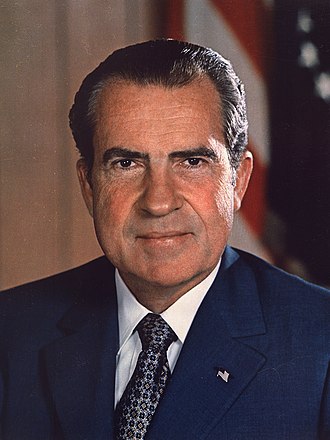
Richard M. Nixon served as the 37th President of the United States from January 1969 until his resignation in August 1974. In February 1971, he ordered the installation of a secret voice-activated taping system in the White House to preserve a historical record of his administration. Until the system's existence was revealed and dismantled in July 1973, the tapes captured Nixon directing major foreign policy initiatives, such as the opening to China, as well as his central role in the Watergate cover-up.
What Nixon talks about on the tapes
White House operations 4,718Presidential scheduling 2,225Public relations 1,784Presidential schedule 1,782Vietnam War 1,693Logistics 1,650Manolo Sanchez 1,626White House communications 1,400White House administration 1,399Presidential communication 1,243Henry Kissinger 1,191Foreign Policy 1,183
Conversations (21,010)
— Page 144 of 211President Nixon met with H.R. Haldeman and Manolo Sanchez in the Old Executive Office Building shortly after the 1972 election. The discussion centered on early election returns and the personal voting experiences of Sanchez and his wife, Fina. During the brief interaction, the President also utilized White House operators to facilitate multiple telephone communications.
President Richard Nixon called Philadelphia Mayor Frank L. Rizzo to express his gratitude for Rizzo’s support during the 1972 presidential election. The two discussed Nixon’s significant victory in Pennsylvania and the political landscape, including their shared disdain for Governor Milton J. Shapp and George McGovern’s conduct. The conversation concluded with Nixon expressing a desire to meet with Rizzo in the future to discuss administration goals and national unity.
President Nixon, H.R. Haldeman, Charles Colson, and others gathered in the early morning hours following the 1972 presidential election to review preliminary results and network projections. The conversation focused heavily on the President's landslide victory, the status of key Senate races, and the performance of various Republican candidates. Nixon expressed frustration over the defeat of certain incumbents and analyzed the broader implications of voter turnout and media coverage, ultimately focusing on his planned victory speech and communication strategy.
President Nixon initiated a brief telephone request to the White House operator to be connected with Governor Nelson A. Rockefeller. The conversation served as a logistical administrative step to facilitate a direct line of communication between the President and the Governor. No further substantive dialogue occurred during this short exchange.
President Nixon instructed the White House operator to place a call to Senator Hubert H. Humphrey following his recent electoral victory. During the brief exchange, the operator also informed the President that Governor Nelson A. Rockefeller was currently waiting on the line. The conversation focused on managing these immediate post-election communications.
President Richard Nixon and Nelson Rockefeller spoke following Nixon’s landslide victory in the 1972 presidential election to review preliminary results and the political landscape. They discussed the President’s strong showing in New York, the outcomes of various congressional races, and the failure of George McGovern's campaign. Additionally, Nixon disclosed that North Vietnam had recently agreed to unconditional negotiations, and the two men discussed the importance of post-election national unity.
Henry Kissinger calls President Nixon to offer congratulations on his overwhelming landslide victory in the 1972 presidential election. The two discuss George McGovern's ungracious concession statement and Nixon's subsequent decision to reject a draft telegram from his staff that was overly conciliatory toward his opponent. Additionally, they reflect on disappointing Republican losses in the Senate and interpret the election results as a definitive public rebuke of the media and liberal intelligentsia regarding the administration's Vietnam policy.
President Nixon and H. R. Haldeman coordinated the preparation of a wire to be drafted by Patrick J. Buchanan. The conversation centered on the logistical execution of this document, with Nixon confirming his role in finalizing the content. The pair moved quickly to ensure the draft would be ready for upcoming strategic use.
In this early morning telephone call following his landslide re-election, President Richard Nixon received a congratulatory call from Hubert H. Humphrey. The two men discussed the political differences between the 1968 and 1972 elections, specifically contrasting the Vietnam War issue and George McGovern’s campaign tactics. They also discussed election results in Minnesota, the future of the country, and Nixon offered Humphrey personal encouragement regarding his political career by referencing the late-career successes of Winston Churchill and Benjamin Disraeli.
President Nixon consulted with an aide to determine the location and availability of Robert Finch, who was visiting Washington. The President requested that the staff arrange a telephone call with Finch once he returned to his base. The conversation concluded with Nixon providing lighthearted, facetious instructions regarding the handling of Finch's whereabouts.
President Nixon contacted the White House operator to initiate a telephone call to Senate Majority Leader Michael J. Mansfield. This brief exchange served as a logistical request to connect the President with congressional leadership. The call was placed to facilitate direct communication between the White House and the legislative branch.
President Nixon and Stephen B. Bull discussed the scheduling and status of a potential telephone call between the President and Senator Michael J. Mansfield. The exchange focused on confirming whether the call had already been initiated and coordinating the timing for a return conversation. No further substantive policy issues were addressed during the brief interaction.
President Nixon met with Stephen B. Bull to review the latest election returns from Illinois, specifically regarding the outcomes for the state's gubernatorial and senatorial races. The discussion further addressed the whereabouts of Charles W. Colson in the immediate aftermath of the 1972 election. This brief interaction served as a status update on electoral results and personnel logistics.
President Nixon met with his aide Stephen B. Bull to coordinate his daily agenda and manage appointments. The primary focus of the discussion centered on the President's upcoming meeting with Charles W. Colson. Bull concluded the meeting shortly thereafter to facilitate the President's scheduled commitments.
President Nixon met with his aide, Stephen B. Bull, to coordinate his daily agenda. The brief discussion centered on managing the President's upcoming schedule, specifically confirming appointments with Charles W. Colson and H. R. Haldeman. No further substantive policy matters were recorded during the exchange.
President Nixon and Stephen B. Bull met to analyze the outcomes of the 1972 presidential election. The discussion focused specifically on electoral results within the state of Illinois. The two reviewed performance data and the limitations of time spent campaigning in that region.
President Nixon met with his personal valet, Manolo Sanchez, in the Oval Office for a brief, informal interaction. The exchange consisted of mundane pleasantries and brief instructions as they prepared for the day's schedule. No substantive policy discussions or significant political decisions were recorded during this segment of the meeting.
President Nixon met with his aide Stephen B. Bull in the Oval Office to review the morning's logistics and scheduling. The discussion focused on the expected arrival times of key staff members, specifically Charles W. Colson and H. R. Haldeman. This brief administrative check-in served to coordinate the President's immediate agenda for the start of the workday.
President Nixon initiates a call to Senator Mike Mansfield through the White House operator. This brief administrative exchange serves to facilitate communication between the President and the Senate Majority Leader. No further substantive policy discussions are captured in this recording segment.
President Nixon met with his personal valet, Manolo Sanchez, in the Oval Office to discuss the whereabouts of Chief of Staff H.R. Haldeman. The brief interaction served as a logistical check-in regarding senior staff availability during the morning hours. No further policy or administrative actions were recorded as a result of this exchange.
President Nixon instructed the White House operator to facilitate communication with Senator Mike Mansfield, who had traveled to Boca Grande, Florida. The President requested that the operator inform Mansfield that he had returned his call and secure a contact number for a follow-up conversation later that evening. This coordination was necessary due to conflicting schedules that prevented the two from connecting during the afternoon.
President Nixon contacted the White House operator to facilitate a telephone connection to Harry S. Dent. This brief administrative interaction served as a logistical step to reach the White House aide. No further policy or substantive matters were discussed during this specific exchange.
President Nixon instructed the White House operator regarding his availability and communication protocols for the remainder of the day. He established instructions for returning calls and confirmed a schedule for an upcoming 2:30 PM meeting. These arrangements ensured that his staff could manage his communications while he remained largely out of reach.
President Nixon met with Stephen B. Bull to coordinate the compilation and delivery of detailed 1972 election results. The President directed Bull to instruct the research group to provide an updated, speech-by-speech breakdown of the national returns, specifically focusing on state-by-state data for California and Minnesota. This information was intended to be prepared and delivered to the Oval Office by 10:00 am to assist the President in analyzing the election outcomes.
President Nixon held a brief exchange with a White House operator to facilitate an outgoing call. The conversation was purely administrative, serving as a routine connection to another party. No substantive policy matters or major decisions were addressed during this short interaction.
President Nixon and Harry Dent discuss the results of the 1972 election, focusing on the Republican Party's performance in the South and the reasons behind specific Senate and House losses. Nixon expresses frustration with the quality of Republican candidates and the perceived incompetence of the National Republican Party, while Dent attributes the victories to Nixon's personal efforts and the "triple play" strategy regarding Vietnam. The two agree on the necessity of recruiting better candidates and expanding the Republican coalition by incorporating Southern Democrats to build a stronger, more viable party in the future.
President Nixon and Harry Dent discuss the results of the 1972 election, analyzing the party's performance and the effectiveness of various Republican candidates. Nixon expresses frustration with the quality of certain candidates and the organizational failures of the National Republican Party, while asserting that his own landslide victory was driven by moral values and patriotism rather than race. The two agree on the necessity of forming a new political coalition that includes conservative Democrats, particularly in the South, to secure a stronger future base.
President Nixon met with Alexander P. Butterfield and Stephen B. Bull shortly after the 1972 presidential election to address administrative and correspondence matters. Discussions focused on the President's post-election letter to George McGovern, involving coordination with staff members Patrick Buchanan and H.R. Haldeman. Additionally, the participants reviewed the incoming election returns, specifically noting results from California.
President Nixon met with Alexander P. Butterfield to coordinate administrative logistics following the 1972 election. The discussion focused on managing Ronald L. Ziegler’s schedule, including the timing of a future press conference and a subsequent meeting with the President. They also briefly reviewed the preparation of a new summary of events.
President Nixon met with Alexander P. Butterfield shortly following the 1972 election to discuss administrative instructions regarding wires. The brief exchange focused on procedural directives pertinent to post-election operations. No major policy decisions were recorded during this short meeting.
President Nixon and aide Stephen B. Bull met briefly to review the President's daily schedule, including upcoming appointments with Charles Colson and H.R. Haldeman. They also touched upon the logistics of a planned Cabinet meeting. The exchange centered on coordinating administrative priorities and ensuring the President was prepared for his subsequent briefings.
President Nixon met with his aide Stephen B. Bull to coordinate administrative logistics regarding his daily schedule. The two reviewed the status of an upcoming meeting with H.R. Haldeman and discussed the latest returns and precinct data following the 1972 presidential election. This brief interaction focused on internal scheduling and processing the immediate political aftermath of the vote.
President Nixon met with H. R. Haldeman, Ron Ziegler, and Rose Mary Woods to plan the second-term administration transition, including the upcoming Cabinet and staff meetings. They discussed the requirement for all political appointees to submit their resignations to facilitate a comprehensive reorganization and structural reform of the executive branch. Additionally, the President and his staff reviewed the positive 1972 election results, addressed concerns regarding the lack of support for Republican congressional candidates, and prepared for the President's upcoming trip to Florida.
President Richard M. Nixon and H.R. Haldeman met briefly in the Oval Office to coordinate logistics and movements during a transitional period in the morning schedule. The participants navigated through the Roosevelt Room while preparing for subsequent official engagements. No substantive policy discussions were recorded during this brief encounter as the President transitioned to meet with an unidentified individual.
President Nixon met with Secret Service agents to coordinate the physical movement and positioning of office furniture or equipment within the Oval Office. The participants provided specific logistical instructions to one another to ensure the items were arranged correctly. This brief interaction served solely to facilitate the immediate reorganization of the workspace.
President Nixon met with his aide, Stephen B. Bull, to conduct a brief review of the President's upcoming daily schedule. The primary focus of the discussion concerned an appointment with Dr. William E. Wymer. The meeting concluded shortly after these logistical arrangements were addressed.
President Nixon and H. R. Haldeman discussed the logistics of administrative restructuring following the 1972 election, focusing on the upcoming submission of resignations by Cabinet members. Nixon instructed that all Cabinet officials submit their resignations to facilitate a comprehensive transition, with individual follow-up meetings planned within the next two weeks. The conversation also touched on the schedules of John A. Volpe and general preparations for the President's second-term reorganization.
President Nixon held a brief, unscheduled meeting with an unidentified woman in the Oval Office shortly before noon. The discussion occurred immediately prior to his scheduled appointment with Charles W. Colson. Due to the lack of audible dialogue in the recording, no specific policy decisions or substantive outcomes were documented.
President Nixon met with an unidentified individual to request the latest electoral data following his 1972 victory. The primary objective was to obtain current figures for the national popular vote and specific results from California for an upcoming report. The President directed his staff to secure and provide these updated statistics to finalize the documentation.
President Nixon met with his valet, Manolo Sanchez, to coordinate logistics regarding upcoming travel plans. The discussion focused on scheduling arrangements for the President's trip to Florida and the corresponding itinerary for Sanchez. They also addressed administrative matters involving Alexander P. Butterfield and the Executive Office Building.
President Nixon met with Stephen B. Bull and Marjorie P. Acker to coordinate the immediate availability of Charles W. Colson. The participants confirmed Colson's whereabouts and status to facilitate his arrival at the White House. This brief exchange functioned primarily as a scheduling adjustment to ensure a timely meeting with a key aide.
President Nixon met with Charles Colson, Ronald Ziegler, and Lawrence Higby to review the final electoral results following his 1972 re-election victory. The participants discussed the significance of the landslide, analyzed specific congressional race outcomes, and explored the emerging political coalition that characterized Nixon's "new majority." The conversation concluded with Nixon requesting updated, accurate vote tallies and election data to be prepared for his review.
President Nixon initiates a request to the White House operator to summon Charles W. Colson to the Oval Office. The conversation is a brief, functional exchange focused solely on facilitating this administrative meeting. No further policy or strategic details are discussed during the brief call.
President Nixon held a brief administrative interaction with a White House operator to facilitate a telephonic connection. This routine contact served the logistical purpose of managing the President's communications within the Executive Office Building. No substantive policy discussions or major strategic decisions occurred during this brief exchange.
President Nixon consulted with an aide to coordinate the delivery of comprehensive election results following the 1972 presidential contest. The discussion focused on the timing of report availability, with the President requesting that the finalized state-by-state data be prepared for him to review by 4:30 p.m. This information was intended for Nixon’s personal use in connection with his upcoming travel plans to Florida.
In this meeting following his 1972 election victory, President Nixon met with Charles Colson, Robert Finch, and other staff to discuss the significance of his electoral mandate and analyze the political landscape. The participants reviewed the election results, including the collapse of the traditional Democratic coalition, and debated the strategic necessity of party reform and staffing changes for the second term. Nixon specifically engaged with Finch regarding his future political prospects in California, while also emphasizing the need for an organized approach to Cabinet resignations and administrative reorganization.
President Nixon directs the White House operator to connect him with British Prime Minister Edward R. G. Heath. The brief exchange serves as a logistical instruction to facilitate immediate high-level diplomatic communication. No further policy discussion takes place during this recording beyond the initiation of the international call.
President Nixon consulted with the White House operator to determine the whereabouts of British Prime Minister Edward Heath, who was meeting with Queen Elizabeth II at Buckingham Palace. The President requested that the operator arrange a call once Heath returned to his office. No urgent action was required, as Nixon indicated there was no rush to expedite the communication.
Prime Minister Edward Heath called President Richard Nixon to offer his congratulations on Nixon's 1972 reelection victory. The two leaders discussed the implementation of wage and price controls, sharing insights on managing union opposition and garnering public support. Additionally, Nixon provided a brief update on the progress of Vietnam peace negotiations, noting that Alexander Haig was traveling to Saigon and that further developments were expected shortly.
President Nixon contacted the White House operator to place an outgoing call to Charles W. Colson. This brief administrative exchange served solely to facilitate communication between the President and his special counsel. No substantive policy matters or further discussions were recorded during this connection.
President Nixon and Henry Kissinger met to coordinate final preparations for a diplomatic mission to South Vietnam. The President confirmed he had signed a letter for President Nguyen Van Thieu and arranged for a briefing with Alexander Haig prior to Haig's departure for Saigon. They also discussed managing public perception through press secretary Ronald Ziegler to ensure the administration's narrative regarding the negotiations remained consistent.
President Nixon met with his personal valet, Manolo Sanchez, in the Old Executive Office Building to handle a minor personal matter. The brief interaction focused on the President's request for refreshments. No substantive policy discussions or significant political decisions were recorded during this exchange.
President Nixon interacts with a White House operator in the Executive Office Building to facilitate a telephonic connection. This brief exchange serves as a logistical bridge to reach another party, though the content of the subsequent conversation is not captured in this specific recording. No substantive policy discussions or major presidential decisions occur during this brief administrative interaction.
President Nixon and Charles Colson discussed the status of incoming 1972 election results ahead of the President's scheduled departure for Florida. They focused on obtaining the most recent presidential vote tallies, specifically highlighting the significance of late-reporting absentee ballots in key states. Colson committed to delivering an updated report of these figures to the President by 4:00 pm.
President Nixon and Charles Colson briefly discuss the acquisition of updated electoral figures and data sheets broken down by state following the recent election. The conversation focuses on securing precise, high-level analytical tools and updated reports to assess the final outcome. The exchange concludes with a brief mention of the logistical advancement of these reporting systems.
President Nixon initiates a brief request for the White House operator to place a telephone call to Charles W. Colson. This administrative exchange facilitates direct communication between the President and his special counsel. No further substantive policy matters are addressed during this short connection.
President Nixon and Charles Colson coordinate a brief, in-person follow-up meeting to discuss administrative or political matters. The President directs Colson to step into his office immediately to continue their dialogue. This interaction serves as a brief logistical bridge to a more substantive discussion between the two men.
President Nixon contacted the White House operator to facilitate communication with Stephen B. Bull. The brief exchange served as a routine administrative request to place a call to a member of his staff. No further substantive policy discussions occurred during this brief interaction.
President Nixon briefly speaks with the White House operator following a minor technical issue or disruption in communication. The interaction concludes quickly after the President identifies the problem, resulting in no substantive policy decisions. This exchange serves as a routine administrative communication regarding the functionality of the presidential phone system.
President Nixon met briefly with Charles Colson to discuss the status of specific materials or documentation the President was expecting to review. The exchange reflects the President's personal interest in securing and examining these items himself. No definitive policy decisions were made during this brief interaction.
President Nixon consulted with his secretary, Marjorie Acker, regarding an upcoming scheduled telephone call from Dr. William O. Chase. The discussion focused on coordinating the timing of the call to ensure the President would be available at 3:45 pm. Acker confirmed the logistical arrangements for the call, noting her own requirement to depart on time.
President Nixon interacted with the White House operator to facilitate an outgoing call. This brief exchange served as a logistical step to connect the President to another party. No substantive policy discussions or significant political developments occurred during this brief telephonic transition.
President Nixon met with Henry Kissinger and Alexander Haig to deliberate on the timing and public announcement of upcoming peace negotiations with North Vietnam. The discussion focused on managing the logistics of these talks while coordinating a strategic message to South Vietnamese President Nguyen Van Thieu, whom Nixon insisted must not test his authority. The participants emphasized that the administration remained in a position of strength following the 1972 election and resolved to utilize the available time to ensure the peace settlement met their terms.
President Nixon received a brief notification from the White House operator regarding the status of Stephen B. Bull. The operator informed the President that Bull was currently en route to the Oval Office. This exchange served strictly as a procedural update to facilitate an upcoming meeting or arrival.
President Nixon met briefly with Alexander P. Butterfield and Manolo Sanchez in the Oval Office to discuss logistical arrangements regarding the President's workspace or personal staff operations. The exchange was extremely short, primarily serving to facilitate immediate administrative coordination before the participants exited the room. No significant policy decisions were reached during this one-minute interaction.
President Nixon met briefly with an unidentified woman in the Oval Office to coordinate his upcoming schedule. During this short interaction, the participants discussed the logistics of an impending meeting with National Security Advisor Henry Kissinger. No significant policy decisions were recorded during this brief administrative exchange.
President Nixon met with his staff and Henry Kissinger to discuss the transition into his second term, the ongoing Vietnam peace negotiations, and various administrative matters. Nixon emphasized his desire to centralize control over foreign policy and White House personnel, signaling a move away from relying on State Department officials like William Rogers for Vietnam initiatives. The group also coordinated logistics for Kissinger's travel to Camp David and New York, reviewed recent election results, and addressed personal financial arrangements for White House staff.
President Nixon and H.R. Haldeman met at Camp David to discuss the staffing and strategic organization for the second presidential term. They reviewed potential roles for Charles Colson and Patrick Buchanan, emphasizing the use of investigative pressure on tax-exempt foundations like the Ford Foundation and Common Cause. Additionally, they planned the logistics for the 1973 Inauguration, focusing on creating inclusive events that appealed to a broader "New Majority" rather than the traditional Washington elite.
President Nixon held an informal telephone conversation with Alice Roosevelt Longworth to discuss the aftermath of the 1972 presidential election and the status of ongoing Vietnam peace negotiations. The two reflected on the intense rhetoric used by Democratic opponents during the campaign and celebrated the President's landslide electoral victory. Nixon also shared an update regarding the progress of Alexander Haig's recent diplomatic mission to Saigon, expressing confidence that the Vietnam situation was proceeding as planned despite criticism from the press.
President Nixon met with John V. Brennan at Camp David to coordinate upcoming scheduling logistics. The discussion focused on arrangements for an impending meeting between the President and Charles W. Colson. No major policy decisions were reached, as the exchange remained limited to administrative and logistical coordination.
President Nixon held a phone conversation with Alice Roosevelt Longworth shortly after his 1972 landslide reelection victory. They discussed the overwhelming electoral results, the unfairness of press criticism during the campaign, and the status of Vietnam peace negotiations. Nixon expressed personal satisfaction in overcoming political adversaries and suggested a future social meeting to celebrate their shared conservative perspectives.
President Nixon consulted with his personal valet, Manolo Sanchez, at Camp David regarding logistical arrangements for local school children. The discussion focused on practical considerations for students attending evening programs and the availability of seating or facilities. This brief interaction highlights the President’s routine oversight of minor personal and administrative matters during his stay at the presidential retreat.
President Nixon consulted with his personal valet, Manolo Sanchez, at Camp David to discuss the evening's entertainment schedule. The primary focus of the brief interaction was to confirm arrangements for a movie screening. No significant policy decisions were recorded during this informal discussion regarding the President's personal agenda.
President Nixon contacted the Camp David operator to facilitate an urgent communication with his Chief of Staff, H. R. Haldeman. This brief administrative interaction served as a logistical request to establish a telephone connection between the President and his top aide. No substantive policy matters were discussed during this specific exchange.
President Nixon initiates a brief, informal communication with the Camp David operator from the Aspen Lodge study. The interaction appears to be a routine administrative request regarding telephone operations or telecommunications connectivity. No substantive policy discussions or significant political developments occur during this brief exchange.
President Nixon and H.R. Haldeman coordinated the logistics of their upcoming meeting at Camp David. The two discussed the presence of Charles Colson and agreed that Haldeman would join the President once other guests had departed. This brief exchange served to clear the President’s schedule for a private debriefing session.
President Nixon instructed H. R. Haldeman to meet with him at the Aspen Lodge study immediately following the departure of Charles Colson and other attendees from a prior gathering. The brief exchange served as a coordination effort to ensure a private follow-up session between the President and his Chief of Staff. No substantive policy matters were addressed during this transitionary communication.
President Nixon met with his personal aide, Manolo Sanchez, at the Aspen Lodge during a stay at Camp David. The interaction primarily involved routine personal matters, including a discussion about walking the President's dog. Following this exchange, the President spent time dictating a memorandum for his personal files.
President Nixon contacted the Camp David operator to facilitate a telephone connection with his National Security Advisor, Henry Kissinger. This brief interaction served solely as a logistical request to initiate a high-level discussion regarding ongoing foreign policy matters. The exchange highlights the standard procedure Nixon employed to manage secure communications while stationed at the presidential retreat.
President Nixon held a brief administrative exchange with the Camp David operator while stationed at the Aspen Lodge. The conversation served primarily as a routine telephonic connection or status check regarding communication logistics. No substantive policy matters or strategic decisions were addressed during this interaction.
President Richard Nixon met with his personal valet, Manolo Sanchez, at Camp David to facilitate the delivery of a taped message to Chief of Staff H. R. Haldeman. This brief interaction served as a logistical hand-off for official correspondence being relayed through staff member Patricia McKee. The conversation focused exclusively on ensuring the secure transit of this material.
President Nixon and Henry Kissinger discussed the recent warming of diplomatic relations with the People's Republic of China, highlighting Beijing's conciliatory tone regarding Vietnam and its willingness to influence the situation in Cambodia. Kissinger reported on his recent meeting with Chinese officials, who expressed strong anti-Soviet sentiment and reassured the U.S. that their growing ties with Japan would not undermine American military interests. The two men also strategized on how to address South Vietnamese President Nguyen Van Thieu’s security concerns regarding North Vietnamese troop presence, focusing on the use of diplomatic language to uphold principles without derailing the ongoing peace negotiations.
President Nixon and Henry Kissinger discuss diplomatic reassurances for Taiwan, including the preparation of talking points for Billy Gray to deliver to Madame Chiang Kai-shek. The two also confer on the diplomatic nuances of potential Vietnam peace agreements, specifically addressing President Thieu’s concerns regarding North Vietnamese troop presence in the South. Finally, the President touches upon potential diplomatic travel for David and Julie Eisenhower and dismisses the necessity of further political favors for Senator Mike Mansfield.
President Nixon contacted the Camp David operator to facilitate a personal phone call to Mamie Eisenhower. The President requested that the operator locate her at either the Eisenhower farm or in Washington, D.C. This brief exchange served as a logistical request to establish communication with the former First Lady.
President Nixon requested that the Camp David operator place a telephone call to Mrs. Dwight Eisenhardt. He specified that the operator should attempt to reach her regardless of her current location, whether in Washington or elsewhere. The brief interaction focused solely on facilitating this personal communication.
President Nixon met with his valet, Manolo Sanchez, at the Aspen Lodge in Camp David to discuss logistical arrangements. The conversation focused on the provision of firewood for the fireplace. Additionally, the pair addressed administrative matters regarding the distribution and handling of private memoranda files intended for top aides John Ehrlichman and H.R. Haldeman.
President Nixon and Mamie Eisenhower shared a brief, informal telephone conversation in which Eisenhower offered birthday wishes and congratulations on the President’s landslide 1972 election victory. Nixon discussed his transition work at Camp David, specifically noting the heavy burden of preparing federal budgets and new appointments. The two also coordinated plans for an upcoming theater outing involving Julie Nixon Eisenhower and Pat Nixon.
President Nixon called Mamie Eisenhower to extend birthday wishes and check on her well-being following the recent presidential election. The two discussed Nixon's post-election workload, specifically his focus on budget preparations and upcoming administration appointments, as well as their shared satisfaction regarding the President's victory in Pennsylvania. The conversation concluded with plans for Eisenhower to meet with Pat and Julie Nixon at the theater.
President Nixon instructed the Camp David operator to facilitate an urgent telephone call to Senator Henry M. “Scoop” Jackson, who was currently traveling in Tel Aviv. The President emphasized his availability to receive the call at any time, signaling an intent to communicate with the Senator regarding pressing legislative or foreign policy matters. The conversation was limited to the technical coordination required to establish this international connection.
John D. Ehrlichman coordinates with the Camp David operator to facilitate a telephonic connection with Ronald L. Ziegler while President Nixon and H. R. Haldeman are present. The discussion focuses on managing Henry A. Kissinger’s travel schedule, specifically regarding the timing of public announcements concerning his upcoming trip to Paris. The participants deliberate on how to synchronize these communications with Ziegler and potential plans for Kissinger to visit Camp David.
President Nixon met with H.R. Haldeman and John Ehrlichman at Camp David to strategize the comprehensive reorganization of his second-term administration. The participants focused on restructuring cabinet-level departments, delegating authority to a new tier of 'super secretaries,' and planning high-profile personnel changes across federal agencies, including the State and Defense Departments. Additionally, they evaluated potential cabinet replacements and discussed the public relations strategy for announcing these shifts to ensure executive efficiency and maintain political momentum.
President Nixon and Senator Henry "Scoop" Jackson discussed Jackson’s upcoming diplomatic tour through Israel, Iran, and Saudi Arabia, during which Jackson agreed to convey the President's regards to foreign leaders including Golda Meir and the Shah of Iran. The conversation also addressed Nixon’s second-term reorganization plans, specifically regarding personnel appointments and the restructuring of the Arms Control and Disarmament Agency. Jackson offered his support for these efforts, promising to coordinate with Henry Kissinger regarding a list of recommended personnel changes and potential new appointments.
President Nixon contacted the Camp David operator to facilitate a telephone call to public opinion researcher Albert E. Sindlinger. The President instructed the operator to obtain the necessary contact information from the office of special counsel Charles W. Colson. This brief coordination was intended to establish direct communication with Sindlinger for an unspecified purpose.
President Nixon contacted the Camp David operator to facilitate a telephone connection with his personal secretary, Rose Mary Woods. This brief administrative interaction served as a logistical step to reach a key staff member while the President was stationed at Camp David. No substantive policy matters were discussed during this request.
President Nixon contacted the Camp David operator to facilitate a telephone call to pollster Albert Sindlinger. The President provided instructions to obtain Sindlinger's contact information directly from the office of special counsel Charles Colson. This brief interaction served as an administrative step to connect the President with his advisor for a consultation.
President Nixon coordinates with his personal secretary, Rose Mary Woods, to arrange for Bebe Rebozo to visit Camp David earlier than planned to provide company during a busy period of staff meetings. Nixon expresses a desire to avoid dining with staff during his current series of consultations with Vice President Agnew and John Connally. Additionally, Nixon declines an invitation from Washington Redskins coach George Allen to attend a football game, citing his focus on second-term reorganization plans and a preference to avoid public appearances before Thanksgiving.
President Nixon and his personal secretary, Rose Mary Woods, discuss the logistics of an upcoming visitor's schedule and the President's availability at Camp David. The conversation touches on balancing professional obligations with personal plans around the Thanksgiving holiday. Nixon indicates a preference to remain at Camp David rather than traveling for public events during this period.
President Nixon met with his personal valet, Manolo Sanchez, at the Aspen Lodge study at Camp David. The interaction served as a brief, private engagement during which the two shared a lunch. No substantive policy or political matters were recorded during this informal meeting.
President Nixon and his daughter, Tricia Nixon Cox, discussed recent personal social visits, including the Coxes' trip to the Supreme Court to meet Chief Justice Warren E. Burger. The President also requested that Tricia coordinate with Pat Nixon and Julie Nixon Eisenhower to oversee the renovation and redecoration of the White House third-floor solarium into a more comfortable family room. Additionally, the conversation touched upon the President's current workload at Camp David and included disparaging remarks regarding the political character of George McGovern following the 1972 election.
President Nixon met with his daughter, Tricia Nixon Cox, at Camp David to discuss personal domestic projects and share brief political observations. The President proposed redecorating the third-floor room to make it more comfortable and vibrant, suggesting they enlist a decorator to update the space with brighter colors. Additionally, the pair touched upon the aftermath of the recent election, with Nixon critiquing George McGovern’s post-election rhetoric regarding voter shifts.