Nixon, Richard M. (President)
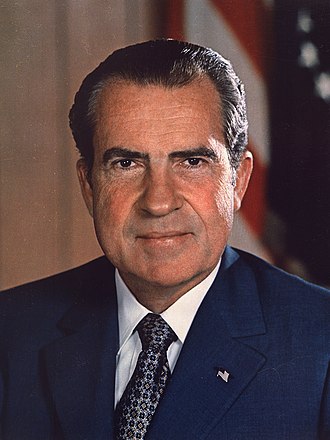
Richard M. Nixon served as the 37th President of the United States from January 1969 until his resignation in August 1974. In February 1971, he ordered the installation of a secret voice-activated taping system in the White House to preserve a historical record of his administration. Until the system's existence was revealed and dismantled in July 1973, the tapes captured Nixon directing major foreign policy initiatives, such as the opening to China, as well as his central role in the Watergate cover-up.
What Nixon talks about on the tapes
White House operations 4,718Presidential scheduling 2,225Public relations 1,784Presidential schedule 1,782Vietnam War 1,693Logistics 1,650Manolo Sanchez 1,626White House communications 1,400White House administration 1,399Presidential communication 1,243Henry Kissinger 1,191Foreign Policy 1,183
Conversations (21,010)
— Page 145 of 211President Nixon contacted the Camp David operator to facilitate an outgoing call to Thomas W. "Teddy" Gleason. Nixon requested that the operator obtain the necessary contact information from Charles W. Colson's office to initiate the communication. This brief exchange served as a logistical administrative step to connect the President with the labor leader.
President Nixon contacted the Camp David operator to facilitate an urgent communication with labor leader Teddy Gleason. He specifically requested that the operator obtain Gleason’s contact information from Charles Colson’s office to place the call. This brief exchange reflects the President's administrative efforts to coordinate with key labor figures during his second term.
President Nixon attempted to initiate a telephone call with labor leader Thomas W. 'Teddy' Gleason from Camp David. The operator informed the President that Gleason was unavailable due to his travel schedule and delays caused by severe flooding in the New York City area. Nixon acknowledged the situation and instructed the operator to place the call whenever Gleason returned to his office.
President Nixon contacted the Camp David operator to facilitate a direct line of communication with his Chief of Staff. The primary purpose of this brief interaction was to initiate a call to H. R. Haldeman. No substantive policy matters were discussed during this brief administrative request.
President Nixon speaks with the Camp David operator to request the delivery of materials. He explicitly instructs the operator that there is no urgency regarding the request, leaving the timing of the delivery to the operator's discretion. This brief interaction serves as a routine administrative coordination of documents or items while the President was stationed at the Aspen Lodge.
President Nixon initiated a brief communication with the Camp David operator from the Aspen Lodge study. The interaction served as a logistical check to facilitate a telephone connection. No significant policy discussions occurred during this exchange.
President Nixon and H. R. Haldeman coordinate the scheduling of meetings at Camp David, specifically planning a session for Patrick J. Buchanan to discuss future work assignments. The two agree to move Buchanan's visit to the following day to better align with the President's schedule, which includes a morning meeting with Vice President Spiro Agnew. Additionally, Nixon requests that Haldeman locate and forward draft form letters intended for post-election campaign acknowledgments.
President Nixon and H. R. Haldeman coordinate the scheduling of an upcoming afternoon meeting and discuss the logistics of a visitor's travel to Camp David. They also address a clerical matter regarding missing form letters that the President requires for his current work. The conversation concludes with a directive to locate these documents within the office to facilitate the President's review.
President Nixon spoke with International Longshoremen’s Association leader Thomas W. Gleason to express gratitude for the support of maritime unions during the 1972 presidential election. Gleason congratulated Nixon on his landslide victory, specifically praising the President’s handling of the Vietnam War in contrast to his Democratic opponents. The conversation concluded with Nixon requesting that Gleason extend his thanks to the union staff for their political contributions.
President Nixon called International Longshoremen's Association president Thomas W. Gleason to extend birthday greetings following the 1972 election. Gleason expressed his gratitude for the call and acknowledged the strong support provided to the administration by maritime labor groups. The brief discussion concluded with both parties affirming their commitment to future collaboration throughout the President's second term.
President Nixon contacted the Camp David operator to facilitate an urgent telephone call to his special counsel, Charles W. Colson. The brief exchange served as a logistical request to establish a line of communication between the President and his advisor. No further substantive policy matters or political strategies were discussed during this brief administrative interaction.
President Nixon consulted with the Camp David operator during a brief administrative interaction at the Aspen Lodge. The exchange served as a routine communication check to facilitate telephone connectivity from the presidential retreat. No substantive policy matters or major decisions were recorded during this short connection.
President Nixon and Charles W. Colson discussed post-election strategies for cementing the 'New Majority' and solidifying support from labor leaders, Democrats, and ethnic voters who backed Nixon's reelection. They reviewed the final vote tallies and coordinated a campaign of personalized correspondence and outreach efforts, including leveraging invitations to White House events and Kennedy Center boxes. Additionally, they analyzed George McGovern's post-election behavior, viewing his continued involvement in Democratic party affairs as a strategic advantage that would alienate mainstream Democrats and labor leaders from the Democratic party.
President Nixon and Charles Colson discuss post-election outreach strategies, specifically planning to send personalized thank-you letters to labor leaders, Democrats for Nixon, and other political supporters. The conversation includes an evaluation of recent electoral turnout and tactics for managing administration-controlled resources, such as Kennedy Center boxes, to build future political goodwill. Additionally, Nixon sets administrative guidelines for upcoming inauguration-related church services, directing that attendance be limited to adults to improve logistics and capacity.
President Nixon contacted the Camp David operator to facilitate an urgent communication with his National Security Advisor, Henry A. Kissinger. This brief interaction served as a logistical step to establish a direct line between the President and Kissinger during Nixon's stay at the retreat. No substantive policy matters were discussed, as the exchange was limited to arranging the connection.
President Nixon met with John V. Brennan at Camp David to facilitate communication regarding Henry Kissinger’s request for a discussion with the President. The conversation centered on the logistical timing of Soviet Ambassador Anatoliy Dobrynin’s departure for Moscow, which influenced the President’s scheduling. Additionally, the participants briefly confirmed the arrival status of Charles “Bebe” Rebozo.
President Nixon held a brief exchange with the Camp David operator from the Aspen Lodge study. The interaction focused on routine administrative communication regarding telephone connectivity. No major policy decisions or historical developments were recorded during this brief contact.
President Nixon held a brief administrative exchange with the Camp David operator from the Aspen Lodge. The conversation served as a routine communication to facilitate the President's telephonic needs during his stay at the retreat. No substantive policy matters or major historical developments were addressed during this short interaction.
President Nixon and Henry Kissinger discuss coordinating an unofficial visit to the Soviet Union for Tricia Nixon Cox and Edward Cox, utilizing Kissinger's communication with Soviet Ambassador Anatoliy Dobrynin to facilitate arrangements. The two also confer on the administrative logistics of an upcoming press briefing at Camp David, where Ronald Ziegler will announce the resumption of Vietnam peace negotiations. Additionally, Nixon requests Kissinger’s prompt review of a forthcoming letter addressed to South Vietnamese President Nguyen Van Thieu.
President Nixon and Henry Kissinger discussed the logistical arrangements for upcoming travel, specifically regarding how to inform foreign capitals of prospective visit plans without creating a formal or official appearance. Nixon also focused on infrastructure improvements at Camp David, emphasizing the installation of secure communication equipment to facilitate working remotely. These efforts aimed to establish the retreat as a functional, long-term office space for administrative staff.
President Nixon contacted the Camp David operator to facilitate an outgoing call to his personal secretary, Rose Mary Woods. The brief interaction served exclusively as a logistical request to establish this communication link. No further substantive policy matters or administrative decisions were addressed during the exchange.
President Nixon and his secretary Rose Mary Woods coordinate her travel to Camp David to assist with the drafting and processing of personalized thank-you letters following the 1972 election. The President emphasizes the urgency of reaching out to labor leaders and Democrats to maintain political support, noting that current draft forms are inadequate. Nixon instructs Woods to arrange transportation via helicopter with Jack Brennan to ensure she arrives the following morning to finalize these communications.
President Nixon directs his personal secretary, Rose Mary Woods, to travel to Camp David to assist with a high-priority mailing project involving hundreds of personalized letters. Nixon explains the urgency of the correspondence, which includes letters to labor groups being drafted by Chuck Colson and Don Rogers, and instructs Woods to coordinate her helicopter transport through Brennan. The primary goal of this meeting is to finalize and dispatch this urgent batch of presidential communications.
President Nixon initiates a brief telephonic request through the Camp David operator to establish a connection with his special counsel, Charles W. Colson. This communication serves as an administrative effort to facilitate a high-level briefing or consultation with a key staff member. The primary action taken during this interaction is the facilitation of a private line to ensure Nixon could communicate directly with Colson.
President Nixon and John V. Brennan met at Camp David to coordinate the President’s administrative schedule and the handling of sensitive correspondence. Nixon prioritized finalizing a letter intended for Henry Kissinger’s office, emphasizing that it must reach the history office before a 5:00 p.m. deadline. Following the completion of this document, the pair planned to facilitate a subsequent meeting with Roy L. Ash and Frederic V. Malek.
President Nixon met with his valet, Manolo Sanchez, at the Aspen Lodge in Camp David to discuss personal service requirements. The conversation centered on specific instructions provided by the President regarding his daily needs and lodge operations. No significant policy decisions were recorded during this brief administrative interaction.
President Nixon held a brief, routine communication with the Camp David operator from the Aspen Lodge study. The exchange was limited to standard operational inquiries and logistical coordination. No substantive policy discussions or significant political decisions were recorded during this brief interaction.
President Nixon and Charles Colson discussed potential appointments for the administration's second-term reorganization, specifically focusing on the Secretary of Commerce position. They weighed the merits of James Cleary versus former Boston mayor John Collins, with Nixon expressing a preference for Collins due to his business community ties and political utility in Massachusetts. Additionally, they reviewed strategies for navigating labor relations with George Meany and Frank Fitzsimmons, and agreed to monitor Democratic Party infighting rather than intervening in public criticisms of George McGovern.
President Nixon and Charles Colson discuss potential appointments for the second administration, specifically focusing on the strategic selection of a Catholic businessman for a congressional-liaison type role. Nixon emphasizes the importance of balancing his cabinet and appointments to reflect 'Middle America' while maneuvering around the influence of labor leaders. The conversation concludes with a brief reflection on recent campaign momentum and the objective of positioning loyal figures in key administrative posts.
President Nixon dictates a memorandum for the file during his time at Camp David. The primary purpose of the recording is to document administrative or political matters involving Patrick J. Buchanan. No further substantive policy discussions are captured in this brief segment.
President Nixon contacted the Camp David operator to facilitate an urgent telephone call to National Security Advisor Henry Kissinger. The primary purpose of this brief administrative exchange was to initiate communication regarding matters of state. No substantive policy discussions occurred during this brief request for connection.
President Nixon communicated briefly with a Camp David operator to facilitate a connection for an outgoing call. The exchange serves primarily as a logistical record of the President utilizing the Aspen Lodge telephone system. No substantive policy discussions or administrative decisions occurred during this brief interaction.
President Nixon held a brief, informal meeting with his personal valet, Manolo Sanchez, while staying at the Aspen Lodge at Camp David. The discussion served as a personal check-in between the President and his longtime staff member. No specific policy decisions or significant administrative actions were recorded during this brief encounter.
President Nixon and Henry Kissinger discuss the delivery and strategic framing of a letter addressed to South Vietnamese President Nguyen Van Thieu, intended to pressure him into accepting current peace terms. The conversation focuses on Thieu's ongoing stalling tactics and the potential, though undesirable, option of the United States pursuing a separate, bilateral settlement with North Vietnam if Thieu remains obstructionist. Both men analyze the diplomatic breakdown between the U.S. embassy and Saigon, ultimately agreeing to maintain pressure on Thieu while acknowledging the significant risks associated with unilateral U.S. withdrawal and the future of regional stability in Laos and Cambodia.
President Nixon and Henry Kissinger discussed the diplomatic strategy regarding a letter intended for North Vietnamese leadership, balancing firm demands with subtle overtures to maintain negotiations. They expressed concern over the breakdown of communication channels in South Vietnam, specifically noting the absence of effective intermediaries like Ellsworth Bunker and Creighton Abrams. The two men aimed to pressure their counterparts while avoiding public escalations that might undermine the perception of their negotiation efforts.
President Nixon dictated a letter to Elizabeth Ogilvie to offer consolation regarding her father Richard B. Ogilvie’s recent electoral defeat. Nixon reflected on the nature of public service and shared personal anecdotes about his daughters' reactions to his own political losses in 1960 and 1962. The conversation served as a moment of empathetic outreach, aiming to frame electoral setbacks within the context of a long-term career in public office.
President Nixon met with John V. Brennan at the Aspen Lodge to coordinate logistics for upcoming meetings. The discussion centered on scheduling arrangements for Vice President Spiro T. Agnew and managing a request for a private meeting with H.R. Haldeman. Brennan sought clarification on whether these appointments should take place within the lodge or at another designated site.
President Nixon dictated a formal letter to journalist Arnaud de Borchgrave in response to correspondence regarding the results of the 1972 presidential election. The President addressed de Borchgrave’s reporting on international affairs and mentioned his anticipation for an upcoming consultation with Henry Kissinger. This dictation served as an official acknowledgement of the journalist's post-election analysis and outreach.
President Nixon met with an unidentified individual at the Aspen Lodge in Camp David to facilitate the delivery of recorded messages to the Oval Office. The brief session concluded when the guest departed prior to 9:50 am. The discussion appears to have been strictly administrative, focusing on the logistical handling of these sensitive communications.
President Nixon met with his personal valet, Manolo Sanchez, at the Aspen Lodge during a retreat at Camp David. The brief interaction focused on the practical management of the facility, specifically regarding the maintenance of a fire. The conversation concluded shortly before the President moved on to other scheduled appointments.
President Nixon dictated drafts for formal appreciation letters to be sent to 'Labor for Nixon' and 'Democrats for Nixon' following his 1972 electoral victory. He expressed gratitude for the coalition support that contributed to his historic landslide, noting specifically the high percentage of Democrat and Independent voters. The President further outlined his vision for the upcoming second term and the significance of the nation's approaching Bicentennial celebration.
President Nixon and H. R. Haldeman met to streamline the administrative process for sending post-election gratitude to supporters, staff, and campaign personnel. The President expressed frustration with the burden of personal correspondence and directed Haldeman to prioritize sending letters while delaying or eliminating the distribution of gifts and mementos to various groups. They reached a decision to exclude paid vendors and service providers from receiving presidential recognition, emphasizing that such honors should be reserved for those who performed significant campaign service rather than mere professional duties.
President Nixon met with Patrick J. Buchanan at Camp David to discuss administrative matters, specifically focusing on the handling of form letters. The conversation touched upon the involvement of Rose Mary Woods in these correspondence processes. No further significant policy decisions were recorded during this brief exchange.
President Nixon utilized the Camp David recording system to dictate a memorandum for the file concerning Maurice H. Stans. This administrative task served as a formal record-keeping measure during a period of transition following the 1972 election. The President systematically organized his thoughts and internal documentation, noting specific details for later reference.
President Nixon met with his personal valet, Manolo Sanchez, at the Aspen Lodge in Camp David. The brief exchange was limited to the President requesting that Sanchez turn off the music playing in another area of the residence. No policy or political matters were discussed during this brief interaction.
President Nixon dictated a memorandum for his files while at Camp David, reflecting on the political landscape following the 1972 election. His notes focused on the roles of businessmen, the state of political leadership, and the status of the Democratic Party. The recording concludes with brief logistical notes regarding his return schedule to Washington and H.R. Haldeman’s whereabouts.
President Nixon dictated a template for a standardized response letter to acknowledge the influx of congratulatory messages received following the 1972 presidential election. This note was intended to streamline communication with supporters, specifically targeting the high volume of personal letters that arrived after his victory. Nixon provided brief instructions to ensure the correspondence could be efficiently processed and distributed to correspondents.
President Richard Nixon met with his valet, Manolo Sanchez, at the Aspen Lodge in Camp David to discuss logistical details regarding the President's upcoming schedule. The conversation focused on the coordination of personal service arrangements to support Nixon's itinerary. No major policy decisions were recorded, as the brief exchange was limited to these routine administrative matters.
President Nixon utilized the recording session at Camp David to dictate notes for administrative correspondence. He specifically focused on drafting a form letter and a personal letter addressed to Clyde A. Tolson. These dictations served to organize and finalize outgoing presidential communications.
President Nixon contacted the Camp David operator to facilitate a telephone call to First Lady Pat Nixon. The brief interaction served strictly as a logistical request to connect the President with his wife. No policy discussions or significant political developments occurred during this exchange.
President Nixon met with his valet, Manolo Sanchez, at Camp David to organize the transit of personal and administrative materials. The President instructed Sanchez to ensure that a specific box and folder were prepared for delivery to Rose Mary Woods. Additionally, Nixon directed that these items be transported back to the White House via the helicopter scheduled for John B. Connally's departure.
President Nixon initiated a brief communication with the Camp David operator from the Aspen Lodge study to discuss logistical arrangements. The conversation focused on the President's immediate location and the coordination of subsequent telephonic or physical movements. No substantive policy or political developments occurred during this brief administrative exchange.
President Nixon utilized this session at the Aspen Lodge to dictate a formal message for subsequent transcription and distribution. This brief recording served as an administrative tool for the President to capture his official thoughts or directives without the presence of other interlocutors. The content of the dictation remains officially undefined in the available records.
President Nixon and First Lady Pat Nixon discussed administrative and social preparations for the upcoming 1972 holiday season. They coordinated plans for Thanksgiving, decided on strategies for managing post-election correspondence and Christmas cards, and reviewed staffing in the White House Visitor's Office. Additionally, the President provided guidance on shifting social outreach efforts away from the local D.C. area toward a broader national audience.
President Richard Nixon and First Lady Pat Nixon discussed logistical planning for the upcoming holiday season at Camp David. The conversation focused on the necessity of expanding their Christmas card mailing lists to include campaign supporters and key political contacts, as well as coordinating plans for a private Thanksgiving dinner. Furthermore, the President emphasized a shift in public relations strategy to prioritize engagement with individuals outside of Washington, D.C., rather than the local D.C. establishment.
President Nixon met with John G. Magner at Camp David to coordinate the drafting and personalization of post-election correspondence. Nixon dictated several form letters expressing gratitude to international heads of state, campaign contributors, and key political allies such as Maurice Stans and John Mitchell. These letters were intended to acknowledge the loyalty of long-term supporters and reflect on the significance of his recent landslide victory.
President Nixon utilized this session to dictate personal correspondence to Robert H. Finch and Leonard Garment following the 1972 election. The letters reflect on his historic landslide victory, acknowledging the long-standing support of his associates and the success of the campaign in previously unlikely political areas. The President also discussed the necessity of generating standardized letters of appreciation for the thousands of volunteers and officials who contributed to his second-term win.
President Nixon met with his personal valet, Manolo Sanchez, at the Aspen Lodge during his stay at Camp David. The interaction served as a routine service encounter, focusing primarily on the provision of coffee. No significant policy decisions or political matters were addressed during this brief meeting.
President Nixon met with his personal valet, Manolo Sanchez, at Camp David to discuss the specific arrangement of furnishings within the lodge. The two focused on the placement of items in the den and the bedroom area to optimize the living space. No major policy decisions were made, as the conversation was strictly limited to residential logistics and interior organization.
President Nixon instructed the Camp David operator regarding the physical measurement of a space for Martin Lewis. This brief administrative interaction focused on logistical coordination within the Aspen Lodge. No broader policy or political matters were addressed during this exchange.
President Nixon contacted the Camp David operator to initiate an outgoing telephone call to Hobart D. "Hobe" Lewis. The President provided the operator with the recipient's name and specified his location in New York to facilitate the connection. This brief exchange served solely as a logistical request to establish communication with Lewis.
President Nixon consulted with the Camp David operator to facilitate phone calls to key contacts. Upon learning that Hobart D. Lewis was unavailable due to travel in the Soviet Union, the President pivoted and requested to be connected to Norman Chandler in Los Angeles. This interaction reflects the administrative process of managing the President's personal and political correspondence while at the presidential retreat.
President Nixon initiates a call to the Camp David operator to request a connection to Mr. Norman Chandler in Los Angeles. The brief interaction serves primarily as a logistical arrangement to reach the prominent publisher. No further substantive policy matters or decisions are documented in this segment.
President Nixon coordinated a return phone call with an individual identified as Mr. Chandler. The operator informed the President that Chandler would be arriving at his office within thirty minutes. Nixon authorized the operator to have Chandler return the call once he became available.
President Nixon held a brief administrative exchange with the Camp David operator from the Aspen Lodge study. The conversation focused on routine telecommunications connectivity and the operational status of the facility's lines. No substantive policy matters or major political decisions were addressed during this brief interaction.
President Nixon held a brief meeting at the Aspen Lodge in Camp David with an unidentified individual. The discussion took place over the hard wire recording system, though no substantive dialogue or specific policy decisions were captured in the available transcript. The interaction concluded without any recorded action items or significant developments.
President Nixon and his daughter, Julie Nixon Eisenhower, held a personal telephone conversation to discuss family matters, upcoming inaugural preparations, and White House renovations. The President shared updates on his electoral vote margins, the progress of facility improvements at the White House and Key Biscayne, and the receipt of a private gift intended for his daughters. They also discussed plans to refurbish the White House solarium to create a more functional and aesthetically pleasing living space for the family.
President Nixon and his daughter, Julie Nixon Eisenhower, met at Camp David to discuss personal matters and White House residential improvements. The President encouraged Julie to spend money on clothing as an inaugural gift and sought her input on redecorating an upstairs room to create a more functional, comfortable family sitting area. Additionally, they touched upon the progress of a new pool project and the search for missing personal items.
President Nixon contacted the Camp David operator to facilitate an urgent communication with H. R. Haldeman. This brief administrative call served as a request to place a telephone connection to his Chief of Staff. No further substantive policy matters were discussed during this brief exchange.
President Nixon and H. R. Haldeman coordinated the logistics for a meeting with Secretary of State William P. Rogers to discuss second-term administrative reorganization. The two also arranged for an immediate working session with John Ehrlichman to review the latest iteration of the presidential appointments list. These discussions served to prepare the administration's staffing strategy following the recent election.
President Nixon and H. R. Haldeman briefly confer to coordinate schedules and assess the status of an ongoing personnel appointment. The discussion touches upon the potential participation of an individual named Roger and clarifies whether Haldeman and John Ehrlichman should consult further on the matter. The exchange serves primarily as a logistical check-in regarding the timeline and decision-making process for these administrative arrangements.
President Nixon met with John G. Magner at Camp David to coordinate his afternoon schedule and logistics for upcoming visitors. The discussion focused on the arrival times of Secretary of State William P. Rogers and the First Lady, Pat Nixon, while also planning for meetings with aides H.R. Haldeman and John Ehrlichman. Nixon provided specific instructions regarding the First Lady’s arrival, suggesting she be encouraged to relax or go for a walk with Bebe Rebozo while he remained occupied with official business until 5:00 p.m.
President Nixon called media executive Norman Chandler to offer well wishes regarding Chandler’s ongoing health struggles and recent surgery. During the conversation, Chandler congratulated the President on his 1972 reelection victory, prompting Nixon to reflect on the historical importance of the Los Angeles Times’ early support for his political career. The two also discussed the status of Ambassador Walter H. Annenberg, with Nixon committing to write a note encouraging Annenberg to remain in his post to help alleviate political pressure.
President Nixon and Norman Chandler discussed their long-standing political relationship, reflecting on Chandler's instrumental support during Nixon's early career in California. The conversation served primarily as a gesture of appreciation following Nixon's 1972 electoral victory, with the President expressing his intent to maintain his current administration team. Nixon also requested Chandler's influence in encouraging an unnamed associate to remain in his current position despite political pressures.
President Nixon, H.R. Haldeman, and John Ehrlichman met at Camp David to strategize the personnel changes and structural reorganization for the President’s second term. The participants discussed replacing Secretary of State William P. Rogers with Kenneth Rush and deliberated over various Cabinet-level and departmental appointments, emphasizing the need for 'tough' management and political responsiveness. They also addressed the transition of White House staff, the handling of the energy crisis, and the importance of ensuring ethnic and regional representation, specifically seeking Catholic and Southern appointees for key roles.
President Nixon met with his personal valet, Manolo Sanchez, at the Aspen Lodge during a retreat at Camp David. The brief, informal exchange serves primarily as a record of their interpersonal interaction rather than a discussion of substantive policy or political strategy. No significant administrative decisions or developments are documented during this interaction.
President Nixon and H.R. Haldeman discussed strategies for reorganizing the executive branch and managing personnel changes for the second term. They focused on balancing the retention of key figures like Secretary of State William P. Rogers and Henry Kissinger with the necessity of political transitions following the Vietnam settlement. The conversation emphasized a cautious, individualized approach to informing Cabinet members about their future roles to maintain stability while planning for potential departures and restructuring within the State Department.
President Nixon dictated a memorandum to Chief of Staff H.R. Haldeman outlining administrative tasks and follow-up procedures following his 1972 election victory. The President directed staff to manage various post-election logistics, including the distribution of certificates and mementos to celebrities, campaign advance men, and financial contributors. He also requested the organization of Christmas mailings, the coordination of pen sets, and initial planning for the upcoming inauguration.
President Nixon dictates a memorandum to H. R. Haldeman and a personal letter of appreciation to Helen Frick. The correspondence acknowledges Frick's loyalty and generous support toward the Nixon family during the political challenges of the 1960s. These communications reflect the President's efforts to maintain and formalize ties with key supporters.
President Nixon contacted the Camp David operator to facilitate an urgent communication with his Chief of Staff, H.R. Haldeman. This brief administrative interaction served as the necessary step to bridge the President to his top aide for an unscheduled discussion. No other substantive policy matters were addressed during this call.
President Richard Nixon met with his personal aide, Manolo Sanchez, at the Aspen Lodge during a retreat at Camp David. The informal interaction focused on the delivery of refreshments, specifically pineapple, to the President. No significant policy discussions or major administrative decisions occurred during this brief exchange.
President Nixon contacted the Camp David operator from the Aspen Lodge to request assistance with a phone connection. This brief interaction served administrative purposes to facilitate the President's telecommunications from the retreat. No substantive policy discussions occurred during this exchange.
President Nixon and H.R. Haldeman discuss the pending departure of Secretary of State William P. Rogers and the subsequent reorganization of the State Department for the second administration term. Haldeman reports on concerns raised by Henry Kissinger regarding the transition and the hiring of new personnel. Nixon asserts that he will personally oversee all senior appointments to ensure staff loyalty and insists that the terms of Rogers's departure be finalized, emphasizing the critical need for confidentiality to prevent premature leaks.
President Nixon and H. R. Haldeman met to coordinate administrative staffing changes and the public messaging surrounding a planned reorganization. Nixon expressed dissatisfaction with Ron Ziegler’s handling of recent personnel announcements and asserted his intent to personally oversee the hiring process for key staff. They concluded by agreeing to establish a definitive cutoff for appointment announcements as part of a broader shift in the administration's structure.
President Nixon and H.R. Haldeman discuss the potential restructuring of executive appointments and diplomatic portfolios for the second term. The conversation centers on the feasibility of Peter G. Peterson’s new role, specifically regarding the impracticality of combining East-West trade duties with European Economic Council responsibilities. Consequently, Nixon instructs Haldeman to have George Shultz propose merging the EEC and NATO ambassadorships into a single, unified position.
President Nixon and H. R. Haldeman engaged in a brief, directive-oriented discussion concerning ongoing negotiations. The President instructed Haldeman to direct George—presumably a high-level negotiator or official—to present an alternative proposal. This exchange highlights the President's hands-on management of diplomatic or administrative strategy through his Chief of Staff.
President Nixon contacted the Camp David operator to facilitate a telephone connection with his Chief of Staff, H.R. Haldeman. This brief administrative exchange served as an urgent request to initiate communication with a key member of the White House inner circle. No substantive policy matters were discussed during this request for logistical assistance.
President Nixon contacted the Camp David operator to issue instructions regarding security or logistics near the Aspen Lodge. He specifically requested that the operator manage personnel located in the hallway outside his study. This brief interaction served to maintain the President's privacy and secure the immediate area.
President Nixon and H. R. Haldeman discussed the administrative restructuring of the upcoming second term, specifically focusing on the roles of George Shultz and Peter G. Peterson. Nixon directed Haldeman to coordinate with Shultz to assign Peterson special responsibilities related to East-West trade and European affairs. This arrangement was intended to maximize Peterson’s utility by leveraging his expertise across these overlapping policy domains.
President Nixon and H.R. Haldeman discussed managing the professional portfolio of George Shultz regarding East-West trade initiatives. Nixon directed Haldeman to strategically position Shultz to incorporate scientific expertise from Peter Flanigan to bolster European trade relations. The objective was to subtly frame these responsibilities to provide Shultz with broader authority while facilitating future collaborative work.
President Nixon contacted the Camp David operator to facilitate an official phone call. The primary purpose of the communication was to request that the operator connect him with Bryce N. Harlow. No further policy discussions or significant political developments occurred during this brief administrative exchange.
President Nixon contacted the Camp David operator to facilitate an urgent telephone connection to his Chief of Staff, H.R. Haldeman. This brief administrative interaction served as a logistical bridge to initiate a private consultation between the President and his senior advisor. No further substantive policy matters were discussed during this specific exchange.
President Nixon initiates a brief communication via the Camp David operator to facilitate a telephone connection. The President requests to be connected with Bryce Harlow, a longtime advisor and former aide. This interaction serves as a routine administrative request to establish contact for a private discussion.
President Nixon initiated a brief exchange with the Camp David operator to facilitate communication logistics. The conversation served primarily as a functional interaction to coordinate telephone connectivity from the Aspen Lodge. No substantive policy matters or strategic decisions were addressed during this short connection.
President Nixon and H. R. Haldeman coordinated a brief, private meeting at the Dogwood cabin to discuss an upcoming afternoon appointment with Secretary of Defense Melvin R. Laird. The President sought to consult with Haldeman regarding the substance of the Laird meeting before it took place. Haldeman agreed to the request and prepared to head to the cabin immediately following his lunch.
President Nixon and H. R. Haldeman briefly conferred at the Aspen Lodge to coordinate their schedules for the afternoon. The discussion focused on setting a meeting time for a later private engagement referred to as a "sacrament." The exchange concluded with the President requesting that Haldeman join him for a brief follow-up meeting.
President Nixon and Bryce Harlow discussed organizational strategies for the administration's second term, focusing on the planned departure of Secretary of Defense Melvin Laird and a broader restructuring of White House staff. Nixon proposed appointing Laird as the new Republican National Committee chairman to lead a reorganization of party political operations, intending to shift partisan activities away from the White House. The conversation also touched upon the necessity of staff turnover to revitalize the administration, with Nixon confirming the pending departures of several key personnel, including Herbert Klein, Donald Rumsfeld, and Charles Colson.
President Nixon consulted with Bryce N. Harlow regarding the strategic reorganization of his administration and political operations for his second term. Nixon expressed his intent to move political functions out of the White House and into the Republican National Committee, proposing that Melvin Laird serve as his primary political operative to manage these activities. The two also discussed necessary staff changes, potential departures, and the importance of infusing new personnel into the administration to avoid the common pitfalls experienced by previous second-term presidencies.
President Nixon contacted the Camp David operator to facilitate an urgent communication with his Chief of Staff, H. R. Haldeman. This brief administrative interaction served as the necessary step to bridge the connection between the President and his top aide. No substantive policy discussions occurred during this exchange beyond the successful initiation of the call request.
President Nixon contacted the Camp David operator to address technical or logistical issues regarding the facility's communication infrastructure. The discussion focused on operational concerns necessary for maintaining secure connectivity from the Aspen Lodge study. No major policy developments or strategic decisions were recorded during this brief administrative interaction.