Nixon, Richard M. (President)
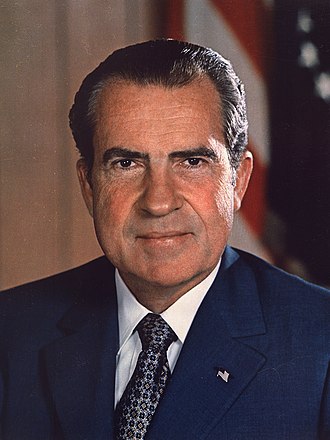
Richard M. Nixon served as the 37th President of the United States from January 1969 until his resignation in August 1974. In February 1971, he ordered the installation of a secret voice-activated taping system in the White House to preserve a historical record of his administration. Until the system's existence was revealed and dismantled in July 1973, the tapes captured Nixon directing major foreign policy initiatives, such as the opening to China, as well as his central role in the Watergate cover-up.
What Nixon talks about on the tapes
White House operations 4,718Presidential scheduling 2,225Public relations 1,784Presidential schedule 1,782Vietnam War 1,693Logistics 1,650Manolo Sanchez 1,626White House communications 1,400White House administration 1,399Presidential communication 1,243Henry Kissinger 1,191Foreign Policy 1,183
Conversations (21,010)
— Page 146 of 211President Nixon held an informal meeting with his personal valet, Manolo Sanchez, at the Aspen Lodge study at Camp David. As the audio segment is restricted and contains no substantive dialogue, no specific policy decisions or political topics were recorded or transpired. The encounter serves primarily as a record of the President's personal interactions with his staff during his retreat.
President Nixon and H. R. Haldeman coordinated the administration's second-term reorganization, specifically focusing on managing the departures and status of Cabinet members and White House staff, including William P. Rogers and Charles Colson. Nixon instructed Haldeman to pressure Rogers to accept new terms for his continued tenure as Secretary of State and to push for Colson’s exit while maintaining a facade of presidential loyalty. Additionally, Nixon directed Haldeman to reprimand Henry Kissinger regarding potential leaks of classified SALT negotiation materials found in a manuscript by a Brookings Institute associate.
President Nixon and H. R. Haldeman discuss the management of staff transitions and the need to exert firm control over key personnel, specifically regarding Secretary of State William Rogers. Nixon instructs Haldeman to handle upcoming meetings with a 'cold turkey' approach, ensuring that staff changes are executed decisively without allowing personnel to believe they are acting on behalf of their colleagues. Furthermore, Nixon directs Haldeman to reprimand Henry Kissinger regarding a subordinate's actions, emphasizing the necessity of maintaining strict administration oversight during these administrative shifts.
President Nixon contacted the Camp David operator to facilitate an urgent communication with his Chief of Staff, H. R. Haldeman. This brief administrative interaction served as a logistical step to initiate a subsequent high-level discussion. No further substantive policy matters were addressed during this exchange.
President Nixon requested that the Camp David operator connect him with Mr. Haller. This interaction was purely functional, serving as a brief administrative request to facilitate a phone communication. No substantive policy discussions or significant political developments occurred during this short exchange.
President Nixon directed H.R. Haldeman to initiate a direct, firm conversation with Secretary of State William P. Rogers regarding the administration's second-term reorganization. Nixon provided a specific briefing on the status of various cabinet members, including the departures of George Romney, John Volpe, and James Hodgson, as well as the retention of George Shultz and Richard Kleindienst. Furthermore, the two discussed concerns raised by the First Lady and family regarding potential negative press coverage of the transition, ultimately concluding that the public reaction to the President's recent interview with Jack Horner had been positive.
President Nixon and H.R. Haldeman discuss personnel management and the perception of the administration's internal culture. Nixon directs Haldeman to address sensitive staffing matters with Larry and expresses concern over reports from family members, including Julie and Tricia, that his administration is perceived as being overly cold and hard-hearted. The President seeks to evaluate the administration's public standing and communications strategies in response to these criticisms.
President Nixon contacted the Camp David operator to request a telephone connection with Patricia B. McKee. The brief communication served solely as a logistical instruction to facilitate this personal or professional call. No other substantive policy or political matters were discussed during this exchange.
President Nixon initiates a brief communication via the Camp David operator to request a phone connection with Travis McKee. This interaction serves purely as a functional attempt to place an outgoing call from the Aspen Lodge. No substantive policy matters or strategic discussions occurred during this brief exchange.
President Nixon initiated a brief, informal telephone call to Patricia B. McKee while she was attending a dinner at Laurel Lodge. The purpose of the contact was to check on the quality of her evening rather than to conduct official business. Nixon concluded the conversation by stating that he would provide her with routine work assignments the following morning.
President Nixon initiated a brief check-in with Patricia B. McKee while at Camp David to inquire about her dinner and confirm her availability for the following day. The exchange served primarily as a personal wellness check rather than a substantive policy discussion. Nixon concluded the brief call by noting that he had minor administrative matters to address with her the next morning.
President Nixon contacted the Camp David operator to facilitate a personal phone call to Ann Duggan in New York City. He instructed the operator to coordinate with the White House switchboard to retrieve the necessary contact information. This administrative exchange served as the preparatory step for completing the outgoing call.
President Nixon contacted the Camp David operator to facilitate a telephone call to Paul W. Keyes, a television producer and frequent associate. The President requested that the White House operator connect him to Keyes, who was located in Los Angeles at the time. This brief administrative interaction served as a logistical step to bridge communication between the President and Keyes.
President Nixon communicated with the Camp David operator to facilitate a connection or inquiry regarding a specific individual located in New York City. The brief exchange focused on verifying the person's location and establishing contact through the White House switchboard. No significant policy decisions were made during this logistical coordination.
President Nixon initiates a brief request for the Camp David operator to establish a telephone connection. The conversation centers on the operator informing the President that the intended recipient of the call is currently located in Los Angeles. This interaction serves as a functional logistics check to facilitate communication with a specific individual.
President Nixon calls Paul W. Keyes to extend an invitation for an upcoming post-Thanksgiving getaway at Mermaid Key with Robert Abplanalp and Bebe Rebozo. The two briefly discuss the President's recent landslide election victory, with Nixon noting that his electoral margin surpassed that of Lyndon B. Johnson. Keyes commends the tone of Nixon's victory remarks, and they finalize logistical plans for their Florida trip.
President Nixon and television producer Paul W. Keyes coordinate a post-Thanksgiving trip to Florida for a period of relaxation. During the brief planning discussion, the two touched upon the electoral success of the 1972 campaign, with Nixon noting that his margin surpassed that of Lyndon Johnson. The conversation concluded with the pair firming up travel logistics for their upcoming getaway.
President Nixon attempted to place a telephone call to Ann Duggan, but the Camp David operator reported that she could not be reached at either her New York or California residences. After receiving confirmation that there was no answer at both locations, the President instructed the operator to abandon the effort. No further action was taken regarding the call.
President Nixon held an administrative discussion with a Camp David operator to facilitate communication logistics. The brief exchange served to establish necessary connections for the President's ongoing work at the Aspen Lodge. No substantive policy decisions or political developments were recorded during this brief technical interaction.
President Nixon contacted the Camp David operator to facilitate an outgoing call to Press Secretary Ronald L. Ziegler. The conversation was strictly administrative, serving solely as a request to connect with a senior staff member. No policy matters or further substantive discussions were conducted during this brief exchange.
In this memorandum, President Nixon dictates his reflections on the reorganization of his second-term administration, focusing on personnel dynamics and structural changes. He evaluates the ongoing friction between Henry Kissinger and William P. Rogers, compares the bureaucratic management styles of Elliot Richardson and George P. Shultz, and weighs the political liabilities of retaining Charles W. Colson amidst the growing Watergate controversy. Nixon ultimately emphasizes the necessity of protecting the integrity of the presidency by removing staff who have become political distractions.
President Nixon met with his valet, Manolo Sanchez, at Camp David to coordinate the logistical details of his return to Washington, D.C. The discussion focused on the timing of his departure and the handling of correspondence from a woman identified as McKee. Nixon directed Sanchez to ensure that the letter was delivered for his review once its preparation was finalized.
President Nixon engages in a wide-ranging discussion concerning his foreign and domestic policy agenda. The dialogue touches upon the influence of British political traditions, historical campaign tactics like those used in 1948, and the importance of maintaining a consistent policy course. The conversation reflects on the strategic utility of media criticism and concludes with a brief exchange regarding impending administrative tasks.
President Nixon and his close associate Charles G. "Bebe" Rebozo met at Camp David to discuss logistics for their upcoming travel and holiday plans. They coordinated transportation arrangements, with the President offering Rebozo a ride back to Washington, D.C., via helicopter. Additionally, the pair finalized itinerary details for a post-Thanksgiving trip to Florida, including potential stops at Grand Key and meetings with acquaintances like Paul Keyes.
President Nixon dictates a letter to British journalist Bernard Levin to express appreciation for his public support during the 1972 election cycle. Acknowledging that Levin likely faced professional backlash from his peers in the British press for backing a Republican candidate, Nixon seeks to reinforce their professional rapport. The recording captures the President finalizing the phrasing of this acknowledgment and arranging for the correspondence to be processed through his office.
President Nixon met with an unknown individual to discuss the strategic distribution of a political column. Nixon directed that the material be sent to Charles Colson for dissemination among key opinion leaders and specifically requested that it be shared with McKinnon. This action reflects the administration's ongoing efforts to influence public discourse through targeted media outreach.
President Nixon communicated with the Camp David operator from the Aspen Lodge study to address logistical or administrative needs at the retreat. This brief exchange reflects the routine coordination required for the President while working at the facility. No substantive policy matters or strategic developments were recorded during this interaction.
President Nixon and Ronald Ziegler discussed media strategy regarding the administration's upcoming second-term reorganization and the President's personal involvement in critical policy negotiations. Nixon clarified that his brief return to Washington was for personal matters and to work on sensitive documents in the Lincoln Sitting Room, rather than to hold formal meetings. They coordinated on messaging to portray the reorganization as an orderly, thoughtful process meant to reenergize the government, while actively countering negative press perceptions of the administration as "heartless." Furthermore, Nixon provided instructions on how to frame his upcoming work on Vietnam and SALT II negotiations to emphasize his personal oversight of technical details.
President Nixon and Press Secretary Ronald L. Ziegler discuss public relations strategy regarding the President's upcoming schedule and the administration's ongoing cabinet and staff reorganization. Nixon directs Ziegler to emphasize that he is actively working on critical negotiating positions for SALT and Vietnam, while clarifying that his travel between Washington and Camp David is a matter of administrative necessity rather than scheduled meetings. Furthermore, they coordinate the messaging for the staff transition to ensure it is perceived as an orderly, renewal-focused process rather than a dismissive or 'heartless' purge.
President Nixon dictates a personal letter to Ann Duggan to express gratitude for the enduring friendship she and her late husband, Tom Duggan, provided his family over the decades. He specifically acknowledges Tom Duggan’s critical role in encouraging him to persevere in his political career following the 1962 election defeat. The letter serves as a formal recognition of the Duggan family's support during both the Nixon family's difficult political periods and their eventual electoral success.
President Nixon met with his confidant Charles G. “Bebe” Rebozo at Camp David to discuss logistics regarding the President’s return to Washington, D.C. The discussion focused primarily on transportation arrangements for the trip. The conversation concluded with brief coordination on travel plans before Rebozo’s departure.
President Nixon dictated a personal letter to his old friend Eddie Dugan while providing instructions to staff members, including Raymond K. Price, Jr., on managing post-election correspondence. He emphasized the importance of carefully culling mail from celebrities and longtime associates to ensure personalized, accurate responses. The dictated letter to Dugan reflected on their shared history, dating back to a 1934 cross-country trip and their time at Duke University, while acknowledging Dugan’s enduring political support.
President Nixon spoke with the White House operator to facilitate an outgoing call. The conversation serves primarily as a logistical step for the President to reach another party. No substantive policy discussions or significant presidential decisions are contained within this brief exchange.
President Nixon coordinated with the White House operator to facilitate communication regarding the travel schedules and locations of the First Family, specifically mentioning Pat Nixon, Julie Nixon Eisenhower, Tricia Nixon Cox, and Edward R. F. Cox. This brief exchange served to track the whereabouts of family members during the weekend. No major policy decisions were made during this logistical coordination.
President Nixon contacted the White House operator to facilitate a personal phone call to his daughter, Tricia Nixon Cox. The conversation was strictly administrative, serving solely as a request to connect the President with a family member. No policy matters or official government business were addressed during this brief exchange.
President Nixon held a brief, informal telephone conversation with his daughter, Tricia Nixon Cox, facilitated by a White House operator. The exchange served as a personal check-in between the President and his daughter. No policy matters or significant political decisions were discussed during this brief communication.
President Nixon contacted the White House operator to facilitate an immediate telephonic connection with his Assistant to the President for Domestic Affairs, John D. Ehrlichman. The brief exchange served exclusively as a procedural request to initiate this official communication. No further substantive policy discussions were recorded during this specific interaction.
President Nixon coordinated his immediate schedule through the White House operator to facilitate communication with key advisors. The President requested that John D. Ehrlichman contact him upon his arrival at the White House. Additionally, Nixon directed the operator to place a follow-up call to former Treasury Secretary John B. Connally.
President Nixon instructed the White House operator to place an outgoing call to Leonard Garment. This brief communication served solely as a logistical request to connect the President with his advisor. No policy discussions or substantive developments occurred during this interaction.
President Nixon requested a telephone connection to Leonard Garment while receiving a status update from the White House operator regarding John Connally. The operator informed the President that Connally was currently located on an island off the coast of Texas and reachable only via radio. Nixon declined a radio-based connection, deciding instead to wait until the following evening to communicate with Connally via a standard telephone line.
President Nixon calls Leonard Garment to coordinate a meeting at Camp David regarding the reorganization of his second-term cabinet. Nixon emphasizes his intent to break free from bureaucratic constraints by installing new personnel, specifically noting plans to move Caspar Weinberger into a major cabinet position and reassign Elliot Richardson. The conversation also transitions into a discussion on political conduct, with Nixon criticizing George McGovern’s 1972 concession statement while reflecting on his own history of gracious election losses.
President Nixon and Henry Kissinger discussed the ongoing Vietnam peace negotiations, specifically addressing concerns that the South Vietnamese government was attempting to delay or obstruct the process. Kissinger reported that Ambassador Ellsworth Bunker was encountering resistance from South Vietnamese officials, but the pair agreed that the U.S. could not delay the Paris negotiations or risk an open break with Saigon at this stage. Nixon instructed Kissinger to maintain a firm stance and finalize the best possible agreement, opting to manage the South Vietnamese response after the terms in Paris were settled.
President Nixon and John Ehrlichman discuss the potential retention of Peter G. Peterson during the administration's second-term reorganization. Nixon expresses a softened stance on Peterson's value, suggesting he may be useful in the Commerce Department despite previous reservations. Ehrlichman is tasked with consulting George Shultz during a scheduled meeting to determine if offering Peterson the Commerce position is a viable bargaining strategy.
President Nixon initiates a request for the White House operator to connect him with National Security Advisor Henry Kissinger. This brief interaction serves as a routine administrative bridge to facilitate direct communication between the President and his top foreign policy aide. No further substantive policy matters were discussed during this brief connection attempt.
President Nixon and Henry Kissinger discuss strategies for managing South Vietnamese President Nguyen Van Thieu's resistance to the ongoing Vietnam peace negotiations. Nixon directs Kissinger to instruct Ambassador Ellsworth Bunker to inform Thieu that the U.S. will maintain its current bargaining position and will not accept further disruptive changes to the draft agreement or new emissaries. Additionally, the pair briefly touches upon the potential appointment of Peter G. Peterson to a role in the Commerce Department under George Shultz.
President Nixon contacted the White House operator to facilitate a telephone connection with his Assistant to the President for Domestic Affairs, John D. Ehrlichman. The call served purely as a logistical request to initiate this communication channel. No further substantive policy matters or decisions were recorded during this brief administrative exchange.
President Nixon and John Ehrlichman discussed the prospects of Peter G. Peterson accepting a new appointment related to foreign policy. Based on feedback from Henry Kissinger, Ehrlichman advised that Peterson was likely to accept the role. Consequently, the President decided to delay pursuing alternative candidates to focus on finalizing the offer with Peterson.
President Nixon instructed the White House operator to contact H.R. Haldeman to arrange a return call. The President specified that Haldeman should not be interrupted if currently meeting with Secretary of State William P. Rogers, but requested that he be reached as soon as that engagement concluded. This exchange functioned solely as an administrative coordination to facilitate a high-level briefing.
The White House operator contacted President Nixon to provide an update regarding an unsuccessful attempt to reach H. R. Haldeman. The operator reported that Haldeman was currently in a meeting with Secretary of State William P. Rogers. Consequently, the operator left a message for Jo Anne Haldeman requesting that her husband return the President's call once he became available.
President Nixon initiates a brief telephone request through the White House operator to be connected with National Security Advisor Henry Kissinger. This administrative communication serves as a standard bridge to facilitate a high-level policy discussion. No further substantive details are provided, as the call concludes upon the establishment of the connection.
President Nixon and H.R. Haldeman discuss the reorganization of the administration for the second term, focusing on key personnel transitions and policy alignments. They confirm Secretary of State William P. Rogers' departure, address the need for greater internal loyalty within the Foreign Service, and strategize the replacement of various agency leaders, including discussions on moving Elliot Richardson to the Defense Department. Additionally, they review the status of Vietnam peace negotiations and contemplate the future roles of staff members such as Charles Colson and Peter Flanigan.
President Nixon and Henry Kissinger discuss the stalled Vietnam peace negotiations and the obstructionist bargaining tactics employed by South Vietnamese President Nguyen Van Thieu. Concerned that Thieu’s latest demands threaten to scuttle the agreement entirely, Nixon directs Kissinger to draft a firm letter emphasizing that the current U.S. aid programs will be jeopardized by the new Congress if a deal is not reached. The two leaders agree on the necessity of pressuring Thieu, acknowledging that the U.S. must take a tougher stance to force an resolution while avoiding an open, disastrous diplomatic break.
President Nixon contacted the White House operator to facilitate a telephone connection with his National Security Advisor, Henry Kissinger. The brief exchange served as a routine administrative request to initiate a high-level diplomatic discussion. No further substantive policy matters were addressed during this short bridge to the advisor.
President Nixon and Henry Kissinger discussed the administration's second-term reorganization, noting Melvin Laird's acceptance of Elliot Richardson's appointment. The conversation then shifted to the surplus of U.S. military aid in South Vietnam and the potential for dispatching Laird on a diplomatic mission to deliver a firm ultimatum to President Nguyen Van Thieu. They agreed that such a mission, to be accompanied by Alexander Haig, should only occur following the finalization of the Vietnam peace agreement.
President Nixon received a brief telephone call from a White House operator to facilitate a personal connection. The operator informed the President that Patricia Nixon was attempting to reach him. No substantive policy matters or administrative decisions were addressed during this brief exchange.
President Nixon contacted the White House operator to facilitate a direct communication with Press Secretary Ronald L. Ziegler. The conversation served exclusively as a brief administrative request to initiate this connection. No substantive policy matters or further developments were addressed during the brief interaction.
President Nixon and Ronald Ziegler discussed the unauthorized leak of information regarding the administration's second-term reorganization plans, which had appeared in the press. Nixon ordered Ziegler to investigate the source of the leak and expressed his intent to maintain strict control over future communications on the matter. Additionally, the President voiced strong frustration regarding a recent press interview given by Henry Kissinger, characterizing Kissinger's public remarks about his diplomatic role as embarrassing and harmful.
President Nixon contacted the White House operator to facilitate a telephone connection with his Chief of Staff, H.R. Haldeman. This brief administrative exchange served as the necessary step to initiate a direct line of communication between the President and his top advisor. No substantive policy matters were discussed during this brief request for the operator's assistance.
President Nixon and H.R. Haldeman discuss the scheduling of Cabinet meetings and the logistics for finalizing administrative appointments for the second term. The President emphasizes the need for a tightly controlled, coordinated public relations strategy to manage the announcement of these appointments and to curb unauthorized leaks, specifically expressing concern over a recent article in the Washington Star. Additionally, they discuss the necessity of maintaining a aggressive political counterattack capability after the 1972 election and examine H.R. Kissinger’s recent interview, which Nixon views as potentially damaging to the administration's internal dynamics.
President Nixon directed the White House operator to place a call to Charles W. Colson, who was believed to be in Virginia. Nixon instructed the operator not to aggressively pursue the connection if Colson was unavailable. The brief exchange served as a routine administrative request to reach a key staff member.
President Nixon and Charles Colson discuss plans for the second-term reorganization of the White House staff and Cabinet, focusing on personnel changes and the retention of a strategic public relations and counterattack capacity. The conversation explores specific appointments, including selecting Peter J. Brennan for the Department of Labor, the possibility of John A. Scali for the United Nations, and identifying a replacement for Colson's role. Nixon and Colson also strategize on managing political optics, including the importance of keeping some party-symbolic figures like Rogers Morton while aggressively purging the bureaucracy and shifting toward more politically loyal appointees.
President Nixon and Press Secretary Ronald Ziegler discussed a Washington Star report regarding the administration's second-term reorganization plans, which the President suspected was a compilation of previous legislative data rather than a deliberate leak. To mitigate further unauthorized disclosures, Nixon directed Ziegler to instruct John Ehrlichman and Caspar Weinberger to threaten the firing of any Office of Management and Budget (OMB) or Ehrlichman staff members responsible for future leaks. The President concluded by reinforcing a policy of strict silence, directing his subordinates to refrain from unauthorized commentary on administration planning.
President Nixon initiates a request through the White House operator to be connected with Chief of Staff H. R. Haldeman. This brief administrative interaction serves as a bridge to facilitate further executive communication. No substantive policy matters are discussed beyond the logistical instruction to place the call.
President Nixon attempted to reach Chief of Staff H. R. Haldeman by telephone to discuss urgent matters. The White House operator informed the President that Haldeman was attending church services and would be unavailable until 12:30 p.m. Consequently, Nixon decided to postpone the call until later in the afternoon.
President Nixon initiates a brief telephone request to the White House operator to be connected with his daughter, Julie Nixon Eisenhower. The exchange serves as a standard administrative request to facilitate a private family conversation. No substantive policy discussions or political developments occurred during this brief communication.
President Nixon held a brief telephone conversation with his daughter, Julie Nixon Eisenhower. Following a segment of the recording withheld for privacy reasons, the audio contains no substantive policy or administrative discussion. The interaction serves primarily as a personal check-in between family members.
President Nixon consulted with the White House operator to facilitate a communication regarding military aid. This brief interaction served to establish a connection for official business pertaining to defense policy or international assistance. No further substantive details regarding the specific parties or strategic directives were captured in this fragment of the recording.
President Nixon coordinated with Commander Craig S. Campbell to ensure the immediate departure of his helicopter. The President emphasized the urgency of the flight to avoid an approaching storm. Campbell confirmed that the transit would be initiated right away as directed.
President Nixon initiates a request to the White House operator to place a telephone call to H.R. "Bob" Haldeman. The exchange focuses on logistical administrative coordination to connect the President with his Chief of Staff. No further substantive policy matters were discussed during this brief communication.
President Richard Nixon initiated a telephone call through the White House operator, but the attempt was unsuccessful. No substantive discussion occurred as the connection failed to materialize. The record serves as documentation of an aborted communication attempt during this period.
President Nixon and H.R. Haldeman discuss the reorganization of the administration for the upcoming second term, focusing on staffing key Cabinet and department positions. They deliberate on potential appointments, including Peter Brennan for Labor, Howard Callaway and George H.W. Bush for Commerce or other roles, and the consideration of Anne Armstrong for a Cabinet post to improve the administration's political image. Additionally, Nixon expresses his intent to prioritize strong leadership at the Department of Defense under Elliot Richardson and addresses personnel transitions involving Charles Colson, Robert Finch, and Donald Rumsfeld.
President Nixon and H.R. Haldeman met at Camp David to discuss staffing decisions and potential cabinet appointments for the second term. They evaluated various candidates for high-level positions, emphasizing the need for political loyalty and effective public relations, including the potential appointment of a woman to a major cabinet role like Commerce or Interior. The President instructed Haldeman to coordinate with George Shultz to ensure specific political appointments were offered and finalized.
President Nixon and John Ehrlichman briefly discussed the status of second-term administration reorganization and Cabinet appointments. Nixon informed Ehrlichman that he had already addressed these issues with H.R. Haldeman, rendering a more detailed discussion unnecessary. The brief call concluded with the President encouraging Ehrlichman to enjoy the weather at Camp David.
President Nixon and John Ehrlichman held a brief, informal meeting at Camp David to exchange pleasantries and address the delivery of a television set. The discussion was entirely social in nature, focusing on personal items rather than official government business or policy. No administrative decisions or substantive developments resulted from this brief encounter.
President Nixon met with his personal valet, Manolo Sanchez, at Camp David to discuss football games. The conversation was informal and primarily focused on game commentary, including observations about specific plays and team performance. No official policy matters or significant administrative decisions were recorded during this brief interaction.
President Nixon met with his personal valet, Manolo Sanchez, at the Aspen Lodge study at Camp David to discuss logistical details regarding the President's schedule. The conversation centered on movements related to Birch Lodge. No significant policy decisions were recorded during this brief administrative interaction.
President Nixon contacted the Camp David operator to facilitate an urgent communication with his Chief of Staff, H.R. Haldeman. The primary purpose of the brief exchange was to secure a direct line for administrative coordination. The operator acknowledged the request and proceeded to initiate the call to Haldeman on the President's behalf.
President Nixon held an informal meeting with his daughter, Julie Nixon Eisenhower, at the Aspen Lodge study in Camp David. The discussion consisted primarily of private family matters, as the only recorded portion of the dialogue was withheld from the public record under a personal returnable deed of gift. No policy decisions or official administration actions resulted from this brief encounter.
President Nixon met with his daughter, Julie Nixon Eisenhower, at Camp David to discuss the status of his personal wardrobe. The brief exchange focused on verifying whether his clothing had been organized or checked. No significant policy decisions or major political developments occurred during this casual interaction.
President Nixon communicated with a Camp David operator to establish a communication line from the Aspen Lodge. This brief interaction served as a logistical necessity to enable the President to make or receive telephone calls from his remote retreat. The conversation functioned primarily as a technical request to facilitate connectivity for the President's ongoing duties.
President Richard Nixon met with his daughter, Julie Nixon Eisenhower, at the Aspen Lodge at Camp David. The primary substance of the discussion remains restricted, as the entirety of the recorded segment is currently identified as a withdrawn item. No policy decisions or actionable outcomes are accessible for this exchange due to the lack of available documentation or transcript.
President Nixon and H. R. Haldeman discuss strategies for removing key Republican officials, specifically RNC Chairman Bob Dole and political figures Peter Dominick and Bob Wilson, without the White House appearing responsible for the personnel changes. Nixon directs Haldeman to orchestrate external pressure by having party allies and state leaders publicly call for a full-time professional chairman, thereby creating a consensus that forces these individuals out gracefully. Additionally, the two touch upon a recent Life magazine cover featuring the President, which Nixon dismisses as a deliberate act of media sabotage, and they discuss organizing a public protest against the publication.
President Nixon and H. R. Haldeman discuss a strategy to force the resignation of Republican National Committee Chairman Bob Dole by orchestrating external pressure from party officials and regional leaders. By generating public calls for a full-time professional chairman, the President intends to distance the White House from the move and avoid the political heat associated with Dole's removal. Nixon instructs Haldeman to coordinate with John Mitchell to mobilize this grassroots-style campaign before the President personally meets with Dole.
President Nixon contacted the Camp David operator to arrange a telephone conversation with his daughter, Julie Nixon Eisenhower. He explicitly instructed the operator to facilitate the call only after she had awakened, ensuring she would not be disturbed. This brief interaction served as a routine personal scheduling request during the President's stay at the retreat.
President Nixon contacted the Camp David operator to facilitate a personal phone call to an individual named Claudia Val in New York. The President directed the operator to retrieve Val's contact information, noting that it should be available on the operator's existing call list or through his personal secretary, Rose Mary Woods. The conversation was limited to these logistical arrangements to establish communication with Val.
President Nixon consulted with Claudia Val to arrange potential entertainment and dining options in New York City for an upcoming trip involving political and legal business. The President requested recommendations for 'clean,' traditional entertainment, such as theater or sporting events, while explicitly excluding heavy or overly political performances. Val provided advice on high-end French restaurants and dining logistics for theater-goers, and Nixon instructed her to relay the final details to his military aide at Camp David.
President Nixon contacted the Camp David operator to request an outgoing call to his personal secretary, Rose Mary Woods. This brief communication served solely to facilitate administrative contact with a key staff member. No policy matters or substantive political issues were addressed during the brief interaction.
President Nixon directs Rose Mary Woods to notify his associates that his upcoming Florida trip will be delayed by one week to accommodate Henry Kissinger’s return from Paris and to coordinate with his Cabinet’s return from abroad. The two also discuss the impending resignation of U.S. representative Gordon H. Scherer, which stemmed from a disagreement with State Department instructions regarding a treaty for the protection of journalists. Nixon agrees to consult with George H.W. Bush on the matter and mandates that a congratulatory telegram be sent to West German Chancellor Willy Brandt regarding his electoral victory.
President Nixon consulted his daughter, Julie Nixon Eisenhower, to coordinate a family trip to New York City for the upcoming holiday weekend. The President planned to combine personal activities—including shopping, attending a Broadway show or hockey game, and visiting a church—with a visit to his former law firm and a symbolic trip to Brooklyn to acknowledge his performance in the 1972 election. Nixon delegated the logistical planning, including selecting entertainment and consulting with Tricia Nixon Cox, to Julie while he remained at Camp David to manage affairs surrounding Henry Kissinger’s return.
President Nixon consulted with the White House operator in an attempt to place a telephone call while at Camp David. The exchange includes background audio of H. R. Haldeman and Ronald Ziegler discussing logistics regarding a scheduled Thanksgiving party. The interaction concludes without the successful completion of the intended call.
In this meeting at Camp David, President Nixon and H. R. Haldeman discuss the personnel and strategic reorganization of the administration's second term, including the management of press relations and the handling of key cabinet members and staffers. Nixon emphasizes the need for loyal, dedicated personnel and discusses his desire to establish a more personal, warmer public image by utilizing surrogates and better controlling media access. They also address the tactical handling of critical news outlets, specifically Life and Time magazines, and deliberate on the best approach for announcing upcoming cabinet changes and the President’s post-landslide agenda.
President Nixon initiated a brief telephone communication with the Camp David operator to facilitate an urgent contact. The primary objective of the call was to request that the operator connect him with a military aide. No further policy discussions or significant political developments occurred during this administrative exchange.
President Nixon instructed the Camp David operator to prioritize a telephone connection with domestic advisor John D. Ehrlichman. Consequently, he directed the operator to cancel a previously requested call to a military aide. The brief exchange served as a logistical adjustment to the President's immediate communications schedule.
President Nixon coordinates a meeting at Camp David with John D. Ehrlichman and George H.W. Bush. The President determines the logistics for the gathering, instructing Ehrlichman to bring Bush to the Aspen Lodge to facilitate their discussion. The brief call serves primarily as a scheduling coordination between the participants.
President Nixon dictates a memorandum for the file regarding a wide-ranging review of his administration's political landscape following the 1972 election. The recording captures his reflections on personnel management, including potential changes to the Republican National Committee and cabinet-level shifts, as well as strategies for managing his public image and press relations. Additionally, the President assesses the effectiveness of key advisors and evaluates potential appointments for his second term, including considerations for the United Nations and the Internal Revenue Service.
President Nixon consulted with H. R. Haldeman and John Ehrlichman to finalize logistical arrangements for an upcoming family trip to New York and to coordinate the scheduling of political meetings at Camp David. The participants discussed hotel accommodations, the timing of a secretive meeting with Henry Kissinger to avoid premature press attention, and the importance of balancing Republican leadership presence at Camp David by inviting Barry Goldwater to meet alongside Nelson Rockefeller. Additionally, they reviewed progress on RNC personnel matters, including directives for John Mitchell to mobilize key committee staff.
President Nixon and H. R. Haldeman coordinate logistical preparations for an upcoming trip, focusing on managing public perception and scheduling meetings with key political figures. They discuss the importance of delaying official announcements to avoid premature speculation and finalize the guest list, which includes Nelson Rockefeller and Barry Goldwater. The conversation concludes with the President instructing Haldeman to hold off on contacting John Mitchell for the time being.
President Nixon contacted the Camp David operator to facilitate a telephone connection with Special Counsel Charles W. Colson. This brief interaction served solely as an administrative request to reach a senior staff member for further communication. No substantive policy discussions or decisions occurred during this exchange.
President Nixon dictated a memorandum outlining key strategies for his second-term administration and executive reorganization. He specifically considered implementing a 'Super Cabinet' structure to better navigate relations with Congress. Additionally, the President reviewed John Connally’s proposal regarding the potential retirement and reconfirmation of Supreme Court justices.
President Nixon consulted with the Camp David operator to locate a specific item or document within the presidential retreat. The brief interaction focused on logistical assistance regarding the physical placement of materials. No substantive policy or political developments occurred during this exchange.