Nixon, Richard M. (President)
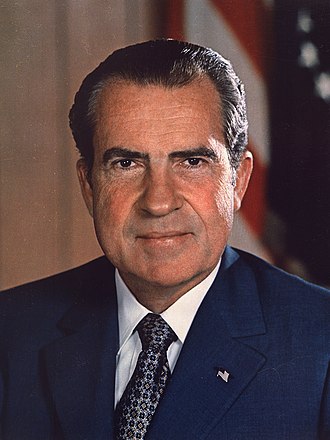
Richard M. Nixon served as the 37th President of the United States from January 1969 until his resignation in August 1974. In February 1971, he ordered the installation of a secret voice-activated taping system in the White House to preserve a historical record of his administration. Until the system's existence was revealed and dismantled in July 1973, the tapes captured Nixon directing major foreign policy initiatives, such as the opening to China, as well as his central role in the Watergate cover-up.
What Nixon talks about on the tapes
White House operations 4,718Presidential scheduling 2,225Public relations 1,784Presidential schedule 1,782Vietnam War 1,693Logistics 1,650Manolo Sanchez 1,626White House communications 1,400White House administration 1,399Presidential communication 1,243Henry Kissinger 1,191Foreign Policy 1,183
Conversations (21,010)
— Page 154 of 211President Nixon consulted with Colonel Richard T. Kennedy to coordinate administrative logistics regarding a planned telephone call to Maurice J. Williams. The discussion also touched upon the timing and messaging strategies for Henry Kissinger’s ongoing negotiations in Paris concerning Vietnam. The President directed the scheduling of the call to Williams and sought status updates on the diplomatic efforts.
President Richard Nixon met with his personal aide, Manolo Sanchez, in the Old Executive Office Building to discuss the President's upcoming schedule. The conversation focused on the logistics and planning of official engagements and personal commitments during the transition into the new year. No significant policy decisions were recorded during this brief administrative check-in.
President Nixon met with L. Nicholas Ruwe to record a dictated letter of appreciation. The discussion centered on the President's gratitude for Ruwe's friendship and a thoughtful gift of Monte Cruz cigars, which reminded Nixon of their association during his 1962 California gubernatorial campaign. The meeting concluded with the exchange of New Year’s greetings.
President Nixon dictates a formal letter to Raymond C. Moley to express personal gratitude for Moley’s long-standing support, including his backing during Nixon's time as Vice President and his period out of office. The President reflects on the 1972 election campaign and the role of the National Committees, while also including a New Year's greeting from First Lady Pat Nixon. The discussion focuses on refining the letter's tone and content to ensure it appropriately acknowledges Moley's past contributions.
President Nixon utilized this time to dictate a letter addressed to Ann Duggan. Additionally, he recorded his personal reflections regarding the transition between his first and second presidential terms. The session concluded with the drafting of a New Year's greeting for First Lady Pat Nixon.
President Nixon dictated a letter to Douglas W. Downs to formally express gratitude for a gift, a sculpture titled the “Tinker,” received by the First Lady during the Christmas season. The correspondence addresses Downs’ earlier letter, acknowledging his reflections on the presidency and his metaphorical advice regarding the political climate of the upcoming second term. The President concluded the dictation by including New Year’s greetings from both himself and Mrs. Nixon.
President Nixon held a meeting in his Old Executive Office Building suite with unidentified individuals to exchange greetings. The discussion primarily focused on reflections regarding the 1972 presidential campaign. No further substantive policy or administrative actions were recorded during this brief encounter.
President Nixon and Stephen B. Bull discussed the relief efforts following the recent earthquake in Nicaragua, specifically noting Ambassador Turner B. Shelton's gratitude for the administration's support. Nixon also provided instructions to facilitate follow-up telephone communications with Maurice J. Williams. Furthermore, the President emphasized maintaining discretion regarding his prior contacts with Williams, requesting that this information not be shared with Gerald L. Warren.
President Richard M. Nixon met with his longtime valet, Manolo Sanchez, in the Old Executive Office Building for a brief personal interaction. The conversation was largely characterized by a 38-second segment that remains withheld for personal privacy reasons, rendering the specific substance of their exchange inaccessible. The meeting concluded shortly after these discussions, with Sanchez departing the office at 2:26 pm.
President Nixon calls Maurice J. Williams while he is on vacation to appoint him to lead the U.S. relief mission to Nicaragua following a devastating earthquake. Nixon grants Williams full authority to coordinate all government and volunteer agencies and emphasizes the necessity of managing public relations to highlight the U.S. aid effort throughout Latin America. Williams is instructed to leverage his discretion in staffing and reporting, with Nixon noting that Ambassador Turner B. Shelton would provide local support.
President Nixon recruited Maurice J. Williams to lead a high-level humanitarian mission in response to a crisis, tasking him with coordinating efforts across both government and volunteer agencies. Nixon emphasized that Williams should maintain a high media profile to highlight U.S. aid efforts, specifically for both domestic and Pan-American audiences. The President directed Williams to provide brief, regular updates while managing the complex inter-agency response to the disaster.
President Nixon contacts the White House operator to request an outgoing call. He specifically asks to be connected to Marjorie P. Acker to conduct official business. No further substantive discussion occurs during this brief administrative exchange.
President Nixon interacts with the White House operator during a brief administrative exchange in the Executive Office Building. This conversation serves as a routine connection point for the President's communications. No substantive policy or political discussions occur during this brief recorded interval.
President Nixon calls Marjorie P. Acker to verify the status of a memorandum intended for Raymond K. Price, Jr. Nixon instructs Acker to ensure the document is delivered to Price before he follows up with a phone call to discuss its contents. The exchange confirms that the draft is nearing completion and establishes a specific sequence for the upcoming communication with Price.
President Nixon held a brief, informal meeting with Marjorie P. Acker in his Old Executive Office Building suite. Their exchange was limited to social pleasantries and a brief directive from the President encouraging her not to rush. No substantive policy matters or administrative decisions were addressed during this minute-long encounter.
President Nixon contacted the White House operator to place a direct call to speechwriter Raymond K. Price, Jr. This brief administrative interaction served as the initiation of a communication link between the President and his staff member. No further substantive policy discussions were recorded during this brief exchange.
President Nixon consulted with a White House operator to facilitate a telephonic connection. This brief interaction served as a routine administrative task to establish communication with another party. No substantive policy discussions or significant political decisions occurred during this brief exchange.
President Nixon and speechwriter Raymond K. Price, Jr. discuss the preparation and thematic direction for Nixon's 1973 inaugural address. Nixon emphasizes the need for a brief, uplifting speech—ideally 1,000 to 1,200 words—that avoids a "laundry list" of policy accomplishments in favor of broader themes like national renewal, individual responsibility, and faith in America. He encourages Price to refine the draft further and offers him the use of Camp David as a workspace to facilitate his writing process.
President Nixon met with speechwriter Raymond K. Price, Jr. to discuss the transfer and handling of sensitive personal or historical documents. Nixon expressed a reflective mood regarding his impending departure from office and the broader legacy of his presidency. The conversation centered on the President's desire to entrust Price with specific materials and provided a brief moment of introspection on the challenges of his tenure.
President Nixon initiates a brief telephone exchange with the White House operator to request a connection to Stephen B. Bull. The interaction serves as a routine administrative step to facilitate a subsequent conversation with a key staff member. No further policy or substantive matters are discussed during this brief bridge call.
President Nixon met with his personal aide, Manolo Sanchez, to coordinate logistics for a trip to Camp David scheduled for later that afternoon. The discussion focused on departure timing and transportation arrangements, including the potential inclusion of the President's dog. Ultimately, the two finalized the travel plans for the upcoming presidential visit.
President Nixon held a brief administrative interaction with the White House operator to facilitate an outgoing call. No substantial policy matters or significant decisions were addressed during this exchange. The conversation functioned solely as a routine operational bridge to connect the President to another party.
President Nixon instructed his aide, Stephen B. Bull, to coordinate travel and lodging arrangements for speechwriter Raymond K. Price, Jr. at Camp David. Nixon offered Price the option to travel via the presidential helicopter or a subsequent carrier, provided he utilized one of the newer lodges rather than Aspen, Birch, or Dogwood. Additionally, Bull confirmed that First Lady Pat Nixon was prepared for the scheduled departure.
President Nixon met with his aide, Stephen B. Bull, for a brief administrative discussion in the Old Executive Office Building. While the exact substance of their exchange remains unrecorded in the available transcript, the meeting served as a direct point of contact for the President to provide instructions or receive updates from his staff. No significant policy developments were captured during this one-minute encounter.
Colonel Richard T. Kennedy informed President Nixon that North Vietnamese negotiators had accepted the proposed schedule for technical meetings on January 2, 1973, and high-level talks between Henry Kissinger and Le Duc Tho on January 8. The two discussed the necessary cessation of U.S. bombing in North Vietnam, ultimately agreeing to move the start date for the halt forward to December 29 to facilitate the diplomatic process. President Nixon directed Kennedy to ensure Kissinger called him immediately to finalize details before his departure for Camp David.
President Nixon and Colonel Richard T. Kennedy briefly coordinated regarding the timing of an upcoming public announcement and the logistics of a follow-up communication from Henry Kissinger. The discussion centered on verifying the current date and clarifying the schedule for when Kissinger would next reach out to the President. No major policy decisions were made, as the exchange focused primarily on internal scheduling and communication protocols.
President Nixon met with his personal secretary, Rose Mary Woods, to coordinate administrative logistics regarding the upcoming 1973 inauguration. They reviewed guest lists and ticket arrangements for individuals including Marjorie P. Acker and historian David Davis, the latter of whom was being considered for potential research collaborations. The discussion also touched upon the scheduling of upcoming appointments and the management of current office correspondence.
President Nixon and his personal secretary, Rose Mary Woods, discussed administrative arrangements regarding the President's upcoming schedule and specific documentation. The pair addressed the logistics of a planned helicopter flight and the handling of materials related to Robert Gray. Nixon directed Woods to leave the documents in his office so he could review them personally upon his return.
President Nixon and Henry Kissinger discussed the resumption of Vietnam peace negotiations following North Vietnam's positive response to U.S. overtures. The two agreed on a schedule to announce a bombing halt of North Vietnam and the subsequent restart of technical talks. They also strategized on how to manage the South Vietnamese leadership and domestic U.S. political concerns, ultimately deciding to delay major diplomatic moves, including Vice President Agnew's trip to Saigon, until after the 1973 presidential inauguration to minimize the risk of a public confrontation.
President Nixon and Henry Kissinger coordinate the timing for a public announcement regarding the acceptance of a peace proposal, finalizing a Saturday morning deadline. They discuss the strategic necessity of adhering to their commitments and address the political optics of the ongoing bombing campaign. The conversation confirms that both parties have agreed to the terms, with Nixon emphasizing the importance of fulfilling their stated word.
President Nixon contacted the White House operator to issue a formal request for Charles W. Colson’s immediate presence. The President directed that Colson report to his Executive Office Building (EOB) office for a consultation. This brief administrative interaction served to facilitate an urgent meeting between the President and his special counsel.
President Nixon contacted the White House operator to place an outgoing call to his aide, Stephen B. Bull. The President initially misidentified the recipient as the First Lady before correcting himself to specify Bull. This brief administrative exchange served solely to facilitate a direct line of communication between the President and his staff.
President Nixon and Stephen B. Bull coordinated logistics for a scheduled departure to Camp David. The President instructed Bull to inform First Lady Pat Nixon of a ten-minute delay in their helicopter transport. Additionally, the pair briefly confirmed that Raymond K. Price, Jr. was slated to arrive the following morning.
President Richard Nixon met with his personal aide, Manolo Sanchez, at Camp David to discuss logistical matters and personal arrangements. The conversation touched upon the organization of White House gifts, including golf balls from Oak Hill Country Club, as well as the President’s evening plans to view a movie with First Lady Pat Nixon. The discussion concluded with brief instructions regarding lighting and general household coordination.
President Nixon contacted the Camp David operator to facilitate an outgoing call to his close friend and confidant, Charles G. “Bebe” Rebozo. This brief administrative interaction served as a logistical step to establish communication during the President's stay at the retreat. No substantive policy matters were discussed during this brief exchange.
President Nixon dictates a memorandum for the file regarding Vietnam peace negotiations and administration strategy, followed by a brief discussion with his aide, Manolo Sanchez, about scheduling and a report on George Wallace. Nixon evaluates the status of ceasefire talks, the potential for resuming bombing, and the administration's public relations management of these policies during the Congressional recess. The conversation concludes with administrative logistics regarding movie plans and a follow-up call to Bebe Rebozo regarding Governor Wallace.
President Nixon held a brief, informal communication with the Camp David operator from the Aspen Lodge study. The interaction appears to be a routine administrative exchange regarding telephone connectivity or logistics at the retreat. No substantive policy discussions or significant political developments occurred during this brief contact.
President Nixon coordinated with a Camp David operator to manage a scheduled communication with Charles G. “Bebe” Rebozo. During the brief exchange, Nixon decided to cancel the pending call with Rebozo until the following morning. The interaction served as a logistical update to delay the conversation until a more suitable time.
President Nixon consulted with the Camp David operator regarding the scheduling of his communications for the evening. The two parties mutually agreed to postpone further calls until the following day. This brief exchange served to finalize the President's logistical plans for the night.
President Nixon met with his valet, Manolo Sanchez, at the Aspen Lodge in Camp David to attend to personal tasks, including the maintenance of a fireplace fire using newspaper. During the brief interaction, the two discussed administrative details regarding a Dictabelt recording and personal files. The conversation concluded with pleasantries as Sanchez departed for the evening.
President Nixon contacted the Camp David operator to facilitate an urgent communication request. The primary purpose of the brief interaction was to initiate a telephone call to National Security Advisor Henry A. Kissinger. This exchange highlights the President's reliance on support staff to maintain secure and direct lines of communication with his foreign policy team while at the presidential retreat.
President Nixon communicated with the Camp David operator to facilitate an operational adjustment at the Aspen Lodge. The brief exchange focused on a request to change the location of their current interaction. No substantive policy matters or administrative decisions were addressed beyond this logistical coordination.
President Nixon and Henry Kissinger discussed the logistical coordination of the upcoming announcement regarding the cessation of U.S. bombing north of the 20th Parallel in North Vietnam. They focused on maintaining a low-key, professional public tone to avoid appearing desperate while ensuring that congressional leaders were properly briefed without providing excessive detail. The two men also reviewed the status of peace negotiations and the strategic significance of the bombing campaign in pressuring North Vietnamese leadership to return to the bargaining table.
President Nixon and Henry Kissinger coordinated the messaging strategy for an upcoming, highly sensitive announcement regarding Vietnam peace negotiations. The President directed that the announcement be delivered in a strictly scripted, low-key manner by press secretary Ronald Ziegler to prevent unauthorized interpretations or deviations from official policy. Additionally, they strategized on managing Congressional leaders, specifically deciding to brief only Senator Mike Mansfield while withholding information from others to protect the delicate status of the ongoing talks.
President Nixon met with William Hirsch at the Aspen Lodge during the holiday season to discuss the residence's atmosphere. The conversation focused on the quality of the Christmas decorations, for which Hirsch held responsibility, and the maintenance of the fireplace. No major policy decisions were made during this informal exchange.
President Nixon contacted the Camp David operator to facilitate an official communication. He requested that a call be placed to Colonel Richard T. Kennedy. This administrative interaction served as a brief logistical step to connect the President with a member of the National Security Council staff.
President Nixon initiates a brief telephonic request through the Camp David operator to be connected with Colonel Kennedy. This interaction serves purely as a functional logistical step to facilitate direct communication with a specific staff member. No policy discussions or substantive administrative developments occur during this brief exchange.
President Nixon and Col. Richard T. Kennedy discuss the ongoing U.S. bombing campaign in North Vietnam, specifically focusing on the strategic effectiveness of sustained strikes and the planned cessation of operations north of the 20th Parallel. They coordinate messaging for White House press secretary Gerald L. Warren, instructing him to maintain a "no comment" stance regarding military operations and negotiations to avoid leaks or premature disclosures. Additionally, the pair reviews media management regarding the upcoming bombing policy shift and touches upon logistical support for earthquake relief in Nicaragua.
President Nixon and Col. Richard T. Kennedy discussed the handling of upcoming official announcements and the management of press speculation regarding ongoing military operations and sensitive negotiations. Nixon emphasized the need for strict message discipline, directing his staff to provide a firm 'no comment' to the press to avoid linking forthcoming disclosures to recent military developments. The President further instructed that information regarding these sensitive matters be withheld from various foreign allies to ensure that the administration’s strategic objectives remain undisturbed by external political pressures.
President Nixon contacted the Camp David operator to facilitate an urgent communication with National Security Advisor Henry A. Kissinger. This brief administrative interaction served as a logistical step to establish a line of contact while the President was working from the Camp David study. No substantive policy matters were discussed during this brief request for assistance.
President Nixon contacted the Camp David operator to facilitate administrative communication regarding his schedule and personal contacts. During the brief interaction, the President sought a status update on a phone call with Henry Kissinger and requested to be connected to his close friend, Charles G. “Bebe” Rebozo. The operator informed the President of Kissinger's unavailability and promised to return the call once the line cleared.
President Nixon and his valet, Manolo Sanchez, discuss the secure storage of sensitive presidential materials at the Camp David retreat. Nixon identifies specific files and a Dictabelt tape intended for his private archives, instructing that they be transferred to Rose Mary Woods’s office for safekeeping. The exchange emphasizes the President's concern for maintaining the security of his personal records within the White House administrative structure.
President Nixon interacted with the Camp David telephone operator while situated in the Aspen Lodge study. The brief exchange primarily involved the President requesting permission to utilize a specific seating area. No substantive policy matters or major administrative decisions were discussed during this interaction.
President Nixon initiated a brief communication with the Camp David operator to establish a connection or verify phone service at Aspen Lodge. The interaction serves as a routine administrative check within the facility's telecommunications framework. No substantive policy matters or strategic decisions were discussed during this brief exchange.
President Nixon and Henry Kissinger discussed the communication strategy regarding the upcoming announcement of a pause in the bombing of North Vietnam. They aimed to frame the decision as a calculated step in an ongoing negotiation process rather than a reaction to domestic political pressure or public protests. Kissinger was tasked with briefing key Congressional leaders and influential media figures to maintain a posture of resolve while reinforcing the administration's serious commitment to ending the conflict.
President Nixon and Henry Kissinger met to coordinate the messaging strategy surrounding the upcoming announcement of resumed peace negotiations with North Vietnam. The discussion focused on how to frame the resumption of talks to avoid the perception that the U.S. had backed down due to public criticism or the recent bombing campaign. They decided on a plan to brief key political allies, including Republican and Democratic congressional leaders, to ensure a controlled and favorable narrative before the news broke.
President Nixon contacted the Camp David operator to facilitate an outgoing call to John V. “Jack” Brennan. The President requested that Commander Alexander R. Larzelere assist in coordinating this communication. No further policy or substantive matters were discussed during this brief administrative exchange.
President Nixon consulted with the Camp David operator to coordinate a series of upcoming telephone calls. The President confirmed the sequence of his communications, directing the operator to connect him with Charles “Bebe” Rebozo immediately following a scheduled call with Commander Lawrence. This brief interaction served as a logistical arrangement for the President's personal and official correspondence.
President Nixon communicated with the Camp David operator to facilitate a phone connection with Major Brennan. The brief exchange focused exclusively on coordinating this specific call. No policy discussions or significant political decisions occurred during this interaction.
President Nixon consulted with Commander Alexander R. Larzelere regarding the logistical arrangements and housing assignments for upcoming visitors at Camp David. The conversation focused on coordinating the arrival and accommodations for staff member Raymond K. Price, Jr. and the travel schedule for Tricia Nixon Cox regarding her planned trip to the Soviet Union. The primary objective was to ensure proper oversight of personnel movements and facility usage during the holiday period.
President Nixon consulted with Commander Alexander R. Larzelere regarding personal logistics and travel arrangements. The discussion touched upon the potential inclusion of a dog in upcoming plans and requested confirmation of Trisha Nixon’s scheduled arrival in Russia. The brief exchange served to finalize these minor administrative and family-related inquiries.
President Nixon and his close associate Bebe Rebozo discuss Rebozo's recent meeting with George C. Wallace, during which Wallace expressed strong appreciation for the President's previous visit. The two men also touch upon personal schedules, including upcoming travel, potential future visits to Camp David, and arrangements for John and Martha Mitchell to dine at the President's residence in Key Biscayne. Additionally, Rebozo briefly updates the President on ongoing real estate operations.
President Nixon and close confidant Bebe Rebozo engaged in a brief, informal check-in at Camp David to discuss personal logistics and travel plans. The President mentioned his upcoming return to work for the congressional session and his wife's travel to California. Additionally, Nixon directed Rebozo to host John and Martha Mitchell for dinner at his home to enjoy the amenities.
President Nixon contacted the Camp David operator to facilitate a telephone connection with his National Security Advisor, Henry A. Kissinger. This brief administrative interaction served as the necessary logistical step to initiate a policy-focused discussion. No further details regarding the substance of the subsequent conversation were captured in this recording.
President Nixon initiated a brief communication with the Camp David switchboard operator to facilitate an outgoing call. The interaction served a purely administrative purpose regarding telephonic logistics at the retreat. No substantive policy discussions or political developments occurred during this brief exchange.
President Nixon and Henry Kissinger discuss the international reaction to the U.S. bombing campaign in North Vietnam, specifically analyzing statements from Chou En-lai and concerns regarding Australian Prime Minister Gough Whitlam. They coordinate strategies for managing communications with various allied nations to ensure the administration maintains control over foreign policy messages. The two also resolve to keep the Australian leadership at a distance while managing tensions stemming from Whitlam's criticism of the U.S. military actions.
President Nixon and Henry Kissinger discuss retaliatory measures against the Australian government following its criticism of U.S. bombing operations during the Vietnam War. Nixon explicitly instructs Kissinger to exclude Australian officials from sensitive communications and mandates a diplomatic freeze that includes avoiding social functions and birthday messages. The conversation underscores the administration's intent to punish the Australian leadership for their political opposition to American military policy.
Colonel Richard T. Kennedy contacted President Nixon to coordinate travel logistics for a scheduled visit to Camp David. Kennedy proposed a timeline for his and Gerald L. Warren's departure and arrival to ensure the meeting could proceed as planned. The President approved the suggested arrangements, finalizing the travel itinerary for the group.
President Nixon consults with Colonel Richard T. Kennedy regarding the logistical arrangements for an upcoming meeting. The President instructs Kennedy to limit the number of attendees to ensure discretion and emphasizes the need for a controlled approach when discussing potential points of contact. The conversation concludes with a directive for the participants to travel to the President's location.
President Nixon contacted the Camp David operator to facilitate a telephone call to his special counsel, Charles W. Colson. This brief communication served solely as a logistical request to establish a line of connection between the President and his aide. No substantive policy discussions or decisions were recorded during this brief administrative interaction.
President Nixon held a brief, informal communication with the Camp David operator from the Aspen Lodge. The exchange involved no substantive policy discussions or significant administrative decisions. It functions primarily as a record of a routine administrative check-in between the President and support staff.
President Nixon and Charles Colson discussed public relations strategy following the resumption of US bombing in North Vietnam and the subsequent stalling of peace negotiations. They focused on countering negative media portrayals and criticism from "liberal" commentators by emphasizing the necessity of the bombing to force North Vietnamese compliance. Nixon directed Colson to coordinate with John Scali to leak the administration's perspective on a deep-background basis, aiming to control the narrative and reinforce the President's credibility with his "new majority" of supporters.
President Nixon and Charles Colson discuss strategies for managing public perception and media narratives regarding the ongoing Vietnam War bombing campaign. Nixon emphasizes the importance of avoiding official White House fingerprints on the messaging to prevent perceptions of political manipulation, preferring that supportive journalists and non-administration voices propagate the administration's perspective. The two discuss using Henry Kissinger to guide key political figures while ensuring that the official line remains consistent to counter anticipated criticism from political opponents.
President Nixon met with his personal valet, Manolo Sanchez, at the Aspen Lodge study at Camp David to manage logistical arrangements. The discussion focused primarily on the President's schedule and the handling of briefcases related to his stay at Birch Lodge. No major policy decisions were recorded during this brief administrative interaction.
President Nixon contacted the Camp David operator to facilitate an urgent communication with Colonel Richard T. Kennedy. The primary objective of the call was to secure a connection to Kennedy, who served as a key staff member on the National Security Council. This brief administrative interaction served as the necessary logistical step for the President to consult with his advisor on pressing foreign policy or national security matters.
President Nixon initiates a brief communication through the Camp David operator to establish a connection with Colonel Kennedy. The exchange serves as a logistical bridge to facilitate a direct conversation between the President and the Colonel. No further substantive policy matters or decisions are addressed in this short administrative interaction.
President Nixon contacted the Camp David operator to determine the whereabouts of Colonel Richard T. Kennedy. The operator informed the President that Kennedy was currently en route to the State Department and expected back in his office after 6:00 p.m. Nixon subsequently requested that a call be placed to Henry A. Kissinger, opting to wait until later to avoid unnecessary interruptions.
President Nixon contacted the Camp David operator to facilitate administrative communication while at the retreat. He specifically requested that a telephone call be placed to his aide, Stephen B. Bull. This brief exchange served as a logistical step to coordinate staff connectivity during the President's stay.
President Nixon held a brief, informal check-in with the Camp David operator to inquire about the status of any incoming messages or pending items. The conversation remained casual and lighthearted, involving no substantive policy discussions or significant presidential decisions. No further actions were requested by the President during this exchange.
President Nixon met with his personal aide, Manolo Sanchez, at Camp David to facilitate the immediate delivery of an urgent message to a military aide. The President also requested an update regarding ongoing discussions and confirmed his personal schedule for the evening. The exchange focused on logistics and ensuring the timely transmission of high-priority communications.
President Nixon communicated with a Camp David operator to address technical or logistical matters regarding the Aspen Lodge. The exchange centered on clarifying instructions for the operator, though the brief transcript remains largely unintelligible. No substantive policy or political decisions were recorded during this interaction.
President Nixon consults with Stephen B. Bull regarding the logistical and protocol requirements for the upcoming memorial service for Harry S. Truman. Drawing on past precedents from the Eisenhower and de Gaulle funerals, the President emphasizes the importance of properly managing the reception for attending heads of state. Nixon directs Bull to ensure that all necessary arrangements are coordinated, specifically tasking him with providing a recommendation for hosting a formal reception following the service.
President Nixon directs Stephen B. Bull to coordinate with the Kennedy family and the State Department regarding a potential reception for visiting foreign dignitaries attending the upcoming funeral/memorial services. Drawing a comparison to the protocol followed after Dwight D. Eisenhower's death, Nixon emphasizes the need for discreet inquiries to determine if such a diplomatic gesture is appropriate. He delegates the final recommendation to the State Department while expressing a personal willingness to host the event if deemed necessary.
President Nixon contacted the Camp David operator to facilitate a telephone connection with his special counsel, Charles W. Colson. The brief exchange served as a logistical request to initiate a direct line of communication between the President and his advisor. No further substantive policy discussions occurred during this short administrative interaction.
President Nixon communicated with the Camp David operator via the hard wire system to manage logistics at his retreat. The interaction focused on routine operational coordination regarding the President's residency at Aspen Lodge. No substantive policy decisions or historical developments were recorded during this brief administrative exchange.
President Nixon and Charles Colson discuss strategies for managing public and congressional opinion regarding the ongoing Vietnam War, specifically focusing on the recent US bombing campaigns against North Vietnam. They analyze the impact of media reporting and political opposition—including protests led by figures like George McGovern—while emphasizing the importance of maintaining U.S. credibility in the peace negotiations. The conversation also touches upon the need to coordinate with congressional leaders and frame the administration's actions to ensure public support for the war effort and the eventual peace settlement.
President Nixon and Charles Colson discuss the strategic messaging surrounding the ongoing bombing campaign in Vietnam, specifically focusing on how to justify the actions as necessary to compel North Vietnam to negotiate. They examine how the President's firm stance serves to reassure U.S. allies and enforce the credibility of international commitments. Additionally, the conversation touches on political strategy regarding Congressional relations and the need to improve messaging to Republican candidates about the importance of aligning with the President's platform.
President Nixon and First Lady Pat Nixon met at the Aspen Lodge to coordinate their evening and next-day schedules. The discussion focused on the logistics and timing of a swim session and dinner arrangements. No major policy decisions were reached, as the conversation served as a brief administrative check-in between the President and the First Lady regarding their private activities.
President Nixon contacted the Camp David operator to facilitate urgent phone calls to National Security Advisor Henry Kissinger and Colonel Richard T. Kennedy. The operator informed the President that Colonel Kennedy was temporarily unavailable but expected to return shortly. The exchange served as a logistical attempt by Nixon to coordinate communications with key members of his foreign policy team during his stay at Camp David.
President Nixon coordinated with the Camp David operator to schedule upcoming telephone calls. They agreed to place these specific calls at 6:30 p.m., approximately 45 minutes after the conclusion of their discussion. The brief interaction served purely as a logistical arrangement for the President's evening communications.
President Nixon met with his valet, Manolo Sanchez, at the Aspen Lodge study at Camp David to oversee the preparation of a fire in the fireplace. During the brief interaction, the President inquired about Sanchez's vision to ensure he could perform the task safely. The meeting concluded shortly thereafter once the fire was attended to.
President Nixon and Henry Kissinger discuss the political management of the ongoing US bombing campaign in North Vietnam, specifically focusing on how to frame the rationale for the strikes to Congressional leaders and the public. They emphasize maintaining a hard-nosed stance to ensure North Vietnam returns to serious negotiations and secures the release of American POWs, while coordinating efforts to keep domestic supporters aligned. Additionally, the pair reviews diplomatic strategies regarding France, including potential support for President Georges Pompidou amidst his domestic political challenges, and touches upon the reception of a message from the People's Republic of China.
President Nixon and Henry Kissinger met to coordinate strategy regarding the recent bombing campaign in Vietnam and the resulting congressional and public pressure. Nixon expressed a determination to remain "hard-nosed" with critics and Congressional leadership, rejecting calls to justify the military actions, which he argued were necessary to force negotiations. Additionally, the pair discussed foreign policy, specifically reaffirming support for French President Georges Pompidou over his socialist opponents and planning for upcoming diplomatic visits.
President Nixon initiates a call to the Camp David operator to request a connection with Colonel Richard T. Kennedy. This brief administrative interaction serves solely to facilitate communication with a member of the National Security Council staff. No further substantive policy matters are addressed in this exchange.
President Nixon initiates a brief request for the Camp David operator to connect him with Colonel Kennedy. This call serves as a functional administrative step to facilitate communication between the President and his staff. No substantive policy discussions or major decisions occur during this brief operator-assisted exchange.
President Nixon and Col. Richard T. Kennedy discuss the tactical and political rationale behind the ongoing U.S. bombing campaign in North Vietnam. The conversation centers on coordinating messaging with U. Alexis Johnson and Kenneth Rush to ensure administration officials present a unified front regarding the necessity of the bombing. Kennedy confirms that logistics and internal communications are prepared for an upcoming announcement, affirming that key stakeholders now understand the strategic intent behind the military actions.
President Nixon and Col. Richard T. Kennedy discussed the strategic importance of excluding Australian officials from receiving advance notice regarding ongoing diplomatic maneuvers. Nixon reaffirmed his belief that recent bombing campaigns were essential to force North Vietnamese negotiators back to the table in a serious manner. The participants also touched upon the intense external pressures influencing their counterparts as they prepared for upcoming meetings.
President Nixon contacted the Camp David operator to facilitate an urgent telephone call to Deputy Secretary of Defense Kenneth Rush. This brief administrative interaction served as a logistical step to establish communication with the high-ranking defense official. No substantive policy discussions occurred during this exchange beyond the successful placement of the requested call.
President Nixon communicated with the Camp David operator to facilitate a return call to Kenneth Rush. The primary purpose of the exchange was to confirm the logistics for reaching Rush once he arrived home. No further policy or administrative decisions were made during this brief coordination effort.
President Nixon contacted the Camp David operator to facilitate an official communication. The primary purpose of the call was to request that the operator connect him with U. Alexis Johnson, the Under Secretary of State. This exchange reflects the President's administrative efforts to initiate high-level diplomatic outreach while stationed at the presidential retreat.